
Hate Your Job but the Pay Is Good? Weigh Your Options

A good salary can make a job worth staying in for now, but it doesn’t mean you have to stay indefinitely. If you hate your job but the pay is good, weigh what the income provides against the toll the work takes on your wellbeing, relationships and sense of direction. You don’t have to make a sudden decision: staying while you plan your next move can give you more room to choose carefully.
It makes sense if leaving feels complicated. Your salary may support your household, future plans or sense of security, even as the daily work leaves you drained or disconnected. That tension doesn’t mean you’re ungrateful or failing. It’s a reason to look at the whole picture.
This article will help you identify what you dislike, distinguish the role from the workplace around it, and consider whether changes or a career move could improve things. You’ll also find practical ways to plan a transition without letting a difficult job dictate your next step. You deserve to make a decision that considers both your financial needs and the life you want to build.
Key Takeaways
- Weigh the salary against the effect your job has on your energy, wellbeing and life outside work.
- Pinpoint what you dislike, then consider whether the problem is the role itself or the workplace around it.
- Planning a career change whilst staying employed can help you make a considered move rather than rushing into another job.
- Reviewing your household expenses can clarify what financial flexibility you may need before making a change.
- Career transition coaching can help you find direction and build confidence as you consider your next step.
Hate my job but the pay is good
If you hate your job but the pay is good, the salary can make leaving feel reckless, even when each working day takes its toll. A sound decision weighs both sides: what your income makes possible and what the role costs in energy, health, relationships and future choices. Neither salary nor dissatisfaction should decide alone.
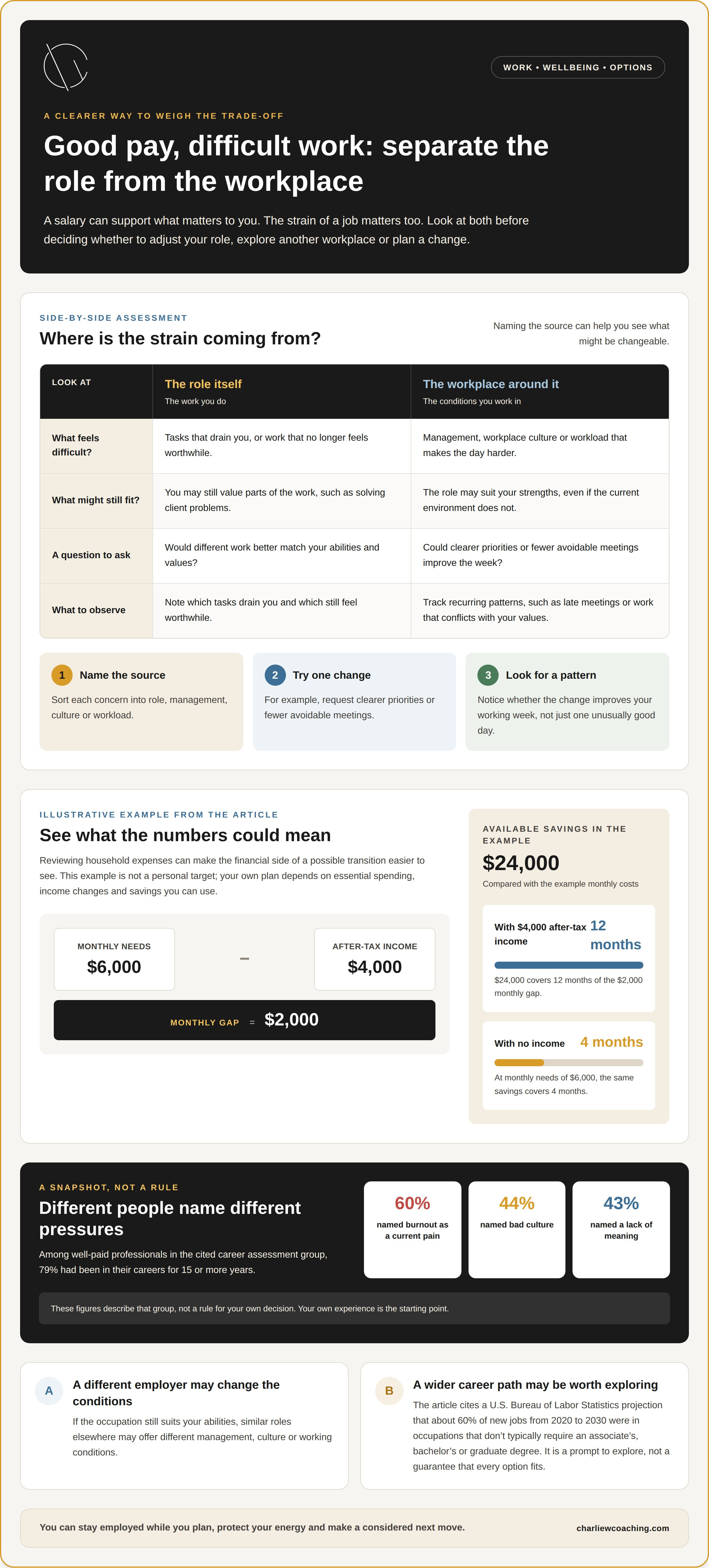
Start by separating the job into three parts: the work itself, the people and culture, and the conditions around it. You might enjoy solving client problems but dread a manager’s unpredictable feedback. Or the role may suit your strengths, while the workload leaves too little energy for family life. Naming the source of the strain helps you see whether changing something within the job could make a difference.
Career assessment data offers a useful reminder that difficult feelings can have different roots. Among well-paid professionals who named meaning, culture, burnout or unused strengths as a pain, 79% had been in their careers for 15 or more years. In that cohort, 60% named burnout, 44% bad culture and 43% a lack of meaning as current pains. These figures describe that group, not a rule for your own decision.
Consider what your salary supports, then what the job asks of you in return. A high income may help with housing, caring responsibilities or plans you value, but it can also make you feel locked into a role. Ask whether the difficult parts are occasional or built into most working days. A weekly calendar can reveal patterns, such as repeated late meetings or work that consistently conflicts with your values.
Try this practical assessment before deciding:
- Write down the tasks that drain you and the work that still feels worthwhile.
- Note whether each problem comes from the role, management, culture or workload.
- Identify one change you could request, such as clearer priorities or fewer avoidable meetings.
- Track whether that change improves your working week, rather than relying on one unusually good day.
This process turns a general feeling into evidence you can use. If a manageable change improves the job, staying may become more sustainable. If the same problems remain, you’ll have a clearer reason to explore alternatives.
Protect your options by reviewing household expenses before considering a move. For example, if monthly needs are $6,000 and after-tax income is $4,000, the gap is $2,000 per month. In that example, $24,000 in available transition savings covers 12 months of the gap. With no income, the same savings covers 4 months at monthly needs of $6,000. Your own plan depends on essential spending, income changes and savings you can actually use.
Don’t assume leaving your field is the only route. First ask whether the occupation suits your abilities, apart from the atmosphere at your current workplace. Similar roles at other employers may offer different management, culture or conditions. Between 2020 and 2030, about 60 percent of new jobs were projected to be in occupations that don’t typically require an associate’s, bachelor’s, or graduate degree, according to the U.S. Bureau of Labor Statistics. That projection may prompt you to explore work beyond familiar career paths, not to assume every option fits.
If health concerns are affecting your ability to work, consider whether medical leave is relevant to your circumstances. Your employer must allow you at least 15 calendar days to provide a medical certification, according to the U.S. Department of Labor. This specific requirement is worth understanding alongside your workplace situation, rather than treating resignation as your only immediate response.
For now, you can remain employed while planning a change and limit the energy you give to workplace drama. Set boundaries around conversations that leave you depleted, then use the time you save to update your CV, explore roles or speak with trusted people. A planned transition gives you more control than moving straight from one difficult job into another.
Charlie Whalley Coaching
Charlie Whalley Coaching can help you find clarity when a well-paid role no longer feels right. If financial security and the desire for change are pulling you in different directions, coaching offers space to explore what matters, recognise your strengths and consider a next step aligned with your priorities.
Career Transition Coaching may suit you if you’re weighing a change in direction, while Life & Leadership Coaching can support reflection on confidence, values and the way you want to work. The focus is not on pushing you to resign or stay. It’s on helping you make a considered choice with greater self-belief.
Ready to speak? Book a discovery call to find out how coaching can work for you.
Take your next step with intention
If you hate your job but the pay is good, you don’t have to settle the decision in a single moment. Give yourself room to consider what you need from work, what you’re ready to change and what a more sustainable direction could look like. A thoughtful next step might be a conversation, a fresh perspective or a clearer sense of what matters most to you.
Career decisions can feel especially difficult when financial security is tied to work that no longer feels right. You can take that tension seriously without judging yourself for staying or feeling pressured to leave. The goal is to move towards a choice that reflects your values as well as your practical needs.
If you’d value a supportive space to explore what comes next, book a discovery call with Charlie Whalley Coaching to find out how it can work for you. You can take the next step at your own pace, with greater clarity and confidence.