
Build confidence as a leader, without losing yourself

What if you could lead with confidence without becoming the most outspoken or certain person in the room? You might know your decision is considered, then question it as soon as someone challenges you. If you compare yourself with leaders who seem effortlessly assured, it can be hard to see your own strengths. But to build confidence as a leader, you don’t need to perform certainty or change who you are.
Second-guessing yourself, holding back in meetings or finding it difficult to set a boundary doesn’t mean you’re not capable. Leadership often asks you to make decisions while the picture is still taking shape. Confidence can grow through small, repeatable actions that help you trust your judgement and respond in a way that feels true to you.
In this article, you’ll find practical ways to speak with greater assurance, make decisions with less second-guessing and strengthen your boundaries without losing your warmth or authenticity. We’ll look at how to notice the evidence behind your judgement, prepare for conversations that matter and take manageable steps to build confidence over time. You don’t have to feel completely certain before you lead well.
Key Takeaways
- Leadership confidence isn’t about being certain all the time. It’s trusting your judgement while staying open to learning.
- Look back at decisions you’ve made and strengths you’ve used to find evidence you can rely on.
- To build confidence as a leader, choose one manageable behaviour to practise, then reflect on what you learn.
- You can feel doubt and still make thoughtful decisions, speak up and ask for input when it would help.
- Reflecting on your values, leadership patterns and practical next steps can help you grow without losing what feels authentic.
What does it mean to build confidence as a leader?
Leadership confidence is trusting yourself to make considered choices, communicate them clearly and keep learning as you go. It isn’t proof that you’ll always get things right. It’s a steadier relationship with your judgement: you can weigh what you know, recognise what you don’t and take responsibility for the next step.
That distinction matters when a decision affects other people. You might feel pressure to have an immediate answer, particularly when colleagues are looking to you for direction. But doubt can accompany responsibility. It doesn’t automatically mean you’re out of your depth or failing as a leader. Often, it’s a prompt to pause, gather relevant information and think carefully, rather than a reason to question every instinct.
Grounded confidence is different from bravado. It doesn’t require you to sound certain at all costs, dominate a discussion or have an answer for every question. The broader idea of Self-confidence in leadership connects with belief in your ability to respond, rather than a guarantee of success. You can be confident and still ask for another perspective. You can be decisive and change course when new information comes to light.
How confidence shows up in everyday leadership
In practice, confidence can mean making a decision after considering the relevant options, then moving forward instead of replaying it endlessly. It can also mean explaining your reasoning clearly while making room for others to contribute. Listening isn’t a sign that you lack conviction. It helps you make a more informed choice.
Imagine someone asks you to approve a change, but you don’t yet know how it will affect the team’s workload. Rather than guessing or apologising for not having an instant answer, you could say, “I don’t have that information yet. I’ll speak with the team lead and come back with a recommendation.” You’ve named the gap and chosen a useful next action. That’s confidence in practice.
Why confidence does not mean changing your personality
You don’t need to copy the colleague who speaks first, fills every silence or seems at ease in every room. A quieter leader can show conviction through preparation, thoughtful questions and clear follow-through. Authentic presence isn’t about being the loudest voice. It’s about communicating in a way people can understand and trust.
Notice which leadership behaviours already feel natural to you. Perhaps you’re good at making space for quieter colleagues, spotting what a discussion has missed or explaining a complex decision simply. These strengths can help you build confidence as a leader. You can practise stretching beyond your comfort zone without treating your personality as something to fix. The aim is to trust yourself more, not to become someone else.
How leadership confidence grows through experience and reflection
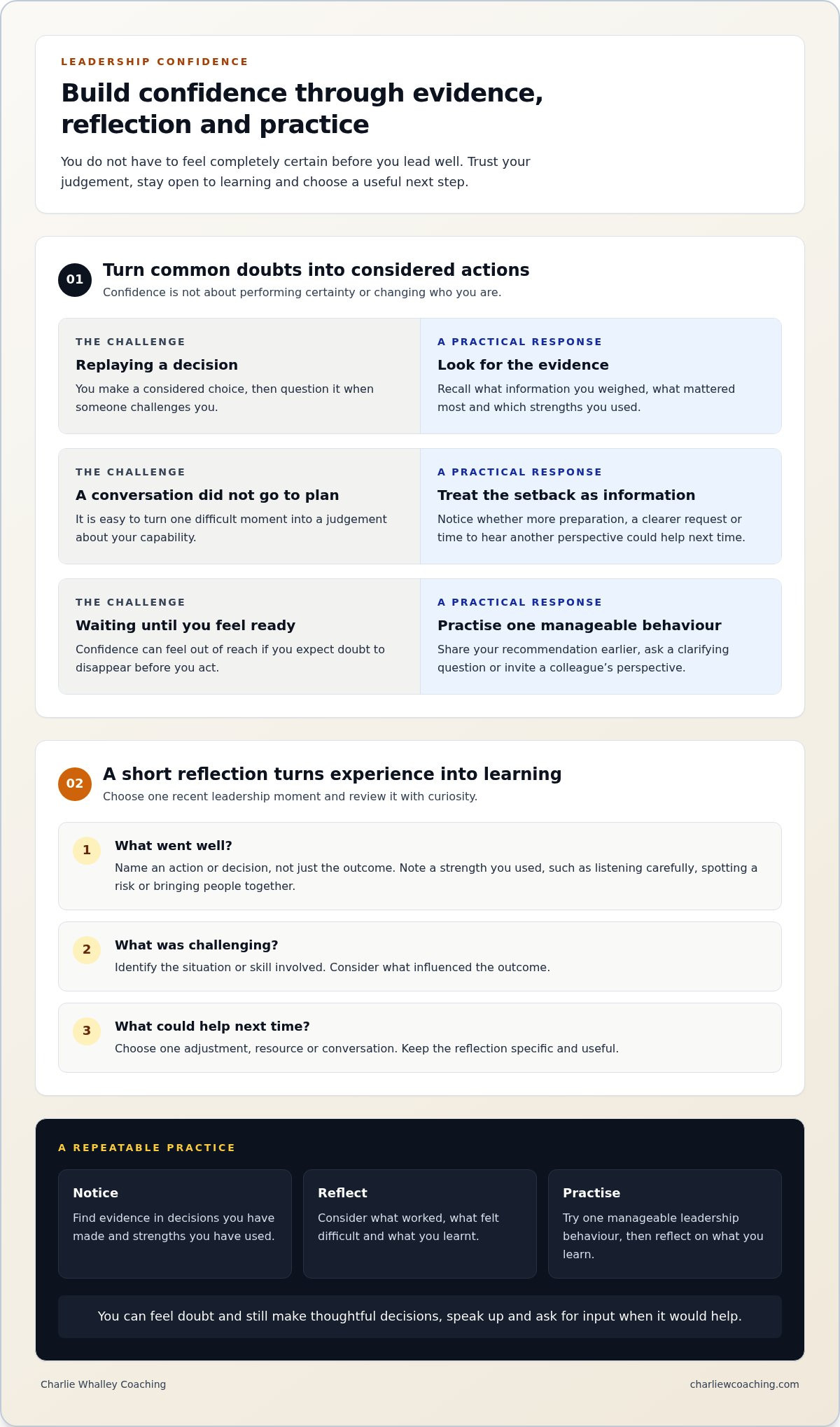
Confidence can feel elusive if you’re waiting for a moment when doubt disappears and every decision feels easy. A more reliable foundation is the evidence you gather as you lead: the choices you’ve made, the strengths you’ve drawn on and what you’ve learnt when things didn’t go to plan. Reflection helps you see that evidence clearly, rather than letting one difficult moment define your whole capability. Guidance such as key practices for confident leadership also highlights the value of deliberate, considered habits.
Use your own experience as evidence
Set aside a few minutes to note a recent decision. What information did you consider? What mattered most? What action did you take? Add a specific example of a strength you used, such as listening carefully, spotting a risk or bringing people together. You’re not building a case that you’re always right. You’re recognising the judgement and skills you already bring.
If you receive positive feedback, record what you did that prompted it. “My colleague said I helped clarify the priorities before the meeting” is more useful than a general note that you’re good at communication.
Turn reflection into learning
Choose one recent leadership moment and review it with curiosity. Ask yourself what worked, what felt difficult and what influenced the outcome. Then consider what the experience revealed about your values, skills or support needs. Keep the questions specific. Reflection is most useful when it helps you decide what to try next, not when it becomes another opportunity to criticise yourself.
- What went well? Name an action or decision, not just the outcome.
- What was challenging? Identify the situation or skill involved.
- What could help next time? Choose one adjustment, resource or conversation.
A setback is information, not a verdict. If a conversation didn’t land as you hoped, you might notice that you needed more preparation, a clearer request or time to hear the other person’s perspective. That insight gives you something practical to work with. A good outcome can also help you identify which choices or strengths contributed, so you can draw on them again.
Look for manageable opportunities to practise. You might share your recommendation earlier in a meeting, ask a clarifying question before agreeing to a deadline or invite a colleague’s perspective before making a decision. Each time you practise a leadership behaviour and reflect on what you learn, you strengthen your trust in your judgement. This is how you build confidence as a leader through experience, rather than waiting to feel ready first.
If you’d value a thoughtful space to reflect on your leadership patterns and turn insight into practical steps, one-to-one leadership coaching offers a tailored coaching partnership for leaders and professionals.
Do confident leaders ever doubt themselves?
Yes. Confident leaders can experience doubt and still act with care and conviction. Confidence doesn’t mean never hesitating, having every answer or making decisions without considering other views. It means working with uncertainty, deciding what information would help and taking responsibility for the next step. No amount of confidence can remove risk or guarantee a particular outcome.
There’s a difference between reflection that helps you move forward and rumination that keeps you stuck. Reflection asks, “What do I know, what might I be missing and what’s the next useful action?” Rumination circles the same fears without bringing in new information or helping you choose. If you’ve reviewed the options and there’s nothing more to learn right now, it may be time to make the best decision you can with what you have.
Uncertainty is not proof that you are unqualified
A moment of uncertainty can be a cue to gather information, not a reason to withdraw or hand every decision to someone else. Imagine your team is choosing between two approaches to a new project. You understand the priorities but want to know how each option could affect delivery. You ask colleagues for their perspectives, weigh what you hear and explain which approach you’re choosing and why.
Seeking input doesn’t cancel out your leadership. Your role is to consider what you learn, make a decision and be clear about who will do what next. There may still be unknowns. You can acknowledge them without presenting your choice as certain to succeed: “Based on what we know, this is the approach I recommend. We’ll review how it’s working and adjust if we need to.” That’s considered action, not a promise that nothing will go wrong.
Respond to mistakes without losing self-trust
If a decision has an unintended impact, it deserves an honest response. But a disappointing outcome doesn’t tell the whole story of your ability to lead. Separate what happened from what you’re telling yourself it means. “The change left a colleague unclear about their responsibilities” identifies an impact. “I’m hopeless at leading people” turns one situation into a verdict on your character.
Instead, focus on what the moment calls for:
- Acknowledge the impact. Be specific about what happened and who was affected.
- Make a repair. Clarify expectations, apologise where appropriate or agree on a practical way forward.
- Take a useful lesson. Consider what information or conversation might help next time.
Then return to leading. You might need to revisit a decision, explain what you’ve learnt or make the next call with more care. The aim isn’t to dismiss a mistake or rush past its effects. It’s to respond, learn and avoid letting one setback decide what you’re willing to do in future. Staying engaged, even when doubt is present, is part of how you build confidence as a leader.
Practical ways to build confidence as a leader at work
Confidence doesn’t have to begin with a dramatic change. It can grow through one ordinary moment at a time: the meeting where you share a view, the decision where you explain your reasoning or the conversation where you set a clear boundary. Use this sequence to turn intention into practice:
- Identify a situation. Choose a specific moment coming up at work, such as giving an update or responding to a new request.
- Choose one behaviour. Decide what you’d like to practise, perhaps stating your recommendation or asking a clarifying question.
- Act. Try that behaviour in the situation, without expecting yourself to deliver it perfectly.
- Reflect. Notice what happened, what felt useful and what you might adjust next time.
Choose a real situation, practise one behaviour, then reflect on what you learn. This gives you a manageable way to build confidence as a leader without trying to change your whole approach at once.
Speak up with clarity, even when you feel nervous
If you tend to leave a meeting thinking, “I should have said something”, prepare one contribution beforehand. It might be a recommendation, a question or a concern you want the group to consider. Jot down the main point in a sentence. You don’t need a polished speech. A clear idea is enough to begin.
Try a sentence starter that feels natural to you:
- “My view is that we should…”
- “Could we clarify how this affects…?”
- “I see the benefits, and I’m concerned about…”
- “What if we considered…?”
After you speak, leave room for discussion. Confidence isn’t about persuading everyone or having the final word. It’s about making a useful contribution and staying engaged with what others say. Focus on clarity, not perfect delivery.
Build confidence through manageable commitments
Choose one behaviour that would make a difference in your working life. For example, share your recommendation before explaining every detail, or pause before agreeing to a request so you can consider your capacity. Make the practice specific: “In Thursday’s planning meeting, I’ll share my view before the discussion moves on.” Afterwards, note what you tried and what you noticed, without marking the attempt as a success or failure.
If you’d like support choosing a practical next step and reflecting on what gets in the way, one-to-one leadership coaching can help you explore your approach and decide what to practise.
How coaching can help you lead with confidence and stay yourself
You can understand what you’d like to do differently and still find it hard to act when an important conversation or decision brings self-doubt to the surface. One-to-one coaching offers a reflective partnership to explore what’s happening, notice patterns in how you lead and turn new understanding into practical next steps. The aim isn’t to give you a prescribed leadership persona. It’s to help you find an approach that fits your strengths and values.
What a reflective coaching partnership can offer
In coaching, you can bring a real challenge, such as finding it difficult to share your view with senior colleagues or feeling unsettled after a decision. With a coach’s questions and reflection, you can look more closely at the assumptions shaping your response. Are you holding back because you need more information, or because you expect yourself to say everything perfectly? What options might be available if you trusted your experience a little more?
That kind of exploration can help you recognise what you already bring to a situation, clarify what matters to you and consider how you want to respond. You might identify a strength you’ve been overlooking or notice a pattern, such as agreeing too quickly when you feel under pressure. From there, you can choose a next step that feels useful and realistic.
Coaching is a collaborative process focused on reflection, awareness and action. It isn’t psychotherapy or mental health counselling, and it doesn’t promise a particular result. Your progress is personal: it may mean preparing for a difficult conversation, making a decision with clearer reasoning or practising a boundary that respects your priorities. Small, relevant steps can help you lead with greater self-trust without asking you to become someone else.
Choose a next step that feels manageable
If you’re considering coaching, start by noting one leadership challenge you’d like to bring into a conversation. It could be a decision you’re postponing, a meeting where you want to speak more clearly or a situation where you’re unsure how to hold a boundary. You don’t need to arrive with a complete plan. A specific starting point is enough to explore what matters and what might help.
Charlie Whalley’s one-to-one coaching is tailored to individual leaders and professionals. Together, you can reflect on your strengths, values and decisions, then identify practical actions that feel right for you. Explore one-to-one coaching with Charlie Whalley.
Take your next leadership step with self-trust
You don’t need to wait until you feel completely certain to make a meaningful change. Choose one conversation, decision or boundary where you’d like to show up differently, and give yourself permission to approach it in a way that fits your values. The aim isn’t to eliminate every uncomfortable feeling. It’s to make room for your judgement and take a considered step, even when confidence is still growing. That’s a practical way to build confidence as a leader without leaving your sense of self behind.
If you’d like support exploring what’s holding you back and deciding what to try next, Charlie Whalley is an ICF Professional Certified Coach (PCC). A discovery call can help you consider whether coaching feels like the right fit for your leadership goals. There’s no need to have everything worked out before you begin. Ready to speak? Book a discovery call to find out how it can work for you.
Let your next step be small, considered and yours. Confidence can grow from there.
Frequently Asked Questions
Can you be a confident leader and still doubt yourself?
Yes, you can be confident and still question whether you’ve chosen the best approach. For example, you might feel uncertain before presenting a proposal, yet be able to explain why you support it and what would make you reconsider. Doubt is a feeling, not proof that you’re unable to lead. Notice whether it points to a useful question you can answer, or asks you to keep seeking certainty that may not be possible.
How can I speak more confidently in leadership meetings?
Choose one useful point you want colleagues to understand, then prepare it in a sentence before the meeting. For example, clarify the decision you recommend and the reason behind it. If you lose your place, pause and return to that central point. You don’t need to sound polished throughout or speak for the longest. Aim to help the group think or decide, and let that purpose guide your contribution.
Is leadership confidence something you can learn?
Yes, leadership confidence can develop as you try new approaches and notice what you learn from them. After a challenging conversation, you could reflect on whether you expressed your concern, listened to the response and made your next step clear. Repeating a behaviour in different situations can help it feel more familiar. There’s no fixed timetable for this process, and progress doesn’t require you to feel assured every day.
What causes a lack of confidence in leadership?
Self-doubt, new responsibilities, comparison and pressure can all contribute to feeling less confident at work. You might have moved into a role with unfamiliar expectations, be weighing conflicting priorities or compare your private uncertainty with a colleague’s public composure. These experiences don’t, by themselves, explain your ability to lead. It may help to identify what’s affecting you in a particular situation, then consider whether you need clearer expectations, support or time to prepare.
Can feedback help me build confidence as a leader?
Yes, specific feedback can help you see which behaviours are effective and where you might want to develop. Rather than asking only, “Was I good in that meeting?”, ask a colleague what they noticed about how you explained the decision or invited discussion. Compare their observations with your own judgement and the needs of the situation. Feedback can offer useful evidence, but it doesn’t have to define your leadership or replace your own considered view.
How do I lead confidently when I do not have all the answers?
Start by separating what’s established from what still needs attention. You might tell your team which priorities are clear, name the information you’re waiting for and explain who will follow up. If a decision can’t wait, weigh the available options and make your reasoning visible. If it can wait, set a clear point to revisit it. People can work with an honest account of what’s known and what happens next.
Can leadership coaching help with self-doubt?
Leadership coaching can give you a collaborative space to examine self-doubt and how it influences your choices at work. You might explore what tends to happen before you hold back, identify strengths you could draw on and consider a practical response to a specific challenge. A coach can help you reflect and clarify your options, while you decide what fits your circumstances. Coaching doesn’t guarantee an outcome, but it can support purposeful reflection and action.