
How to get the most from coaching: a practical guide

What if the most useful coaching session isn’t the one where you arrive with a perfect goal, but the one where you’re willing to say what’s really on your mind? If you’re wondering how to get the most from coaching, you don’t need polished answers or a clear plan before you begin.
It’s understandable to want each conversation to lead somewhere, especially when progress feels slow or an insight fades as soon as everyday demands return. Coaching isn’t about saying the right thing or proving you’re changing quickly. It’s a space to reflect honestly, work out what matters to you and choose a next step that feels possible.
This guide will help you approach sessions with openness and purpose, use your time well and turn reflection into small, practical experiments between conversations. You’ll also find ways to review progress without expecting a straight line. The aim isn’t to follow someone else’s blueprint. It’s to build momentum in a way that feels genuinely your own.
Key Takeaways
- Start with a question, tension or recurring pattern. You don’t need a polished goal to explore what matters.
- Speak honestly about uncertainty and competing priorities. You’re not expected to arrive with all the answers.
- Progress can mean greater awareness or a more considered choice, not only an immediate decision or dramatic change.
- To learn how to get the most from coaching, carry one insight into a manageable action, then notice what you learn from trying it.
- Use coaching as a partnership: bring your reflections, while keeping ownership of the choices and next steps that feel right for you.
Maximising coaching: start with what you want to explore
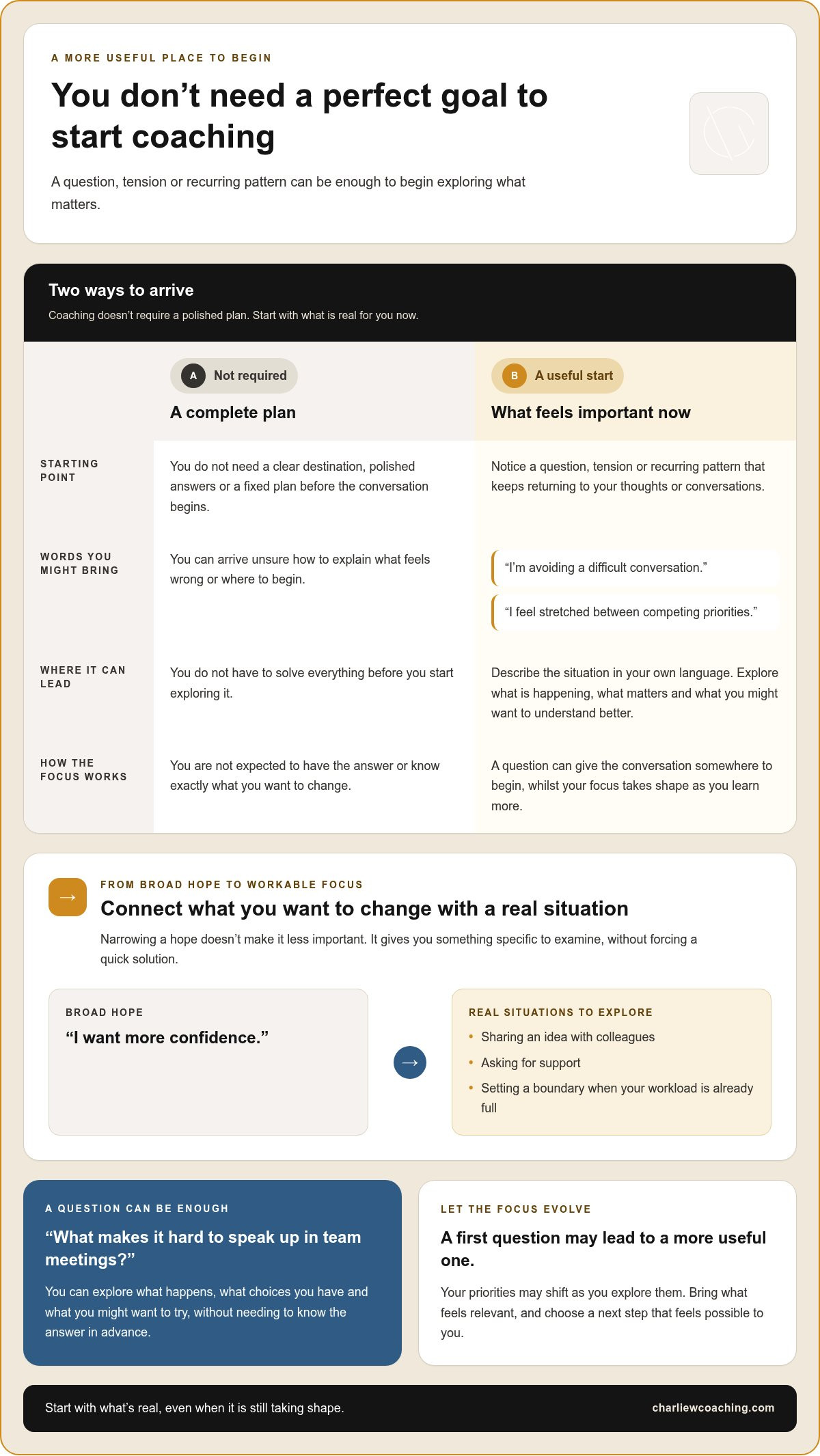
You may know you want something to change, yet feel unsure how to explain what’s wrong or where to begin. Perhaps the same frustration keeps surfacing at work, or you notice yourself hesitating in situations where you’d like to feel more confident. You don’t need to arrive with a complete plan. A question, tension or recurring pattern is a useful place to start.
Effective coaching is a collaborative process shaped by your aims, helping you reflect and choose your own next steps. The conversation doesn’t need to follow a fixed script. You bring what feels relevant; your coach helps you explore it through attentive questions and reflection. The broad Coaching overview describes the practice across different settings, but your starting point can be much more personal: what is happening in your life, and what would you like to understand better?
Start with what feels important now
Before a session, notice what keeps returning to your thoughts or conversations. Jot down a few words, such as “I’m avoiding a difficult conversation” or “I feel stretched between competing priorities”. Describe the situation in your own language before trying to fix it. That first description can reveal what matters, including feelings or assumptions you might otherwise rush past.
If the destination is unclear, let a question guide you. “What makes it hard to speak up in team meetings?” gives you somewhere to begin without requiring you to know the answer. You can explore what happens, what choices you have and what you might want to try. Your focus can take shape as you learn more.
Turn a broad hope into a useful focus
A hope such as “I want more confidence” can feel meaningful but difficult to act on. Narrowing it doesn’t make it less important. It connects the hope to a real situation you can examine, such as sharing an idea with colleagues, asking for support or setting a boundary when your workload is already full.
From there, you might explore what you tell yourself before speaking, what you want to communicate and what a manageable first step could look like. The aim isn’t to force a quick solution. It’s to find a focus that supports reflection and can evolve as your understanding changes.
That flexibility matters: an early question may lead you towards a more useful one, and your priorities may shift as you explore them. For a broader look at how coaching can support personal and professional change, read this guide to life and leadership coaching. Getting the most from coaching starts with permission to bring what’s real, even when it’s still taking shape.
How to participate fully in a coaching session without needing perfect answers
You might arrive at a session with a full week behind you, several competing priorities and only a vague sense of what you want to discuss. That’s enough to begin. You don’t need a complete plan, polished language or the “right” answer. A useful conversation can start with what you’re noticing, even if you’re still working out what it means.
You bring the agenda; your coach supports you to explore it with curiosity and care. This is a partnership, not a test. You’re an active participant, not someone waiting to be told what to do. A successful coaching relationship makes room for openness and trust, so you can take part honestly and shape the conversation as it unfolds.
Bring real situations into the conversation
A recent moment can be easier to explore than a broad statement such as “work feels difficult”. Perhaps you left a conversation with a colleague feeling unsettled, or agreed to take on a task when you were already stretched. Describe what happened, what you noticed in yourself and what you’d like to understand better.
Specific details help you and your coach move beyond generalities. What did you say? What were you thinking at the time? What do you wish you’d been able to express? You don’t need to analyse everything in advance. Bring the moment as you remember it, and stay curious about what it might show you.
Make room for honesty and challenge
If you feel hesitant, say so. “I’m not sure I want to look at this yet” or “I’m worried I’ll disappoint someone” can open up a more useful conversation than trying to sound certain. Uncertainty isn’t a sign you’re doing coaching badly. It may point to competing needs or concerns worth understanding.
Your coach may sometimes offer a respectful challenge or ask you to consider another perspective. Treat this as an invitation to reflect, not criticism or pressure. If a question, pace or direction doesn’t feel useful, say that too. Your feedback helps bring the session back to what matters to you.
Taking part fully doesn’t mean speaking constantly or producing a breakthrough every time. It means being willing to notice what’s happening and respond honestly. If you’re considering one-to-one coaching as a space for that kind of reflection, you can book a discovery call to explore how it could work for you. Being open about what you need is one way to get more from each conversation.
Immediate answers? How to recognise useful progress
It’s understandable to hope that each coaching session will end with a clear decision or visible change. But reflection doesn’t always produce an immediate answer. Sometimes a conversation helps you name what has been bothering you, notice an assumption you hadn’t questioned or see a choice more clearly. These quieter shifts can matter, even if they don’t look like a finished goal.
There’s no single pace for meaningful change. What feels useful depends on your circumstances, priorities and what you’re ready to explore. Rather than judging the work only by whether you’ve made a major decision by the end of a session, notice what has become clearer and what still needs attention.
Notice progress beyond a finished goal
Compare how you see a situation now with how you understood it earlier. You might recognise that you often say yes before checking what you can realistically manage, feel clearer about a boundary you want to express, or have found more precise words for a concern. These aren’t guaranteed outcomes, but noticing a shift can help you understand what you’re learning and where you may want to go next.
Useful reflection often brings new understanding, even if it raises further questions. If you find yourself returning to the same topic, ask: “What am I seeing differently?” or “Is there something I’m avoiding, or do I need a different angle?” You don’t have to force an answer. The question can help you distinguish a pause that’s part of thinking from a conversation that feels stuck.
Speak up if the work feels stuck
If sessions start to feel repetitive, unclear or disconnected from what matters to you, bring that into the conversation. You could say, “I feel as though we’ve talked about this before, but I’m not sure what I’m taking from it,” or “I’d like to revisit what I want to focus on.” That isn’t a criticism of the process. It’s useful information about your experience.
You and your coach can review the focus together. Perhaps the original question no longer feels relevant, or you need to understand a particular part of the situation before deciding what to do. Being candid about slow progress doesn’t mean you’ve failed. It gives you both a chance to clarify what you want to explore next and whether the conversation is helping.
As you learn how to get the most from coaching, make room to recognise what has shifted as well as what remains unresolved. Progress isn’t always a dramatic turning point. Sometimes it’s seeing your choices more clearly and deciding for yourself what to do with that understanding.
How to turn coaching insights into small actions between sessions
A useful thought from a session can be easy to lose once your inbox fills up, home life needs attention and familiar routines take over. You don’t need to overhaul your week to keep the reflection alive. Choose one insight and explore it through a small action that fits your real commitments.
Coaching insights become more useful when you test them in the situations where everyday choices are made. Treat the action as an experiment, not a test you can pass or fail. The point is to learn what happens, including what feels difficult or unexpected.
Choose an action that belongs to you
Before you leave a session, ask yourself: “What am I willing to try before we next speak?” Let your answer come from your own priorities and capacity, rather than a universal checklist. If you’re exploring how to speak up more confidently, for example, you might choose to share one idea in a meeting or pause before agreeing to an additional task.
Keep it manageable. A small behaviour gives you something specific to notice without adding another demanding project to an already full week. Save a reminder on your phone, add a note to your diary or write down a question to revisit, such as: “What was I expecting would happen?” Choose a format you’re likely to use.
Reflect on what happened, not just whether it worked
After trying your action, take a little time to notice the experience. What did you feel beforehand? What assumptions came up? Did anything surprise you? Perhaps you followed through but found it harder than expected, or didn’t take the action and learnt something about what was getting in the way. Either experience can give you something to reflect on.
Bring what happened back to your next session, including what went well and what felt uncomfortable. You’re not reporting a result for approval; you’re giving yourself and your coach something real to explore. That reflection may help you adjust the action, understand a choice or find a more fitting next step. If circumstances changed and the experiment no longer made sense, that’s useful to discuss too.
This cycle of insight, action and reflection helps make coaching relevant to everyday life, without asking you to change everything at once. Charlie Whalley’s one-to-one coaching can support you as you explore and test your own next steps. Explore one-to-one coaching with Charlie.
How to make coaching a partnership that supports lasting, self-directed change
Coaching works as a partnership, not a handover of responsibility. Your coach can support reflection, ask questions and help you consider different perspectives. You remain the decision-maker, choosing what matters, which actions to take and what feels right for your life or work.
That shared approach brings the different parts of the process together. You prepare by noticing what you want to explore, speak candidly about what’s happening, try a manageable action and reflect on what you learn. The focus can change as your circumstances or understanding shifts. This flexibility keeps the work connected to your real life, rather than turning it into a rigid plan you feel obliged to follow.
Keep the work connected to your real life
Priorities can change. A step that once felt manageable may no longer fit if work becomes busier or something important shifts at home. Instead of forcing the original plan, bring the change into your next conversation and consider what would be useful now. You might adjust the action, choose a different one or pause to understand what has changed.
That isn’t losing momentum. It’s responding thoughtfully to the life you’re actually living. Your coach can help you reflect, but the choices remain yours. Self-directed progress means finding a way forward that reflects your needs and values, rather than measuring yourself against someone else’s expectations.
Decide what you want to carry forward
As you finish this guide, identify one insight you’d like to remember and one small next step you might want to explore. There’s no need to turn either into a firm commitment. Even a question you want to bring to a conversation can be a useful beginning.
Charlie Whalley offers tailored one-to-one life and leadership coaching and is an ICF Professional Certified Coach (PCC). Her coaching supports self-awareness and confidence as you navigate personal or professional change. A discovery conversation gives you space to talk about your goals, questions and the support you’re looking for.
Learning how to get the most from coaching is about making the process your own: reflecting honestly, choosing what to explore and deciding what to carry into everyday life. Book a discovery call to talk about whether coaching feels like a helpful next step. The decision to begin is yours, and it’s fine to take time with it.
Carry your next step into everyday life
Getting the most from coaching doesn’t require a perfect goal or a breakthrough every time you meet. Start with what feels important, speak honestly about what’s unclear, then choose a small action you can reflect on in your own time. Progress may show up as greater awareness or a more considered choice, as well as practical change.
That’s the heart of how to get the most from coaching: use the conversation to explore what matters, while keeping ownership of the decisions and steps that follow. Your focus can shift as you learn more about yourself and your circumstances.
Charlie Whalley offers bespoke one-to-one coaching for individuals and leaders. Her work supports self-awareness and confidence as you navigate personal or professional change.
Ready to explore coaching? Book a discovery call and find out how it could work for you. Bring a question, a hope or simply a sense that something needs to change. The next step is yours to choose.
Frequently Asked Questions
How do I prepare for a coaching session?
Before a session, notice what’s been occupying your thoughts and what you’d like to understand better. Bring a recent situation, a question or simply the feeling that you’re stuck. For example, jot down what happened in a conversation that’s stayed with you. You don’t need a polished goal or a complete solution. Starting with what feels unclear is enough.
What should I do between coaching sessions?
Choose one idea from your conversation and consider how it might apply in everyday life. You might try a small action, ask yourself a different question or notice a familiar response as it happens. Reflect on what you observed without labelling it a success or failure. Bring what felt helpful and what was difficult to your next session, so you can decide what to explore or adjust.
How can I tell if coaching is working?
Progress may appear as clearer thinking, greater awareness of a recurring pattern or more confidence in making a considered choice. It doesn’t always mean reaching a large goal quickly. Getting the most from coaching includes noticing these smaller shifts. If sessions feel repetitive or disconnected from your needs, tell your coach. Together, you can revisit the focus and discuss what would make the work more useful.
What if I do not know what I want from coaching?
You can start without knowing exactly what you want. Describe what feels difficult, what keeps returning to your mind or what you’d like to feel different. A question such as “Why do I keep avoiding this conversation?” gives you something to explore without requiring an immediate answer. Your focus can become clearer as you reflect on what matters and what you feel ready to discuss.
Is coaching just someone telling me what to do?
No. Coaching is a collaborative conversation that helps you explore your perspective, choices and possible next steps. Your coach may ask questions or offer a respectful challenge, but you decide what feels right for you. You remain responsible for your choices and actions. If advice is what you’re looking for, discuss that expectation while recognising that coaching centres on supporting your own reflection and decision-making.
Can coaching help if I feel stuck in my career?
Career transition coaching can give you space to explore what feels stuck, what matters to you and which options you might consider. Reflect on your strengths, priorities and what you want from your working life. Coaching doesn’t guarantee a particular career outcome or provide job placement. You can begin by describing your situation as it is, even if you’re not yet sure what change you want.
How do I get more honest in coaching?
Start by noticing what you might be holding back, then share what feels appropriate. You could say, “I’m finding this difficult to talk about,” or “I’m not sure how to explain what I’m feeling.” You don’t need to disclose everything at once. Talking openly about what feels uncomfortable, including the pace or direction of a conversation, can help you and your coach find a way forward that feels workable.