
Career Coaching for Professionals: Find Clarity and Move Forward

What if feeling stuck isn’t proof you’ve made the wrong choices, but a signal that something needs closer attention? Even when your work looks successful from the outside, you may be questioning your strengths, second-guessing your next move or wondering how ambition can fit with the rest of your life. Those questions deserve attention, not a quick fix. Career coaching for professionals offers a thoughtful space to explore uncertainty without rushing you towards a decision.
It makes sense to want a clearer direction while also being careful about what you change. Coaching can help you notice what’s driving your doubts, reconnect with the strengths and values that matter to you, and build confidence in your own judgement. The aim isn’t to have someone else choose your path. It’s to identify a practical next step that fits your circumstances, whether that means preparing for a conversation at work or taking time to reflect before deciding.
In this article, we’ll look at how career coaching can support you through professional uncertainty, what the process may involve, and how it differs from mentoring or counselling. You’ll also find prompts to help you prepare for a coaching conversation and consider how greater self-awareness can help you move forward at a pace that respects your priorities and wellbeing.
Key Takeaways
- Career coaching for professionals offers a collaborative way to explore work-related questions and identify a direction grounded in your priorities.
- A coaching conversation can move from exploring your situation to noticing patterns, weighing options and choosing a practical next action.
- Coaching, mentoring and counselling differ in their purpose and where guidance comes from. Understanding those differences can help you decide what kind of support suits your needs.
- Use four prompts to clarify your concern, define what clarity would look like, recognise your constraints and choose a useful first question.
- Charlie Whalley’s bespoke one-to-one coaching connects self-awareness, strengths and personal values with purposeful career decisions.
Career Coaching for Professionals: When Can It Help?
Your role may look like a success: you’ve earned trust, built expertise and taken on responsibility. Yet perhaps the work that once felt meaningful now leaves you unsettled, or a new opportunity brings as much doubt as excitement. That gap between outward progress and inner uncertainty can be hard to explain. It doesn’t mean you’re ungrateful or failing. It may be a signal to pause and consider what you want your working life to make room for.
Career coaching for professionals is a collaborative process that creates space to reflect, find direction and decide on self-led action. Rather than being told what career to pursue, you explore your experience with a coach’s questions and support. The focus might be understanding what energises you, recognising assumptions that are narrowing your options, or identifying what a purposeful next step could look like. The aim is greater clarity, not a prescribed answer.
Career coaching supports decisions, not job allocation. It isn’t a recruitment or job placement service that assigns you to a role. Instead, it can help you think through the choices in front of you and decide what fits your strengths, values and circumstances. For broader context on related forms of career guidance, see this overview of Career Counseling.
What career coaching means for a working professional
A coaching conversation can help you look beyond the immediate dilemma and notice what may be shaping it. You might identify strengths you’ve begun to take for granted, examine an assumption such as “I should say yes to every promotion”, or consider which working conditions help you do your best. These reflections become useful when you connect them to the choices in front of you.
For example, suppose you’re weighing up a new responsibility that could broaden your experience, while also trying to protect time for family or personal priorities. Coaching can help you explore what appeals, what concerns you and what information you need before deciding. You remain the decision-maker. A coach can support your thinking, but can’t choose your path or promise a particular outcome.
Signs that a coaching conversation could be useful
You don’t need to be in crisis, ready to resign or certain that you want a new job before exploring coaching. A conversation may be helpful if you keep revisiting the same decision, find your confidence dipping, or struggle to describe what a satisfying role would involve. Sometimes the uncertainty isn’t about whether to leave, but about how to grow, contribute or work differently where you are.
You may be considering progression, a change in direction or a more sustainable way to meet your responsibilities. You may simply want to understand why a role that looks right on paper no longer feels like a fit. None of these concerns requires an immediate, dramatic change. Wanting thoughtful development is reason enough to reflect. A useful first step is to write down the question you keep returning to, then consider what you’d need to understand before taking action.
What Happens in Career Coaching for Professionals?
A coaching conversation starts with what matters to you, not a pre-set career plan. Your goals, current responsibilities and preferred pace all shape the discussion, whether you’re trying to make sense of a nagging doubt or prepare for a significant decision. Career coaching for professionals offers a steady space to think things through, while leaving you in charge of what happens next.
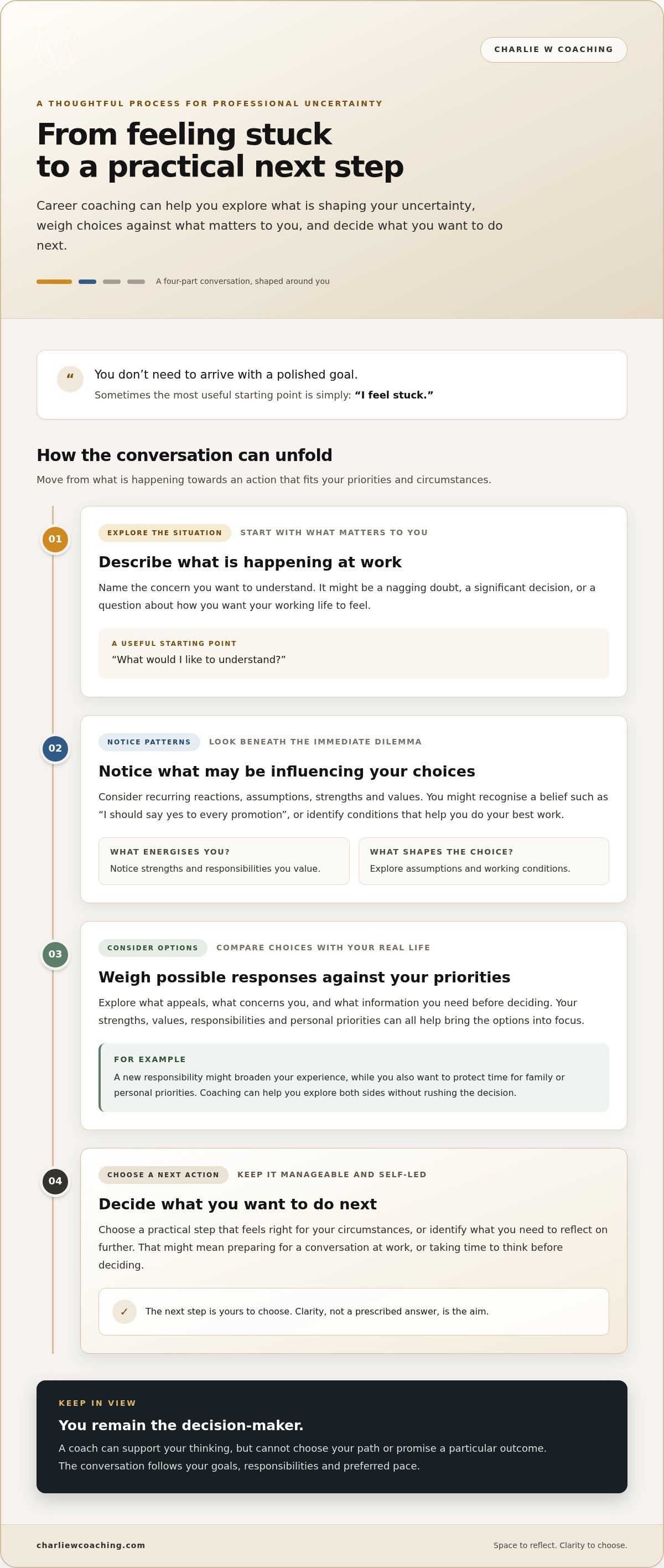
The conversation may move through a simple progression:
- Explore the situation: Describe what’s happening at work and what you’d like to understand.
- Notice patterns: Consider recurring reactions, assumptions, strengths or values that may be influencing your choices.
- Consider options: Compare possible responses against your priorities and circumstances.
- Choose a next action: Decide on a manageable step you want to take, or identify what you need to reflect on further.
There’s no requirement to arrive with a polished goal. Sometimes the most useful starting point is simply, “I feel stuck.”
From a broad concern to a useful coaching focus
With thoughtful questions, “I feel stuck” might become a more focused conversation: “Do I want this promotion, or am I worried about turning it down?” Another useful focus might be workplace confidence, such as finding it difficult to speak up despite having relevant experience. Naming the question makes a tangled concern easier to examine.
Your professional experience, strengths and personal values can all help bring the issue into focus. For instance, you might notice that you enjoy mentoring colleagues but feel drained by constant meetings. That contrast may prompt questions about which responsibilities you want more of and which conditions help you work well. The National Career Development Association also offers resources connected with career development, a field that includes reflection on people’s working lives and choices.
Turning reflection into practical professional action
Effective coaching makes room for reflection and connects insight to an action you choose. That action doesn’t have to be a resignation or a major career move. It could be preparing for a conversation with your manager, testing an idea by taking on a small project, or setting a development goal that fits alongside your existing responsibilities.
You decide what feels relevant and realistic. A coach isn’t there to issue instructions or prescribe a career path. After you’ve tried a step, reflecting on what happened can help you understand what worked, what felt uncomfortable and what you might adjust. Perhaps a conversation clarifies your priorities, or a small experiment shows that a particular responsibility suits you. Progress can mean asking a clearer question, setting a boundary or feeling more grounded in your judgement. It needn’t demand an immediate change.
If individual support would help you turn reflection into a next step, explore Charlie Whalley’s career transition coaching. Ready to speak? Book a discovery call to find out how it can work for you.
Career Coaching, Mentoring and Counselling: What Is the Difference?
If you’re considering support with a work-related question, it can help to know what kind of conversation you’re looking for. Coaching, mentoring and counselling can each offer a different kind of support. None is automatically better than the others; the useful choice depends on what you need right now.
| Approach | Purpose | Conversation focus | Typical source of guidance |
|---|---|---|---|
| Career coaching | Support reflection and progress towards professional goals | Your choices, strengths, values and possible actions | Your own insight, supported by a coach’s questions |
| Mentoring | Offer practical perspective and support for development | Challenges, opportunities and learning in a professional context | A mentor’s experience and knowledge |
| Counselling | Offer a different form of personal support | Personal concerns, according to the purpose of the counselling | A counselling professional’s approach and expertise |
Career coaching and mentoring answer different needs
Coaching is generally client-led: a coach asks questions that help you examine what matters, consider your options and arrive at your own decisions. Mentoring more often draws on another person’s experience. A mentor might share how they approached a similar professional challenge, while a coach may help you explore what response makes sense for you.
For example, if you’re unsure how to approach a stretch assignment, a mentor could offer perspective from their own career. Coaching could help you clarify what you want from the opportunity and what concerns you about accepting it. You might value reflection at one point and practical perspective at another. Some people find both useful at different moments. The distinction isn’t a ranking; it’s about whether you most need space to think, someone’s relevant experience, or a combination.
Career coaching for professionals doesn’t mean being told what to do or handed a ready-made answer. You bring your knowledge of your circumstances, while the coach supports your reflection. It’s reasonable to expect a considered conversation, not a prescription.
When career concerns may need a different kind of support
Career coaching focuses on professional goals, choices, strengths and change. It can help you think through questions about progression or direction, but it isn’t clinical psychotherapy or mental health counselling, and it shouldn’t be presented as a replacement for specialist care. Counselling has a different purpose and approach. If the support you’re seeking is broader than professional reflection, consider what kind of help best fits that need.
There’s no need to label your experience before exploring what would be useful. You can begin by asking yourself: do I want help thinking through a work decision, insight from someone who has faced a similar challenge, or a different kind of personal support? A clearer answer can make your next conversation feel more purposeful.
How to Decide Whether Career Coaching Fits Your Situation
You don’t have to know exactly what you want before deciding whether coaching could help. It can be enough to notice that a question keeps returning, or that your current way of working no longer feels sustainable. A short reflection can help you see whether you want space to think, support in weighing choices, or a clearer sense of what matters before making any change.
Try these four prompts to bring the concern into focus:
- Name the concern. What feels difficult right now: a decision, a lack of confidence, a shifting sense of purpose, or a tension between work and personal priorities?
- Define what clarity would mean. What would you like to understand better? You may not need a complete career plan. Knowing what you want to ask for, or what no longer fits, can be meaningful progress.
- Note your constraints. Consider your time, finances, caring responsibilities and current commitments. Some factors can be influenced; others may be outside your immediate control. Recognising the difference helps you focus on choices available to you without blaming yourself for circumstances you can’t change.
- Choose a first question. What would you most like to explore in a conversation? For example, “How can I build confidence to share my ideas?” is a more workable starting point than expecting yourself to solve your whole career at once.
Questions to clarify what you want from coaching
As you reflect, consider what you’ve already tried and what you hope to understand. Perhaps you’ve spoken with a manager, taken on extra work or put off a decision, but still feel uncertain. Ask yourself what a useful conversation would leave you thinking or doing differently. You don’t need a long list of preparation notes; one honest question can be enough to begin.
Choosing a manageable next step without rushing
Forward movement doesn’t have to mean deciding whether to stay or leave. A small, reversible experiment can give you information without committing you to a dramatic change. You might ask to contribute to a project, try a different way of structuring your work, or set a date to revisit a decision once you’ve gathered more perspective.
Choose a pace that respects the rest of your life. When deadlines, family needs or limited energy are already competing for attention, a manageable step is more useful than an ambitious plan you can’t sustain. Career coaching for professionals can help you identify what you can influence now, while acknowledging what may need time or lie beyond your control.
If you’re reflecting on work alongside broader questions about purpose and priorities, this guide to life and leadership coaching offers related context. For individual support with professional change, book a discovery call to explore how coaching could fit your situation.
How Charlie Whalley Supports Professionals Through Career Change
Career change doesn’t always begin with a resignation letter or a clear plan. Sometimes it starts with a quiet sense that your work no longer fits, or with a promising opportunity that leaves you unsure whether it’s right for you. Charlie Whalley offers bespoke one-to-one coaching for professionals navigating career shifts and strategic progression. The focus is on helping you understand what matters to you and make choices with greater confidence, not steering you towards a preselected outcome.
As an ICF Professional Certified Coach, Charlie creates a collaborative space to explore the questions behind your uncertainty. You might be weighing up a new leadership responsibility, considering a different direction, or wondering how to feel more engaged in your current role. Coaching can help you examine how your strengths, values and experience relate to those choices, so your next step reflects your circumstances and priorities.
A collaborative space for professional change
Charlie’s role is to support your thinking, not make decisions on your behalf. Through conversation, you can explore what’s shifting at work or in life, what you want to preserve, and what you may be ready to change. You don’t have to assume that progress means leaving your role. It might mean approaching your responsibilities differently, recognising where your strengths are underused, or building confidence to express what you need.
Uncertainty can be uncomfortable, especially when other people see you as capable and successful. It doesn’t mean you’ve failed or that you need to make a dramatic move. Bespoke coaching makes room for the whole picture, including ambition, wellbeing and the commitments that shape your choices. From there, you can consider a direction that feels purposeful and realistic for you.
A considered first step towards greater clarity
You can begin with the question already on your mind, even if it feels unfinished. Perhaps you’re unsure whether to pursue progression, want to understand why your confidence has dipped, or are trying to work out what a satisfying working life means now. Charlie’s one-to-one approach responds to your individual aims and context, rather than asking you to fit a standard career plan.
The value of a first conversation may simply be seeing your question more clearly. You can explore what support might involve and whether the approach feels relevant to what you’re facing. There’s no need to arrive with every answer, or to commit to an immediate career change. Start with what’s true for you now.
Ready to speak? Book a discovery call to find out how it can work for you.
Take One Thoughtful Step Towards Your Next Chapter
You don’t need a complete career plan to begin. Sometimes the most useful starting point is a question you’ve been carrying for a while: what do I want more of in my working life, and what am I ready to reconsider? Giving that question proper attention can help you move from circling possibilities to choosing a next step that respects both your ambitions and your wellbeing.
Career coaching for professionals can offer a space to explore that question without pressure to make an immediate, life-changing decision. You remain the author of what comes next. The aim is to approach your choices with greater self-trust, even if the path becomes clear gradually.
If you’re ready to explore your situation with Charlie, arrange a discovery call and find out how one-to-one coaching could support you. You can start with the uncertainty you have today, and take it from there.
Frequently Asked Questions
Is career coaching only for professionals who want to change jobs?
No. You can use career coaching to think about how to develop in your current role, take on new responsibilities or find a more sustainable way of working. For example, you might want to contribute more confidently in meetings or explore whether a leadership opportunity suits you. Career coaching for professionals can support reflection while you remain in your job, with no assumption that leaving is the right answer.
Can career coaching help if I am unsure what I want next?
Yes. You don’t need a settled goal to start. A useful conversation can help you identify what you’d like more or less of in your working life, which experiences have felt meaningful, and what you want to protect as you consider change. You might leave with a sharper question rather than a final decision. That can be a worthwhile beginning, especially if you’ve been going round in circles alone.
Can career coaching help me feel more confident at work?
It can help you explore what’s affecting your confidence and how you want to respond, though it can’t promise a particular feeling or outcome. For instance, if you hesitate to share your view in meetings, you could reflect on what makes speaking up difficult and what preparation would help you contribute. You might also identify examples of your skills and past achievements to draw on when receiving feedback or taking on a challenge.
Can I have career coaching whilst I am still employed?
Yes. You can explore professional questions while continuing in your current job. Coaching might help you prepare for a development conversation, consider how a new responsibility fits with your priorities, or decide what you want to learn before making a bigger move. If your employer is involved in arranging or funding coaching, clarify who will receive information about the process and what will remain private before sessions begin.
How much does career coaching cost?
The cost depends on the coaching arrangement and your needs. Charlie Whalley Coaching provides bespoke one-to-one coaching, so the fee is discussed alongside the support you’re considering. You can use a discovery call to talk through your aims and understand the proposed arrangement before deciding whether to proceed. Book a discovery call to discuss coaching and find out how it could work for you.
Is career coaching confidential?
Confidentiality arrangements should be clear before coaching begins. Discuss how information from sessions is handled, whether notes are kept, and what circumstances, if any, could lead to information being shared. This is especially useful if your employer has arranged or funded the coaching, as you’ll want to understand what updates they may receive. A clear agreement can help you feel more comfortable speaking openly about your professional questions.