
One-to-One Coaching: What It Is and How It Can Help You Move Forward

What if the next step isn’t finding someone with all the answers, but making room to hear your own? When work, relationships and personal priorities pull in different directions, it can be hard to know what you want, let alone how to move forward. One to one coaching gives you a dedicated space to pause, think and explore what matters.
You might be wondering what happens in a coaching conversation, or whether it will feel like generic advice, pressure to make a change, or therapy by another name. It isn’t about someone else deciding what’s right for you. Coaching is a collaborative conversation shaped around your circumstances, questions and choices.
In this article, you’ll discover what individual coaching can involve, what it may help you explore, and how it differs from therapy. You’ll also consider whether life or leadership coaching connects with what you’re facing, from self-doubt and confidence to personal or professional change. You don’t need to have everything figured out before you begin. You can start with what’s on your mind and take it one thoughtful step at a time.
Key Takeaways
- One to one coaching creates a tailored space to explore your priorities and development, rather than follow a generic formula.
- A coaching conversation can move from naming what feels difficult to considering different perspectives and choosing a practical next step.
- Coaching, mentoring, advice and therapy have different purposes. Understanding those differences can help you decide what kind of support you need.
- Before deciding whether coaching feels right for you, reflect on the question you want to explore and what useful progress would look like.
- Charlie Whalley’s bespoke coaching can support reflection on confidence, self-awareness and change, while keeping your choices at the centre.
What is one-to-one coaching, and who is it for?
You can be capable, experienced and trusted by others, yet still feel uncertain about what comes next. Perhaps you’re carrying a leadership challenge, questioning a decision or sensing that something needs to change. That doesn’t mean you’ve failed to work it out. Sometimes you need a little space to think it through.
One to one coaching is a collaborative conversation focused on your priorities and development. A coach helps you reflect, explore possibilities and consider your own next steps. Here, coaching means personal and professional development, not private sports lessons. Rather than practising a sporting technique under instruction, you bring a question or challenge from your life or work and explore it in conversation. Coaching is used in a range of settings, including personal and professional development.
What does individual coaching mean in a professional context?
You might arrive with a specific question, such as how to approach a difficult conversation, or with a less defined feeling that you’re stuck. The coach listens, asks questions and helps you look at the situation from different angles. You could notice an assumption you’ve been making, clarify what matters most, or identify an option you hadn’t considered.
The coach isn’t there to hand you a ready-made answer or take responsibility for your choices. You decide what feels right for your circumstances and own any actions you choose to take. The conversation centres on your context, rather than a standard formula applied to everyone.
Who might find life or leadership coaching useful?
Life or leadership coaching may be useful if self-doubt is affecting how you show up, you’re facing a new responsibility at work, or you’re moving through personal or professional change. You might have a clear goal, but you don’t need one. A question, competing priorities or a sense that you want to approach things differently can all be places to begin.
Coaching is most relevant when you’re open to exploring your own perspective, even if you’re not sure what you’ll discover. You don’t need to arrive in crisis or with a perfectly defined plan. You can start with an honest conversation about what’s on your mind and what you’d like to understand better.
How one-to-one coaching works: conversation to action
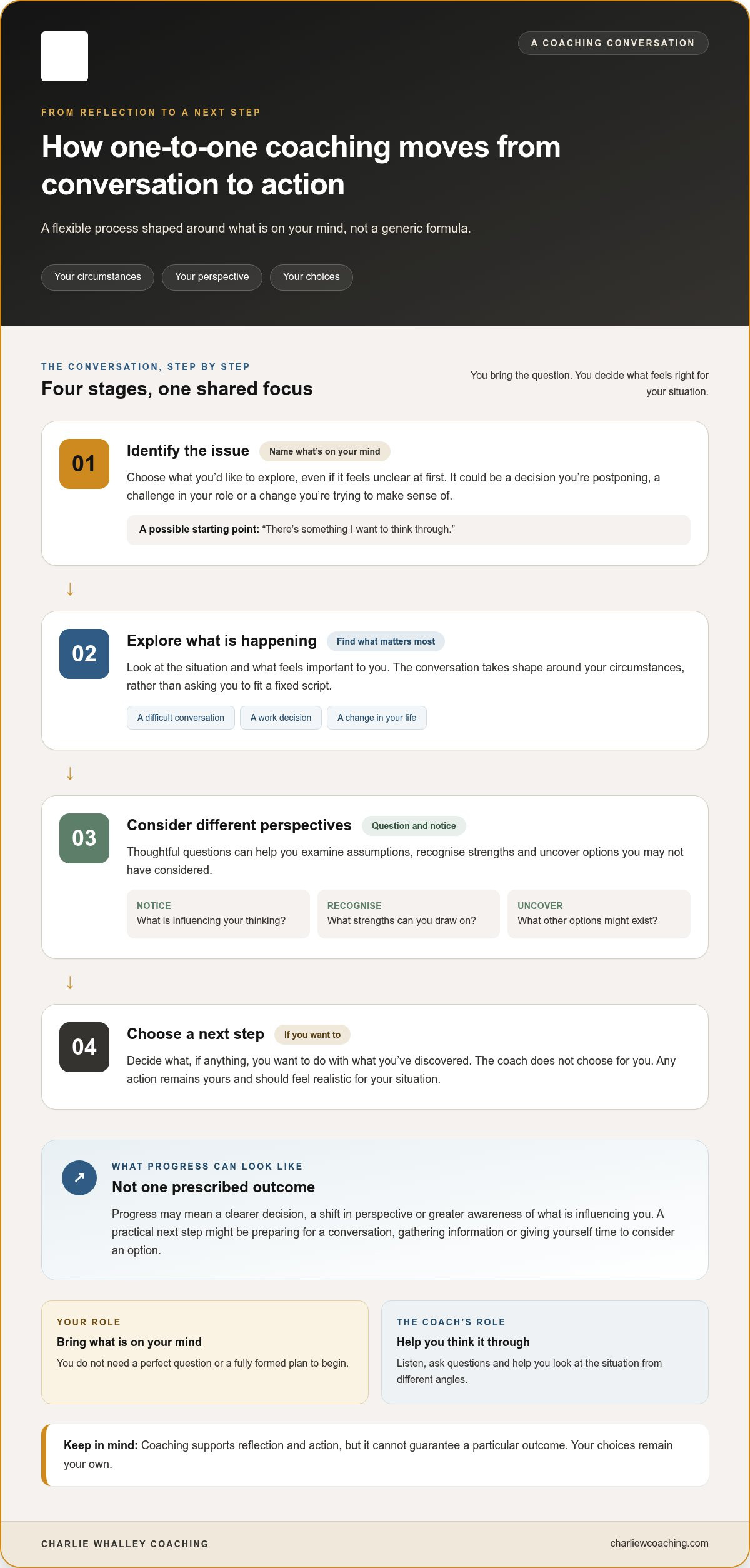
A coaching conversation doesn’t need to follow a fixed script. You bring what’s on your mind, whether it’s a decision you’re postponing, a challenge in your role or a change you’re trying to make sense of. The session takes shape around your circumstances, rather than asking you to fit a generic formula.
A simple way to understand the process is:
- Identify the issue: Name what you’d like to explore, even if it feels unclear at first.
- Explore it: Look at what’s happening and what feels most important to you.
- Consider perspectives: Examine assumptions, recognise strengths and uncover options through thoughtful questions.
- Choose a next step: Decide what, if anything, you want to do with what you’ve discovered.
For example, a concern about confidence might turn out to be tied to a particular situation. Or a work decision might feel difficult because several priorities matter to you. The coach won’t tell you which option to choose. The aim is to help you see your thinking more clearly, so your choices remain your own.
Coaching supports reflection and action, but it can’t guarantee a particular outcome.
What might you talk about in a coaching session?
You might explore how to speak up with more confidence, whether to pursue a change at work, how you want to lead your team, or what matters as your personal circumstances shift. You don’t need to arrive with the perfect question. As you talk, the focus may develop. A broad feeling of uncertainty could become a clearer question about a decision, a relationship at work or the kind of role you want to grow into.
How can reflection lead to practical progress?
Reflection gives you room to pause before reacting, weigh what matters and identify a manageable next step. That might mean preparing for a conversation, gathering information before making a decision or allowing yourself time to consider an option you hadn’t taken seriously.
Progress won’t look the same for everyone. It may be a clearer decision, a shift in perspective or greater awareness of what’s influencing you. In one to one coaching, the next step should connect with your priorities and feel realistic for your situation, not like a task chosen to satisfy someone else.
If you’d like to explore how bespoke life and leadership coaching could fit your circumstances, book a discovery call to find out how it can work for you.
How is coaching different from mentoring, advice, or therapy?
These forms of support can all involve a thoughtful conversation, but they don’t have the same purpose. Knowing the difference can help you choose support that fits the question you’re carrying. One to one coaching generally focuses on development, decisions and goals within an agreed scope. It makes room for your perspective and choices rather than assuming the same approach suits every situation.
| Type of support | What it generally focuses on |
|---|---|
| Coaching | Exploring your priorities, perspective and possible next steps in relation to development, decisions or goals. |
| Mentoring | Sharing knowledge, guidance or lessons drawn from the mentor’s own experience. |
| Advice | Offering a recommendation or a view about what you could do. |
| Therapy | Providing support with a distinct clinical purpose and professional scope. |
What is the difference between coaching and mentoring?
A mentor may say, “This is what I learned when I faced something similar,” and share practical knowledge from their own experience. A coach is more likely to ask what you’ve noticed, what matters to you and which options you want to consider. The emphasis is on your reflection, priorities and decisions, rather than following another person’s path.
In some professional relationships, coaching and mentoring may overlap. Someone might share relevant experience, then use questions to help you work out what you want to do with that perspective. Being clear about the purpose of the conversation helps keep your needs at the centre.
Is coaching the same as therapy or professional advice?
No. Advice may offer a direct recommendation, which can be useful when you want someone’s expertise or a clear answer. Coaching instead supports you to explore the situation and reach your own considered view. A coach can ask questions and help you consider possibilities, but won’t make the decision for you.
Therapy and clinical care have different purposes and professional scopes. Coaching is not clinical treatment and isn’t a substitute for appropriate care. If you’re seeking support for a clinical or health concern, coaching isn’t the right replacement. These boundaries matter: understanding what each approach is designed to do can help you choose support that reflects what you need.
How can you tell whether one-to-one coaching may suit you?
You don’t have to be certain that coaching is right for you before considering it. Start by noticing whether a question keeps returning, a decision feels difficult to make, or something about work or life may need to change. This four-step reflection can help you decide whether a coaching conversation could be useful.
- Name the question: What decision, recurring doubt, leadership challenge or transition is on your mind? Describe it in your own words, even if the question feels unfinished.
- Consider what matters: Which priorities, values or responsibilities are shaping how you see the situation? You may be balancing ambition with wellbeing, or weighing what you want against what others expect.
- Explore your readiness: Are you open to examining your perspective and considering different options? You don’t need to feel ready to act straight away.
- Define useful progress: What would help you leave the conversation feeling it had been worthwhile? It could be a clearer view of the decision, a considered choice or one practical next step.
What question would you bring to a coach?
You might begin with “I keep doubting myself in meetings”, “I’m unsure whether to take on this leadership responsibility” or “I know something needs to change, but I can’t yet say what”. The question doesn’t need to sound polished. Putting the unresolved part into words can show you what you want to understand, and the focus may become clearer as you reflect.
Coaching can support you in finding clarity, but it isn’t about asking someone else to make the decision for you. You remain responsible for what feels right and what you choose to do.
What might useful progress look like to you?
Progress doesn’t have to be dramatic or immediate. It might mean recognising which priorities matter most, seeing a familiar situation from another angle, or identifying a step that feels manageable rather than overwhelming. Define progress in terms that are meaningful to you, not by someone else’s idea of success.
These reflections can also help you prepare for a coaching session. If you’d like to explore whether Charlie’s tailored life and leadership coaching fits what you’re facing, book a discovery call to discuss how it could work for you.
How can Charlie Whalley’s coaching support your next step?
Understanding what coaching involves is one thing. Deciding whether it could help with what you’re facing is more personal. Charlie Whalley offers bespoke life and leadership coaching for professionals and leaders, shaped around each person’s questions, priorities and circumstances. The conversation starts with what matters to you, not a ready-made plan.
A coaching conversation shaped around your context
You might want to explore self-doubt that’s affecting your confidence at work, how you show up in a leadership role, or a personal or professional change that’s left you unsure of your direction. These concerns can overlap. A shift in responsibilities, for example, may bring questions about confidence, identity and what you want from work next.
In one to one coaching, Charlie supports you to examine your experience, build self-awareness and consider which choices feel right for you. You might explore how you want to communicate, what’s shaping a decision or what executive presence means in your role. The focus stays connected to your circumstances and can develop as you gain clarity. You bring your perspective and make your own decisions.
Charlie is an ICF Professional Certified Coach (PCC). This credential reflects her professional standing as a coach, but it doesn’t mean coaching can promise a particular result. The value lies in having a tailored space to reflect, explore possibilities and consider your next step with care.
A low-pressure way to explore what comes next
You don’t need a polished goal or a complete plan before starting a conversation. You may simply want to talk through a question that keeps returning, or understand what would make a change feel more aligned with your priorities. A discovery call gives you the opportunity to discuss what you’re looking for and consider whether Charlie’s approach feels like a good fit. You don’t need to have every answer before you speak.
If you’re ready to explore whether coaching could support your next step, book a discovery call to explore how coaching could work for you.
Make space for your next step
Feeling uncertain or pulled between priorities doesn’t mean you need someone else to decide what comes next. One to one coaching offers a tailored space to explore your questions, understand what matters to you and consider a practical next step. It focuses on your development and choices, not a promise of a particular result.
Coaching differs from mentoring, advice and therapy, each of which has a distinct purpose. You don’t need a perfectly formed goal to begin, either. A recurring doubt, a leadership question or a sense that change is needed can be enough to start reflecting.
Charlie Whalley is an ICF Professional Certified Coach (PCC) who offers bespoke life and leadership coaching for individuals and leaders. Sessions are shaped around your circumstances, whether you want to explore confidence, self-awareness or a change in your personal or professional life. You remain at the centre of your decisions.
If a conversation feels like a helpful next step, book a discovery call to explore how coaching could work for you. You can begin with the question you have today and take things one thoughtful step at a time.
Frequently Asked Questions
What is one-to-one coaching?
One-to-one coaching is a collaborative conversation focused on your development, priorities and questions. You might bring a work decision, a leadership challenge or a personal change you’re trying to make sense of. The coach helps you reflect and consider possibilities, rather than deciding for you. It isn’t a fixed formula, and you don’t need to arrive with a fully formed goal or a crisis to discuss.
What happens during a one-to-one coaching session?
A session usually centres on a question or situation you want to explore. You and the coach may clarify what feels unresolved, consider different perspectives and identify what matters most to you. Thoughtful questions can help you notice assumptions, strengths or options you hadn’t considered. You decide whether to take a next step. The discussion is shaped around your circumstances, rather than a generic set of instructions.
Who can benefit from one-to-one coaching?
Coaching may suit people who want space to explore self-doubt, build confidence, develop their leadership or navigate personal or professional change. You don’t need to be in crisis or know exactly what outcome you want. Charlie Whalley’s bespoke coaching is tailored to individuals and leaders. To explore whether it could suit your circumstances, book a discovery call to find out how it can work for you.
How is one-to-one coaching different from mentoring?
Mentoring is more likely to involve someone sharing knowledge, guidance or lessons from their own experience. Coaching focuses more on your reflection, priorities and choices, with the coach asking questions to help you explore what feels right for your situation. Some professional relationships may combine both approaches. It can help to be clear about whether you’re looking for experience-based guidance, space to think, or a blend.
Is one-to-one coaching the same as therapy?
No. Coaching and therapy have different purposes and professional scopes. Coaching generally focuses on development, decisions and goals within an agreed scope. It isn’t clinical treatment and shouldn’t be treated as a substitute for appropriate care. If you’re looking for support with a clinical or health concern, coaching isn’t a replacement for that care. Knowing this distinction can help you consider what kind of support fits your needs.
Can one-to-one coaching help if I feel stuck at work?
Coaching may give you room to explore what’s contributing to that feeling and what you want to do next. You could examine a leadership challenge, a decision you’ve been putting off, or how self-doubt affects your confidence at work. The conversation won’t decide your career for you, but it can help you clarify your priorities, consider options and identify a next step that feels relevant to your circumstances.
How do I prepare for one-to-one coaching?
You don’t need to prepare a polished goal or presentation. It may help to notice what’s been on your mind, such as a recurring doubt, a decision or a situation you’d like to handle differently. You could also consider what would make a conversation feel useful, whether that’s greater clarity, a different perspective or one manageable next step. It’s fine if your focus becomes clearer as you talk.