
What Are the Benefits of Career Coaching? A Clear Guide

What if your next career step isn’t a leap into the unknown, but a clearer understanding of what matters to you? If you’ve been questioning whether your role still fits, or wondering why professional success doesn’t feel as fulfilling as you hoped, it’s natural to ask: what are the benefits of career coaching? Feeling uncertain doesn’t mean you’ve failed. It may be a sign that you’re ready to look at your work from a different perspective.
Career coaching offers a supportive, collaborative space to explore your strengths, values and priorities. Rather than telling you what to do, a coach can help you weigh your options, build confidence in your judgement and turn reflection into practical next steps. Your decisions remain yours.
In this guide, we’ll look at how coaching can help you find direction, navigate a career transition and move towards work that feels more purposeful. You’ll learn what to consider, how to make uncertainty more manageable and how coaching can support thoughtful change at a pace that feels right for you.
Key Takeaways
- Explore what are the benefits of career coaching, from gaining direction to building confidence in your career decisions.
- Learn how reflecting on your strengths, values and priorities can turn uncertainty into a manageable next step.
- See how coaching can support career transitions, professional progression and the search for greater fulfilment at work.
- Understand what coaching can offer, and why the choices and actions remain yours.
- Discover how Charlie Whalley’s career transition coaching can help you consider work that feels more purposeful and aligned.
What are the benefits of career coaching when work feels uncertain?
You can be ambitious and unsure at the same time. You might value your experience and still wonder whether your role fits, or feel drawn to change while doubting your confidence to make it. Asking what are the benefits of career coaching is a useful starting point, especially when there isn’t one obvious answer.
Career coaching is a collaborative process for exploring your work goals, choices and possible next steps. Through conversation and guided reflection, you can examine what’s happening in your working life and what you’d like to be different. It’s related to career guidance, but the focus is on supporting your own thinking and decisions. For broader context, read this career counseling overview.
A coach won’t tell you which job to take or guarantee a particular result. Instead, coaching can help you see your options more clearly, recognise strengths you may have overlooked and make choices with greater self-trust. You remain in charge of the direction and the action.
What can career coaching help you do?
When work feels tangled, it can be hard to separate what you want from what you feel you should want. Guided reflection can help you identify which responsibilities energise you, what matters in your day-to-day work and where your priorities may have shifted. You can then explore your strengths and possible directions, and decide which step would help you learn more.
A plan can make movement feel more manageable. You might research a different field, speak with someone about opportunities at work or set aside time to clarify your priorities. These are ways to organise your thinking, not promises of a promotion, job offer or perfect outcome.
Who may benefit from career coaching?
Coaching may be helpful if you’re considering a career transition, hoping to progress or looking for a renewed sense of purpose. It can also offer space to reflect when your work looks successful from the outside but feels unfulfilling on the inside. You don’t need to arrive with a complete plan. A question, a recurring feeling or the sense that something needs to change can be enough to begin exploring.
Uncertainty doesn’t have to be solved all at once. Career coaching can help you turn a broad concern into clearer questions, consider choices against your priorities and identify a realistic next step. The decision stays with you, along with the agency to shape what happens next.
How career coaching turns self-awareness into clearer decisions
Not every career decision is a clear choice between staying and leaving. You might enjoy parts of your role, value its security and still feel curious about a different direction. Coaching can help you examine those mixed feelings and move from broad uncertainty towards a considered action.
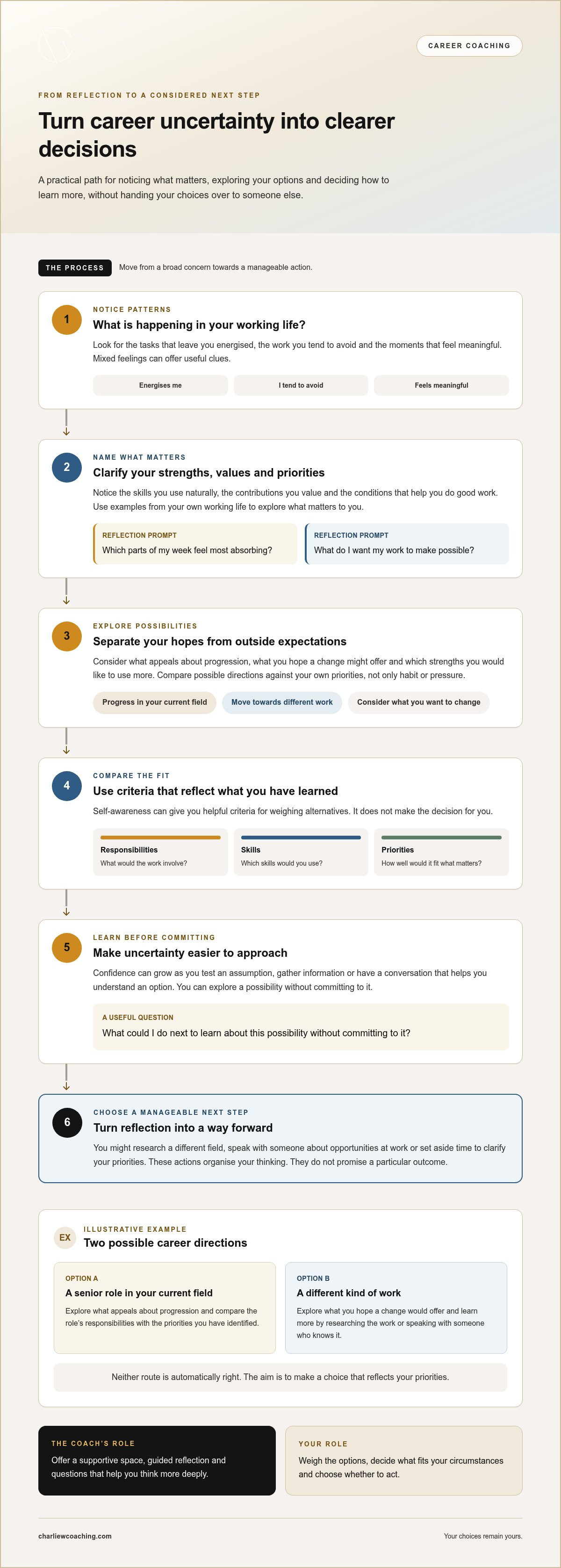
The process can begin with noticing patterns: which tasks leave you energised, what you tend to avoid and when your work feels meaningful. From there, you can name the priorities behind those patterns, explore options that might fit and choose a manageable way to learn more. A coach’s questions can help you think more deeply, but they won’t lead to a prescribed answer. Your circumstances and judgement matter.
Clarifying values, strengths and priorities
Reflection can bring into focus the skills you use naturally, the contributions you value and the conditions that help you do good work. Ask yourself: Which parts of my week feel most absorbing? or What do I want my work to make possible? Then look for examples in your working life that help answer those questions. These prompts can reveal what matters, but they aren’t a formula for choosing a role. The same strength can be useful in different settings, and your priorities may change over time.
Self-awareness can inform a career decision by showing which options fit your strengths, values and priorities. It won’t make the decision for you, but it can give you useful criteria for weighing alternatives. For example, you might compare options by the responsibilities involved, the skills you’d use and how well each fits your priorities.
Building confidence to consider your options
It’s easy to confuse your own hopes with expectations you’ve absorbed from family, colleagues or a familiar idea of success. Coaching can help you separate them. You can then compare options against what you’ve identified as important, rather than choosing only from habit or pressure. The decision may still feel significant, but breaking it into smaller questions can make it easier to approach.
Confidence doesn’t have to come first. It can grow as you test an assumption, gather information or have a conversation that helps you understand an option more clearly. A useful question is: what could I do next to learn about this possibility without committing to it?
Illustrative example: Imagine you’re deciding between pursuing a senior role in your current field and moving towards a different kind of work. Coaching might help you explore what appeals about progression, what you hope a change would offer and which strengths you’d like to use more. You could compare the responsibilities of the senior role with the day-to-day work in the alternative field, then speak with someone who knows that work or research it further. Neither route is automatically right. The aim is to make a choice that reflects your priorities.
What are the benefits of career coaching in this situation? It can give you a thoughtful way to turn insight into a next step without taking ownership of the choice away from you. If you’re considering a transition, explore Charlie’s career transition coaching.
Are the benefits of career coaching worthwhile if you are unsure?
You don’t need to feel certain before coaching can be useful. Uncertainty may be the reason to pause and explore: perhaps you’re weighing a change, struggling to see a way forward or wondering whether your doubts are telling you something important. If you’re asking what are the benefits of career coaching, a realistic answer is that it can offer structure and perspective, but it can’t make the choice or take action on your behalf.
Coaching is a space to think through your situation, consider options and build confidence in your decisions. It doesn’t guarantee employment, a promotion or any particular result. It isn’t recruitment or job placement, and it isn’t clinical mental health support. Its focus is your working life and the choices you want to explore.
Coaching, informal advice and independent reflection
Each approach can be useful, depending on what you need. Coaching offers a dedicated, collaborative conversation; informal advice brings another person’s perspective; independent reflection gives you room to think at your own pace.
| Approach | Purpose | Your role |
|---|---|---|
| Career coaching | Explore priorities, options and possible actions through guided conversation. | Bring your questions, decide what fits and choose whether to act. |
| Informal advice | Hear another person’s experience, suggestions or perspective. | Consider their input alongside your own circumstances and judgement. |
| Independent reflection | Make time to think, write or weigh up a decision privately. | Set your own questions and decide when you have enough clarity to move. |
These approaches can work together. You might use coaching to explore a dilemma, talk it through with someone you trust, then take time to consider what feels right for you.
Recognising useful progress
Progress doesn’t have to mean reaching a final answer straight away. You might notice that your priorities feel clearer, that you’re weighing choices more carefully or that a next step better reflects what matters to you. Sometimes progress means refining a direction after learning more, rather than sticking with your first idea.
There’s no universal timeline. If you’re willing to explore, uncertainty can be a starting point, not a reason to wait until you feel completely ready. Useful coaching supports steady, client-led movement while leaving the decisions and actions in your hands.
How career coaching can help in different professional situations
Career questions vary from person to person. You might be ready to explore a new field, keen to progress where you are or doing well by external measures while feeling that something is missing. Coaching can help you examine what’s behind the question and consider possibilities that fit your circumstances. The same approach won’t suit everyone, and no particular situation requires an immediate change.
The focus of career coaching should reflect your situation, priorities and chosen next step.
| Situation | Possible coaching focus | A client-led next step |
|---|---|---|
| Considering a career transition | Explore transferable strengths, values and directions that could make use of your experience. | Identify one role or field to learn more about before committing to a major change. |
| Seeking professional progression | Clarify what meaningful progress means to you, beyond a title or seniority. | Consider a conversation about responsibilities or development in your current role. |
| Feeling successful yet unfulfilled | Reflect on which parts of work feel worthwhile and which priorities may need more attention. | Choose one aspect of your working week to understand or adjust. |
When you’re considering a career transition
A transition doesn’t have to mean starting over. Coaching can help you recognise strengths you already use, consider the values you want your work to reflect and explore where those might fit elsewhere. For example, take a responsibility you enjoy and identify the skills it draws on. Then look at roles or fields where those skills could be useful. This creates room for thoughtful exploration, rather than pressure to reinvent your whole career at once. If a change is on your mind, learning more about career transitions can help you consider the process in greater depth.
When you want progression or renewed alignment
Progression may mean more influence, learning or responsibility, but its meaning is personal. Coaching can help you define what you’re seeking and consider how to move towards it, including ways to reshape an existing role or direction. Likewise, feeling unfulfilled doesn’t automatically mean you need to leave. Reflecting on what feels out of step can help you decide whether an adjustment, a different challenge or a broader change deserves consideration.
If you’re weighing a transition, progression or a renewed sense of purpose, learn about Charlie Whalley’s career transition coaching.
How Charlie Whalley’s career coaching can support your next step
Once you’ve begun to understand what you want from work, the next challenge can be deciding how to move towards it. Charlie Whalley provides bespoke career transition coaching to help you explore that question in a thoughtful, practical way. The benefits of coaching are personal: you have space to consider your circumstances, strengths and hopes, rather than being handed a one-size-fits-all answer.
A collaborative approach to career transition coaching
Charlie’s coaching is tailored to you and your professional context. Bring the questions, experience and priorities that matter to you. Charlie offers a supportive partnership to help you explore them. Together, you can reflect on your values and strengths, consider possible directions and build confidence in your judgement.
This isn’t about being told which career to choose. You remain the decision-maker. Coaching can help you look at professional change more clearly and identify practical steps that feel relevant to your goals, whether you’re exploring a new direction or working out what you want from your current one.
Charlie is an ICF Professional Certified Coach (PCC). Her coaching supports reflection and purposeful career choices, but it can’t guarantee a particular outcome. The direction and decisions remain yours.
A manageable next step when you feel ready
You don’t need a polished plan before considering coaching. It can be enough to name one question you’d like to explore, such as, What kind of work would make better use of my strengths? or What would meaningful progress look like for me? Starting with a question gives you a place to begin without requiring you to know exactly where you’ll end up.
If you’d like to explore whether this support feels right for your situation, book a discovery call to find out how it can work for you. Bring the career question that’s on your mind. You can take it from there.
Take a thoughtful next step towards work that fits
Career uncertainty doesn’t mean you need to make a sudden change or have every answer before you begin. Coaching can help you understand what matters, recognise how your strengths might guide your choices and consider practical next steps that remain yours to take.
So, what are the benefits of career coaching? For some people, it’s a clearer sense of direction. For others, it’s the confidence to explore options or a fresh perspective on work that looks successful but doesn’t feel fulfilling. Progress can begin with one honest question.
Charlie Whalley provides bespoke one-to-one coaching to support career transition, confidence and purposeful choices. If you’d like a supportive space to explore your situation, book a discovery call to find out how it can work for you.
You don’t need a complete plan to begin. A question and a willingness to explore can be enough to find your next step.
Frequently Asked Questions
What are the main benefits of career coaching?
The main benefits of career coaching can include clearer priorities, a better understanding of your strengths and more confidence when weighing career options. A coach can help you reflect on what you want from work, explore possible directions and identify practical actions that feel manageable. Coaching doesn’t guarantee a result or decide your path for you. Its value is in supporting your thinking so you can make choices that feel more purposeful.
Can career coaching help if I do not know what I want to do?
Yes. You don’t need a complete plan to start exploring your options. Coaching can help you notice what you enjoy, what matters to you and which strengths you’d like to use more. For example, reflecting on the tasks that feel most engaging may help you identify themes to explore further. You can begin with uncertainty, then use questions and conversation to work towards a clearer sense of direction at your own pace.
Is career coaching useful if I am not changing jobs?
Yes. Coaching can be useful even if you want to stay in your current role. You might want to clarify what progression means to you, make better use of your strengths or find more purpose in your day-to-day work. Exploring those priorities can help you consider changes within your existing role or identify what you value about it. A job move isn’t the only way to create a working life that feels more aligned.
How does career coaching help build confidence?
Career coaching can help build confidence by giving you space to recognise your strengths, reflect on what you’ve already achieved and consider options more clearly. When self-doubt makes every choice feel risky, breaking a decision into smaller questions or actions can make it easier to approach. Confidence doesn’t have to be in place before you begin. It may develop as you understand your priorities and make decisions that reflect them.
What is the difference between career coaching and career advice?
Career coaching supports you to think through your own goals and choices, using questions and reflection to explore what fits your circumstances. Career advice usually involves someone offering recommendations or sharing what they believe you should do. Advice can provide useful perspective, but coaching keeps your judgement and decisions at the centre. You might use both, considering advice from others while reflecting on what feels right for you.
How long does it take to see the benefits of career coaching?
There’s no set timeline for seeing the benefits of career coaching. It depends on what you want to explore, your circumstances and the actions you choose to take. You may notice progress as your priorities become clearer or you feel more able to weigh up a decision. For others, clarity develops gradually, and refining an initial direction is part of the process. Progress doesn’t have to mean reaching a final answer straight away.
Is career coaching the same as therapy or recruitment?
No. Career coaching focuses on work-related goals, choices and next steps. It isn’t clinical psychotherapy or mental health counselling, and it doesn’t provide recruitment or job placement services. A coach can support you to explore your strengths, build confidence and consider career directions, but the decisions and actions remain yours. Coaching also can’t guarantee a job, promotion or other specific outcome. Its purpose is to help you think through your working life.