
Life and leadership coaching: A grounded guide to meaningful change

What if the next step in your career isn’t doing more, but getting clearer about what matters? You may be meeting expectations at work and keeping everything moving, yet privately wondering whether your direction, confidence or priorities still feel right. Life and leadership coaching offers space to explore that tension and connect personal clarity with the choices you make as a leader.
It’s understandable to want support while also wondering what coaching actually involves. Is it advice from someone more experienced, practical skills training, or something closer to therapy? The differences matter. Coaching isn’t about being handed a ready-made answer. It’s a collaborative conversation that can help you reflect, recognise what’s getting in the way and choose purposeful next steps for yourself.
In this guide, you’ll learn what life coaching and leadership coaching can help you explore, how coaching differs from mentoring, training and therapy, and what to consider when deciding whether a one-to-one relationship feels right for you. The aim isn’t to fix what’s wrong with you. It’s to help you find a grounded way forward that fits your circumstances, values and life beyond work.
Key Takeaways
- Life and leadership coaching can help you connect what matters personally with the way you lead and make decisions.
- Discover how a coaching conversation can move from a question or concern towards practical next steps that reflect your priorities.
- Understand how coaching differs from therapy, mentoring and training, so you can consider what kind of support fits your needs.
- Explore whether recurring self-doubt, a change in responsibilities or uncertainty about direction could be a reason to seek coaching.
- Find out what a bespoke one-to-one coaching relationship with Charlie Whalley could involve, and how his PCC credential fits into his approach.
What is life and leadership coaching, and what can it help you explore?
You can be trusted to make difficult decisions, support your team and keep work moving, yet still wonder whether you’re heading in the right direction or leading with the confidence you want. That uncertainty doesn’t mean you’re failing. It may be a signal to pause and look more closely at what matters to you now.
Life and leadership coaching gives you a structured, collaborative space to explore questions like these. You bring the priorities and challenges; a coach helps you reflect, notice assumptions and consider purposeful actions. As an overview of Coaching describes, coaching takes different forms, including life and business coaching. In practice, the conversation can connect your wider circumstances with the decisions and behaviours you bring to work, without assuming every workplace difficulty has a personal cause.
Coaching is a reflective partnership that helps you clarify what matters and choose your own next steps, rather than receiving instructions or ready-made answers.
How personal questions and leadership challenges can connect
Your values, confidence and boundaries can influence how you respond to workplace demands. For example, if you value being present with your family but regularly accept extra responsibilities, coaching might help you identify what makes it hard to set limits. You could then consider one response, such as pausing before accepting a new request or discussing priorities with your manager. The aim isn’t to prescribe a perfect balance. It’s to help you recognise the trade-offs and decide what feels workable in your circumstances.
Leadership behaviour also affects how you experience your role. You might explore how you communicate under pressure, whether you make enough room for others’ views, or how your confidence shapes a decision. At the same time, practical issues such as workload, team dynamics or unclear expectations may need attention in their own right.
Who might consider coaching?
Coaching may be useful if you’re seeking clearer direction, steadier confidence or a thoughtful way through change. You might be taking on new responsibilities, reconsidering what success means to you, or noticing that a familiar approach no longer fits. You don’t need to be in crisis or hold a senior title to benefit from making space for reflection.
Leaders may also use coaching to consider their presence, relationships and the effect their behaviour has on colleagues. These questions aren’t about judging yourself. They can help you identify what you’d like to keep, what you might approach differently, and where a small, deliberate shift could make a difference to how you lead.
How does coaching turn reflection into practical progress?
Feeling stuck can be difficult to pin down. You might know that something needs to shift, without knowing whether the issue is your role, your confidence, competing priorities or simply a question you haven’t had room to consider. Coaching helps bring that uncertainty into focus, then gives you space to explore it at a pace that suits your situation.
The conversation is guided by what matters to you, not by a prescribed answer. You bring your priorities, experience and questions; the coach supports your reflection with focused questions and a fresh perspective. In life and leadership coaching, you set the aims and make the choices. The coach helps you explore context, assumptions and options without directing you towards a fixed outcome.
Start with the question that matters now
A broad sense of being stuck can become a more useful question: “What do I want my next step at work to make possible in my life?” From there, you might look at your responsibilities, relationships, values and current circumstances. The focus can change as you understand more. A question that begins with confidence, for example, may lead you to consider whether the expectations around you still fit your priorities.
Move from a new perspective to a considered action
Reflection doesn’t need to produce a dramatic decision. It might help you notice an assumption you’ve treated as fact, such as believing you must accept every request to be seen as committed. You can then consider different responses, weigh what feels realistic and choose whether to try one small change.
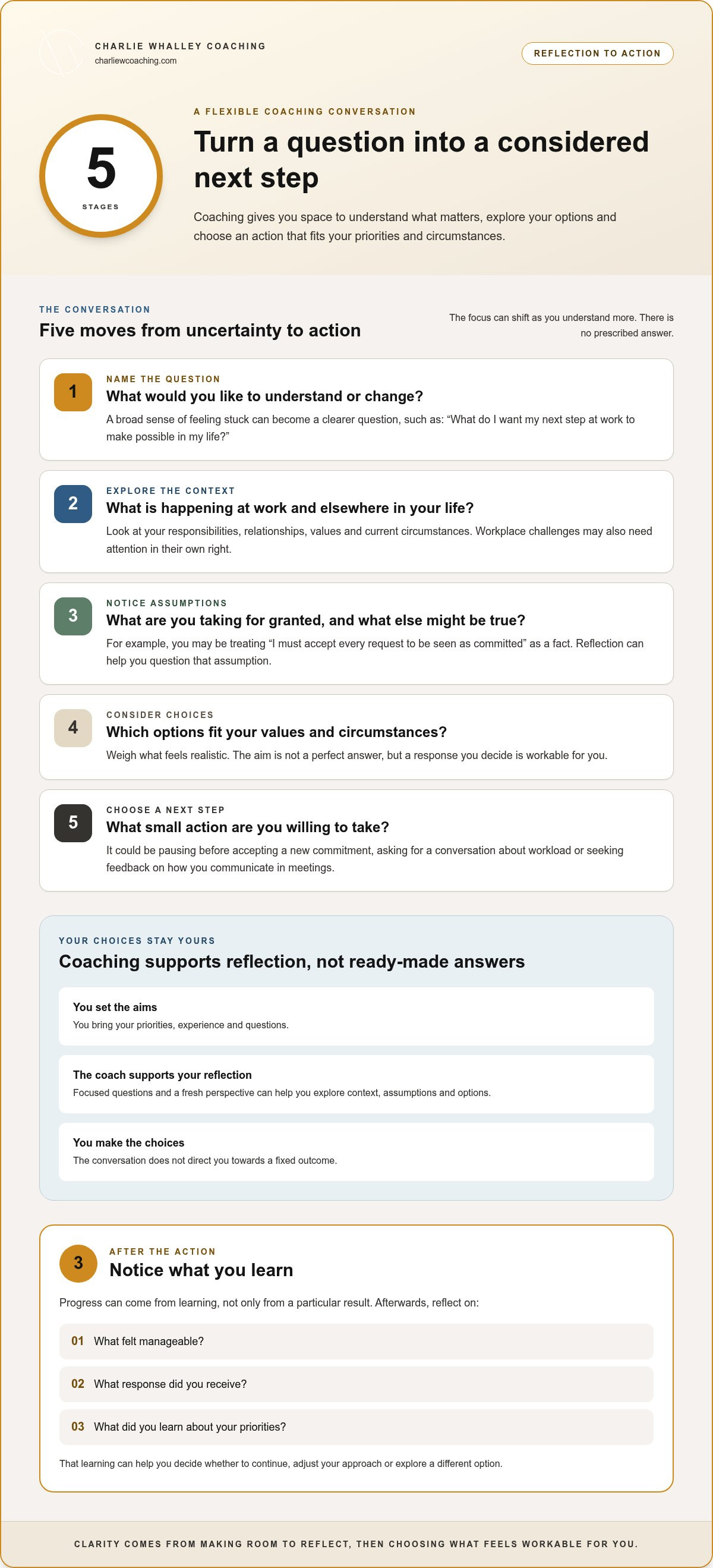
A flexible coaching conversation might move through these stages:
- Name the question: What would you like to understand or change?
- Explore the context: What’s happening at work and elsewhere in your life?
- Notice assumptions: What are you taking for granted, and what else might be true?
- Consider choices: Which options feel relevant to your values and circumstances?
- Choose a next step: What small action are you willing to take?
You might decide to ask for a conversation about workload, pause before agreeing to a new commitment or seek feedback on how you communicate in meetings. The action is yours. Afterwards, notice what happened: what felt manageable, what response you received and what you learned about your priorities. That can help you decide whether to continue, adjust your approach or explore a different option. Progress can come from learning, not only from a particular result.
If a collaborative space for reflection and practical next steps feels useful, explore one-to-one coaching with Charlie.
Coaching vs therapy, mentoring and training: what is the difference?
If you’re concerned coaching might feel vague, it helps to know that a conversation can have a clear purpose without following a rigid script. You and your coach agree what you want to explore, then use questions to examine your perspective and possible next steps. The direction comes from your aims, not from a set of instructions.
These forms of support can all be valuable, but they serve different purposes. Here’s a simple comparison:
| Type of support | Purpose and typical focus | Who guides the process? |
|---|---|---|
| Coaching | Explores the client’s questions, goals, context and choices. | The client sets the focus; the coach guides reflection. |
| Therapy | Offers support shaped around a person’s psychological or emotional needs. | The therapist guides the work in a professional therapeutic relationship. |
| Mentoring | Shares experience, perspective and advice relevant to a situation or career. | The mentor contributes guidance based on their knowledge and experience. |
| Training | Builds defined knowledge or skills, often around a particular subject. | The trainer or programme provides instruction and learning activities. |
Coaching and therapy serve different purposes
Coaching can support you to reflect on your circumstances, clarify what you want to work towards and consider choices. It isn’t clinical psychotherapy and doesn’t replace mental health care. Therapy can offer a different kind of support, shaped around your needs and the work you and your therapist agree is appropriate. If you’re seeking mental health care, approach an appropriately qualified clinical professional.
The distinction isn’t a judgement about which is more valuable. It’s about finding support suited to what you’re experiencing. If your main concern calls for clinical care, coaching isn’t a substitute.
Coaching, mentoring and training offer different kinds of support
A mentor may share how they handled a comparable challenge or offer advice drawn from their own experience. That perspective can be useful, though their path may not fit your circumstances. Training, meanwhile, is often a good choice when you want to develop a defined skill, such as learning a process or practising a specific technique.
In life and leadership coaching, the emphasis is on your own thinking and decisions. A coach may ask questions rather than tell you what to do, helping you consider what fits your values and situation. If you need expert instruction or someone to share direct experience, mentoring or training may be a better match. If you want to work through your own questions and choices, coaching may offer the space you need.
When could life and leadership coaching be useful for your situation?
You don’t need to be facing a crisis or holding a senior executive role to consider coaching. It may be helpful if self-doubt keeps resurfacing, a change in responsibilities has unsettled your confidence, or you’re unsure what direction feels right. You might also want to understand how your leadership presence and behaviour affect the people around you.
These aren’t signs that something is wrong with you. They can be reasons to make space for a more considered view of what’s happening and what you’d like to change. Coaching won’t make choices on your behalf, and its value depends on your needs, circumstances and willingness to reflect.
Questions to clarify what you want from coaching
You don’t need to arrive with a polished goal. Start with what feels unclear, difficult or important in your working or personal life. An open question can give a conversation somewhere to begin, while leaving room for your understanding to develop. To make the conversation more specific, consider noting a recent situation, what you wanted to happen and what felt difficult about it.
- What’s taking up the most thought or energy at the moment?
- Which decision, relationship or change would you like to see more clearly?
- What might feel different in an ordinary working week if things were moving in a useful direction?
- What would you like to understand about your confidence, choices or way of leading?
Your answers might point towards a specific change, or reveal a broader question about what matters to you now. Either is a worthwhile place to start.
Recognise progress without expecting a quick fix
Progress may show up in subtle ways: noticing a familiar assumption, making a decision with more confidence, approaching a conversation differently or taking an action you’ve chosen. These shifts aren’t a guarantee of a particular outcome, and they won’t look the same for everyone. They can still help you understand what’s changing and what you want to explore next.
If you’re considering this kind of support, reading what to expect from one-to-one coaching can help you picture how the relationship and conversations might work. You can also book a discovery call with Charlie to discuss whether coaching could fit your situation.
Charlie Whalley’s grounded approach to life and leadership coaching
When work is demanding and your confidence or sense of direction feels less certain than it appears from the outside, it can help to have space to think without needing to arrive with everything worked out. Charlie Whalley provides bespoke one-to-one life and leadership coaching for professionals and leaders navigating self-doubt, personal or workplace change, confidence and direction. As an ICF Professional Certified Coach (PCC), Charlie brings a professional coaching credential to this work, while each coaching relationship is shaped around the individual client and their circumstances.
The aim isn’t to hand you a formula for leading or living. It’s to support you to explore what’s happening, understand what matters to you and consider practical next steps that feel relevant to your situation. You remain an active partner throughout.
A collaborative space for honest reflection
Coaching can make room for questions that are difficult to consider in the middle of a busy working week. You might be carrying the pressure of a new role, a change at home or uncertainty about whether your current direction still fits. Those pressures are real. Taking time to reflect doesn’t minimise them; it can help you see them more clearly.
Through thoughtful questions, Charlie supports you to bring your own perspective and priorities into focus. You might explore what’s behind a recurring doubt, what you want from a change or which parts of a challenge are within your influence. There’s no need to present a polished version of yourself. An honest starting point is enough.
Connect insight with the leadership you want to practise
Greater self-awareness can help you notice how your values and assumptions shape everyday choices: how you respond under pressure, set boundaries, communicate with colleagues or make room for different views. These are areas to explore in coaching, not promises of a particular result. The conversation can also focus on confidence, executive presence and how you want to navigate change, with attention to the realities of your role and wider life.
Leadership isn’t separate from the person doing it. Reflecting on what matters to you can help you consider how you want to show up, while practical next steps keep the conversation connected to daily working life. Your circumstances set the context; your choices remain your own.
If you’d like to explore whether this tailored approach fits what you’re facing, book a discovery call to find out how it can work for you.
Make space for your next step
You don’t need to have everything figured out before you seek support. Coaching can help you make sense of what feels unclear, distinguish it from other forms of support and turn reflection into a next step that feels relevant to your circumstances.
Life and leadership coaching brings personal priorities into conversation with the way you lead, helping you explore self-awareness, confidence, executive presence and change. Charlie Whalley is an ICF Professional Certified Coach (PCC), and his one-to-one approach is tailored to each client’s situation. The focus stays on your questions and choices, not a promised outcome.
If you’re ready to explore whether this kind of support could fit where you are now, book a discovery call. A clearer way forward can begin with one honest conversation.
Frequently Asked Questions
What is life and leadership coaching?
Life and leadership coaching is a collaborative process that helps you explore personal or professional questions, clarify what matters and consider purposeful next steps. It can connect your wider circumstances with the way you make decisions and lead, without assuming every workplace challenge has a personal cause. The coach supports your reflection rather than prescribing answers, so the choices and actions remain yours.
How does life and leadership coaching work?
Coaching usually starts with a question or area you want to explore. You and your coach consider the context, examine assumptions and look at possible choices. You don’t need a perfectly formed goal at the outset. As your understanding develops, you can decide on a practical next step, then reflect on what you learn from putting it into practice. The focus is shaped around your priorities and circumstances.
Who can benefit from life and leadership coaching?
Professionals and leaders may find coaching useful when they’re facing change, questioning their direction or seeking greater confidence in their decisions. You might be stepping into new responsibilities, reflecting on how you work with colleagues or trying to balance leadership demands with personal priorities. Coaching isn’t only for senior executives or people in crisis. It can also offer a considered space to reflect before a challenge feels urgent.
Can coaching help with self-doubt at work?
Coaching can help you explore how self-doubt affects your decisions, conversations and confidence at work. You might look at situations where you hold back, question your judgement or find it hard to express a view. A coach can support you to examine your perspective and consider possible responses. This doesn’t guarantee self-doubt will disappear, but it may help you understand it and choose how you want to act.
Is life and leadership coaching the same as therapy?
No. Coaching and therapy are different forms of support, each shaped around different needs. Coaching focuses on the client’s questions, goals, context and choices. It isn’t clinical psychotherapy and doesn’t replace mental health care. If you’re seeking support for your mental health, approach an appropriately qualified clinical professional. Choosing the right kind of support depends on what you’re experiencing and what you need help with.
What is the difference between coaching and mentoring?
A mentor may offer advice or share relevant experience from their own career or circumstances. Coaching centres on your thinking, priorities and choices, with the coach using questions to help you explore your own perspective. Neither approach is automatically better. If you want practical guidance drawn from someone’s experience, mentoring may suit you. If you want space to examine your situation and decide what feels right for you, coaching may be useful.
How do you know whether coaching is right for you?
Coaching may be worth considering if there’s a question, decision or change you want to understand more clearly, and you’re open to reflecting on your part in it. You don’t need a precise goal before starting. Consider what feels important now and what you’d like to be different in everyday life or work. A conversation about your circumstances can help you decide whether a coaching relationship feels like a good fit.