
Career transition coaching: get unstuck, and find your way forward

What if the next step isn’t choosing a new job straight away, but getting clearer about what you need from work? If you’re questioning your direction while still managing daily responsibilities, it can be hard to see how your strengths and experience might lead somewhere different. A career transition coach can help you explore those possibilities without expecting you to have the answer already.
It’s understandable to want a clear plan before making a change, especially when uncertainty brings self-doubt with it. But clarity often comes through reflection, not pressure. You can take time to consider what feels meaningful, what’s realistic for your circumstances and which parts of your working life you want to carry forward.
This article explains what career transition coaching can help with, how it differs from other kinds of support, and whether it might suit you. You’ll find practical questions to help identify what feels misaligned, what you want to keep and which possible directions are worth exploring. The aim isn’t to have someone choose your future for you. It’s to find a more considered way forward that feels like yours.
Key Takeaways
- Feeling successful on paper but out of step with your work can be a useful signal to pause and reflect.
- A career transition coach can help you explore what matters and consider possible directions without deciding for you.
- Coaching, recruitment and self-guided change serve different purposes, and each calls for a different role from you.
- Simple reflection prompts can help you identify what feels misaligned, what you’d like to change and what you want to keep.
- Structured, one-to-one coaching can help turn reflection into practical exploration at a pace that feels considered.
When could a career transition coach help you find a way forward?
You may be trusted at work, progressing in your role and grateful for the stability, yet still feel that something no longer fits. Perhaps the tasks that once interested you now leave you flat, or your working week has drifted away from what you value. That tension doesn’t mean you’ve failed or should resign tomorrow. It may mean the question is bigger than which job to apply for next.
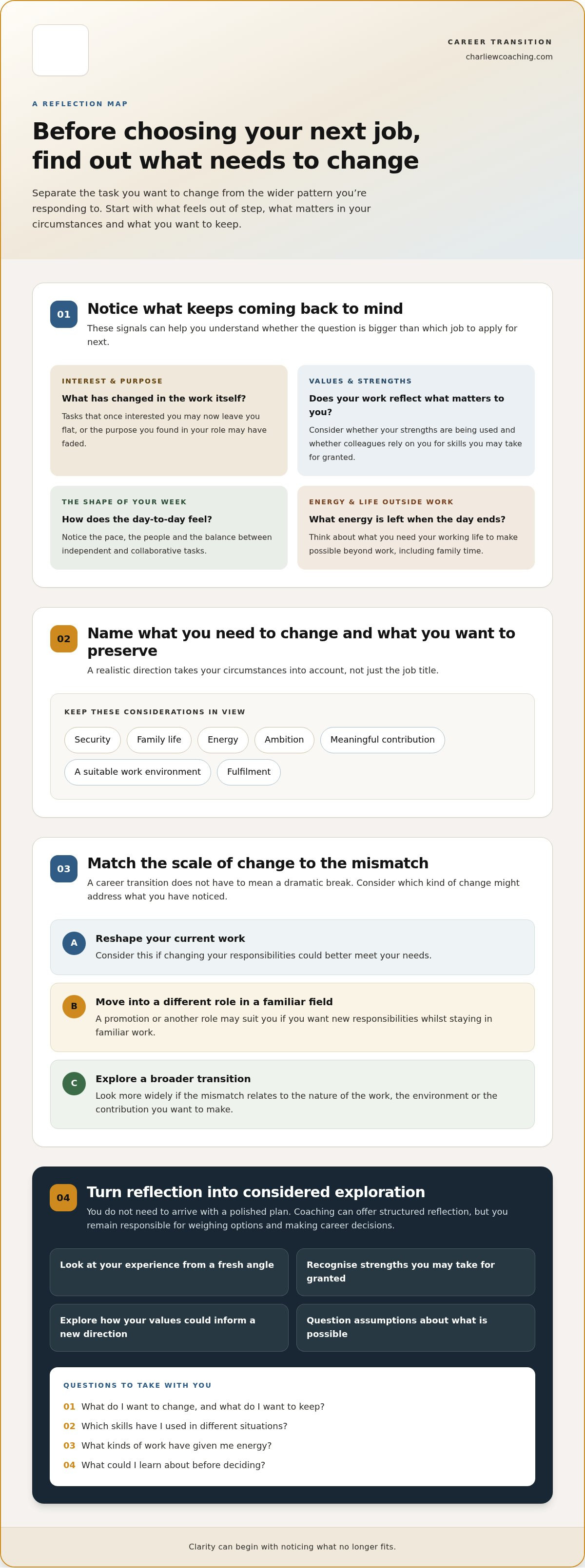
A career transition can mean a significant change in direction, but it doesn’t have to involve a dramatic break. A promotion or move into a different role might meet your needs if you want new responsibilities in a familiar field. You might be able to reshape your current work instead. A broader transition could be worth exploring if the mismatch is tied to the nature of the work, the environment or the contribution you want to make.
Signs your career question may be about direction, not just your next job
Notice what keeps returning to mind. You might question whether your work reflects your values, whether your strengths are being used, or whether the purpose you once found in your role has faded. The day-to-day shape of work matters too: the pace, the people, the balance between independent and collaborative tasks, and the energy you have left when the day ends.
Try separating the task you want to change from the wider pattern you’re responding to. If you enjoy your profession but want more autonomy, a different role could be enough. If you can’t see yourself continuing in the field, you may be considering a more substantial change. Security, family life, energy and ambition can pull in different directions. Naming those competing priorities helps you understand what a realistic and satisfying move might look like.
What a career transition coach does, in plain English
A coach offers structured reflection and forward-focused conversation, not a ready-made answer about what career you should pursue. They can help you look at your experience from a fresh angle, recognise strengths you may take for granted, and explore how your values could inform a new direction. If you’re unsure whether a preference is truly yours or an assumption about what’s possible, that question can become part of the conversation.
You don’t need to arrive with a polished plan. Uncertainty is a starting point. You remain responsible for weighing your options and making career decisions; coaching can help you do so with more considered insight. For a broader introduction to career exploration and decision-making, see this overview of career counseling. Your first step may simply be noticing what you want to understand better.
What can career transition coaching help you work through?
Once you’ve started questioning your direction, the next challenge is making sense of the possibilities. You might have several interests but no obvious route between them, or know what you want to leave behind without knowing what should come next. Coaching gives those questions room and structure, helping you look for a direction that fits your values, strengths and circumstances.
Transition coaching helps you turn what matters to you into clearer career choices and considered next steps. It won’t hand you a guaranteed answer. Instead, it can help you notice patterns in your experience, test the assumptions shaping your options and decide what to explore further.
Clarifying what you want work to make possible
A useful starting point is to look beyond job titles. What contribution would you like to make? What kind of environment helps you do your best work? What would make your working life feel more fulfilling, and what do you need it to make possible outside work?
Values and strengths can help you answer these questions. You may value creativity, for instance, but also need reliable boundaries around family time. You may be good at bringing people together, even if your current title doesn’t reflect that strength. Naming what you want to change and what you want to preserve makes the picture more grounded.
This reflection can help separate genuine preferences from beliefs about what’s realistic. Perhaps you’ve dismissed a direction because you assume your experience won’t transfer, or because you think a satisfying role must follow a particular career path. Look at the evidence: which skills have you used in different situations, what have colleagues relied on you for, and what kinds of work have given you energy? These questions open up possibilities without assuming a particular role will be right.
Moving from insight towards considered action
Clarity becomes useful when it helps you explore. You could identify a few kinds of work to learn more about, speak with people whose roles interest you, or consider whether changing your responsibilities might meet your needs. The career transition resources from the U.S. Department of Education also cover practical areas such as self-assessment and retraining.
These steps help you gather insight, not guarantee employment. Your priorities may sharpen as you learn more, and an initial idea may change. The aim is to make decisions with better information and a stronger sense of what fits. For a broader view of how coaching can support meaningful change across work and life, explore life and leadership coaching with Charlie.
Charlie’s career transition coaching offers a structured space to explore your values, strengths and possible next steps.
Career transition coach, recruiter or self-guided change: what is the difference?
When you’re weighing a career change, it helps to know what kind of support would meet your need. You might be trying to decide what direction feels right, looking for a specific vacancy, or gathering information independently. These approaches can complement one another, but they serve different purposes.
| Approach | Purpose and typical focus | Your role |
|---|---|---|
| Coaching | Structured reflection on direction, strengths, values and career decisions. | Bring your questions, reflect and decide which steps feel right for you. |
| Recruitment | Hiring processes and matching candidates with roles. | Share your experience and consider relevant opportunities. |
| Self-guided change | Independent research, reflection and exploration. | Choose what to investigate and organise your own next steps. |
Career coaching and recruitment solve different problems
A recruiter generally works around a hiring need, helping identify candidates whose experience may fit a role. This can be useful if you already know what kind of position you want to pursue. Coaching, by contrast, gives you space to consider whether a direction suits your values and longer-term priorities. Neither approach can promise a particular outcome.
A career transition coach focuses on your questions and decisions. Through conversation, you can examine what you want from work, what you bring to a new direction and which options might be worth exploring. You remain the decision-maker. The National Career Development Association offers career development resources that can provide additional context as you consider different forms of support.
When coaching may be useful, and when another route may fit better
Coaching may be helpful when you’re caught between competing priorities, feel unsure which strengths to build on, or find self-doubt making every option seem unrealistic. Independent research can also be a good starting point, especially if you have the time and confidence to explore possibilities on your own. Coaching adds a regular, structured conversation to help you reflect, stay engaged with your exploration and make sense of what you learn.
If you’ve already chosen a direction and need to pursue a specific vacancy, focused job-search activity may be the more immediate priority. If you’re facing a mental health concern that needs clinical support, that has a different purpose from career coaching. Seeking appropriate clinical care is not a sign that you’ve failed at work or at making a decision. It’s a way to get support suited to that need.
There’s no single right route. The useful question is whether you need help finding direction, acting on a decision, or addressing something beyond career choices. If structured reflection feels like the right starting point, read about Charlie’s career transition coaching.
How to decide whether career transition coaching fits your situation
You don’t need to be certain you want a major career change before considering coaching. It can be useful if you’re trying to understand whether the problem is your current role, the kind of work you do, or the way work fits with the rest of your life. A few honest questions can help you find where to begin.
Questions to help you name the change you are considering
Take a little time to write down your answers. They don’t need to sound polished or point towards a particular job.
- What feels draining? Notice the tasks, situations or expectations that regularly leave you depleted. Is the strain tied to one part of your role, or does it reach into the work itself?
- What still feels meaningful? Identify the moments when you feel engaged, useful or quietly proud of what you’ve done. They can reveal what you may want to carry into a different role.
- What do you want to change, and what would you rather retain? Consider responsibilities, working environment, flexibility, security and the contribution you make. A shift in role may be enough, or the question may be about a broader direction.
- What do your strengths suggest? Think about what people rely on you for and which skills you enjoy using. Could those strengths be relevant in a different setting or type of work?
Your answers may not line up neatly. You might want greater purpose and more security, or feel drawn to a new field whilst needing to protect time for family. That isn’t a reason to dismiss the idea. It helps you see the real conditions any next step needs to work within.
What to bring into a first coaching conversation
You don’t need a complete career plan. Bring one question, concern or decision that’s occupying your attention. You might be wondering whether to stay in your profession, how to use a particular strength, or what a more sustainable working week could look like.
It can also help to name the values you want your work to reflect, the skills you’d like to use more, and practical constraints such as responsibilities or the need for stability. You’re not expected to solve everything in advance. Uncertainty itself gives the conversation somewhere meaningful to start.
Readiness doesn’t have to mean having a clear destination; clarity can grow through exploration. You can learn more about career transition coaching with Charlie before deciding on a next step.
Explore career transition coaching with Charlie Whalley
After exploring what you want from work and what kind of support could help, you may be ready to consider how coaching could support your situation. Charlie Whalley offers bespoke one-to-one career transition coaching for professionals considering a change in direction or progression. The focus is not on prescribing a new path, but on helping you understand what purposeful work could mean for you and how to explore it thoughtfully.
A thoughtful coaching partnership for professional change
Charlie is an ICF Professional Certified Coach (PCC). In a coaching partnership, you bring your experience, questions and priorities; the conversation helps you reflect on them with care and structure. Together, you can consider how your values and strengths relate to possible career directions, and what you want to learn before making a decision.
The work is tailored to you. Perhaps you’re weighing whether to build on your existing experience, shift your responsibilities or explore a different field. Rather than starting from a ready-made answer, coaching can help you notice what matters in those options, where your assumptions may be limiting the picture, and which practical exploration could give you more insight.
Your agency stays central throughout. Charlie supports reflection, self-awareness and considered action, while you make your own career decisions. You choose what to explore and what feels appropriate for your circumstances. A next step might be gathering information, testing an idea through conversation or taking time to clarify what you want to retain in your working life. Progress can begin with a better question, not a fully formed plan.
Take a low-pressure next step
If you’re curious about working together, a discovery call offers space to share what’s prompting change and what still feels uncertain. You can talk about the questions on your mind and explore how coaching could work for you, without needing to arrive with a complete career plan.
Find out about coaching with Charlie. You don’t need every answer before beginning. A willingness to talk through what matters is enough to start.
Make space for your next considered step
A career decision doesn’t have to settle every question about your future. It can simply help you move from turning the same uncertainty over in your mind to learning something useful about what might fit. Begin by noticing one possibility, then ask what you would need to find out before taking it further.
If you’d value a steady sounding board as you explore, a career transition coach can help you make room for reflection and choose your own pace. You don’t need to arrive with a polished plan or a firm commitment to change. It’s enough to feel ready to look at your options with care.
Book a discovery call to find out how career transition coaching can work for you. A conversation can be a thoughtful first step towards a working life that feels more considered and more your own.
Frequently Asked Questions
Can a career transition coach help if I have no idea what I want to do next?
Yes. You can begin with what you know, even if it’s only that your current work no longer feels right. A career transition coach can help you examine what you enjoy, what you want less of and what you’re curious about, then use those clues to guide your exploration. For example, noticing that you enjoy explaining complex ideas could prompt you to explore roles where communication is central.
Is a career transition coach only for people who want to change industries?
No. You might want to stay in the same industry but change your responsibilities, level of seniority or working environment. A transition could also mean moving into a different sector or reshaping your professional priorities without changing employers. The useful question is what you want to be different. If the change feels significant to you, coaching can help you think it through, whatever its scale.
Can career coaching help me change careers without starting from scratch?
It can help you identify experience and skills that may be relevant beyond your current role. For instance, managing projects, building relationships or making complex decisions could be useful in more than one field. You’ll still need to explore the requirements of any new direction and where you may need to develop. The aim is to make informed choices about what you can carry forward, not assume every skill transfers automatically.
Will a career transition coach find me a job?
Coaching supports your reflection and career decisions, while job applications and conversations with employers are steps you take yourself. You remain responsible for deciding which opportunities to pursue. If you already know the kind of job you want, you may prefer to focus on those activities. Coaching can also help if you’re still weighing your direction as you explore opportunities.
Can I work with a career transition coach whilst I am still employed?
Yes. You can explore possible changes whilst continuing in your current role, giving yourself time to think through practical considerations before making a decision. You might use coaching to consider what you want from your next move, or whether changes within your current workplace could address what feels unsatisfying. You don’t need to resign or have a firm departure date before reflecting on your options.
What should I expect from a discovery call about career transition coaching?
Expect a chance to share what has prompted you to consider change, what you’re unsure about and what you’d like support to think through. You can ask questions and get a clearer sense of whether coaching feels like a helpful approach for your situation. There’s no need to prepare a detailed career plan. Book a discovery call to explore how coaching could work for you.