
Overcome Fear of Career Change: A Gentle, Practical Guide

What if fear isn’t a sign that you should stay, but a signal to pause and understand what matters? If you’re trying to overcome fear of career change, you may be weighing the security of your current role against a growing sense that something no longer fits. You might wonder whether your dissatisfaction will pass, worry about letting people down or fear choosing the wrong path. Those concerns are real. They don’t mean you’re failing to move forward.
You don’t have to make a dramatic decision before you feel ready. A thoughtful career change can begin with small steps that help you distinguish practical risks from assumptions, and temporary strain from deeper misalignment. Fear can offer useful information without making the decision for you.
This guide will help you understand your hesitation without judging yourself, explore possible directions at a manageable pace and choose a next step grounded in your strengths and values. You’ll find ways to make the unknown feel more workable and move towards a career that better reflects what matters to you.
Key Takeaways
- Fear around changing careers is a response to uncertainty, not proof that you’re making the wrong choice.
- Separate what you can observe from what you’re predicting, then identify what you still need to learn.
- Compare staying as you are, changing direction and exploring while remaining in your current role before deciding.
- To overcome fear of career change, begin with reflection and one small, manageable step rather than a sudden leap.
- Career-transition coaching can help you work through self-doubt and connect your strengths and values with a purposeful next step.
Why the fear of career change can feel so difficult to move through
You can want work to feel more purposeful and still feel uneasy about changing it. Perhaps you’re tired of your current role but rely on its income. Maybe you can picture a different direction, yet worry about losing the status, confidence or sense of belonging you’ve built. These feelings can pull you in opposite directions, making even a first step seem like a decision you can’t undo.
Fear of changing careers often comes from uncertainty: you don’t yet know what a new path would demand or bring. That uncertainty deserves attention, but it isn’t proof that change is wrong. An unexpected event can also prompt you to question your direction. The term career shock describes an event that leads someone to reconsider their professional path. Whether change is prompted by an event or builds gradually, the questions it raises can feel personal and practical at once.
Work may be closely tied to how you see yourself, what you contribute and the future you’ve planned. You might worry about disappointing a manager or family member, or feel pressure to appreciate a role that looks secure from the outside. If you have financial responsibilities, the concern isn’t simply “being scared”. It may point to real constraints that need careful thought. You can take those seriously without assuming they settle the decision.
What might sit underneath career-change fear?
Try naming the specific loss you imagine: income, professional standing, familiar routines or the ease of knowing what you’re good at. Perhaps you fear starting again and feeling less capable, or wonder whether a new team would feel like home. Responsibilities and other people’s expectations can make these questions harder to untangle. Mixed feelings are understandable. They can sit alongside genuine limits, such as commitments that make an immediate move impractical.
Does feeling afraid mean you should stay?
No. Fear alone can’t tell you whether a role fits or whether a different direction is feasible. It can, however, show you what needs investigating. Ask yourself: what am I predicting, and what do I know today? If you’re worried about income, clarify your financial needs before weighing options. If you’re worried about your capability, consider which strengths might transfer to another role. Caution can help you ask better questions; it doesn’t have to make the final decision. This distinction can help you overcome fear of career change without dismissing it or letting it choose for you.
Understand what your fear is telling you before you decide
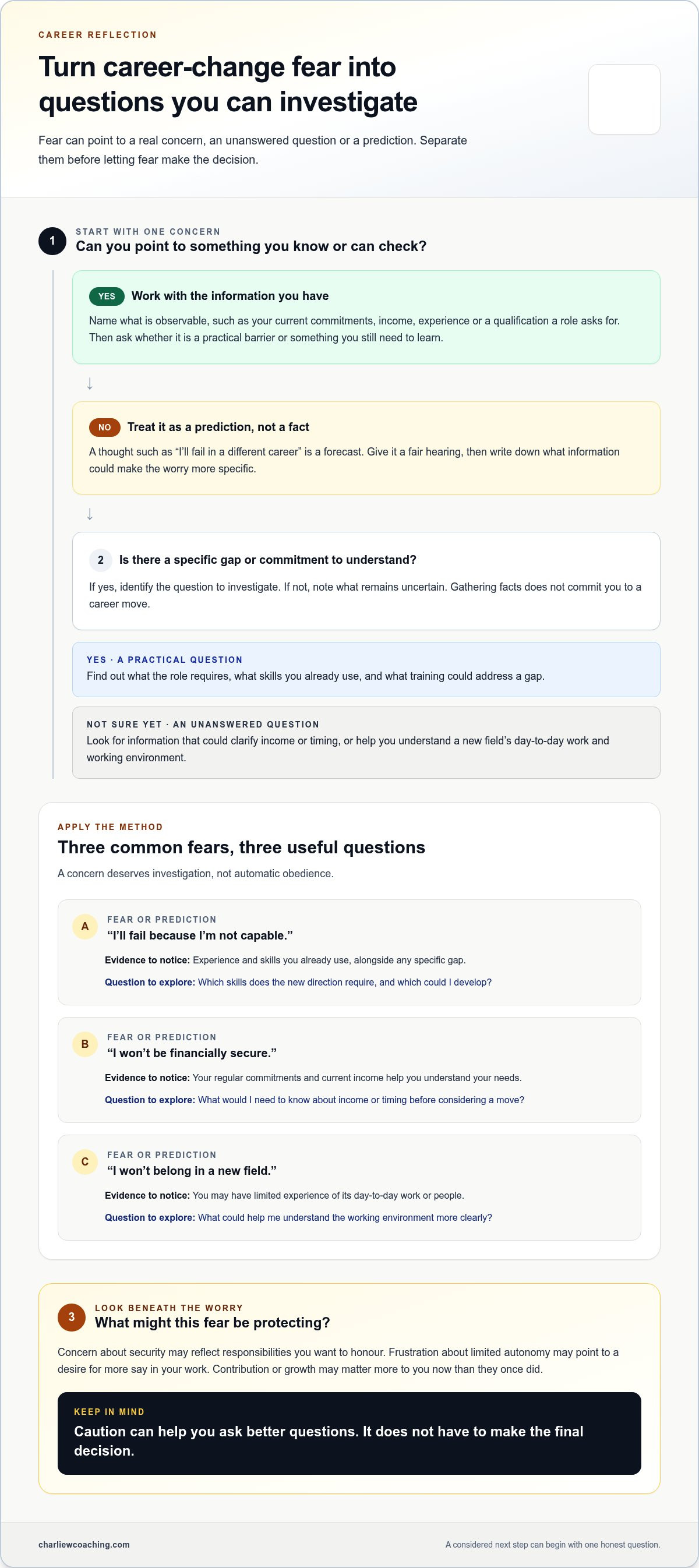
Once you’ve named what worries you, distinguish a prediction from something you can observe or investigate. “I’ll fail in a different career” is a forecast, not a fact. “The roles I’m considering ask for a qualification I don’t have” is a specific gap you can look into. Neither concern should be dismissed, but each calls for a different response.
To slow your thoughts down, write three short notes: what you know, what you’re assuming and what you’re still uncertain about. If you’re worried about losing financial security, your current commitments are useful information. The belief that you could never manage a change is an assumption to examine. You don’t need to solve everything at once.
Separate predictions from information you can gather
Give each concern a fair hearing, then look for information that could make it more specific. You might investigate the skills a role actually requires or what training could address a gap. The U.S. Department of Labor job training resources provide information about training programmes. Gathering facts doesn’t commit you to a career move. It can help you see whether a concern is a practical barrier, an unanswered question or a prediction shaped by uncertainty.
| Fear or prediction | Evidence available | Question worth exploring |
|---|---|---|
| “I’ll fail because I’m not capable.” | You can identify experience and skills you already use, alongside any specific gap. | Which skills does the new direction require, and which could I develop? |
| “I won’t be financially secure.” | Your regular commitments and current income give you a starting point for understanding your needs. | What would I need to know about income or timing before considering a move? |
| “I won’t belong in a new field.” | You may have limited experience of its day-to-day work or people. | What could help me understand the working environment more clearly? |
A concern deserves investigation, not automatic obedience. That doesn’t mean every fear will disappear when you gather information. It means you can respond to what it’s telling you instead of treating its worst-case scenario as a decision already made.
Notice whether fear connects to what matters to you
Sometimes worry points towards something you value. Concern about security may reflect responsibilities you want to honour; frustration about limited autonomy may signal a desire for more say in your work. Perhaps contribution or growth matters more to you now than it once did. Your priorities can shift, and you don’t need to justify that. Reflecting on meaningful change may help you consider what matters in your life and leadership.
If you’d find it helpful to explore these questions with someone alongside you, career-transition coaching with Charlie Whalley Coaching offers a supportive space to clarify concerns and consider purposeful next steps. For now, ask yourself: what information would help me see this concern more clearly?
Compare staying, changing and exploring before making a career decision
When every option seems risky, it can feel as though you have to choose between staying unhappy and leaping into the unknown. There are more possibilities. You can compare staying as you are, changing direction and exploring a new path while remaining in your current role. None is automatically the right answer. The value is in considering what each could mean for your life, responsibilities and longer-term priorities.
Use the table as a prompt, not a scorecard. Your benefits, concerns and unanswered questions will be personal, and may shift as you learn more.
| Path | Potential benefits | Concerns | Unknowns | Small question to investigate |
|---|---|---|---|---|
| Stay as you are | Preserve familiar routines, relationships and current income. | The parts of work that feel draining may continue. | Could anything improve in your current role? | What change at work might make the next few months feel more sustainable? |
| Change direction | Make room for work that may better reflect your interests or priorities. | A new path could involve adjusting to different expectations or responsibilities. | What would the day-to-day work actually involve? | What could I learn about a role or field that interests me? |
| Explore whilst staying | Gather information while keeping your current position for now. | Exploration may take time alongside existing commitments. | Which skills, working conditions or opportunities would fit? | What is one low-pressure way to find out more? |
What are the real trade-offs in each option?
Look beyond the immediate feeling each path brings up. Staying may feel reassuring today, while leaving may feel energising, but neither reaction tells the whole story. Consider what you’d preserve, what might change and what you hope could become possible. Include practical realities such as caring responsibilities, essential income, energy and time. They aren’t excuses or signs that you lack ambition. They are part of the life your career needs to fit.
Exploration can give you useful information without committing you to a career change. You might learn about a role, speak with someone in the field or identify a capability you’d like to build. Then you can decide what that information means for you.
What would make a decision feel more grounded?
Notice which unanswered question is keeping you stuck. Is it whether you’d enjoy the work, whether your experience transfers or how a change might affect your responsibilities? Decide what evidence would help answer that specific question. It could be a clearer picture of the role, feedback on relevant skills or a realistic view of the practical steps involved. You don’t need complete certainty. You need enough information to make the next decision.
Give yourself permission to revisit your view as new information emerges. A choice made with what you know now isn’t a promise to ignore what you learn later. If you’re working to overcome fear of career change, a provisional decision can be a grounded starting point, not a final verdict.
Take small, low-pressure steps to explore a career change
Exploring a different career doesn’t have to begin with handing in your notice or having a complete plan. If you’re balancing work with family, financial commitments or limited energy, your next step needs to fit your real life. Start with reflection, then choose one question to investigate. Small actions can help you move from imagining a change to understanding what it might involve, while leaving you room to pause or change direction.
Try this sequence at a pace that feels manageable:
- Reflect on what you want to understand. Name one aspect of your current work you’d like more or less of, such as autonomy, collaboration or opportunities to use a particular strength.
- Identify one information gap. Perhaps you don’t know what a role involves day to day, or which of your skills could transfer. Make the question specific enough to investigate.
- Choose a small experiment. Set aside time to research a role, review its stated skills or speak with a trusted contact who knows the field. The aim is to learn, not to secure a job offer or decide your whole future.
- Pause and review. Note what you discovered, what surprised you and what you’d like to explore next. Then continue, adjust your question or take a break.
Choose an experiment that fits your current capacity
A useful first action is small enough to fit alongside your existing responsibilities. If you have little time, read about one role or compare its requirements with work you’ve already done. If you have more room, a conversation with a trusted contact could give you a clearer sense of the work. Before you begin, ask: “What do I hope to learn?” That keeps exploration focused without turning it into pressure to change careers.
Keep the experiment reversible. Reviewing transferable skills doesn’t commit you to applying for a job; asking someone about their experience doesn’t obligate you to follow the same path. You’re gathering perspective. If the first action feels too demanding, make it smaller. One question and a short period of attention can be enough to get started.
Review what you learn without demanding certainty
Afterwards, record what felt energising, concerning or unexpectedly useful. Maybe the role’s purpose appeals to you, but a particular responsibility raises questions. Perhaps you notice that skills you considered ordinary are relevant in another setting. Treat both reactions as information. If something you learn changes an earlier assumption, update your view rather than judging yourself for having held it.
Progress doesn’t require an immediate career move. It can mean having a clearer picture of what attracts you, what needs further investigation and which practical considerations matter. That’s a grounded way to overcome fear of career change: build understanding at a pace you can sustain. Charlie Whalley Coaching offers career-transition coaching to support you as you explore professional change.
How career-transition coaching can support your next direction
You may have spent time reflecting, comparing possible paths and taking small steps, yet still find yourself circling the same questions. That doesn’t mean you haven’t made progress. Sometimes it helps to talk through thoughts that are difficult to untangle alone, especially when practical responsibilities, self-doubt and hopes for different work all compete for your attention.
Career-transition coaching offers a collaborative space to explore professional change. A coach can help you examine what feels uncertain, recognise strengths you may overlook and consider how your values relate to the direction you’re considering. The aim isn’t to tell you which career to choose or promise a particular employment outcome. It’s to support your reflection and help you identify purposeful next steps.
What could you bring to a coaching conversation?
You don’t need a finished career plan. You might bring a decision that feels unresolved, competing priorities or a sense that your current work no longer fits. Perhaps you’re unsure whether to pursue a new field or seek a different role in your current one. Starting with uncertainty is enough. Together, you can give the questions more shape without rushing towards an answer.
It may help to share what you’ve already considered: what attracts you to another direction, what gives you pause and what you’ve learnt from exploring so far. You could also bring a practical concern, such as how a possible change might fit alongside your responsibilities. The conversation can stay close to what matters to you, rather than follow someone else’s idea of what a successful career should look like.
How can coaching help you move forward at your pace?
Career-transition coaching can be tailored to your situation, whether you’re exploring a shift or considering strategic progression in your existing field. A coach can help you notice patterns in the work that energises you, name the strengths you draw on and clarify which values you’d like your next direction to reflect. If self-doubt is loud, you can explore it with curiosity while still giving practical questions the attention they deserve.
Charlie Whalley is an ICF Professional Certified Coach (PCC), providing bespoke coaching for people navigating professional change. You remain responsible for your choices; coaching offers a supportive space to consider them thoughtfully. As you gain clarity, your next step might be to explore a possibility, gather more information or allow yourself time to reflect. There’s no requirement to make an immediate career move.
If you’d like support as you consider what comes next, book a discovery call to find out how career-transition coaching can work for you.
Let your next step be a beginning, not a verdict
You don’t need to feel completely certain before moving towards work that feels more like you. Choosing to overcome fear of career change can simply mean staying open to what you learn next, then allowing that knowledge to shape your direction in its own time. You’re allowed to take this thoughtfully, with care for both your ambitions and the life you’ve built.
You don’t need to arrive at a conversation with everything worked out. Start where you are, and take the next step when it feels right for you.
Frequently Asked Questions
Is it normal to feel afraid of changing careers?
Yes, it’s understandable to feel afraid when a career change could affect your routine, finances or sense of identity. You might feel hopeful one day and doubtful the next, especially if people around you expect you to follow a familiar path. Notice when the worry becomes strongest. That can show whether a particular part of the change needs attention, such as discussing your plans with family or understanding what a new role involves.
Can I explore a career change without leaving my current job?
Yes. You can explore alongside your current work by using a lunch break to read about a role, attending a relevant public event or asking someone you trust about their experience. Keep the activity proportionate to your time and energy. If you have caring or financial responsibilities, you might choose one small enquiry this month rather than add a demanding project to an already full schedule.
Should I quit my job before deciding what career to pursue?
Not necessarily. You don’t have to resign before understanding what you want to move towards. If your current job is affecting your wellbeing or circumstances feel urgent, consider what support and practical options are available to you before making a decision. Otherwise, you may prefer to gather information while employed. The right timing depends on your situation, including your responsibilities, resources and the demands of your current role.
How can I tell whether I fear change or genuinely want to stay?
Look at what draws you to staying and what you’d miss if you left. Is it the work itself, your colleagues or the predictability? Then imagine your current role with one difficult feature changed. If that feels appealing, there may be adjustments worth considering. If the deeper work no longer interests you, that’s useful information too. You don’t need to force an answer straight away.
What if I make the wrong career-change decision?
You can reduce the pressure by treating a decision as something to review, not a judgement on your ability. Before acting, consider what you’d want to learn during an initial period in a new role and what signs would tell you it suits you. If the reality differs from your expectations, you can use that experience to reassess your direction. The possibility of changing course doesn’t make your first choice a failure.
Can career coaching help when I am unsure what I want?
Yes, career coaching can help you explore uncertainty without arriving with a polished plan. You might bring a few roles you’re curious about, a sense of what drains or motivates you, or simply the feeling that your current path needs reconsidering. A coach can support reflection on your strengths and priorities as you think through professional change. Coaching can help clarify options, but it doesn’t promise a particular job or outcome.
What if other people do not support my career change?
It can be difficult when people you care about respond with doubt, especially if their concerns touch on shared finances or responsibilities. Try separating practical questions from general disapproval. You could explain what you’re exploring, what you still need to find out and how you’ll consider the effects on those close to you. You don’t have to persuade everyone before reflecting on your own direction, but honest conversations may clarify what support or boundaries you need.