
How to Make a Career Change Without Starting Over: Build on What You Know

What if changing direction didn’t mean leaving everything you’ve learnt behind? If you’re wondering how to make a career change without starting over, look beyond your job title. The way you solve problems, support people, lead projects or make sense of complex situations may be valuable in a different field, even when the work itself looks unfamiliar.
It’s understandable to worry that a new direction will send you back to square one. When you know you’re dissatisfied but can’t yet see a realistic next step, uncertainty can make change feel harder than it needs to be. You don’t have to dismiss your experience to find a better fit.
This article will help you recognise strengths you can carry forward, find adjacent roles where they matter and take manageable steps to test possible directions. You’ll learn how to gather evidence of your skills, investigate what different roles involve and make room for reflection as you move towards work that feels more aligned with your values and goals.
Key Takeaways
- Map the tasks you enjoy, the strengths you use and the evidence of what you’ve achieved to spot capabilities that can travel with you.
- Compare a small number of adjacent roles by how well they match your skills, interests and willingness to learn.
- A career change without starting over can begin with a focused hypothesis, a conversation or a small project, rather than a major leap.
- Use each exploration step to notice what energises you, what feels unfamiliar and what you’d like to understand better.
- Coaching can help you organise your reflections and consider possible directions, while leaving the decisions in your hands.
Career change without starting over: what can you carry forward?
You may want work that feels more meaningful, sustainable or closely aligned with who you are now, whilst worrying that a change will make years of effort count for nothing. That fear can be especially strong if your professional identity is tied to a role, sector or level of responsibility you’ve worked hard to reach.
A career change without starting over means looking for ways to use relevant skills, knowledge and working relationships in a different direction. It doesn’t require staying in the same job or industry. Nor does it mean every qualification, achievement or specialist skill will transfer directly. The aim is to recognise what remains useful and consider where it could have value in a new setting.
A career change can build on your experience rather than erase it.
What does changing careers without starting over mean?
Changing careers might involve different tasks, a new sector or a different kind of organisation. Continuity can come from less obvious things: your judgement under pressure, your understanding of a subject, the trust you’ve built with colleagues, or your ability to bring people together. These strengths may help you contribute in a new role, even if its title is unfamiliar. Some roles will also call for fresh learning, so treat your experience as a foundation to assess, not a promise that every door will open automatically.
Why a new direction can still make use of your experience
Leaving familiar work can bring mixed feelings. You might be ready for a change and still feel attached to the status, expertise or sense of belonging your current profession gives you. That doesn’t mean you’re making the wrong choice. It may simply mean you’re weighing more than a job title.
Imagine someone who has spent years coordinating projects in a large organisation. In another setting, they might draw on planning, communication and stakeholder-management skills to support community programmes. The subject matter, pace and responsibilities could be different, and they may need to learn new processes. This example shows how skills might carry across, not a guaranteed route or outcome.
To start spotting your own points of continuity, consider:
- Skills: What do people rely on you to do well, such as explain complex ideas or keep work moving?
- Knowledge: Which subjects, customer needs or organisational challenges do you understand from experience?
- Relationships: Have you built connections that help you collaborate, influence or understand a sector?
- Judgement: What situations can you now handle with confidence because of what you’ve learnt?
These prompts aren’t a test of whether you’re qualified for a particular job. They help you describe what you bring, so you can explore where it might fit. For a wider introduction to the field, Wikipedia offers an overview of career counseling, including its purpose and methods.
How to identify the skills and strengths you can take with you
Once you’ve started to see what might carry across, turn that impression into something you can examine. A useful inventory isn’t a list of flattering labels. It connects what you do to specific examples and helps you distinguish skills you enjoy using from those you can use but no longer want at the centre of your working life.
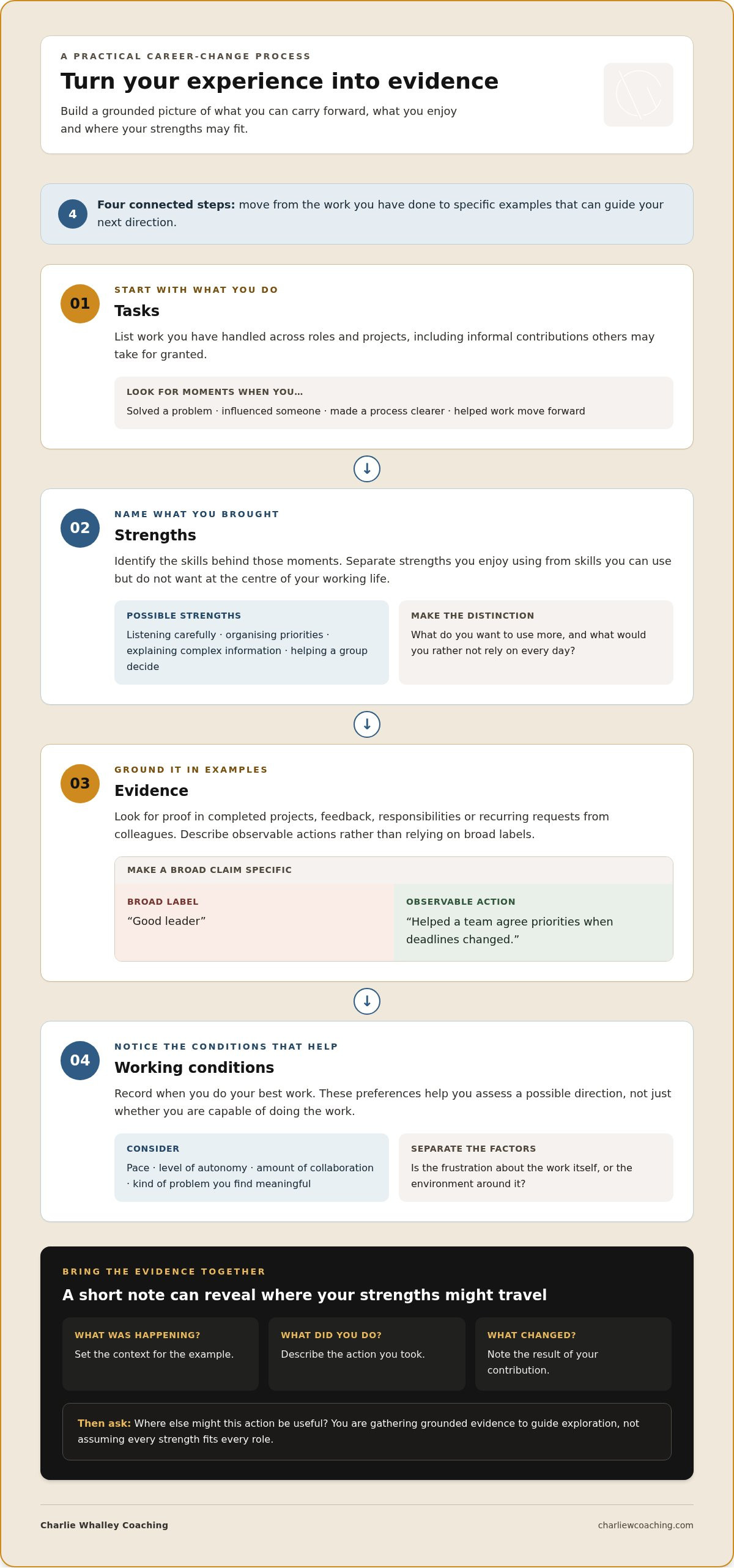
Transferable skills are demonstrated actions that can be useful in more than one setting, not simply labels attached to a job title. Build your inventory in four steps:
- Tasks: Write down work you’ve handled across roles and projects, including informal contributions others may take for granted. Think of moments when you solved a problem, influenced someone, made a process clearer or helped work move forward.
- Strengths: Note what you brought to those moments. Did you listen carefully, organise competing priorities, explain complex information or help a group reach a decision? Include skills you enjoy using, and separately mark those you could use but don’t want to rely on every day.
- Evidence: Find examples in completed projects, feedback, responsibilities or recurring requests from colleagues. Replace broad claims such as “good leader” with observable actions: “helped a team agree priorities when deadlines changed”, for instance.
- Working conditions: Record when you do your best work. Consider the pace, level of autonomy, amount of collaboration and kind of problem you find meaningful. These preferences help you assess a possible direction, not just whether you’re capable of doing the work.
Keep each example brief: what was happening, what you did and what changed as a result. Then add a final note: where else might this action be useful? A project that required you to bring different people together, for example, may show facilitation and communication skills that apply beyond the original team or subject area. You don’t need to claim that every strength fits every role. You’re gathering grounded evidence to guide your exploration.
Use values and working preferences to narrow the direction
Look across your notes for patterns. Which tasks gave you a sense of contribution? Which conditions helped you feel focused, and which regularly drained you? Separate the work itself from the environment around it, too. If constant interruptions or limited autonomy are your main frustrations, you may be dissatisfied with your current workplace rather than your entire profession.
Reflection can help you understand what you want more of and what you’d prefer to leave behind. Charlie Whalley Coaching’s career transition coaching can help you explore how your strengths and values relate to possible next steps.
Ready to make sense of your inventory? Book a discovery call to talk through how coaching could support your career transition.
How to compare adjacent career paths without guessing
Once you have a clearer picture of what you do well and what matters to you, the next challenge is choosing which possibilities deserve a closer look. You don’t need to identify one perfect role straight away. Compare a small group of options against the work you know, the work you want and what you may need to learn.
Adjacent roles can have different titles or sit in different settings, yet share core responsibilities. A new title doesn’t automatically make your previous experience irrelevant. The useful question is whether the role draws on similar actions, knowledge or judgement, not whether its name sounds like your current job.
Find roles that share the work you already know how to do
Start with recurring tasks and problems, rather than searching by job title alone. If you often explain complicated information, coordinate people or resolve customer concerns, look for roles where those activities appear in the day-to-day work. Read role descriptions for verbs and responsibilities, then compare them with your own evidence. The title may be unfamiliar while the underlying work feels recognisable.
For example, someone with experience answering customer questions might explore roles involving client communication or service improvement. These are possibilities to investigate, not guaranteed routes. The setting, expectations and specialist knowledge could differ, so look at the actual responsibilities before deciding whether a role feels like a fit.
Separate essential gaps from skills you can learn along the way
For each option, compare what you can already demonstrate with the capabilities the role appears to call for. Don’t treat every unfamiliar phrase as a reason to rule yourself out. Sort questions into essential knowledge, skills you could learn and assumptions you still need to explore. This makes uncertainty more specific and easier to investigate.
A simple comparison snapshot can help. Choose a few roles and jot down your answers under the same prompts:
Role option: What does the work involve in practice?
Skills overlap: Which responsibilities match examples from your experience?
Interest: Which parts of the work appeal to you, and which don’t?
Learning needs: What knowledge or capability might you need to develop?
Open questions: What are you assuming that you could explore through a conversation, project or focused research?
Look across your notes, not just down one column. A role with less obvious skills overlap might still be worth exploring if its work strongly interests you and the learning feels manageable. Another option may look familiar but reproduce the conditions you hope to leave behind. Neither observation makes the decision for you. Each helps you choose a more informed next move.
This is the practical heart of a career change without starting over: you’re not asking whether your whole past fits a new role. You’re assessing which parts are relevant, what you could learn and what you still need to find out before taking the next step.
How to explore a career change through manageable next steps
A possible direction can feel exciting in theory and uncertain once you picture the daily work, the people you’d work with and the skills you might need to build. You don’t have to resolve all of that before taking action. Treat exploration as a way to gather useful information, not as a promise to make a major change.
Choose one idea to test, then move through a simple cycle: form a hypothesis, gather insight, try a small action and reflect before deciding what comes next. For example, your hypothesis might be, “I’d enjoy using my planning skills in a more people-focused setting.” The point isn’t to prove yourself right. It’s to find out what the idea looks like in practice.
- Choose a hypothesis. Name the type of work you want to explore and what draws you to it. Keep it specific enough to investigate, without treating it as a final decision.
- Gather insight. Look at publicly available role descriptions and seek an informational conversation with someone familiar with the work. Ask what a typical week involves, which responsibilities take most attention and what they find challenging.
- Try a small action. Depending on your circumstances, this might mean taking on a relevant project, completing a short learning activity or volunteering a skill in a different context. Choose something that gives you a closer view without requiring an irreversible commitment.
- Reflect and adjust. Write down what felt energising, difficult or unexpectedly familiar. Decide whether to explore further, change your hypothesis or set that option aside.
Make each step answer a question. Before a conversation, you might ask yourself, “What do I want to understand about the everyday work?” After a learning activity, consider, “Did I enjoy applying this knowledge, or only the idea of the subject?” A clear question helps you gather relevant information instead of collecting impressions without knowing what they mean.
Notice your reactions as well as the information you gather. Perhaps a role uses skills you already have, but the pace sounds draining. Perhaps the unfamiliar parts seem challenging yet interesting. Record those responses without judging them. An option you rule out has still helped you understand your preferences and narrow the field.
Exploration is especially helpful when a career change without starting over feels too large to contemplate as one decision. A smaller test gives you a chance to see how your existing strengths might fit, and where you’d need more insight or practice. It can also show that a role you imagined isn’t what you want. That’s useful clarity.
When you’ve completed an exploratory step, choose one next action based on what you learnt. You might speak with someone else, look more closely at a responsibility or explore a different role. Set a review point that suits your circumstances, rather than following a universal timeline. You’re allowed to pause, reconsider and move at a pace that feels workable.
If you’d value a reflective space to make sense of your options and plan a thoughtful next step, book a discovery call about career transition coaching.
How coaching can support a career change without starting over
Even after you’ve gathered examples of your strengths and explored possible roles, you may still feel pulled in different directions. Perhaps one option feels secure but uninspiring, whilst another excites you and brings up doubts about whether your experience will count. A reflective coaching conversation can help you slow down, organise those thoughts and see which questions are worth exploring next.
When a reflective conversation may help you move forward
Coaching can be useful when you’re finding it hard to recognise your strengths, make sense of competing options or move past self-doubt. Rather than telling you which career to choose, a coach can ask questions that help you connect what you’ve done with what matters to you now. You might look at evidence from your work, the values you want your next role to reflect and what a small, useful experiment could be.
That can make the process feel more manageable. For example, if you’re unsure whether you want to leave your profession or simply change your working environment, focused reflection can help you separate those questions. You remain the decision-maker. Coaching supports your thinking, so you can consider your own next steps with greater clarity.
Charlie Whalley is an ICF Professional Certified Coach (PCC). Her career transition coaching provides a collaborative space to clarify your strengths, values and possible next steps as you consider professional change.
Choose a next step that feels considered and your own
You’ve begun by recognising what your experience has given you, considering how those strengths might fit adjacent roles and finding ways to explore possibilities without committing to a sudden change. You don’t need complete certainty before taking another step. Clarity can grow through thoughtful action, including learning that an option isn’t right for you.
Before you act, ask yourself what you know, what you’re still assuming and what would help you decide. Your next move might be a conversation, a small project or simply setting aside time to review what you’ve learnt. Keep the choice proportionate to what you’re ready for. A considered step can be modest and still bring you closer to a direction that feels like yours.
If you’d like a supportive space to reflect on your experience and consider possible directions, explore career transition coaching and book a discovery call.
Let your next move grow from what you’ve learnt
You don’t need a complete map before you begin. A change can take shape through a series of considered choices, each giving you more insight into what suits you and what you want to carry forward. If uncertainty remains, that doesn’t mean you’ve failed to find an answer. It means there is still something worth exploring.
Give yourself permission to move at a pace that respects both your ambitions and the life you have now. Your experience is not a detour to explain away; it is part of the perspective you bring to what comes next. A career change without starting over can be less about proving you belong somewhere new and more about recognising where your strengths could make a meaningful contribution. You can keep learning as you go, rather than waiting for perfect certainty.
If you’d value a thoughtful space to consider your options and decide what feels right for you, explore career transition coaching and book a discovery call. Your next direction doesn’t have to be perfectly clear today. One purposeful step is enough to begin.
Frequently Asked Questions
Can you change careers without a degree?
Yes, a degree isn’t a universal requirement for changing careers. It depends on the role and employer, so read descriptions of the work you’re considering and note any stated qualifications or subject knowledge. Then compare those expectations with your experience and identify genuine gaps. Some roles may call for formal study, whilst others may place greater emphasis on relevant examples. Avoid enrolling in a degree before you know what your direction actually requires.
Do I need to retrain to change careers?
Not always. You may already have knowledge or capabilities that are useful in your next direction, or you may find one specific area where further learning would help. If you are considering a practical or hands-on trade, specialised programmes such as those at 5T Beauty Academy show how targeted vocational training can help you gain professional qualifications. Before choosing a course, write down what you need to learn and why. A short introductory activity or beginner project can help you decide whether the subject interests you and where your knowledge gaps are before you commit to a larger programme.
How long does it take to change careers?
There’s no single timeline for a career change. The time involved can depend on the direction you choose, any learning you want to undertake and the other responsibilities in your life. Instead of measuring progress only by how quickly you change jobs, set a point to review what you’ve discovered. You might decide you need more insight, feel ready to apply for a role or want to explore another option first.
Can I explore a new career whilst working full-time?
Often, you can begin exploring while remaining in your current role, depending on your circumstances and capacity. For instance, you could use a break to read about a role, arrange a conversation outside working hours or try a small learning activity in your own time. Keep the step realistic alongside your existing commitments. Exploring an option is a way to make a more informed decision, not a commitment to leave your job.
What should I put on my CV when changing careers?
Include the experience that makes your fit for the role clear, rather than relying on your previous job title to do the explaining. Choose responsibilities and achievements that relate to the work you’re pursuing, and describe what you personally contributed. For example, if a role involves improving processes, explain a relevant change you helped put in place and its effect. Tailour the detail to each application, and be precise about your contribution.
How do I explain a career change in an interview?
Explain your interest in the new direction clearly, then connect it to a relevant example from your work. You might say, “I’m interested in this role because it brings together the parts of my previous work I found most meaningful, particularly helping teams make complex information easier to use.” Add what you’re doing to understand the field. You don’t need to apologise for your past career; describe the move as a considered choice.