
Career change at 40: Start with what you know

What if a career change at 40 didn’t mean starting again, but finding a new direction for the experience you’ve already built? If you’re questioning work that once felt right, you may also be wondering whether a change means taking a step backwards, losing stability or trying to retrain around everything else you carry. Those are understandable concerns. You don’t have to dismiss them or make a sudden decision to explore what might fit better.
Your years of work have given you skills, perspective and knowledge that can travel with you. The challenge is recognising which strengths matter in a different role and finding a path that feels realistic alongside your current responsibilities. This article will help you explore what may be prompting a change, identify experience you can carry forward and choose a manageable next step. You’ll also have space to think about what you want from your next chapter, so change feels less like a leap into the unknown and more like a direction you can investigate thoughtfully.
Key Takeaways
- A career change at 40 can take different forms, from adapting your current role to exploring a broader shift.
- Look for transferable strengths in specific work situations. Note what you did, what it required and whether you enjoyed doing it.
- Compare possible directions by what you can carry forward, what you may need to develop and what you still need to find out.
- Explore options in manageable stages: clarify what you want to change, gather relevant insight and choose a practical next step.
- Career transition coaching can help you connect your strengths and values with a clearer sense of direction.
Career change at 40: why the question can feel so significant
By your forties, work may be woven into more than your working day. It can represent years of effort, relationships you’ve built, knowledge you’re proud of and the stability that supports other parts of life. So if you’re considering a career change at 40, it’s understandable to feel two things at once: grateful for what you’ve achieved and dissatisfied with how work feels now.
That tension doesn’t mean you’re ungrateful or that your career has been a mistake. Your priorities, values, energy, interests or circumstances may have shifted. Sometimes the pressure comes from a particular manager, team or period of heavy demands, rather than from the work itself. In other cases, a workplace change brings a longer-standing mismatch into sharper focus.
It may help to separate two questions: What do I want to leave behind? and What would I like more of? The first might point to a draining commute or a lack of autonomy. The second might reveal a wish for creativity, purpose or a steadier rhythm. Thinking about the wider idea of career change can offer context, but your own reasons deserve attention too.
A career change can begin with reflection, not a resignation. You can take the question seriously without deciding today to leave your job or reinvent yourself completely. Consider which parts of work feel meaningful, which consistently drain you and which you’d be ready to change. A difficult week may call for rest or a conversation. A repeated sense of misalignment may be asking for deeper exploration. You don’t need to know the answer straight away.
What might be prompting a career change in your forties?
There may be one clear reason, or several threads coming together. Perhaps the work no longer reflects what matters to you, your energy has changed or your interests have grown beyond your current role. A shift in personal circumstances can also alter what feels manageable or worthwhile. Look for patterns over time: which tasks leave you engaged, which leave you depleted, and what do you repeatedly wish were different?
Does changing careers at 40 mean starting from scratch?
Not necessarily. A new direction doesn’t automatically erase your experience, professional relationships or judgement. Some knowledge may apply directly; other strengths may need to be described differently or developed further. The balance depends on the path you explore. You can investigate possibilities in stages, taking your commitments and comfort with uncertainty into account, rather than treating the decision as an all-or-nothing leap.
It’s also possible that you want a different role, team or way of working, rather than an entirely new profession. Give yourself permission to explore both possibilities. The aim isn’t to force a decision, but to understand what the dissatisfaction is telling you and what you’d like your working life to make room for next.
How to recognise the strengths you can carry into a new career
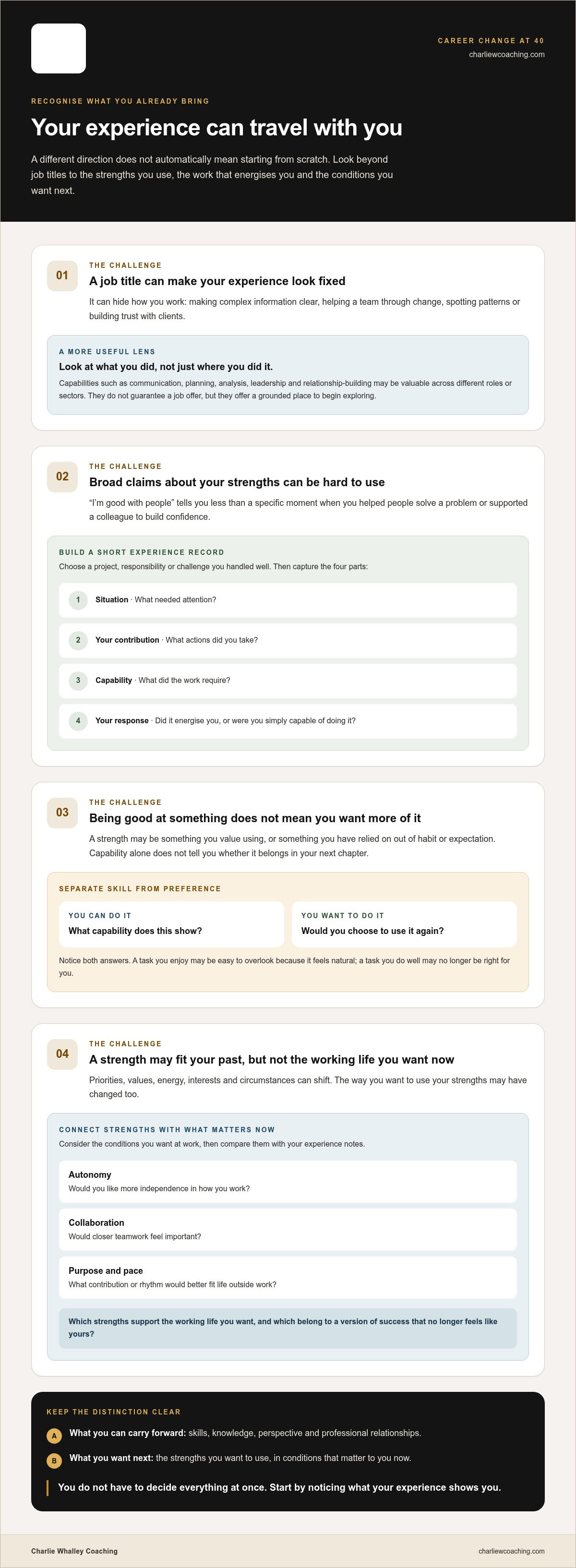
Job titles can make experience look fixed: a particular role, industry or set of responsibilities. But how you work often matters just as much as where you’ve worked. You may have spent years making complex information clear, helping a team through change, spotting patterns or building trust with clients. Those capabilities can be useful in other roles, even if the work looks different on the surface.
Transferable skills are abilities and knowledge that can be valuable across different roles or sectors, though they don’t guarantee a job offer. Identifying them gives you a more grounded starting point for a career change at 40 than assuming you must discard everything you’ve learned.
Map your experience beyond job titles
Instead of beginning with your CV, think about specific projects, responsibilities and challenges. Choose a few moments when you handled something well, then note what you actually did. Perhaps you brought people together to solve a problem, analysed information before making a recommendation or helped a colleague build confidence. Feedback from others can offer clues too, especially when the same strengths come up repeatedly.
Try writing each example as a short record:
- The situation: What needed attention?
- Your contribution: What actions did you take?
- The capability: What did it require, such as communication, planning, analysis, leadership or relationship-building?
- Your response: Did the work energise you, or were you simply capable of doing it?
That last question matters. Being good at something doesn’t mean you want it to define your next chapter. You may be an effective organiser who no longer wants a role centred on coordination. Equally, a task you enjoy might be easy to overlook because it feels natural to you. Notice the difference between a skill you value using and one you’ve relied on out of habit or expectation.
Connect your strengths with what matters now
Once you have examples, consider the conditions in which you want to use those strengths. Perhaps you value more autonomy, closer collaboration, purposeful contribution or a pace that better fits life outside work. Compare those priorities with your notes. Which strengths support the working life you want, and which belong to a version of success that no longer feels like yours?
Personal reflection can help bring these pieces together. This grounded guide to life and leadership coaching explores how values and strengths can inform meaningful change. You could also talk your reflections through with someone you trust, or give yourself time to write before settling on a direction. Clarity often grows through noticing patterns, not finding one perfect answer.
If you’d value a reflective partner as you connect your experience with possible next steps, career transition coaching can support you to explore your strengths, values and options.
Career change at 40: compare three ways to move forward
A career change doesn’t have to mean the same thing for everyone. You might want to keep the work you know but change your role or environment. You may be drawn to a different field where some of your experience still applies. A broader shift is possible too. Comparing these routes can help you distinguish a need for change in your current situation from a wish to change direction altogether.
Use the table as a reflection aid, not a promise of outcomes or earnings. Each route involves unknowns, and the right fit depends on your priorities, circumstances and appetite for learning.
| Route | What may carry over | What may need development | What remains uncertain |
|---|---|---|---|
| Continuity: adapt your current career | Industry knowledge, relationships and familiar expertise | Skills for a different role, workplace or level of responsibility | Whether changing the setting will address the underlying tension |
| Adjacent move: change context | Related skills, professional judgement and understanding of similar work | Knowledge of a new sector, audience or way of applying your strengths | How the work and culture will feel in practice |
| Broader shift: explore a new field | Capabilities that can apply across settings, such as communication or planning | Foundational knowledge, practical experience or other role-specific skills | Which parts of your experience will translate, and what the new direction involves day to day |
Adapt your current career without changing fields
Sometimes the field still interests you, but the role, workplace or level of responsibility no longer fits. You might enjoy the subject but want less hands-on delivery, or value the work but need a different team environment. Make two lists: what you want to retain and what you want to change. A closer-fitting role may address the real issue, but it’s one option to explore, not a reason to dismiss a deeper desire for change.
Move into an adjacent or entirely new field
An adjacent move can put familiar strengths to work in a different context. A broader shift may offer a stronger sense of renewal, while asking you to investigate what you’d need to learn and what the work actually involves. Neither route is automatically more suitable because of your age. Compare them by fit, motivation and practical readiness, including how each could sit alongside your current responsibilities.
You don’t need to choose a route on the spot. Note what draws you to each, what you’d miss and what you still need to understand. Career transition coaching can provide a reflective space to weigh your priorities and explore possible directions.
How to explore a career change at 40 before making a big decision
If an idea about changing direction feels exciting one day and daunting the next, you don’t have to settle the question all at once. Exploration can help you replace assumptions with useful information while keeping your current responsibilities in view. For a career change at 40, progress might mean having a clearer question, not making a dramatic decision.
Turn a broad wish for change into questions you can explore
Start by writing down what you hope to move away from and what you want more of. Be specific: perhaps you want less time spent on routine administration and more opportunity to solve problems, or work that better reflects your values. Then choose one or two possible directions to explore. You can return to other ideas later.
Next, list what you’re assuming about those options. Do you believe you’d need to retrain, take a more junior role or give up flexibility? Treat each thought as a question to investigate, not a fact. A measured sequence can help:
- Clarify: Describe what feels out of step and what you’d like more of.
- Identify: Choose a small number of roles or fields that might fit.
- Gather insight: Read role descriptions and reliable career information. Speak with people who understand the work when you have the opportunity. If you don’t have access to someone in the field, begin with the information you can find.
- Reflect: Compare what you learn with your strengths, priorities and everyday needs.
- Choose: Decide on one practical next step, or identify what you still need to find out.
A small experiment can make an unfamiliar direction feel more real. You might attend a relevant event, try a short learning activity or explore a project that uses a skill you’d like to develop. Keep it manageable. Not every option will fit alongside work, caring responsibilities or limited time, and you don’t need to test every possibility.
Build a transition around your real responsibilities
Income, caring commitments and energy all shape what change can look like. Before deciding what level of uncertainty feels manageable, define what stability means for you. It might include predictable hours, maintaining a particular income or having enough time for family responsibilities. Naming these needs isn’t a lack of ambition. It helps you explore options that fit your life as it is, rather than an imagined version of it.
You might also distinguish between what you can explore now and what would need more preparation. Researching a role, reviewing your budget or setting aside time to learn can provide insight without committing you to leave. The pace and order depend on your circumstances. There’s no single timetable you need to follow.
A useful next step creates information without forcing an immediate career decision. Charlie Whalley’s career transition coaching can help you turn your questions into a considered way forward.
Career transition coaching can help you find a considered next step
Once you’ve looked at what’s prompting change, recognised strengths you could carry forward and considered possible routes, you may have a clearer picture but still feel unsure what to do with it. That’s a natural point to pause. You don’t need to arrive at coaching with a finished plan. It can give you space to think through the questions that remain and decide what feels worth exploring next.
One-to-one career transition coaching offers a reflective partnership. Rather than telling you which job to pursue, a coach can help you notice patterns, test assumptions and connect your experience with what matters to you now. Charlie Whalley is an ICF Professional Certified Coach (PCC), supporting people as they consider career transitions and purposeful work.
What can career transition coaching help you clarify?
Coaching can help you explore how your strengths and values relate to possible directions. You might talk through what you’ve learned from researching a role, consider which trade-offs feel acceptable or work out what you need to learn before moving forward. The process is collaborative: the coach offers questions and reflection, while you remain the decision-maker. It doesn’t promise a particular job or a fixed timeline.
That distinction matters. Career transition coaching supports reflection and career decisions; it isn’t recruitment or job placement, and it isn’t psychotherapy. It can help turn a broad concern into a question you can work with, such as whether a different environment could suit you better or what you want to understand about a new field. You can move at a pace that takes your circumstances into account.
Choose one next step that feels possible
Before you act, ask yourself what would make the next step manageable. You could write down one question you want to answer, identify someone you might speak with if the opportunity arises, or set aside time to reflect on what you’ve learnt so far. Small steps can create momentum without requiring you to decide everything at once.
Clarity often grows through considered action. You may learn that a possibility fits, discover what needs further thought or decide to explore a different route. Each outcome gives you information to work with, rather than demanding an immediate leap. If you’d value a supportive conversation about your options and what matters to you, a discovery call is a useful place to start.
Book a discovery call to explore how career transition coaching could support you.
Let your next chapter take shape with intention
You don’t have to have your whole future mapped out before you begin. A career change at 40 can start with being honest about what you want work to make possible, then allowing your decisions to grow from that understanding. Your direction may become clearer as you learn more about what fits, what matters and what you’re ready to change.
Give yourself permission to move thoughtfully. You can honour the career you’ve built while making room for a different kind of fulfilment. The next step doesn’t need to prove anything to anyone else. It only needs to help you move towards work that feels more aligned with the life you want.
If a dedicated space to consider your options would be helpful, Charlie Whalley’s bespoke career transition coaching can support you in shaping a purposeful direction that reflects your strengths and values. Book a discovery call to explore how career transition coaching could support you. Your next chapter can begin with a considered conversation.
Frequently Asked Questions
Is 40 too old to change careers?
No, 40 isn’t too old to consider a different career. Age alone doesn’t determine whether a change is possible or right for you. Your circumstances, interests, experience and willingness to learn all matter. Start by exploring what you’d like your working life to include, then look for roles that use your capabilities. There’s no need to judge your readiness against someone else’s timeline.
Can I change careers at 40 without starting from the bottom?
It may be possible to move into work that recognises some of your experience, though every transition is different. For example, someone who has coordinated complex projects might explore roles in another sector where planning and stakeholder communication are relevant. Compare role requirements with examples of work you’ve done, then note where you’d need to build knowledge. That gives you a clearer view of the change involved.
How do I know whether I need a new career or just a new job?
Look at what feels difficult across different parts of your working life. If the subject and core tasks still interest you, but your manager, workload or workplace culture is the main source of frustration, a different job may be worth considering. If the work itself feels consistently disconnected from what you value, a wider shift may deserve attention. Write down what changes when you imagine each option.
What careers can I move into at 40?
There isn’t one set of careers suited to people in their forties. Your options depend on what you enjoy, what you’ve done and what you’re prepared to learn. You might investigate a related role in your current field, a position that uses your experience in a new sector or a more substantial change. Read job descriptions and notice which responsibilities appeal, rather than choosing by title alone.
Do I need to retrain to change careers at 40?
Not always. Some roles may value your existing experience, while others ask for specific knowledge or qualifications. Before committing to a course, compare requirements across several job descriptions and identify the exact gap you need to address. You could then explore whether a short course, supervised practice or experience on a relevant project would help. Choose learning that connects to a direction you’ve already investigated.
How can I change careers at 40 while keeping financial stability?
Start by working out what financial stability means for your household, including regular commitments, savings priorities and the income you rely on. Research potential roles and learning requirements before making changes to your current employment. If retraining or a different work pattern is involved, consider how those choices fit your budget and caring responsibilities.
Can a career coach help me change careers at 40?
Yes. Career transition coaching can give you a dedicated space to examine your priorities, test assumptions and decide what to explore next. It’s collaborative: you bring the context and make the choices, while the coach helps you think them through. If you’d like to discuss whether this support could suit your situation, book a discovery call to explore career transition coaching.