
Leadership Coaching: A Guide to Leading with Clarity

What if the next step in leadership isn’t having all the answers, but making space to find your own? When responsibility grows, workplace expectations shift or self-doubt creeps into important conversations, leadership coaching for professionals can offer a thoughtful space to pause and see what’s really going on.
You might be trying to support your team while managing change, or questioning a decision you’d once have made with confidence. That doesn’t mean you’re failing as a leader. It may simply mean the demands of your role have changed, and your usual ways of responding need a fresh look.
This guide explains how leadership coaching works, how it differs from mentoring and training, and how reflection can lead to practical changes in your day-to-day work. You’ll find prompts to help you consider a current challenge and decide whether coaching feels like the right fit. The aim isn’t to become someone else. It’s to lead with greater clarity in a way that feels true to you.
Key Takeaways
- Leadership coaching for professionals can help you examine a real workplace challenge and identify practical next steps that fit your values.
- You don’t need to wait until you feel fully confident or ready to reflect on how your role is changing.
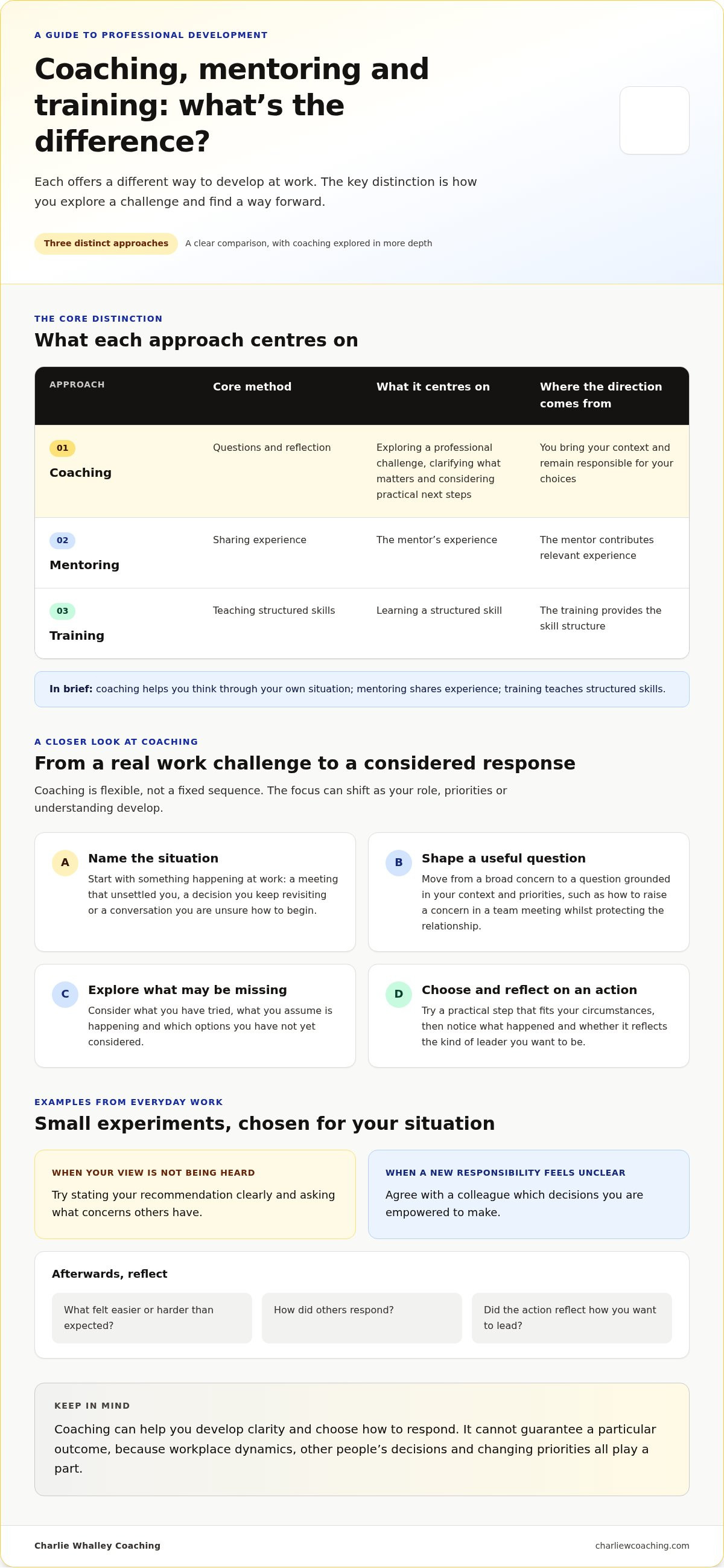
- Coaching uses questions and reflection, while mentoring shares experience and training teaches structured skills.
- Use focused prompts to name what feels difficult, what you want to understand and what progress might look like.
- Explore how Charlie Whalley’s coaching approach could support greater self-awareness and confidence in your professional life.
Leadership coaching for professionals: why it can matter before you feel ready
You’ve taken on more responsibility, but the old ways of making decisions don’t quite fit. Perhaps a change at work has left you wondering how to support your team while managing your own uncertainty. You might look composed in meetings and still replay a conversation afterwards, asking yourself whether you handled it well. These moments don’t mean you’re failing. They can be a reason to pause and consider what kind of leader you want to be.
Leadership coaching is a collaborative process that helps you explore professional challenges, clarify what matters to you and make considered choices about how to move forward. You bring the context: the people, pressures and decisions that make your situation unique. A coach supports your reflection and development, helping you notice patterns and consider new responses. Business coaching is also used to describe coaching focused on professional and organisational settings.
What does leadership coaching mean for a working professional?
It offers space to look closely at your goals, choices and behaviour at work, without assuming there’s something wrong with you. The focus might be a decision you’re avoiding, a conversation you need to prepare for, or a gap between how you want to lead and how you respond under pressure. Reflection matters, but so does what you do with it.
For example, imagine you’re preparing to take on greater responsibility. You may be pleased about the opportunity and unsure how to set boundaries, delegate or speak with confidence. Rather than handing you a formula, coaching can help you explore what feels difficult, what you already know and which practical step fits your workplace. The answer remains yours.
When can leadership coaching feel relevant?
There’s no single career stage when coaching becomes appropriate. A first-time manager learning to lead former peers may face different questions from an experienced professional adapting to organisational change, but both may want a clearer sense of direction. Leadership coaching for professionals can be useful across these transitions, whether you’re adjusting to a new role, preparing for a challenging conversation or working out how to lead in a way that feels authentic.
Self-doubt can surface even when you’re capable and committed. You may question your judgement after a difficult decision, or wonder whether your communication is landing as intended. That uncertainty is not proof of a personal flaw. It can point towards an area you’d like to understand better.
Coaching isn’t performance correction, and it can’t promise promotion. It’s a space to think carefully, test your assumptions and choose purposeful actions. It may not suit every challenge or every person, and you don’t need to wait until you feel completely ready to consider whether it could help.
How leadership coaching works: from reflection to everyday action
A coaching conversation often starts with something that happened at work: a meeting that left you unsettled, a decision you keep revisiting, or a conversation you’re not sure how to begin. The aim isn’t to analyse every detail or produce a perfect answer. It’s to understand what matters in that situation and find a considered way to respond.
Leadership coaching is flexible rather than a fixed sequence or guaranteed programme. The focus can shift as your role, priorities or understanding develop. You explore your own professional challenges, while the coach helps you reflect and consider action. You remain responsible for your choices and how you lead. This is different from learning techniques so you can coach your team.
Starting with a professional challenge
A broad concern can become more useful when you shape it into a question. “I’m not communicating well” might become “How can I raise a concern in team meetings without losing sight of the relationship?” Or “I’m struggling with change” could become “What do I need to understand before deciding how to support my colleagues?” The most useful question comes from your context and priorities, not a template.
From there, a coach may help you look at what you’ve already tried, what you assume is happening and what options you haven’t yet considered. You might notice that you’re waiting for complete certainty before speaking, or that you’re taking responsibility for a decision that belongs elsewhere. Seeing the situation from a fresh angle can create room for a different response.
Turning insight into practical experiments
Reflection can lead to a small action to test in your working life. If you tend to leave meetings unsure whether your view was heard, you might try stating your recommendation clearly and asking what concerns others have. If a new responsibility feels unclear, you could agree with a colleague which decisions you’re empowered to make. These aren’t universal prescriptions. They’re realistic experiments chosen to suit the circumstances.
Afterwards, notice what happened. What felt easier or harder than expected? How did others respond? Did the action reflect the kind of leader you want to be? Your answers can help you keep, adjust or set aside that approach, then decide what to explore next. Progress may be a visible change in behaviour, or a more grounded understanding of what’s within your influence.
Coaching supports reflection and purposeful action, but it can’t guarantee a particular outcome. Workplace dynamics, other people’s decisions and changing priorities all play a part. The value lies in developing your own clarity and choosing how to respond, rather than being handed a script for every situation.
Charlie Whalley offers life and leadership coaching for people who want to reflect on a professional challenge and decide on a purposeful next step.
Leadership coaching, mentoring and training: understand the difference
Professional development can take different forms, and the names can sometimes blur together. You might want to think through a leadership dilemma, learn from someone who has faced a similar situation, or build a specific skill. Knowing what each approach is designed to do can help you decide what kind of support would be useful, without treating one as better than the others.
In simple terms, coaching creates space to explore your own thinking, mentoring shares experience and training teaches structured knowledge or skills. These are broad distinctions, not rigid rules. A development relationship may sometimes draw on more than one approach, provided the purpose is clear.
How coaching differs from mentoring and management training
Imagine you’ve recently become responsible for a project team, and you’re finding it difficult to address missed deadlines. Each approach might help in a different way:
| Approach | Main purpose | A question it might address |
|---|---|---|
| Coaching | Inquiry-led reflection and development | “What’s making this conversation difficult, and how do I want to handle it?” |
| Mentoring | Sharing relevant experience and perspective | “How have you approached a similar challenge?” |
| Training | Structured learning of knowledge or skills | “What steps can I use to give clear feedback?” |
In coaching, you bring the situation and explore what you think, feel and want to do. A mentor may offer insight from their own working life, while a training session may teach a framework for setting expectations. The lines can overlap. A mentor might ask reflective questions, and a course may include practice and discussion. What matters is understanding the main purpose of the support you’re receiving.
Being coached is also different from learning to coach other people. Coaching for your own development focuses on your goals and choices. Coach training, by contrast, teaches someone how to use coaching approaches with others. You don’t need to become a coach to benefit from a coaching conversation.
Is leadership coaching only for executives or struggling leaders?
No. Leadership coaching for professionals can be relevant at different stages, from someone taking on their first team responsibilities to an experienced leader reconsidering how they want to influence decisions. It can support development, transitions and clearer professional choices. You don’t have to be in crisis or have a senior title to want space to think carefully about your impact.
Workplace uncertainty is part of professional life, not automatically a sign that something is wrong. Coaching can help you examine a leadership question, but it isn’t clinical mental health care. If what you’re facing calls for that kind of support, coaching isn’t a substitute. For professional development, it can sit alongside mentoring or training, each contributing something different to your learning.
How to reflect on whether leadership coaching fits your situation
You don’t need to arrive with a polished goal or a clear explanation of what’s wrong. It can be enough to notice that a situation keeps returning to mind, or that your usual response no longer feels quite right. A little reflection can help you decide whether coaching might give you useful space to explore it.
Questions to clarify what you want to work on
Start with one recent moment at work that has stayed with you. Perhaps you left a meeting wishing you’d spoken up, felt unsettled after making a decision, or found it hard to adapt to a change in your responsibilities. Try putting the situation into a few plain sentences, without judging yourself or rushing to solve it.
Then consider what you’d like to understand. These prompts may help you find a starting point:
- What part of this situation is taking up most of my attention?
- What feels difficult, uncertain or outside my control?
- Is there something I’d like to handle differently next time?
- What matters to me in the way I lead or work with others?
- What would meaningful progress look like in my working life?
Your answer doesn’t have to be a promotion, a major change or a perfect solution. It might be feeling clearer about a choice, having a more direct conversation, or understanding why a particular situation affects your confidence. If your questions are broader than your role, life and leadership coaching can offer context for thinking about professional challenges alongside wider priorities.
Recognising useful progress without expecting a quick fix
Progress isn’t always dramatic or immediately visible to other people. You might notice that you can name what you need before agreeing to a new responsibility, or that you pause to consider your options rather than reacting under pressure. These small shifts can help you make more deliberate choices, even if the wider situation takes time to change.
After trying a different response, reflect on what you learned. Did the conversation go as you expected? What did you notice about your own behaviour, and what would you keep or adjust next time? This gives you a grounded way to recognise movement without setting an unrealistic standard for yourself. Coaching can’t promise a particular outcome, but it can help you explore your perspective and decide what action feels purposeful.
If your main question is less about how to lead in your current role and more about where your career is heading, career transition coaching can help you consider how your values and strengths relate to your next professional step. Leadership coaching for professionals is worth considering when you have a real question to work through, even if you’re still finding the words for it.
Charlie Whalley’s coaching programmes offer a space to explore your situation and what you want to change.
Charlie Whalley’s approach to leadership coaching for professionals
You may have read about coaching, considered the questions you want to explore and still feel unsure what a coaching partnership would be like. That hesitation is understandable. The value is not in having someone else take charge of your decisions. It is in having thoughtful space to examine your professional situation and decide what feels like a useful way forward.
Charlie Whalley is an ICF Professional Certified Coach (PCC) who offers bespoke one-to-one coaching for professionals and leaders. Her work can support people experiencing self-doubt, seeking greater confidence or self-awareness, and finding their way through professional change. The focus is shaped around you, rather than assuming that every leader needs the same development plan.
A bespoke coaching partnership for professional growth
Your leadership context matters: the responsibilities you hold, the relationships you navigate and the changes taking place around you. Coaching can create room to explore what you want to develop, whether that means understanding a recurring response at work, considering how you communicate or finding a steadier way to approach a new responsibility.
Self-awareness can help you notice how your assumptions, values and habits influence the way you lead. Executive presence, too, is not about adopting a performance or copying someone else’s style. It can involve understanding how you come across, what you want others to take from your communication and how to express yourself with greater intention.
Perhaps you have good ideas but hesitate to voice them in senior discussions. Or you may feel pressure to appear certain while a complex change is unfolding. Coaching can help you explore what is happening for you in those moments, what matters most and what response might feel both practical and authentic. You bring your own judgement and knowledge of the workplace. The coach supports your reflection, helping you make fuller use of your own judgement and agency.
This is a partnership, not a corrective intervention. Your priorities can guide the conversation, and the questions that matter may change as your perspective develops. There is no need to arrive with a complete plan. A concern you can name, even imperfectly, is a place to begin.
A gentle next step if you are considering coaching
If you’re weighing up whether one-to-one support feels right, consider what you’d want to think through openly and what would make a conversation useful to you. You can take time to consider those questions. Exploring coaching is a choice, not a commitment to change before you’re ready.
To explore what you’d like to work on, book a discovery call with Charlie.
Choose a next step that feels right for you
You don’t have to resolve every leadership question at once. One useful next step could be noticing which workplace situation you’d like to approach differently, and what you want to understand before acting. That reflection can help you decide whether leadership coaching for professionals feels relevant now, or whether you’d rather give yourself more time.
If you’re ready to explore coaching, a conversation can help you consider what you want from the experience and whether it feels like a good fit. There’s no need to arrive with a perfectly formed goal. Start with what’s on your mind.
Move forward at your own pace, with greater clarity about the kind of leader you want to be.
Frequently Asked Questions
Can leadership coaching help if I am not a senior executive?
Yes. Leadership development isn’t reserved for people with executive titles. If you’re newly managing colleagues, leading a project or influencing decisions without formal authority, leadership coaching for professionals may help you examine how you communicate, make choices and respond to responsibility. The fit depends on what you want to explore and the realities of your role, not your position on an organisation chart. Coaching doesn’t promise promotion or a particular career outcome.
How often should a professional have leadership coaching sessions?
There’s no universal schedule that suits every person or coaching goal. The rhythm can be shaped around what you want to work on, your circumstances and the practical space you have for reflection between conversations. For instance, a demanding period at work may affect what feels manageable. Consider what pace would give you room to think and apply your learning without adding unnecessary pressure.
How long does leadership coaching take to make a difference?
There isn’t a guaranteed timeline, because each person’s focus, work environment and actions differ. A conversation may help clarify a decision or identify a next step, while becoming more comfortable with a new behaviour can take longer and involve practice. You could define progress in terms of something you can notice, such as expressing a view more clearly or understanding what makes a choice difficult, rather than expecting a fixed result by a particular date.
What should I bring to a leadership coaching session?
Bring a current work situation, a question you genuinely want to explore and any thoughts from recent experiences that seem relevant. You might note what happened in a conversation, what you found yourself holding back or what decision you’re weighing up. There’s no need to prepare a polished explanation or arrive with a perfectly formed goal. Even “I’m not sure where to start, but this keeps bothering me” can open a useful discussion.
Is leadership coaching confidential?
Privacy expectations should be clear in the coaching agreement, particularly if your employer is sponsoring the work. Before discussing sensitive matters, understand what information may be shared, with whom and for what purpose. You can raise questions about those boundaries before coaching begins, so you have a clearer sense of what feels appropriate to discuss. Avoid assuming that every arrangement has identical terms, especially where an organisation is involved.
Can leadership coaching help me navigate a new role?
It can offer space to think through how a new role changes your responsibilities, working relationships and the way you need to show up professionally. For example, you might be working out how to set expectations with former peers or where to focus your attention first. The conversation centres on your circumstances and choices, rather than supplying a guaranteed transition plan. You remain the person best placed to judge what fits your workplace.
What is the difference between leadership coaching and therapy?
Leadership coaching centres on professional goals, reflection and development, such as considering how you communicate or approach a workplace decision. Therapy is a distinct form of support that may address mental health needs. Coaching isn’t a diagnosis or a substitute for clinical care. If you’re unsure what kind of support would best meet your needs, consider whether your main concern is professional development or something calling for a different kind of care.