
Develop Executive Presence Without Being Someone Else

What if developing executive presence didn’t mean becoming louder, more polished or more dominant? If your ideas sometimes get lost in senior meetings or high-pressure conversations, it’s understandable to wonder which behaviours will help others recognise your judgement. Learning how to develop executive presence can begin with small, practical shifts, not a new personality.
Executive presence is often associated with confidence and composure, but those qualities don’t have to look the same in every person. You can be thoughtful rather than outspoken, calm rather than commanding, and still make your contribution clear. The aim isn’t to perform a leadership persona. It’s to help others see the steadiness, values and perspective you already bring.
In this article, you’ll explore what executive presence can look like in everyday work, from how you communicate an idea to how you respond when a conversation becomes tense. You’ll also find ways to practise clearer, steadier habits while staying grounded in your own strengths. Small changes can make your leadership easier to recognise, without asking you to be someone else.
Key Takeaways
- Notice how your communication, judgement and awareness of others shape the way colleagues experience your leadership.
- Make your reasoning easier to follow by sharing concise explanations and the context behind your decisions.
- Explore how to develop executive presence through a simple cycle: choose a situation, set an intention, practise and reflect.
- Use everyday moments, such as presenting a proposal or responding to challenge, to practise a steadier approach.
- Reflective coaching can help you recognise habitual responses and build presence in line with your values and leadership context.
What executive presence means, and why it can feel hard to develop
You may know your subject thoroughly, prepare carefully and have a useful perspective, yet still find yourself saying less in a room of senior colleagues than you intended. Perhaps the discussion moves quickly, or you’re weighing how a suggestion will land before you speak. The gap between what you can contribute and what others get to see can be frustrating.
Executive presence is the way others experience your judgement, communication and steadiness in moments that matter. It isn’t a mysterious quality you either have or lack. It takes shape in observable choices: how you explain a recommendation, respond to a difficult question or help a meeting find direction. This matters when considering how to develop executive presence, because behaviour can be practised and adjusted. You don’t need to adopt a fixed personality type.
What does executive presence look like at work?
In practice, presence can be quiet and clear. When presenting a recommendation, state your proposal first, then give the reasons and context that support it. If a colleague challenges an assumption, pause, listen to what they’re asking and respond to the substance rather than rushing to defend yourself. In a meeting with competing priorities, bring the conversation back to its purpose.
These small actions make your thinking easier to follow. Colleagues can understand what you’re recommending, why it matters and what needs attention next. Presence is not the same as charisma, a particular speaking style or polished appearance. The idea of making a leader’s perspective visible also appears in discussions of executive visibility in public relations, though in everyday workplace conversations, visibility can begin with making your reasoning and priorities clear.
Consider how you contribute, not just how often you speak. A brief, well-timed observation that connects a decision to its implications can carry more weight than filling every pause. Calm direction doesn’t mean having every answer. It can mean naming what’s known, identifying what needs consideration and helping the group agree on a next step.
Why can developing executive presence feel uncomfortable?
Speaking with senior colleagues can make you more self-conscious. You may monitor your tone, worry about being interrupted or wonder whether questioning a familiar approach will be taken personally. That mental effort can make it harder to express a sound idea in the moment, even when you’ve already thought it through.
There can also be a gap between feeling capable and communicating that capability confidently. If you’re used to softening recommendations, waiting for an invitation or giving extensive background before reaching your point, changing those habits may feel unfamiliar at first. Unfamiliar doesn’t mean inauthentic, and discomfort isn’t proof that you lack leadership potential. It may simply mean you’re practising a new way to make your contribution understood while staying true to yourself.
The building blocks of executive presence: communication, judgement and trust
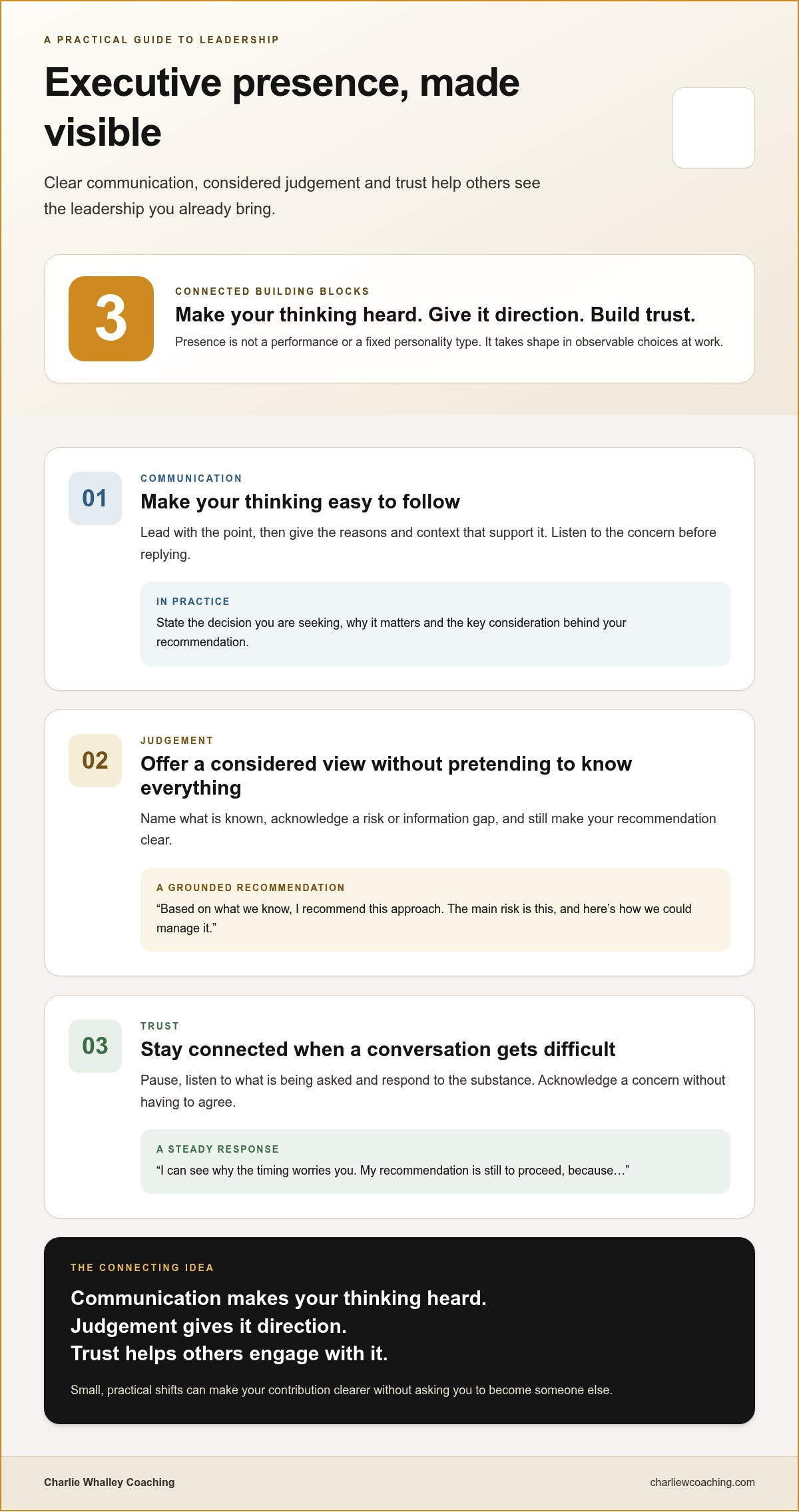
Executive presence becomes easier to understand when you look at the behaviours beneath it. Clear communication helps people follow your thinking. Grounded confidence lets you make a recommendation without pretending every detail is certain. Relational awareness helps you notice how your words land and respond to what others need to understand.
These elements work together. Communication makes your thinking heard, judgement gives it direction, and trust helps others engage with it. This is not about sounding impressive. It is about making your perspective useful and staying connected to the people involved, even when a decision is complex.
Confidence doesn’t require certainty. You can acknowledge a risk or a gap in the available information and still offer a considered view: “Based on what we know, I recommend this approach. The main risk is this, and here’s how we could manage it.” That balance shows conviction while remaining open to new information.
How communication makes your thinking easier to follow
In a presentation or discussion, lead with the point you want people to understand, then add the detail that supports it. If you’re proposing a change, explain the decision you’re seeking, why it matters and the key consideration behind your recommendation. Concise language doesn’t mean simplifying your thinking; it gives others a clear route into it.
Communication also includes listening. Before replying, check that you’ve understood the concern. A relevant follow-up question, such as “Which part feels most uncertain to you?”, can surface useful context and show that you’re considering more than your own argument.
How composure and emotional intelligence build trust
If a conversation becomes challenging, a brief pause can give you room to choose your response rather than react to the pressure. You might recognise the other person’s concern before explaining your view: “I can see why the timing worries you. My recommendation is still to proceed, because…” Acknowledgement doesn’t mean agreement.
Composure isn’t suppressing emotion or appearing detached. It’s responding with care and intention, even when you feel frustrated or caught off guard. That steadiness can help others stay engaged with the issue rather than becoming distracted by tension between you.
Ideas about the new rules of executive presence also make space for authenticity and inclusion alongside communication and gravitas. You don’t need to borrow someone else’s style. Notice which habits help your own judgement come through, then build on them in the conversations that matter to you.
If you’d value a reflective space to explore how your communication supports your leadership, life and leadership coaching can help you build self-awareness and practise approaches aligned with your values.
Executive presence is not a performance: challenge common assumptions
If you’ve watched a senior colleague command a room and wondered whether you need to become more like them, pause before copying their style. Their approach may suit their personality, role or workplace. Trying to reproduce it can make you feel less natural and hide the strengths that already help you lead.
There’s a difference between performing and being intentional. Performing means adopting behaviours mainly to look like someone else. Intentionality means choosing how to communicate so your judgement and values are easier to understand. You might prepare a clear opening for a meeting or make your recommendation more direct, without changing the care or thoughtfulness behind it.
That distinction matters when you’re working out how to develop executive presence. The aim isn’t to create a perfect impression in every interaction. It’s to make choices that help others understand what you stand for and what you’re contributing, while remaining open to learning and adjustment.
Does executive presence mean being charismatic or extroverted?
No single speaking style works in every workplace or culture. A reflective leader might take a moment to consider a question, then offer a concise answer. A more expressive leader might think aloud and bring others into the conversation. Either style can communicate clarity, provided people can follow the speaker’s point and understand what they’re asking or recommending.
Quiet doesn’t have to mean uncertain, and being direct doesn’t require being forceful. For example, you could say, “I’ve considered both options, and I recommend the second because it addresses the main risk.” That sentence is clear without being showy. A thoughtful question can also demonstrate leadership: “What would need to be true for this decision to work?”
Confidence can include recognising complexity. You might say, “I don’t have the full picture yet, but this is my current view,” or revise your recommendation when new information changes the situation. That isn’t a failure of presence. It can show you’re willing to take responsibility for your thinking rather than defend a position for appearance’s sake.
How can you adapt without losing your authenticity?
Start by identifying what you want colleagues to experience in your leadership. Perhaps you value fairness, clarity, curiosity or calm. Then consider how those values could show up in a particular situation. You might communicate more briefly in a time-sensitive meeting, for instance, while still making space to hear a colleague’s concern.
- Keep useful feedback: If someone says your recommendation was hard to follow, consider how to make your main point clearer.
- Question imitation: If feedback asks you to be “more like” a particular person, look for the specific behaviour that could help, rather than copying their whole style.
- Choose a small adjustment: Adapt your preparation, pace or level of detail to the moment, while keeping your underlying values in view.
Feedback is most useful when it helps you see the impact of a behaviour, rather than turning another person’s preferences into a test of your potential. You can adapt your delivery to the room without abandoning what matters to you. That’s not pretending. It’s choosing how to make your strengths visible.
How to develop executive presence through deliberate workplace practice
Presence grows through what you do in real situations, not through trying to get every interaction right. Choose one moment to work on, such as presenting a proposal, leading a meeting or responding to a challenge. Focus on a behaviour you can observe, then review what happened with curiosity rather than judging yourself by whether everyone agreed.
Choose a situation, set one intention, practise it, then reflect on what you noticed. This simple cycle makes how to develop executive presence a practical process, rather than another vague expectation to “be more confident”.
- Choose a situation: Pick a meeting or conversation that matters to you and where you have some control over how you contribute.
- Set an intention: Decide what you want to practise, such as stating your recommendation early or asking one clarifying question before responding.
- Practise: Try that behaviour in the moment, while staying attentive to the people and discussion around you.
- Reflect: Note what you did, how the conversation unfolded and what you might adjust next time.
Prepare for a high-stakes conversation or presentation
Before you speak, identify the message you most want others to understand. Prepare a clear opening, the main reasons behind your view and a few questions you may be asked. You don’t need a script for every turn. A short pause to settle your attention can help you begin with intention, rather than rushing to fill the silence or over-explaining.
For example, before presenting a proposal, write down the decision you’re seeking and the most relevant reason for it. If you’re leading a meeting, decide what outcome would make the discussion useful. If someone challenges your view, your intention might be to hear the concern fully before answering. A focused intention gives you something specific to practise, whatever the response.
Reflect on what happened and choose one adjustment
Afterwards, note what felt clear, steady or difficult. Keep observations separate from guesses about what others thought. “I stated my recommendation before giving the background” is observable; “They must have thought I sounded unsure” is an interpretation. This distinction helps you learn from the interaction without turning it into a verdict on your ability.
Choose just one adjustment for next time. If you lost your main point in too much detail, try a shorter opening. If you answered a challenge before understanding it, practise pausing to clarify. Small, focused changes are easier to notice and build on than trying to change everything at once.
Trusted feedback can add another perspective. Ask someone who understands the situation a specific question, such as, “Was my recommendation clear?” or “Did I leave enough room for others to contribute?” Useful feedback describes impact and gives you something actionable. It isn’t a requirement to seek universal approval or adopt someone else’s style.
For support reflecting on workplace patterns and practising a leadership approach that feels like your own, explore one-to-one leadership coaching.
How coaching can help you develop executive presence with greater self-awareness
You might know what you want to contribute and still hold back when the stakes feel high. Perhaps a new role has brought greater visibility, you’re adjusting to increased responsibility, or a difficult workplace conversation is taking more energy than you expected. A reflective coaching conversation can help you notice what happens in those moments, without treating self-doubt as a personal failing.
You could explore the thoughts and habits that shape your response. Do you wait until your view feels completely certain before sharing it? Do you soften a point because you’re concerned about how it will be received? Noticing a pattern creates room to consider another choice. It doesn’t mean you have to force yourself into a different personality.
That kind of self-awareness can make how to develop executive presence feel more personal and practical. Rather than being given a script for “acting like an executive”, you can consider what you want others to experience in your leadership, and how that connects with your values, strengths and working context. A coach can help you clarify your goals, reflect on what you’ve tried and explore responses that feel genuine to you.
When might executive coaching be useful?
Coaching may be helpful when a change in responsibility or visibility leaves you reconsidering how you show up, or when a recurring workplace conversation brings up hesitation. You can define what you want to work towards, identify what tends to get in the way and think through possible approaches. The focus is on your learning and choices, not on promising a promotion, influence or a particular response from others.
What could a first step towards change look like?
Start with one upcoming situation. It could be a conversation where you need to hold a boundary, contribute a different perspective or communicate a decision. Ask yourself: “How do I want to feel in this moment, and what impact would I like to have?” Naming your intention gives reflection a useful direction.
After the situation, revisit what you noticed: what felt aligned with your values, what was harder than expected, and what you might try next time. Small experiments give you something real to learn from. Progress may be a clearer contribution or a response that feels more considered, even if the wider situation doesn’t change straight away.
Charlie Whalley’s one-to-one leadership coaching offers a tailored, collaborative space to build self-awareness and explore ways of strengthening your executive presence. You bring the context and goals; the conversation helps you reflect and consider your next steps, without asking you to become someone else.
Ready to explore whether this approach could support you? Book a discovery call to find out how it can work for you.
Take one grounded step towards being seen
You don’t need to transform your personality to make your leadership more visible. Start with one moment ahead: what would you like others to understand about your perspective, and what small choice could help you communicate it? That intention gives you a practical place to begin learning how to develop executive presence, while staying connected to your values.
If you’d like support exploring what feels natural for you and what you’d like to practise next, Charlie Whalley is an ICF Professional Certified Coach. Her bespoke, one-to-one coaching supports self-awareness and executive presence, with space to reflect on your own leadership context rather than follow a prescribed persona.
Arrange a discovery call with Charlie to explore whether coaching could support your next step. You can build confidence in a way that feels like your own.
Frequently Asked Questions
Is executive presence something you are born with?
No. Some people may feel naturally comfortable speaking in groups, but executive presence isn’t reserved for them. It can grow as you learn which behaviours help others understand your perspective. For example, if you tend to wait until you’ve perfected an idea, try sharing a considered early view and naming what you’re still working through. Your starting point matters less than the skills you can develop through experience.
Can you develop executive presence without being extroverted?
Yes. A quieter communication style can still be clear and influential. If you prefer to think before speaking, note the question you want to raise before a meeting, then contribute when the discussion reaches that point. Learning how to develop executive presence doesn’t mean speaking more often than feels natural. It means finding ways to make your thinking accessible, whether you’re naturally reflective, expressive or somewhere in between.
How long does it take to develop executive presence?
There’s no set timeframe. Progress depends on the behaviours you want to practise, the situations available to you and how regularly you can reflect on what happens. Rather than waiting for a complete transformation, choose one sign to notice over the next few relevant conversations, such as sharing a view before the discussion moves on. Small changes can take time to feel familiar, so look for gradual learning, not an instant result.
What happens if developing executive presence feels inauthentic?
Take that feeling seriously. It may mean you’re trying to follow someone else’s idea of leadership rather than choosing an approach that fits you. Ask what specific behaviour you’re testing and whether it helps you communicate with more clarity or care. If it feels like a costume, look for another option. You can also ask a trusted colleague what they observed, then decide which feedback aligns with your values.
Can executive presence help when speaking to senior leaders?
It can help you make your contribution easier to understand in senior conversations, though it can’t control how others respond. Before a discussion, decide what you need from it: a decision, feedback or agreement on a next step. Then make that request clear. If you’re interrupted or the conversation shifts, calmly return to the point you need addressed. This can help you use limited speaking time with purpose.
How can I tell whether my executive presence is improving?
Look for changes in your own actions and in how conversations unfold, rather than trying to read every expression in the room. Are you contributing when you intended to? Can you explain your view without losing the main point? Are you more able to stay engaged when someone disagrees? You could also ask a trusted colleague for one specific observation, such as whether your recommendation was clear, then compare notes over time.