
Leadership keynote speaker costs and profiles for events

The biggest name on the programme isn’t always the best fit. A leadership keynote speaker’s fee depends on their profile, experience and how closely their expertise suits your event. Choosing a speaker is about more than reputation: it’s about finding someone whose perspective connects with your audience and supports the purpose of the gathering.
It’s understandable to want a clear budget while hoping the keynote leaves people with something useful to take back to work. This guide explains what shapes speaker costs, when to plan and how to compare different profiles. You’ll also find practical ways to assess a speaker’s background, expertise and relevance to your audience, so you can choose a leadership keynote speaker with greater confidence.
Key Takeaways
- Match a speaker’s expertise and style to your event’s purpose and audience, rather than choosing on name recognition alone.
- Compare speaker profiles by their professional experience, subject knowledge and ability to make ideas relevant to attendees.
- Plan ahead for high-profile speakers, who often book six to twelve months in advance.
- Clarify what you want attendees to take away so you can assess whether a keynote is the right format for your event.
- Consider coaching when your goal is ongoing personal or leadership development rather than a single event experience.
How much does it cost to hire a leadership keynote speaker?
A leadership keynote speaker’s fee depends on their profile, the event format and the work involved. Your event’s purpose and audience will help you decide which level of experience is the right fit.
Live and Virtual Speaker Fees
Virtual delivery changes the event requirements, but the fee still depends on the speaker’s profile and agreed scope. Compare proposals by asking what each includes rather than assuming an online session has a lower fixed rate. For an in-person event, include travel and logistics when reviewing the overall budget.
Customisation and Event Fit
Customisation means shaping the talk around your event’s theme, audience and intended learning. Share the challenge attendees are facing, then ask how the speaker would adapt their examples and ideas. For instance, an event about communication gaps could benefit from a session linking leadership behaviour with practical team conversations.
Ask the leadership keynote speaker what they would tailor, which examples they might use and how attendees could apply the ideas afterwards. These questions help you judge whether the session fits your goals, rather than simply matching the event title.
Fees and Contract Inclusions
Before agreeing, ask what the fee covers and make sure the terms are clear. Discuss the speaking session, preparation, delivery format, travel arrangements and any agreed follow-up. The contract should reflect your planned event, including the session scope and the customisation you discussed.
Useful questions include: “What is included in the fee?” “What preparation do you need from us?” and “How will changes to the event be handled?” Clarify these points before confirming the booking. A shared understanding helps you compare proposals fairly and plan for the full arrangement.
To choose a speaker, first define the event’s purpose and audience. Then identify the expertise and tone that would serve them, research profiles and discuss how each candidate would shape the talk. An author or professor may bring a different perspective from a former executive, so assess how relevant their experience is and how well they connect with attendees. Choose the person whose knowledge and approach support the learning you want from the event.
Booking lead times
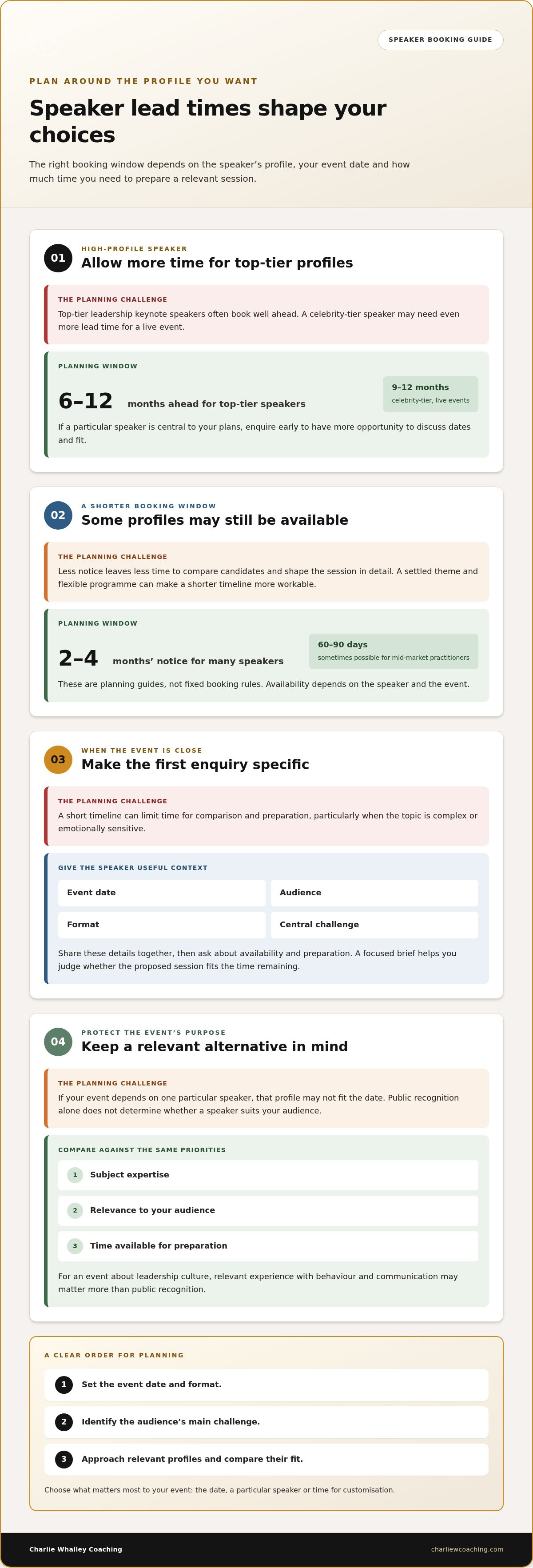
Timing affects which speakers you can consider and how much preparation time you have. Top-tier leadership keynote speakers often book six to twelve months ahead. Many remain available with two to four months’ notice, while mid-market practitioners can sometimes accommodate bookings sixty to ninety days ahead. Treat these as planning guides, not fixed booking rules.
Plan around the speaker’s profile
Start with your event date, then work backwards from the profile you want. Celebrity-tier speakers may need nine to twelve months’ lead time for live events. If a particular leadership keynote speaker is central to your plans, enquiring early gives you more opportunity to discuss dates and fit.
Keep your event’s purpose in view if your first choice is unavailable. For example, an event about leadership culture might prioritise experience with behaviour and communication over public recognition. A complex topic or emotionally sensitive challenge can also benefit from thoughtful preparation. Focus on the expertise attendees need, then consider profiles that offer a relevant perspective.
Use shorter windows thoughtfully
Some speakers remain available with two to four months’ notice. Mid-market practitioners can sometimes accommodate bookings sixty to ninety days ahead. A shorter timeline may suit an event with a settled theme and flexible programme, but leaves less time to compare candidates and shape the session in detail.
If your event is close, make your first enquiry specific. Share the date, audience, format and central challenge together, then ask about availability and preparation. This gives the speaker useful context from the outset and helps you decide whether the proposed session fits the time remaining.
Build preparation time into the schedule
Booking early gives you room to brief the speaker and discuss the audience’s needs. For instance, a leadership conference about team behaviour may need examples that reflect its culture, rather than a broad talk about authority or decision-making. A clear brief helps the speaker understand what attendees should take away.
Plan in stages: settle the date and format, identify the audience’s main challenge, then approach relevant candidates. If your preferred leadership keynote speaker has a shorter window, a focused brief can keep discussions practical. Agree which event details matter most, then give your team time to prepare accordingly.
Have a practical alternative
Keep another suitable profile in mind if your event depends on a particular date. An alternative might be a practitioner with relevant leadership experience rather than a high-profile author. Compare candidates against the same criteria, including subject expertise, audience relevance and preparation time.
A shorter booking window doesn’t automatically make a keynote unsuitable, but it makes clear priorities more valuable. Decide whether the date, a particular speaker or time for customisation matters most. That choice gives your team a sound basis for adapting plans if your first option cannot fit the schedule.
Leadership keynote speaker profiles
A speaker’s profile shows the experience and perspective they bring to an event. Compare their expertise with your audience’s needs, not simply their reputation.
Speaker Profiles
Some profiles centre on executive experience, others on innovation, research or entrepreneurship. Josh Linkner’s startups created over 10,000 jobs, sold for a combined $200 million and helped drive over $1 billion in venture-capital returns. Those details point towards an entrepreneurial perspective. Consider whether that connects with your event’s organisational priorities.
Some speakers draw on leadership experience in sport, technology or public life. Ron Johnson was formerly a senior vice president at Apple and a vice president of merchandising at Target. His background may suit a discussion about business decisions and innovation. Look beyond job titles, though: ask how the speaker turns experience into useful ideas for your audience.
Academic and specialist profiles can bring a different kind of thought leadership. Dr. JP Pawliw is described as a co-founder of IHHP, while Sol Rashidi is described as having four C-suite and Amazon executive roles. Consider which subjects each profile supports, such as emotional intelligence, organisational change or leadership practice. A powerful biography matters when its lessons fit your event.
Repeat invitations can be one factor to consider alongside topic relevance and audience connection. They don’t replace your own assessment of the speaker’s approach.
Experience and Review Checks
To assess a speaker’s experience and reviews, compare their biography with specific roles, organisations and examples. Then look for feedback that describes audience engagement, relevance and practical value. For instance, a review explaining how a talk connected with a leadership team gives more context than general praise.
Use the same review process for each candidate. Look for feedback from events with similar audiences or themes, then note recurring comments about clarity, preparation and delivery. If a profile names an organisation, check that the stated role matches the experience being highlighted. Treat reviews as evidence to weigh, not a substitute for a conversation.
Ask candidates to explain how their experience would shape the talk you’re considering. A speaker with executive experience may use decision-making examples; a researcher may draw on evidence and frameworks. Request a relevant sample or discuss a previous event with a similar audience. These steps help you assess whether the speaker can make their expertise meaningful for attendees.
Leadership keynote speakers
Leadership speakers bring different kinds of experience to the stage, from business growth to public service and sport. A useful profile connects that experience to your audience’s questions, rather than relying on reputation alone.
For an event focused on entrepreneurship, Marc Randolph offers a founder’s perspective as a co-founder of Netflix. His experience may connect with audiences exploring innovation, growth or the choices involved in building an organisation. Consider whether attendees need practical insights into creating a company or a different perspective on leading established teams.
Sport can offer another lens on leadership and team performance. Tony Dungy became the first African-American head coach to win a Super Bowl when the Indianapolis Colts won in 2007. His profile may suit an event exploring team culture, trust or performance under pressure. The key is to identify how the speaker’s experience relates to the specific challenge attendees want to understand.
Mike Krzyzewski was head men’s basketball coach at Duke University from 1980 to 2022. That long coaching career can provide material for conversations about sustained leadership and developing teams. For an event centred on organisational strategy, compare this perspective with a speaker whose experience comes from business, public service or executive decision-making.
Public-sector profiles can speak to leadership amid complex responsibilities. William McRaven commanded U.S. Special Operations Command from 2011 to 2014 and served as chancellor of the University of Texas System from 2015 to 2018. Those roles span military command and higher education. Consider whether your audience would benefit from insights shaped by those settings, particularly when discussing change, accountability or uncertainty.
Political and diplomatic experience offers another possible angle. James Stavridis served as the 16th Supreme Allied Commander of NATO. Tony Blair served as prime minister of Great Britain and Northern Ireland from 1997 to 2007. Their profiles may appeal to audiences interested in leadership across institutions, but a relevant subject and speaking approach still matter more than a prominent title.
A motivational keynote can help leaders reflect on behavioural patterns and communication gaps at work. For example, an event about workplace culture might focus on how leadership behaviour affects collaboration. Choose a speaker whose examples make those ideas clear and relevant, not simply powerful in the moment.
To compare candidates, write down the event’s central challenge, the audience’s needs and the learning you want to support. Then match each speaker’s experience to those points. An entrepreneur may suit a growth-focused gathering, while a former public leader may offer a useful perspective on navigating uncertainty. The best fit is the profile that helps your audience think differently about its real work.
What does a leadership keynote speaker do?
A leadership keynote speaker gives an event a focused perspective on leading people and organisations. They shape a central message, connect it to the audience’s concerns and present ideas attendees can consider in their work. For example, a session on communication can help leaders notice how assumptions or unclear expectations affect collaboration.
The keynote usually begins with a defined theme, such as trust, decision-making or workplace culture. The speaker uses relevant experience, research or practical examples to make that theme easier to understand. Rather than covering every leadership challenge, a strong presentation gives attendees a clear thread to follow, from a familiar issue to a different way of approaching it.
Preparation is part of the role. The speaker learns about the event’s purpose, audience and context, then uses that information to shape examples and language. At a conference for new managers, the talk might address setting expectations and listening to team members. For senior executives, the same broad theme could explore organisational behaviour and communication through change.
During the event, the speaker holds attention and makes ideas accessible. They might use a story to illustrate a leadership choice, invite attendees to reflect on a familiar situation or offer a framework for discussing team behaviour. These approaches help people connect a broad message with their own responsibilities. The precise format depends on the agreed session and event design.
A keynote can also help an organisation surface patterns that affect workplace culture. Leaders may leave with shared language for discussing behavioural patterns or communication gaps. For instance, a team that struggles with unclear decisions could use the session as a starting point for conversations about responsibility and follow-through. The event prompts reflection, but does not replace everyday leadership practice.
Organisers can support practical application by giving attendees a clear next step. Before the talk, identify one challenge the audience recognises. Afterwards, invite people to discuss one idea they want to apply, such as making meeting decisions clearer. A short reflection or facilitated conversation can connect the keynote’s message with the team’s actual work.
A keynote differs from ongoing development. One event can introduce a perspective to a room, while leadership coaching offers space to explore personal goals and challenges over time. If your next step is to work through leadership questions beyond the event, explore leadership coaching and book a discovery call to discuss how it could support you.
Charlie Whalley Coaching: Life & Leadership Coaching
Charlie Whalley Coaching offers a next step when a keynote has raised questions you want to explore beyond the event. Through Life & Leadership Coaching, you can work on confidence, self-doubt or change in relation to your leadership and life. It’s a personal way to turn reflection into considered action, rather than relying on a single talk to address ongoing challenges.
If you’re considering a career change, Career Transition Coaching can support you as you think through what comes next. For event organisers seeking a speaker, Speaking & Events may also be relevant. Choose the kind of support that fits your situation. Ready to speak? Visit Charlie Whalley Coaching to get in touch.
Take your next step with confidence
A keynote can open a valuable conversation, but the most meaningful ideas often continue beyond the event. If a speaker’s message has prompted you to reconsider your leadership, take a moment to name the question you want to explore and the change you’d like to make.
You don’t need to have every answer before starting a conversation. Talking through what feels important can help you find a direction that feels right for you, whether you’re considering a shift at work or looking for more confidence in your next steps.
If you’re ready to explore what might help, contact Charlie Whalley Coaching. A thoughtful next step can begin with simply talking things through.
Frequently Asked Questions
How far in advance should I book a leadership speaker?
Book as early as your event plans allow, especially if you have a particular speaker in mind. Top-tier leadership speakers often book six to twelve months ahead, while some remain available with two to four months’ notice. Once you have a date, share the event format and audience needs in your first enquiry. That gives you a clearer starting point for discussing fit and preparation.
What industries benefit most from leadership speakers?
Leadership speakers can be useful across industries where people guide teams, manage change or shape workplace culture. A technology organisation facing rapid growth, for example, might want insights into decision-making, while a community organisation may focus on communication across teams. The audience’s challenge is a stronger guide than its industry label. Choose a speaker whose experience can make that challenge easier to discuss.
What is the difference between a leadership speaker and a motivational speaker?
A leadership speaker usually centres a talk on how people lead, communicate or make decisions, while a motivational speaker primarily aims to energise and encourage an audience. The roles can overlap: a talk on leading through change may also be uplifting. Before booking, decide whether attendees need practical leadership ideas, renewed momentum or both, then ask how the speaker will balance those aims.
What topics do the best leadership speakers cover in 2026?
Useful leadership topics in 2026 include communication gaps, behavioural patterns, workplace culture and how leaders guide teams through change. The right choice depends on what your audience is facing, rather than a universal list of “best” subjects. For example, if teams struggle to understand decisions, a talk on clear communication may be more relevant than a broad presentation on leadership principles.
How much does a leadership keynote speaker cost in the United States?
Format and profile affect the fee.
How do I choose the right leadership keynote speaker for an event?
Start by writing down the event’s purpose, audience and the change or conversation you want to support. Then compare candidates’ expertise, professional background and relevance to that purpose. For example, a conference for new managers may need practical guidance on team conversations, rather than a speaker whose experience focuses on a different leadership context. Ask candidates how they would connect their subject with your attendees.
What leadership keynote topics are most popular?
Relevant themes often include communication, leadership behaviour, workplace culture, decision-making and innovation. Popularity alone won’t tell you which subject will serve your event. If attendees are navigating organisational change, for example, a talk about trust and communication may be more useful than a general presentation on innovation. Choose a topic that gives people a shared starting point for discussion after the event.
How far in advance should I book a leadership keynote speaker?
For a celebrity-tier speaker at a live event, plan for nine to twelve months’ lead time. Mid-market practitioners can sometimes accommodate bookings sixty to ninety days ahead. Use those ranges to shape your shortlist, then set internal deadlines for agreeing the date, speaker and session brief. A clear schedule gives your team time to prepare attendees and coordinate event details.