
Ways to understand feeling unfulfilled at work

Feeling unfulfilled at work is a reason to pause, not a verdict on your ability or a sign that you must resign. If you feel unfulfilled at work, take time to understand what’s behind it before making a major career decision. Dissatisfaction can point to burnout, a mismatch with your values, or boundaries that need attention.
It makes sense to want a clear answer when your job feels draining or strangely empty, especially if you’ve been telling yourself to be grateful or just push through. But you don’t have to blame yourself or rush towards a solution. Reflection can help you separate what needs to change at work from what may need care and attention in your life.
This article offers practical ways to respond to dissatisfaction, consider whether burnout or low mood may be involved, and reconnect with the people, activities and values that help you feel like yourself. You’ll also explore how to set work-life boundaries and take measured steps before making a major change. A steadier sense of direction can start with noticing what you need.
Key Takeaways
- Name what feels unsatisfying without treating it as a personal failing; noticing the pattern is a useful first step.
- Pause before making a major career decision and explore what might change if you adjusted your current role first.
- Consider whether exhaustion or low mood is affecting your perspective, and make space for rest and support.
- Notice when you feel most like yourself to clarify which values and sources of joy deserve more room in your working life.
- Set practical boundaries around your workload, and look for responsibilities you can simplify, share or renegotiate.
1. Accepting feelings of dissatisfaction without self-blame
If you feel unfulfilled at work, begin by naming the feeling rather than judging it. Write down what seems different: your energy, interest in tasks, relationships with colleagues, or sense of purpose. A difficult Monday after a demanding project may call for recovery; the same frustration across varied tasks may deserve closer attention. Neither observation makes you ungrateful or incapable.
Try a short check-in at the end of each working day. Note one task that felt manageable, one that drained you, and what was happening around each. For example, you might enjoy planning a project but dread presenting updates, or feel engaged until repeated interruptions break your focus. These details help distinguish a temporary dip from a pattern without forcing an immediate answer.
Motivation can dip after a demanding period, a change in routine, or a stretch of repetitive work. Treat that dip as information, not proof you chose the wrong career. Before deciding what it means, take a restorative break that differs from your last task. Switching from an online call straight to Instagram, for instance, may not give your mind the change it needs.
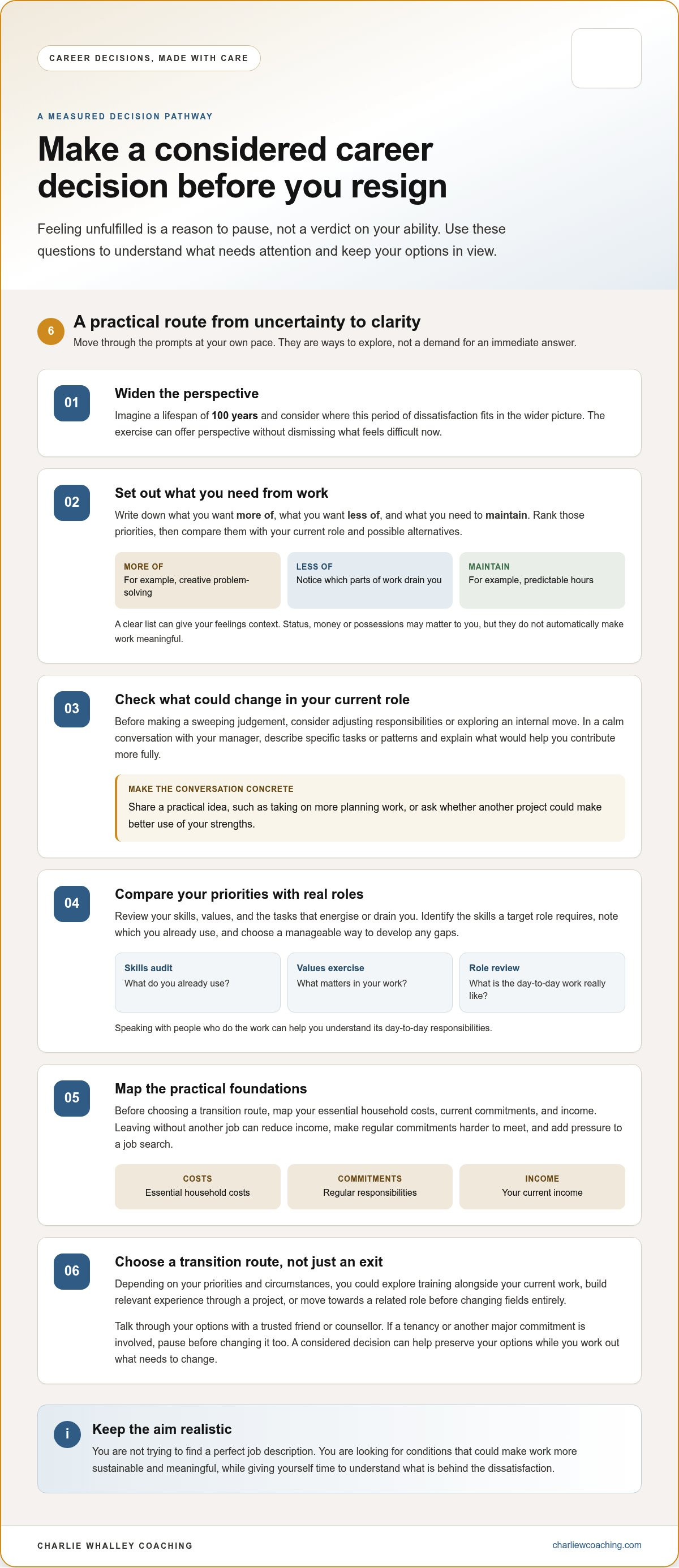
How do I talk to my manager about feeling unfulfilled at work? Choose a calm conversation, describe specific tasks or patterns, and explain what would help you contribute more fully. According to Springer Nature, a supervisor can help brainstorm adjustments to tasks and responsibilities, so bring a practical idea, such as taking on more planning work.
Keep the conversation focused on work you can discuss together. Instead of saying, “Nothing here matters,” try, “I feel most engaged when I solve customer problems, but my week is mostly reporting.” That gives your manager something concrete to respond to. You could ask whether responsibilities might shift or whether another project could make better use of your strengths.
Self-blame can grow when you measure fulfilment against expectations about status, money or possessions. Those things may matter to you, but they don’t automatically make work meaningful. Write down what you want work to offer, such as learning, connection, stability or a sense of contribution. A clear list gives your feelings context without dismissing them.
Try one small experiment before making a sweeping judgement. You could request feedback on a task, approach a recurring responsibility differently, or protect a quiet break after a socially demanding meeting. Even five minutes alone in the toilet may help replenish social energy. Notice what changes afterwards; that evidence can guide your next step with less self-criticism.
Pausing before making major career or life decisions
A difficult week can make resignation feel like the only clear choice. Before acting, separate the immediate pressure from the longer-term question: what do you want your working life to make possible? Imagine a lifespan of 100 years, then consider how this period of dissatisfaction fits into that wider picture. The exercise can create perspective without dismissing what feels difficult now.
What career assessment tools can help identify fulfilling jobs? Start with a skills audit, a values exercise and a review of tasks that energise or drain you. Then compare your findings with real roles by speaking with people who do that work and looking at their day-to-day responsibilities.
Reflect on your career goals by writing down what you want more of, what you want less of, and what you need to maintain. For example, you may value creative problem-solving but also need predictable hours. Rank these priorities, then compare them with your current role and possible alternatives. The aim isn’t to find a perfect job description; it’s to identify the conditions that would make work more sustainable and meaningful.
How can I plan a career change while maintaining financial stability? Map essential household costs, current commitments and income before choosing a transition route. You could explore training alongside your current work, build relevant experience through a project, or move towards a related role before changing fields entirely.
A plan can also include practical checkpoints: identify the skills a target role requires, note which you already use, and choose a manageable way to develop any gaps. If you’re unsure where to begin, trusted friends can offer perspective on your strengths and priorities. Career Transition Coaching can also help you clarify goals and structure a change; explore career transition coaching as you consider your next step.
What are the risks of quitting a job without another job lined up? Leaving first can reduce your income and make regular commitments harder to meet, while uncertainty may add pressure to your job search. Before deciding, consider how you would manage essential costs, daily structure and the time needed to find suitable work.
Talk through your options with a trusted friend or counsellor who can offer an outside perspective. Rather than making an abrupt choice, list alternatives such as adjusting responsibilities, exploring an internal move, or preparing a transition plan. If a tenancy or another major commitment is involved, pause before changing it too. A considered decision can preserve your options while you work out what needs to change.
Pause before making a rash decision, such as immediately resigning from a job or ending a tenancy. A trusted friend or counsellor can offer an outside perspective as you consider what to change.
Burnout and low mood
Burnout and low mood can both involve reduced motivation and fatigue. You might finish a full working day, then find even a familiar evening routine difficult. These experiences can overlap, so don’t assume that losing interest in work means you’ve chosen the wrong career. Notice whether tiredness and sadness appear only around work or across other parts of life too.
Consider three workplace factors: demand, control and support. Demand includes the volume and pace of tasks; control concerns how much say you have in doing them; support includes the help available from colleagues or a manager. Constant deadlines, little influence over priorities and limited support, for example, can leave you depleted. Write down which factor feels most pressing, then consider one practical change to raise with your manager.
Recovery can start with time away from work spent on enjoyable, relaxing activities. Choose something that genuinely helps you unwind, such as a quiet walk, cooking with someone you enjoy, or time with a favourite hobby. If time off isn’t possible, reduce pressure where you can: simplify responsibilities, delegate a task, or ask someone for help. These steps create space to notice what improves your energy.
If fatigue, sadness or lethargy persist, tell a healthcare practitioner. Explain when the feelings began, how they affect your routine, and whether they continue outside work. This gives them a clearer picture and helps assess whether a physical health issue could be affecting your emotional wellbeing. If you’re concerned about your mental health, consider speaking with your GP.
When should workplace dissatisfaction be addressed with a therapist or career counsellor? Consider a therapist if distress or low mood affects your wellbeing beyond work; a career counsellor can help when you want to explore role fit or career direction. If you’re experiencing fatigue or sadness, tell your GP or healthcare practitioner too, so health factors aren’t overlooked.
While you’re recovering, notice habits that can add strain. Drinking more, getting into arguments, overspending, staying up late or not eating enough can make things harder. You don’t need to change everything at once. Pick one manageable action, such as setting a regular bedtime or planning a proper meal, and notice how it affects your next working day.
Keep a simple record of what affects your energy: a demanding meeting, a supportive conversation, or a quieter afternoon. Compare days with heavier workloads against those with more control or support. This isn’t a diagnosis; it’s a practical way to spot patterns and decide what needs attention first. If rest doesn’t ease persistent low mood or exhaustion, share your observations with your GP.
4. Reconnecting with personal values and sources of joy
When work feels flat, compare your days with moments when you feel most like yourself. Think of a recent conversation, project or activity that absorbed your attention. Were you helping someone, solving a puzzle, making something or learning? Write down what you were doing and who was there. These clues can point to values your current routine leaves out.
Choose a quiet moment to name the qualities you want your working life to reflect. Examples include creativity, connection, security, independence or contribution. Then ask which moments at work support each value and which conflict with it. If collaboration matters but your week is mostly solitary, the gap is clearer than a general feeling that something is missing.
Values can shift as circumstances change. A role that suited you before caring responsibilities, a move or a change in confidence may fit differently now. Review your priorities without treating earlier choices as mistakes. Flexibility might matter more now than rapid progression, for instance, or mentoring colleagues might bring more meaning than individual recognition.
What are practical ways to feel more fulfilled in my current job? Identify one valued activity, such as helping a colleague learn, and find a realistic way to do more of it. You could also ask to contribute to a project that uses a strength you enjoy, or reshape a routine task to involve more problem-solving.
Keep the experiment small enough to learn from. For a week, note one moment that felt meaningful and what made it so. Perhaps you enjoyed turning a customer’s concern into a clear solution, even though the rest of the day felt routine. Look for recurring ingredients, then consider how to bring one into your regular responsibilities.
Joy doesn’t have to come from a grand career purpose. A kind exchange with a teammate, a satisfying piece of work or a calm lunch can offer useful clues. Ask yourself what happened, what you contributed and whether you’d welcome more of that experience. Specific observations help you distinguish a value from an abstract ideal.
One respondent estimated that a person had approximately 17520 days left in life while encouraging a search for meaning and ways to help others. The estimate isn’t a personal forecast; its useful prompt is to consider how you want to spend your time. Try listing one contribution you’d like to make at work, then identify a small action that could express it this week.
Revisit your notes before drawing conclusions about your whole career. If your examples repeatedly involve learning, ask for a chance to develop a skill. If they centre on helping others, notice where that contribution already happens. Your values can guide changes within your current role and clarify what you may want from future work. If you are exploring deeper shifts in your personal perspective, mindset resources such as salarahstarre.com offer guidance on aligning your daily life with what matters most to you.
5. Setting work-life boundaries
Work can take over gradually: one late email becomes an evening habit, then your recovery time disappears. A useful boundary makes a specific change visible. Choose a clear stopping point, such as closing your laptop after your final scheduled task, and tell colleagues when you’ll respond the next working day. A boundary isn’t a lack of commitment. It protects the energy you need to keep contributing.
Start by identifying where work spills into personal time. For a week, note examples such as skipped lunches, evening messages or tasks that regularly overrun. Choose the pattern causing the most strain, then decide what you can change. You might block a lunch break in your calendar or ask for priorities when new work arrives. One defined adjustment is easier to discuss and sustain than a vague request to feel less busy.
When raising a workload concern, use a concrete example and a clear request. You could say, “I’m completing these reports after hours. Which task should take priority if I can’t finish both today?” This invites a decision about responsibilities rather than leaving you to absorb every extra task. A manager may also help adjust duties. One respondent said a change to his workload helped him love his job again, after being expected to do his previous workload for just 2 hours a day.
If your calendar is already full, make the trade-offs visible. List current tasks, their deadlines and who depends on each one. Then ask which can be delayed, simplified or delegated. If a new client request arrives during a week of fixed deadlines, for example, agree which existing task should move. This gives your manager a clearer basis for balancing demands and helps stop every urgent request becoming your responsibility.
Protect breaks by choosing an activity that differs from the task you’ve just finished. After an online call, scrolling Instagram may keep you focused on a screen rather than help you reset. Step outside, stretch, or prepare a drink away from your desk. A deliberate pause between meetings can also help you return with more focus than moving straight into another task.
Some boundaries concern access, not workload. If evening messages pull you back into work, agree when you’ll check them and tell relevant colleagues. Use a clear status message, such as, “I’m offline now and will reply tomorrow.” If time off isn’t possible, look for responsibilities you can reduce, tasks to delegate, or support to ask for.
To turn these ideas into a workable plan, explore coaching support for clarifying priorities and setting sustainable boundaries.
Charlie Whalley Coaching: Life & Leadership Coaching
Charlie Whalley Coaching offers Life & Leadership Coaching for people seeking greater clarity, confidence and direction in their working lives. If you’ve explored your values and boundaries but still feel unsure how to move forward, coaching can help you reflect on what matters and consider practical next steps. When dissatisfaction points towards a career change, Career Transition Coaching can help you think through that transition.
You don’t need a complete plan before starting a conversation. It can be enough to bring the questions you’re carrying, such as whether to reshape your current role or explore a different path. Coaching can help you find a way forward that feels more aligned with your priorities.
Ready to speak? Visit Charlie Whalley Coaching to find out how it could work for you.
Choose one next step that feels possible
If you feel unfulfilled at work, you don’t have to solve your whole career today. A useful next step could be writing down one change you want to explore, then deciding who could help you think it through. Small, considered actions can bring more clarity than waiting for certainty to arrive all at once.
You might still be weighing whether to reshape your current role or move towards something different. Talking it through can help you make space for your priorities and consider a path forward at your pace. Reaching out doesn’t commit you to a particular decision; it simply opens a conversation.
Charlie Whalley Coaching is there for people seeking support as they reflect on what comes next. Contact Charlie Whalley Coaching to start a conversation about the direction you’d like to take.
Your next step can be small. It still counts.
Frequently Asked Questions
How can I tell whether I’m unhappy with my job or experiencing burnout?
Consider whether your dissatisfaction centres on specific parts of the job or follows you into other areas of life. You may dislike a particular responsibility but still enjoy social plans and personal projects, for example. If your energy and interest feel low at work and in your time away, consider discussing the pattern with a health professional. These signs can overlap, so treat them as observations, not a diagnosis.
How can I find more meaning and purpose in my work?
Trace one piece of work through to the person or decision it supports. A report, for instance, might help a colleague plan resources or help a customer get a clearer answer. Seeing that connection can make routine tasks feel less detached from their impact. If the link feels weak, ask whether you can take responsibility for work with a clearer outcome or a closer connection to the people affected.
Should I change jobs or try to improve my current role?
Test whether a specific change could address the hardest part of your role. If clearer priorities, a different project or more say over your work would make the role more workable, discuss those options before deciding. If the core duties or working environment conflict with what you need, explore other roles while considering your practical commitments. Compare both paths against the same priorities, not just how difficult this week feels.