
Coaching for School Challenges: Practical Ways to Support Your Child

What if your child doesn’t need you to solve every school problem, but needs space to work out what feels difficult and what they could try next? Coaching for school challenges can offer that space, especially when your child seems anxious, discouraged or overwhelmed and you’re unsure how to help without adding pressure.
It’s hard to watch a young person struggle, and there isn’t always one obvious answer. A conversation at home, support from school or another kind of help may each have a part to play. Coaching gives a child or young person a supportive setting to reflect, build self-confidence and explore manageable next steps, without promising a particular academic outcome.
In this article, you’ll learn what kids coaching involves and how it differs from subject-focused tutoring. You’ll also find practical ways to help your child talk about school, identify what might make things easier and take one step at a time. We’ll look at when it may be helpful to involve school staff or seek additional support, too. Small, thoughtful steps can help your child feel more able to face what’s in front of them.
Key Takeaways
- Coaching for school challenges gives a young person space to explore what feels difficult and consider manageable next steps of their own.
- Help your child build confidence by noticing their strengths and past efforts, without brushing aside what they’re finding hard.
- Coaching centres on reflection and personal development, whilst tutoring focuses on subject content and school staff can offer support within the school setting.
- Listen first, reflect back what you’ve heard, then ask what might help and agree one small next step together.
- Kids coaching can offer practical tools to manage anxiety and build resilience, while keeping the young person’s confidence and agency at the centre.
Coaching for school challenges: understand what your child may be facing
Your child may dread Monday morning, retreat to their room after lessons or say, “I can’t cope,” when you ask how school went. It can be painful to hear, particularly when you want to help but aren’t sure whether to listen, reassure them or step in. A difficult period doesn’t automatically point to one clear cause or an obvious fix.
School challenges can take many forms. A young person might be finding friendships hard, adjusting to a change, losing confidence in lessons or feeling overwhelmed by expectations. Motivation may dip, or they may struggle to explain what’s wrong. The same outward behaviour can mean different things for different children, so avoid diagnosing the issue or settling too quickly on an explanation.
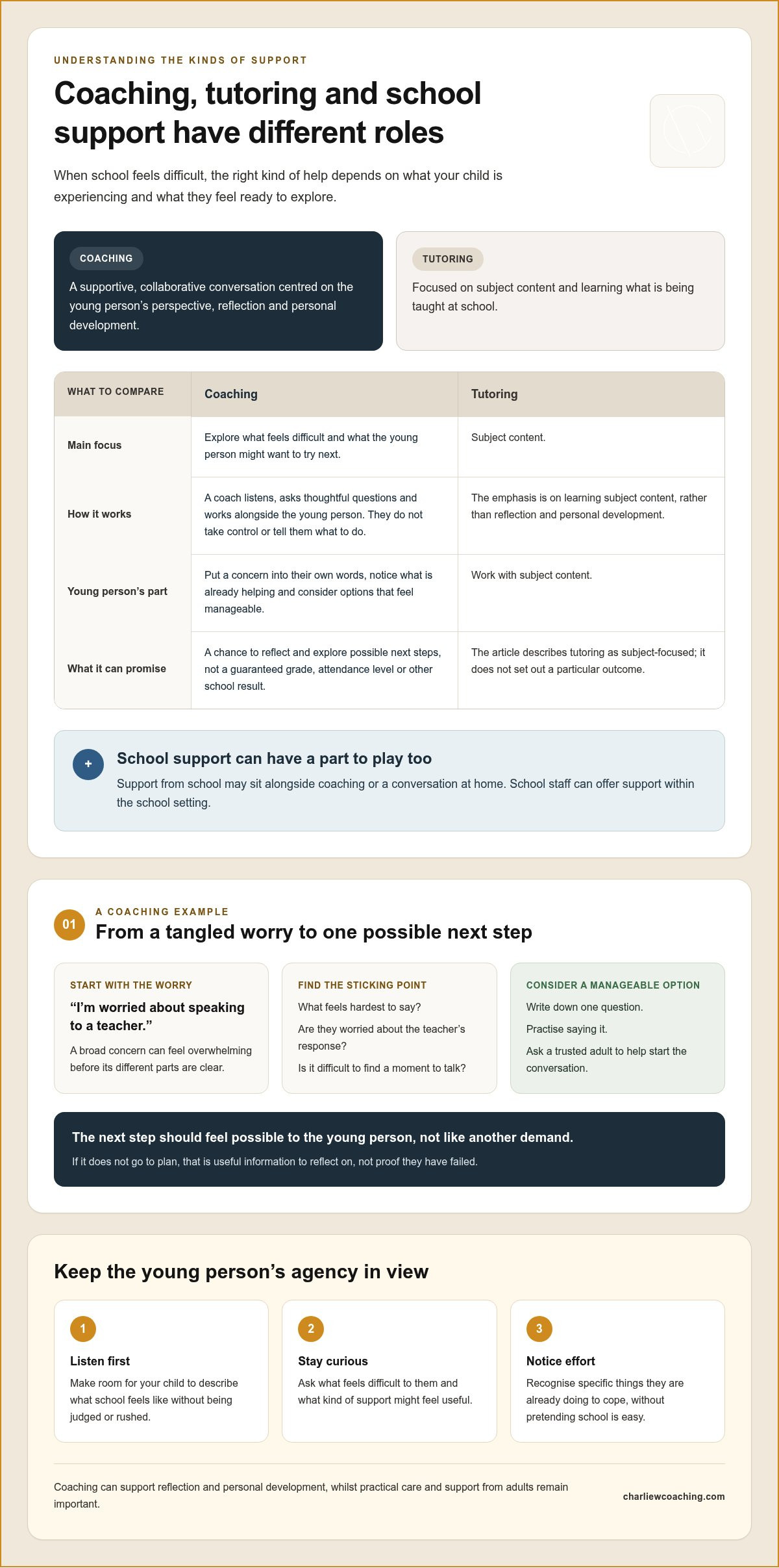
Coaching for school challenges is a supportive, collaborative conversation. A coach helps a young person explore what’s on their mind, notice their strengths and consider possible next steps, rather than taking control or telling them what to do. The process starts with the child’s perspective. It supports reflection and personal development, but can’t promise particular grades, attendance or other school results. Learning and development can be influenced by individual differences, motivation and self-regulation, subjects explored in educational psychology.
As a parent, you don’t need to find the perfect solution straight away. Start by making room for your child to describe their experience without feeling judged or rushed. You may notice that school feels harder, but their account can give you important context. Stay curious: what feels difficult to them, and what kind of support might feel useful?
What might a school challenge look like for a child?
You might notice your child seems quieter, more irritable or less confident than usual. They may avoid talking about lessons, withdraw after school or be less willing to take part in activities. These observations can help you spot a pattern, but one hard day isn’t proof of a deeper problem. Ask gently what the experience is like for them. Their explanation may differ from what you’ve assumed.
What does coaching for school challenges mean?
In coaching, a young person can put a concern into their own words, talk through what’s already helping and explore possible actions. A broad worry such as “school is awful” may become a more specific concern they feel ready to think about. The coach works alongside them and keeps their agency in view. Any next step is an option to consider, not a guaranteed route to a particular school outcome.
How coaching can help a young person build confidence and resilience
A school worry can feel enormous when it’s tangled up with everything else. A young person might say, “I’m rubbish at school,” when the hardest part is asking for help in one lesson, joining a group or facing a particular conversation. Coaching can help them slow down and separate the different parts of the worry, so they can decide what they want to focus on first.
Child-centred coaching helps a young person understand what feels difficult and choose a next step that feels possible to them. The coach doesn’t take over or set success for the child. Instead, they offer thoughtful questions and a supportive space where the young person can notice what matters to them and what they might try.
Moving from a broad concern to a clearer focus can make a challenge feel less overwhelming. It won’t make the difficulty disappear, and it doesn’t mean the child has to handle everything alone. It gives them a chance to find their own words and take part in shaping what happens next.
Turning a tangled worry into a clearer next step
If a child is worried about speaking to a teacher, open questions can help them work out what feels most difficult. Is it knowing what to say, worrying about the teacher’s response or finding a moment to talk? Once they’ve identified the sticking point, they might choose to write down one question, practise saying it or ask a trusted adult to help them start the conversation.
The action should feel manageable to the young person, not like another demand. Agreeing one small experiment can give a child a sense of agency: they have a say in what they try, and they can reflect on how it felt afterwards. If the step doesn’t go to plan, that’s useful information, not proof they’ve failed.
Building self-belief without adding pressure
Confidence can grow when a young person recognises what they’re already doing to cope. Perhaps they kept attending a club despite feeling shy, asked a friend for help or returned to a task after getting frustrated. Naming these efforts specifically can help them see their strengths without pretending school is easy.
Resilience isn’t about being cheerful all the time or pushing through without support. The American Psychological Association’s overview of resilience describes it as adapting to difficult experiences and emphasises that it can be developed. Progress may be gradual, with easier days and setbacks. A young person can build skills while adults continue to offer care and practical support.
As a parent, acknowledge effort rather than focusing only on the outcome: “You found a way to ask for help, even though it felt awkward.” This recognises both the challenge and your child’s capability. You can also learn more about kids coaching with Charlie Whalley Coaching.
Coaching, tutoring and other support: what is the difference?
When school feels difficult, it’s natural to look for the right kind of help. The best fit depends on what’s getting in the way. A child who needs to practise fractions may benefit from teaching, whilst one who feels unsure about asking for help may want space to explore confidence and possible next steps. Sometimes, more than one kind of support can work alongside the others.
| Type of support | What it focuses on |
|---|---|
| Coaching | Reflection, confidence, resilience and choosing manageable actions. |
| Tutoring | Learning or practising subject content, such as working through a topic or skill. |
| School staff | Support within the school setting, including concerns about learning, provision, relationships or safety. |
Coaching isn’t a quick fix or a promise of better grades. It supports a young person’s development, but it doesn’t teach subject content in the way tutoring does or replace the school’s role in responding to issues in its setting. Knowing the difference can help you focus on the need behind the worry rather than expecting one approach to solve everything.
When might coaching be a useful kind of support?
Coaching may be useful when a young person wants to build confidence, strengthen resilience or think through a change, such as moving to a new class or finding it difficult to speak up. Their willingness to take part matters: coaching works best as a collaborative process, not something imposed as a consequence or another task to get right. Explain what it involves and listen to how your child feels about it.
A joined-up approach can help, too. Family conversations and appropriate school support may complement coaching. For example, a child could explore how they want to handle a social concern in coaching, whilst a parent or member of school staff helps address practical circumstances around it. The aim is to support the child, not leave them responsible for sorting everything out alone.
When might another form of help be needed?
If the main difficulty is understanding or practising a particular subject, teaching or tutoring may be a more direct fit. If the concern relates to what is happening at school, the support available there or a child’s safety, involve appropriate school staff so the issue can be addressed in that context. Coaching can sit alongside this support, but it doesn’t take its place.
Coaching is not psychotherapy or mental health counselling, and it isn’t a substitute for specialist assessment or care when a child needs it. If you’re concerned about your child’s wellbeing, seek appropriate professional support. Choosing the right help isn’t about labelling your child. It’s about responding thoughtfully to what they need now.
How parents can support a child through a school challenge
When your child is upset about school, it’s easy to move straight into problem-solving. You might offer advice, contact someone or reassure them that things will be fine. Those instincts come from care, but your child may first need to feel heard. A calm conversation can help them share what’s going on and show you what kind of support feels useful.
Try this simple sequence, adjusting it to suit your child and the moment:
- Listen. Give them time to speak without rushing to fill a pause or find a solution.
- Reflect back. Sum up what you’ve heard: “It sounds like break time has been feeling lonely.” Let them correct you if you’ve misunderstood.
- Ask what would help. Try “Would you like me to listen, help you think it through or do something with you?”
- Agree one small next step. Choose something specific together, then check in later about how it felt.
Starting a conversation without making school feel like an interrogation
Look for a quieter moment when neither of you is rushing. Begin with a gentle observation, such as, “I’ve noticed you’ve seemed a bit quiet after school this week,” rather than asking why they’re being difficult or insisting they explain themselves. Keep your voice curious, not accusing.
Then give your child space. You could ask, “What’s been taking up most of your thoughts about school?” If they shrug, change the subject or say they aren’t ready to talk, try not to push. Let them know you’re available when they are. Reflect their feelings without minimising them: “That sounds frustrating” can feel more supportive than “It’s not a big deal.”
Agreeing a small, child-led plan
Once your child feels heard, ask what might make the next school day a little easier. They may want to draw on something that helped before, such as talking to a particular friend, taking a quiet moment or asking for clarification. You could ask, “What would you like me to do, if anything?” This keeps the child involved and helps you avoid guessing what support they want.
Make any agreed action clear enough to revisit. Your child might decide to tell you after school whether a particular part of the day felt easier, or you might agree to talk together about contacting a member of staff. Keep the plan flexible. If it feels too big, circumstances change or it doesn’t help, pause and consider another option. A plan is a starting point, not another test your child has to pass.
If a concern relates to what’s happening at school, a gentle conversation with an appropriate member of staff may help you understand what support could be available. Explain what your child has shared and ask how you might work together, keeping their voice and comfort in mind. You can read about kids coaching with Charlie if you’re considering a supportive space for your child to explore school worries and build confidence.
How Charlie Whalley Coaching supports young people with school challenges
When your child is anxious about school, discouraged by a setback or finding it hard to explain what’s wrong, you may want support that takes their feelings seriously without making them feel like a problem to fix. Charlie Whalley Coaching provides coaching for children and young people, with a focus on building resilience and self-confidence. The aim is to help each young person explore what feels difficult and consider manageable next steps in a supportive setting.
Sessions offer practical tools to help young people manage anxiety and navigate school challenges. The focus is on the child’s perspective and agency, not on imposing a solution or promising better grades. Charlie is an ICF Professional Certified Coach (PCC), bringing a professional coaching qualification to her work with young people.
A supportive space to explore what feels difficult
Every young person’s experience is their own. Coaching is tailored to the child and their circumstances, giving them space to put concerns into words, reflect on what matters to them and think about what might help. A parent may see reluctance to attend school; the young person may be carrying a worry about friendships, a change in routine or a particular classroom situation. Listening carefully can bring their perspective into view.
From there, the conversation can help a child consider their strengths, what they’ve already tried and what feels possible now. A next step might be something small, such as thinking through what they’d like an adult to understand. It should be a step they can take ownership of, not another expectation placed on them. Coaching doesn’t remove every difficulty, but it can offer a steady space to reflect and build confidence over time.
Taking a low-pressure next step
If you’re considering support, reflect on what you hope your child might gain. Perhaps you’d like them to feel more able to talk about school, recognise their strengths or find practical ways to manage anxiety. You don’t need to have everything worked out before exploring the possibility. Your child’s needs and readiness matter, too.
A discovery call gives you an opportunity to talk through your questions and consider whether coaching feels like a helpful next step for your family. There’s no need to promise a particular outcome. You can begin with what you’ve noticed and what you’d like to understand.
Ready to speak? Book a discovery call to find out how it can work for you.
Take the next step at your child’s pace
You don’t need to have every answer before you support your child. A steady, open conversation can help them feel less alone and give you both room to understand what might make the days ahead more manageable. Let their needs guide the pace. Some children will be ready to talk straight away; others may need time to find the words.
If you’re considering coaching for school challenges, think about what your child would want from the experience and what feels comfortable for them. The right next step doesn’t need to solve everything at once. It can simply create space for a thoughtful conversation about support, confidence and what might help your young person move forward.
If you’d like to explore that possibility, arrange a discovery call to discuss your child’s needs. Bring your questions and take things one conversation at a time. With care and patience, a manageable first step can open the way to new possibilities.
Frequently Asked Questions
What are common school challenges that coaching may help a child navigate?
Coaching for school challenges may be relevant when a young person is struggling with confidence, friendships, a transition, motivation or feeling overwhelmed. A new timetable or changing friendship group, for example, may feel harder than adults expect. These are possibilities, not diagnoses, and they don’t mean coaching is automatically the right fit. Ask your child what they think is happening and what kind of support they’d find helpful.
Can coaching help a child who feels anxious about school?
Coaching can give a young person space to talk about school worries and consider a manageable step, such as identifying what they’d like an adult to understand. It doesn’t treat anxiety or guarantee that a child’s feelings will change. Start by listening calmly and taking their concerns seriously. If their needs call for support from school staff or a specialist, coaching should not replace that care.
How can I talk to my child about problems at school?
Choose a calm moment and begin with an open question, such as, “What part of today felt hardest?” Let your child speak without rushing to correct their account or offer a solution. Reflect back what you’ve heard and ask, “Have I understood that properly?” If they don’t want to talk yet, respect that. A patient, non-judgemental response can make it easier for them to return to the conversation.
Is coaching the same as tutoring for school difficulties?
No. Tutoring generally helps a pupil learn or practise subject content, such as working through a maths method or revising a topic. Coaching supports reflection, confidence and a young person’s thinking about personal next steps. The approaches can address different needs, and using one doesn’t automatically mean the other is unnecessary. Coaching isn’t a promise of higher marks or a substitute for subject teaching when that’s what a child needs.
What happens in a coaching session for a young person?
A session offers a supportive conversation about what’s happening from the young person’s point of view. They may explore what they’d like to understand or change, what feels important to them and what small action seems manageable. The approach is tailored rather than based on a fixed script or guaranteed result. A child’s participation matters, so their questions, comfort and willingness to share should help shape the conversation.
Should I involve my child’s school when they are struggling?
Involving relevant school staff may help if the difficulty concerns learning, relationships, attendance or support available at school. Where possible, talk with your child about what you plan to share and what they’d like the school to understand. This can help them feel included rather than discussed without their knowledge. Coaching may sit alongside family and school support, but it doesn’t replace appropriate specialist care when that’s needed.