
Coaching for Career Stagnation: A Gentle, Practical Way Forward

What if feeling stuck in your career is a reason to pause and investigate, rather than a sign that you need to leave? When work feels repetitive or out of step with what matters to you, it’s natural to wonder whether a new role is the answer. Yet self-doubt, uncertainty and the pressure to make the “right” choice can make even a small first step feel difficult. Coaching for career stagnation gives you space to understand what’s behind that feeling without rushing into a major decision.
You don’t have to choose between staying exactly where you are and handing in your notice. A clearer sense of what you need can begin with noticing what drains you, what still gives you energy and where you use your strengths. Small steps can help you gather useful information and find momentum.
In this article, we’ll look at what may be contributing to career stagnation, how to identify a manageable next step and how coaching can help you reflect on your values, strengths and options. The aim isn’t to decide everything at once. It’s to move forward with greater self-awareness and confidence, at a pace that feels right for you.
Key Takeaways
- Notice where work feels repetitive, less challenging or disconnected from your priorities to put words to what feels stuck.
- Explore role design, recognition, challenge, values and confidence before settling on a single explanation for your dissatisfaction.
- Compare reshaping your role, pursuing internal progression and exploring a new direction against what matters to you and what you need to learn.
- Use coaching for career stagnation to reflect on patterns and consider a next step that feels useful, without being pushed towards leaving.
- Try a small career experiment, then review what it reveals about your energy, strengths and possible direction.
Coaching for career stagnation starts by naming what feels stuck
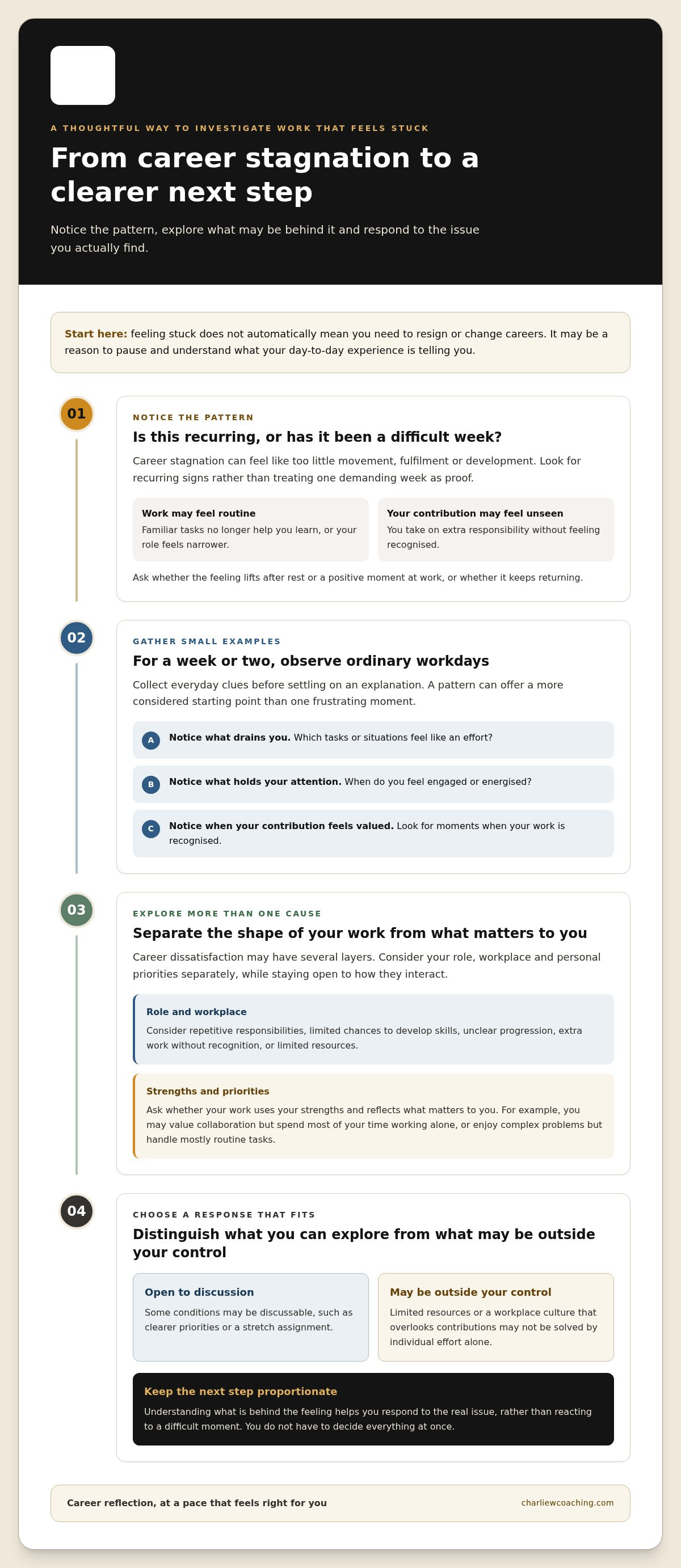
You might still be meeting deadlines, supporting colleagues and doing work you know well, yet feel that your working life has lost its sense of movement. Perhaps tasks that once stretched you now feel routine, your contributions go unrecognised, or you’re no longer sure what you want to work towards. These feelings are worth paying attention to, but they don’t prove that you’ve failed or chosen the wrong career.
Career stagnation is a persistent feeling that your work offers too little movement, fulfilment or development, rather than a diagnosis or a difficult week. It can take different forms: limited chances to learn, a role that no longer feels meaningful, fading confidence or uncertainty about which direction would suit you. Naming the experience makes it easier to examine without turning it into a verdict on your ability.
Feeling stuck doesn’t automatically mean you should resign or change careers. The cause might lie in the shape of your current role, how your work is recognised or a shift in what matters to you. Sometimes the first useful step is to understand the pattern more clearly. Coaching for career stagnation offers space to explore it, but you can start by noticing what your day-to-day experience is telling you.
How can you tell whether work has become stagnant?
Look for recurring patterns, not proof that you’re having a bad day. A demanding week can leave anyone frustrated; a longer-lasting sense of limited growth may be different. For example, you might regularly take on extra responsibility without feeling recognised, or complete familiar tasks without learning anything new. Ask yourself whether the feeling lifts after rest or a positive moment at work, or whether it keeps returning.
Consider what has changed, too. Perhaps your role has become narrower, or work that once felt worthwhile now seems disconnected from the contribution you want to make. You don’t need to have a clear alternative in mind. Noticing when your energy dips and when you feel engaged can help you describe the issue more precisely.
Why feeling stuck is not a personal failure
Roles and workplaces change, and so do people’s priorities, strengths and ambitions. A position that suited you at one point may offer less challenge now. That doesn’t make your earlier choice a mistake. Progression can also bring new difficulties. The Peter Principle and career stagnation is one way to understand how promotion into a role that no longer fits someone’s strengths may affect their sense of progress.
Self-doubt can make choices feel harder, especially when you’re unsure whether to speak up, seek a new challenge or explore another direction. But doubt is a feeling to notice, not a measure of your capability. Dissatisfaction can be useful information. You don’t have to act on it immediately. First, give yourself permission to understand what it might be pointing towards.
Explore the causes of career stagnation before choosing a response
Once you’ve noticed a recurring sense of being stuck, the next question is what might be contributing to it. It can be tempting to settle quickly on one explanation: “I need a promotion” or “I’ve chosen the wrong career.” But the feeling may have several layers. Look at your role, workplace and personal priorities separately, while staying open to how they interact.
Understanding what is behind career stagnation helps you choose a next step that responds to the real issue, rather than simply reacting to a difficult moment. For a week or two, collect small examples from ordinary workdays. Note what leaves you drained, what holds your attention and when you feel your contribution is valued. One frustrating meeting may not tell the whole story, but a pattern can give you a more considered starting point.
What might be happening in your role or workplace?
Look at the conditions around your work, not just your own performance. Are your responsibilities repetitive, with little chance to develop new skills? Is progression unclear, or do you take on extra work without recognition? Notice which tasks you approach with energy and which feel like an effort. This can help distinguish a lack of challenge from a lack of meaning, or from limited opportunities in your workplace.
Some factors may be open to discussion, such as asking for clearer priorities or a stretch assignment. Others, including limited resources or a workplace culture that overlooks contributions, may be outside your control. Individual effort can help you explore options, but it can’t resolve every structural difficulty. Be honest about the difference.
What might your own priorities be telling you?
Consider whether your responsibilities still use your strengths and reflect what matters to you. Perhaps you value collaboration but spend most of your time working alone, or you enjoy solving complex problems but now handle mostly routine tasks. These aren’t signs that you’re ungrateful. They’re clues about the kind of work that may feel more purposeful.
Self-doubt can complicate this reflection. You may dismiss a strength as “nothing special” or avoid raising an idea because you fear being judged. Try separating what you know from what you’re predicting: “I haven’t been offered a development opportunity” is different from “I’m not capable of taking one”. Career transition coaching with Charlie Whalley can offer a collaborative space to examine those assumptions and clarify what matters to you, without deciding in advance that you must leave.
For broader context, the article on career coaching for meaningful professional growth connects these reflections with the wider question of what purposeful progress might look like. You don’t need a perfect explanation to begin. A clearer picture of the conditions, priorities and doubts involved can make the options you consider more relevant to your situation.
Compare your options: reshape your role or explore another direction
Once you have a clearer sense of what feels out of balance, compare possible responses without treating any of them as a final decision. Use what you’ve noticed about your energy, values and strengths, alongside practical realities such as time, finances or caring responsibilities. Ask what each option might improve and what it could help you learn.
The right choice isn’t always the biggest one. A conversation or a small change to your responsibilities may give you useful information before you consider a wider move.
| Option | Could suit you if… | What it might help you discover |
|---|---|---|
| Reshape your current role | Some parts of the work still engage you, but particular tasks or responsibilities feel draining. | Whether a change in projects, priorities or focus could bring more energy and use your strengths. |
| Pursue internal progression | You value the organisation but want greater challenge, responsibility or development. | Whether another role or opportunity within the workplace better reflects your values and ambitions. |
| Explore a career transition | A sense of mismatch continues across different tasks or aspects of your working environment. | Which transferable strengths and priorities could guide a broader professional direction. |
When might a change within your current role be worth exploring?
If you still find meaning in parts of your work, look for a realistic adjustment connected to what you’ve observed. You might ask to contribute to a project that uses a strength you rarely draw on, or discuss how responsibilities could be balanced differently. A workplace conversation may open up possibilities, but it can’t guarantee that change will follow. Treat it as one way to gather information.
When might a wider career change deserve attention?
If the mismatch seems to persist across tasks, relationships or the broader direction of your work, it may be worth looking beyond your current role. Start with curiosity, not a job title. Which abilities do you want to use more? What values would you like your work to reflect? Charlie Whalley’s career transition coaching can help you explore these questions without turning exploration into a commitment to resign or retrain.
There’s room between staying exactly as you are and making a dramatic leap. You could learn about an unfamiliar field, speak with someone whose work interests you, or explore leadership and entrepreneurial advisory resources like janihavunen.com. These steps can make a potential direction more tangible while leaving your options open.
Coaching for career stagnation can support a more considered comparison, helping you clarify what matters and what each path might involve. You don’t have to choose perfectly now. Aim to identify the option that feels worth exploring next, based on what you know today and what you still need to learn.
Use small career experiments to build momentum without rushing
Reflection can help you spot what feels out of step, but it may not answer every question from your desk. A small career experiment lets you test an idea in real working life without treating the result as a decision to resign, retrain or commit to a new direction. The purpose is to learn, not to prove you’ve found the perfect answer.
A small career experiment turns reflection into evidence by letting you notice what changes when you try something different. Keep it practical and low-risk. You might track which tasks leave you energised, ask to contribute to a stretch project or arrange a conversation with someone whose responsibilities interest you. A modest experiment can still offer useful information.
Choose one question your next step can help answer
Start with a question specific enough to guide an action. For example: “Would more collaborative work suit me?” or “Do I want greater challenge, or simply more recognition for the work I already do?” Choose an experiment that fits your circumstances and can shed light on that question. Before you begin, jot down what you expect to notice.
Then move through the process in order:
- Choose a question. Focus on one area, such as challenge, values, strengths or preferred working conditions, rather than trying to resolve your whole career at once.
- Design a small experiment. Select an action that gives you relevant insight without a major commitment. You could volunteer for a contained task, request a stretch assignment or keep a brief record of the work you find absorbing.
- Set a review point. Decide when you’ll pause to look back. A clear point to review helps the experiment stay manageable and stops it becoming another open-ended task.
- Record what you notice. Make a few notes before, during and after. Include your energy, interest and any practical obstacles, not just whether the task went well.
Review what you learn and decide what comes next
At your review point, compare what happened with your original question and expectations. Did the task feel more engaging than your usual work? Did you enjoy the challenge, or did the surrounding conditions make it harder to focus? One experience won’t define your future, but it can help you decide whether to repeat the experiment, adapt it or leave it behind.
A useful result isn’t always a clear yes. You might discover that you enjoy mentoring but not managing, or that a new responsibility appeals only when priorities are clear. That detail can guide a more relevant next test. Broader reflection, including themes explored through life and leadership coaching, can also help you connect work choices with what matters across your life.
If you’d value a thoughtful space to explore what your experiments are showing you, book a discovery call about coaching.
How coaching for career stagnation can support your next step
When you’ve been turning the same questions over in your mind, it can help to have a thoughtful space to explore them with someone else. Coaching isn’t about being told to stay, leave or pursue a particular job. It’s collaborative: you bring your experience, and your coach helps you examine what matters, notice patterns and consider possible actions.
Charlie Whalley offers tailored one-to-one coaching for people working through professional change. As an ICF Professional Certified Coach (PCC), she supports clients to build self-awareness, work with self-doubt and reflect on their next steps. The focus is on helping you find greater clarity, not promising a particular outcome or setting a deadline for change.
What can a coach help you explore?
You might begin by considering what you want more of, less of or differently in your working life. Coaching can help you explore how your strengths and values connect with your current responsibilities, and where uncertainty or fear of judgement may be limiting what feels possible. From there, you can shape actions that fit your circumstances and reflect on what you learn.
- What kinds of work bring out your strengths?
- Which values would you like your working life to reflect more clearly?
- What practical possibilities feel open to you now?
- What would help you feel more confident about a next step?
You don’t need to arrive with polished answers. Honest questions are a good place to start. The conversation can move at your pace, with room to consider both changes within your current role and broader possibilities.
How to approach a first conversation about feeling stuck
A recent example can make it easier to begin. You might describe a day when work felt particularly flat, or a moment when you felt engaged and useful. You could also name what you hope to understand, such as whether you need more challenge or want your work to feel more aligned with your values.
There’s no need to have a finished plan or know whether you want to leave. A first conversation can be a chance to share what’s on your mind and consider whether coaching feels like a useful fit. Take time to decide what you want from the conversation and what you’re comfortable exploring.
If you’d like to talk through what’s keeping you stuck, book a discovery call to explore how coaching could work for you.
Let your next step begin with curiosity
You don’t need to have your whole career mapped out before moving towards work that feels more aligned. Sometimes progress starts with giving yourself permission to take your questions seriously, without demanding an immediate answer or a perfect plan.
Coaching for career stagnation can help you make space for reflection and explore what matters to you. Charlie Whalley’s one-to-one approach is shaped around the individual, so the conversation can focus on your priorities, strengths and circumstances. There’s no expectation that you arrive knowing whether to stay or go.
If you’d like to explore whether coaching feels like a helpful next step, book a discovery call to find out how coaching can work for you. You can begin with what’s on your mind today. A little more clarity is a meaningful place to start.
Frequently Asked Questions
Is career stagnation normal?
Yes, feeling that your career has lost momentum can happen at different stages of working life. Your interests, responsibilities and circumstances may shift, so a role that once suited you might no longer feel like the right fit. That feeling isn’t proof you’ve made a mistake or fallen behind. Treat it as a prompt to get curious about what you need from work now, rather than as a reason to judge yourself.
Can coaching help if I do not want to leave my job?
Yes. Coaching for career stagnation can help you consider ways to make your current working life more satisfying without assuming you should leave. For instance, you might explore how to raise a request for clearer priorities, protect time for focused work or build confidence in a conversation with your manager. The focus can be on understanding your choices and deciding what feels appropriate, not pushing you towards a career move.
How do I know whether I am experiencing career stagnation or just a difficult period?
Consider whether the unease continues when a particular pressure eases. A difficult deadline or change in workload may affect your mood for a time, whereas feeling that your role no longer fits can remain even during calmer weeks. You could note how you feel after different kinds of tasks or conversations. If the picture is mixed, that’s useful too. You don’t need to label the experience before exploring it.
What should I do first when I feel stuck in my career?
Choose one recent moment that captures the feeling, then write down what happened and what you needed at the time. Perhaps a meeting left you feeling overlooked, or a task felt worthwhile because you could use a particular skill. This small record gives you something specific to reflect on, rather than asking yourself to solve your whole career at once. From there, decide what question you’d most like to answer.
Can career coaching help me decide what I want to do next?
Career transition coaching can help you explore possible directions and the factors that matter when choosing between them. You might clarify which skills you want to use more, what you value in a working environment or what practical limits shape your choices. A coach won’t decide for you. Instead, the conversation can help you form your own criteria and consider manageable ways to learn more about a potential path.
How is career coaching different from therapy?
Career coaching generally focuses on work-related priorities, decisions and actions, such as considering a role change or preparing to discuss development opportunities. Therapy has a different focus and may support people with psychological or emotional difficulties. The two aren’t interchangeable. If your main concern is your mental health or emotional wellbeing, career coaching isn’t a substitute for appropriate clinical support. You can choose the kind of support that best fits what you’re facing.