
Executive coaching: what it is and is it right for you?

What if the next step in your leadership isn’t another course or a ready-made answer, but space to think clearly about the challenge in front of you? Executive coaching can offer that space, helping you explore how you lead and what you want to change. If you’re unsure what happens in a coaching session, or wary of conversations that feel vague or overly corporate, it’s reasonable to want a clearer picture first.
You might be managing a demanding role, facing a change at work or questioning how confidently you show up as a leader. Wanting support doesn’t mean you’re failing. It can simply mean you’re ready to look at a challenge from a different angle. Coaching is also distinct from mentoring, training and therapy: each offers a different kind of support.
This article explains what executive coaching can help with, what it can’t offer and how a coaching relationship might work in practice. You’ll also find practical questions to help you assess whether an approach feels useful and comfortable. The aim is to help you decide whether coaching could be a worthwhile next step for you.
Key Takeaways
- Executive coaching can help you explore a real leadership challenge and decide what you want to develop.
- A coaching conversation may move from reflecting on a current situation to identifying practical next steps, without following a fixed programme.
- Coaching is client-led, mentoring draws on another person’s experience, and training focuses on building specific skills.
- To assess fit, consider whether your hopes are clear enough to discuss and whether you feel heard and respected.
- Charlie Whalley offers bespoke one-to-one coaching for professionals and leaders and is an ICF Professional Certified Coach (PCC).
Executive coaching: when might it be useful in your working life?
You might be the person colleagues turn to for direction, keeping projects moving and making decisions under pressure. Yet, once the meeting ends, you’re still wondering whether you chose the right path, how to handle a strained working relationship or whether you’re ready for what comes next. The contrast between appearing capable and feeling uncertain can be difficult to share. It can also be a useful starting point for reflection.
Executive coaching is a collaborative conversation centred on your leadership challenges and development. It isn’t a promise of promotion, improved performance or any particular result. Instead, it gives you dedicated space to examine what’s happening, understand your priorities and consider possible ways forward.
What does executive coaching mean in practice?
Executive coaching is a collaborative process in which a coach listens, asks questions and supports a leader to reflect on challenges, clarify priorities and identify possible actions. The coach doesn’t arrive with a standard answer for every situation. Your experience and aims shape the focus, whether you want to think through a decision, explore how you respond under pressure or build greater clarity in your leadership.
A session might begin with a situation that’s been occupying your thoughts. The coach may invite you to consider what matters most, what assumptions you’re making and what options you haven’t yet explored. You choose where the conversation goes. Reflection can then help you decide whether there’s a practical step you want to take. Business coaching, also known as executive coaching, is a broad field, and the specific focus depends on the client’s needs.
What kinds of leadership moments can prompt coaching?
There doesn’t need to be a crisis. A new responsibility might bring questions you didn’t face in your previous role: how to set direction, delegate or find your voice with a more senior team. Difficult workplace dynamics can make it harder to communicate openly. Or a consequential decision may leave you weighing competing priorities without a clear answer.
Self-doubt can be part of the picture, too. You might wonder whether you’re suited to a role, replay a conversation or notice that your usual confidence feels less steady. These experiences don’t mean you’ve failed as a leader. They may point to an area where thoughtful attention could help you understand what you need and how you want to respond.
The right focus is personal. You may want to explore how you lead through change, or what greater clarity would look like in your day-to-day work. The leadership coaching guide for professionals explores how reflection can relate to leading with clarity. You don’t need a polished goal to begin: a question you keep returning to can be enough.
How does executive coaching work, from reflection to practical action?
A coaching conversation can start with something specific that’s on your mind, even if you haven’t worked out exactly what you need. Perhaps a team meeting left you unsettled, or you’re finding it hard to give clear feedback while maintaining a relationship you value. You might describe what happened, then explore what you want to understand or handle differently.
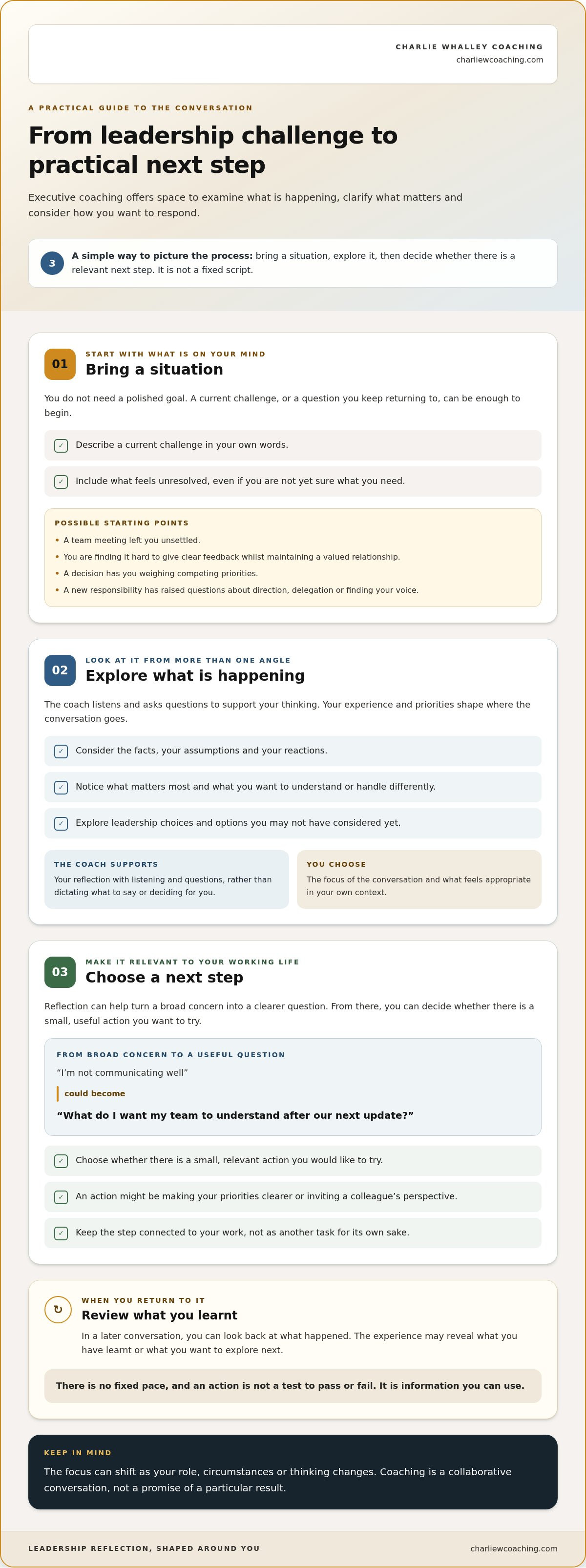
There’s no single script or guaranteed sequence. The focus should reflect your priorities and can shift as your role, circumstances or thinking changes. A simple way to picture the process is:
- Bring a situation. Describe a current challenge in your own words, including what feels unresolved.
- Explore it. Consider the facts, your assumptions and reactions, and the leadership choices available to you.
- Choose a next step. Decide whether there’s a small, relevant action you’d like to try before revisiting the situation.
What might happen in a coaching conversation?
The coach listens and asks questions to help you examine the situation from more than one angle. If you’re preparing to give difficult feedback, for instance, you might explore what you want the other person to understand, what you’re concerned they may hear, and how you’d like to approach the conversation. The coach supports your thinking rather than dictating what to say or deciding for you.
A useful conversation isn’t simply a place to receive advice or rehearse an ideal version of yourself. It gives you room to notice your responses, consider what matters and make sense of your leadership choices. You remain the person who decides what feels appropriate in your context.
How can reflection become practical progress?
A broad concern such as “I’m not communicating well” can become a more useful question: “What do I want my team to understand after our next update?” From there, you might choose one action, such as making your priorities clearer or inviting a colleague’s perspective. The step should be relevant to your working life, not another task added for its own sake.
In a later conversation, you can look back at what happened. Perhaps the exchange went differently than expected; perhaps it revealed a new concern. Reviewing the experience can help you notice what you’ve learnt and what you want to explore next. Progress doesn’t have to follow a fixed pace, and an action isn’t a test you pass or fail. It’s information you can use.
A thoughtful coaching relationship can deepen, change or pause as your needs evolve. If you’d like to explore one-to-one coaching for your leadership challenges, book a discovery call to consider what support might be useful for you.
Executive coaching, mentoring, training or therapy: how do they differ?
These forms of support can all help you make sense of a challenge, but they serve different purposes. If you’re unsure whether you need space to think, advice from someone experienced, a specific skill or different support altogether, comparing how each approach works can make the choice clearer. None is automatically better than the others. The useful question is which purpose best matches what you need right now.
| Approach | Purpose | Conversation style | Who guides the work? |
|---|---|---|---|
| Coaching | Explore a current challenge or development goal | Questions and client-led reflection | The client sets the focus; the coach supports their thinking |
| Mentoring | Learn from another person’s relevant experience | Sharing perspectives, advice and examples | The mentor contributes experience; the mentee considers its relevance |
| Training | Build defined knowledge or a skill | Structured instruction and practice | The trainer or facilitator leads the learning |
| Therapy | Support emotional or psychological wellbeing | Professional therapeutic conversation | An appropriately qualified therapist guides the work |
How is coaching different from mentoring or training?
Imagine you’ve recently become responsible for a larger team and aren’t sure how to delegate effectively. In coaching, you might explore what makes delegation difficult, what you want your team to take ownership of and what approach you want to try. A mentor might share how they handled a similar transition, while recognising that their experience may not map neatly onto yours. In training, you might learn a structured delegation method and practise applying it.
Each approach can be useful, depending on the need. If you want to build a particular skill, instruction and practice may be a direct fit. If you value advice grounded in someone else’s experience, mentoring may help. Coaching puts the emphasis on exploring your own perspective and deciding what feels appropriate in your circumstances.
How is coaching different from therapy?
Coaching generally centres on work-related challenges, leadership development and future goals. Therapy is a distinct form of support focused on emotional or psychological wellbeing. The boundaries and approach depend on the professional and the support being sought, so coaching shouldn’t be treated as a substitute for clinical or mental health care.
If what you’re experiencing calls for therapeutic or clinical support, consider seeking help from an appropriately qualified professional. You don’t have to label or resolve everything alone before asking for support. Different kinds of support have different purposes, and the aim is to find an approach suited to your needs.
How can you judge whether executive coaching is a good fit?
It’s natural to want more than a confident promise before making space for coaching. A good fit isn’t about being told you’ll get promoted or transform your leadership. It’s about whether the conversations feel relevant to your situation, whether you can speak openly and whether the approach respects your judgement and priorities.
Use an initial conversation to notice both what’s discussed and how it feels. Do you have room to explain what’s on your mind? Does the coach listen carefully, or rush towards a solution? You don’t need to feel completely certain straight away, but you should feel that your perspective is taken seriously.
- Your challenge: Can you talk about the work situation or leadership question you want to explore?
- Your hopes: Can you describe what you’d like to understand, even if you’re not sure what the answer is?
- Trust: Do you feel comfortable enough to be honest about what’s difficult?
- Communication: Does the coach explain their approach clearly and respond to your questions without pressure?
- Reflection: Are you willing to consider your own assumptions and choices, as well as what others might need from you?
What questions can help you assess a coach’s approach?
Ask how the coach helps clients explore leadership challenges, set a focus and decide what to take from a conversation. It’s also reasonable to ask about professional credentials and how confidentiality is approached, particularly if you’re discussing sensitive workplace dynamics. Notice whether the answers are clear and whether you feel able to say what you want from the relationship. That exchange is useful in itself.
What if you are unsure what you want to change?
You don’t need to arrive with a polished goal. Sometimes the starting point is a feeling: you’re less confident than usual, a decision is weighing on you or something about work no longer feels straightforward. Reflection can help you understand what sits beneath that uncertainty, what matters most and what you want to explore next.
Notice when the feeling appears. Is it tied to a particular conversation, responsibility or expectation? You might jot down what happened, what you were concerned about and what you wish you’d been able to say or do. These observations aren’t homework; they can simply give you a clearer starting point. If confidence and authenticity are part of your concern, this perspective on developing executive presence without being someone else may help you reflect on what feels true to you.
Ultimately, fit depends on your needs and the relationship, not on bold guarantees. If you’d like to explore whether Charlie’s thoughtful, personalised approach feels right for your leadership challenges, book a discovery call to talk through the support you’re looking for.
Explore executive coaching with Charlie Whalley
If you’re weighing up whether coaching could help, begin with your own experience, not a promise of who you’ll become. Charlie Whalley offers bespoke one-to-one coaching for professionals and leaders, shaped around the questions and changes that matter to each person. You might be working through self-doubt, wanting to understand how you come across as a leader, or finding your feet in a changing workplace.
Charlie is an ICF Professional Certified Coach (PCC). Her work offers a thoughtful space to explore leadership challenges and build self-awareness and executive presence, with the focus guided by what you bring to the conversation. Coaching can help you look at your situation with fresh perspective, but it can’t guarantee a particular outcome. The choices and direction remain yours.
What can one-to-one leadership coaching help you explore?
You don’t need to arrive with a neatly defined development goal. You might start with a meeting you’re dreading, a decision that keeps returning to mind, or a sense that the way you lead no longer feels quite like you. Together, you can explore what’s behind the concern and what you’d like to understand or approach differently. Life coaching can also be relevant when professional questions connect with changes in other parts of life.
This kind of one-to-one support isn’t about adopting someone else’s leadership style. It can help you notice what feels natural, where you’re holding back and how you want to show up at work. If you’re facing a transition, reflection may help you clarify what matters to you as you find your footing. You can begin with the question you have today, even if it changes as you think it through.
What is a gentle next step if you are considering coaching?
A discovery conversation can be a low-pressure way to talk about what’s on your mind and what you hope to get from support. Bring one question or challenge, such as “How can I feel more confident in this role?” You don’t need to have the answer ready. Talking it through can help you clarify what you’re looking for and whether Charlie’s approach feels like a good fit.
Ready to speak? Book a discovery call to find out how coaching can work for you. Begin with curiosity, share what matters and consider your next step in your own time.
Make space for your next leadership question
You don’t need to have everything mapped out before deciding whether support could be useful. Sometimes the next step is simply to pause and name what’s been taking up space in your mind. What would you like to feel clearer about? What kind of conversation would help you think with more confidence? Your answers can develop over time.
Executive coaching is worth considering when you’re ready to explore a real challenge with curiosity and honesty. Take time to decide whether the approach feels right for you. There’s no need to force certainty or make a big commitment before you’re ready.
If you’d like to explore what support might look like for your situation, arrange a discovery call and talk through what you’re looking for. A thoughtful first conversation can help you find a way forward that feels like your own. You can begin with one question.
Frequently Asked Questions
Is executive coaching worth it if I am already successful in my role?
It can be useful even when your work is going well, particularly if your responsibilities are changing or you want to approach a familiar challenge differently. Success doesn’t mean you’ve stopped learning. For example, you may be trusted to deliver results but want to get better at influencing decisions across teams. Consider what you’d like to think through, then judge whether dedicated reflection would be valuable to you.
Can executive coaching help with self-doubt at work?
Coaching can help you explore when self-doubt shows up and how it affects your choices at work. You might notice that you hesitate to share an idea in senior meetings, even when you’ve prepared carefully. Reflecting on the situation can help you examine what you’re assuming, what evidence you have and what response you’d prefer to practise. It won’t promise that doubt disappears, but it may offer a clearer way to work with it.
How do I know whether an executive coach is right for me?
A coach may be a good fit if you can discuss your aims openly and understand how the conversations will support your thinking. Notice whether you feel listened to, whether the coach responds to your circumstances and whether you can ask questions without feeling pushed. You could also agree how you’ll review the work together. If the approach feels unclear or uncomfortable, it’s reasonable to pause and consider what you need.
What qualifications should an executive coach have?
Look for relevant coach training, a professional credential and a clear explanation of the coach’s experience and working approach. Credentials can offer useful context, but they don’t tell you on their own whether the relationship will suit you. Ask what professional standards inform the coach’s work, how they continue developing their practice and whether your goals fall within their scope. Their answers should be understandable and open to discussion.
Is executive coaching confidential?
Confidentiality arrangements can vary, so discuss them before sharing anything sensitive. Ask what stays between you and the coach, whether notes are kept, and what information might be shared with an employer or sponsor if one is involved. Clarifying these boundaries helps you make an informed choice about what to bring to the conversation. Don’t assume that every coaching arrangement handles confidentiality in exactly the same way.
Can executive coaching take place online?
Yes, coaching can take place online, often through video calls, so you and the coach don’t need to be in the same place. A private setting can help you speak comfortably, especially if you’re discussing workplace relationships or a decision you haven’t shared with colleagues. Before a conversation, consider whether you’ll have a quiet space and a reliable connection, so you can give it your attention.
How can I tell whether coaching is helping me?
Look for useful shifts in how you understand a situation or approach a choice, rather than expecting every conversation to produce an immediate result. You might prepare more deliberately for a difficult discussion or recognise sooner when an assumption is shaping your response. Revisit what you hoped to explore and discuss what feels different, what remains difficult and whether the focus still reflects your needs.