
What to bring and consider before career coaching

You don’t need a perfect career plan before meeting a coach. To prepare for a career coaching session, bring an up-to-date CV, notes on what you’d like to change or develop, and one clear question to explore. Examples from your work or experience can make the conversation more specific.
When your career feels unsettled, it can be hard to know where to begin, especially while balancing daily responsibilities with questions about what comes next. You don’t need everything worked out. Coaching can help you explore your needs, strengths and possible direction, rather than simply hand you a ready-made answer.
This guide will help you reflect on what matters to you, share useful background and approach career assessments with curiosity rather than pressure. You’ll also find ways to make room for honest, constructive feedback, so you can identify next steps that feel relevant to your life.
Key Takeaways
- Reflect on what you want to change, what you’ve learned and the strengths you’d like to build on.
- Bring an up-to-date CV and choose one or two career directions to help focus the conversation.
- Approach career assessments as prompts for reflection, not as a final judgement on your options.
- Share practical barriers and stay curious about feedback, so your next steps fit your circumstances.
- Use coaching to explore career direction, build confidence and turn reflection into considered action.
Reflecting on your experiences, strengths, and motivations
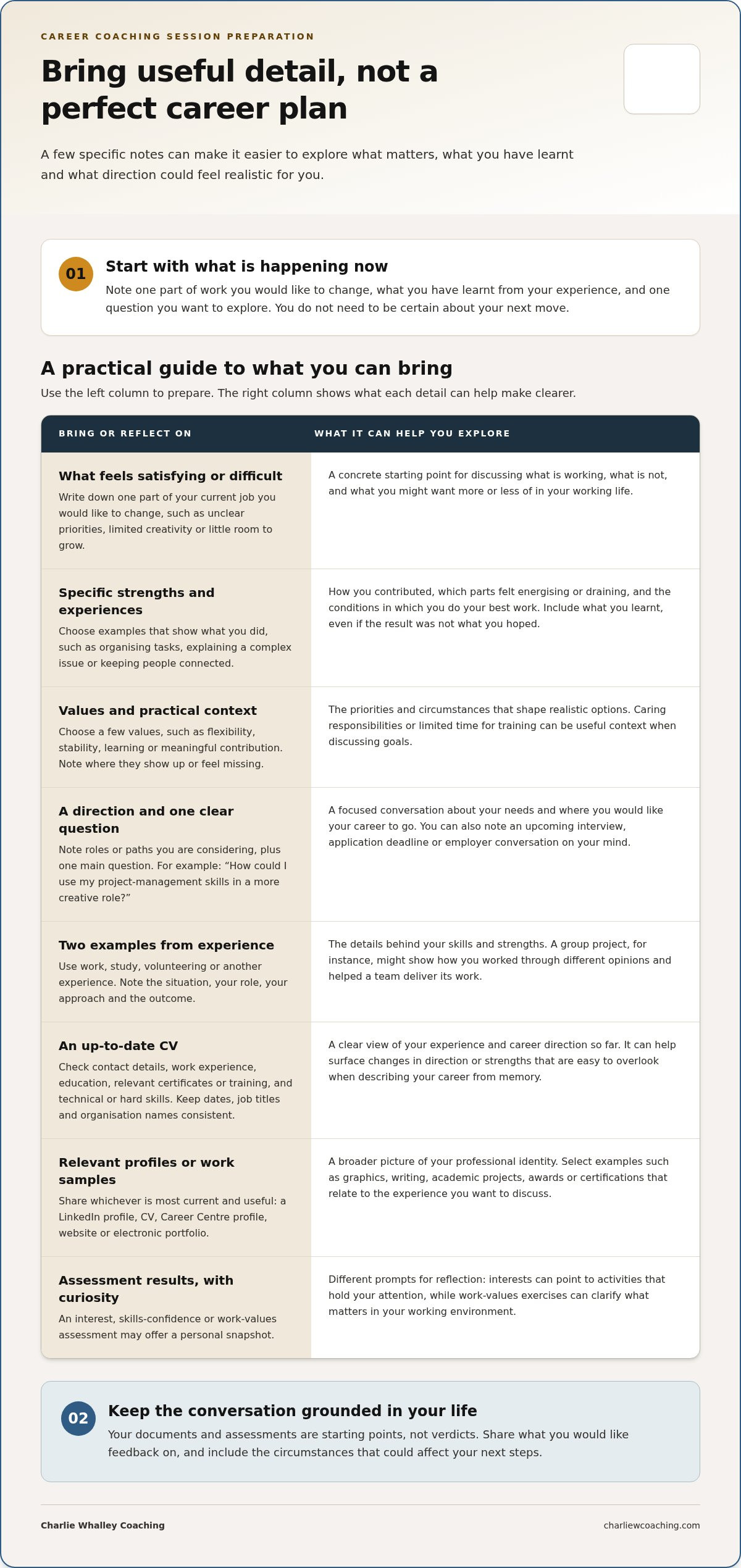
Before your session, take time to notice what feels satisfying and what feels difficult in your working life. Write down one part of your current job you’d like to change, such as unclear priorities, limited creativity or little room to grow. Then note what you’ve learnt from your career so far, including responsibilities you’ve handled well and experiences that changed your perspective. These details give the conversation a useful starting point.
Look for strengths in specific moments rather than relying on broad labels such as “hard-working”. For example, if you helped a team meet a deadline, consider how you contributed: did you organise tasks, explain a complex issue or keep people connected? Think about which parts felt energising and which felt draining. Comparing these experiences can reveal the conditions in which you do your best work.
Your values matter alongside your skills. Choose a few that shape your decisions, such as flexibility, stability, learning or meaningful contribution. For each, write a brief example of how it shows up in your work, or where it’s missing. If flexibility matters because you care for a family member, that context can help make future options realistic. The U.S. Government Publishing Office notes that a coach may assess your life experience and education during a session.
As you prepare for a career coaching session, identify roles or career paths you’re considering. You don’t need to be certain; a tentative direction gives you something concrete to explore. Write one main career question, such as, “How could I use my project-management skills in a more creative role?” Note any upcoming interview, application deadline or conversation with an employer that’s on your mind. The U.S. Government Publishing Office says a session may discuss your needs and where you want your career to go.
Prepare two examples from work, study, volunteering or another experience. For each, note the situation, your role, the approach you took and the outcome. A university group project, for instance, might show how you resolved different opinions and helped the team deliver its work. Include what you learnt, even if the result wasn’t what you hoped. Honest reflection makes it easier to discuss both strengths and areas you want to develop.
A useful way to prepare for a career coaching session is to note practical barriers that could affect your next steps, such as caring responsibilities or limited time for training. If you’ve repeatedly found daily tasks difficult to complete, mention this in your first session. It isn’t a judgement about your ability; it’s important context for shaping goals that fit your circumstances.
2. Sharing an up-to-date resume and contact information
An up-to-date CV gives your coach a clear view of your experience, education and career direction so far. Make your latest version available for the session, even if you’re not applying for a role. It can help you spot gaps, changes in direction or strengths that are easy to overlook when describing your career from memory. Include your current contact details, so your document is ready if you later decide to share it with an employer.
Check that your CV includes the essentials: current contact information, work experience, relevant certificates or training, and technical or hard skills. For each role, use concise descriptions to show your responsibilities and contribution. For example, “co-ordinated project updates” gives a clearer picture than “helped the team”. Keep dates, job titles and organisation names consistent. If a course or qualification is relevant to a direction you’re exploring, make it easy to find.
If you have a specific role in mind, tailor your CV to the opportunity. Read the job description and identify the skills or responsibilities it emphasises, then use accurate, relevant terms to describe your own experience. A role seeking data analysis, for instance, may prompt you to highlight a project where you worked with data. Don’t claim skills you don’t have or copy phrases without context. A tailored CV should clarify your genuine experience, not change what you’ve done.
Your coach can get a broader sense of your professional identity from your LinkedIn profile, CV, résumé or Career Centre profile. Share whichever is most current and useful. If details differ between documents, such as an older job title or contact address, update them where appropriate. This helps you discuss the career story you want to carry forward, rather than spending the session untangling outdated information.
Your professional identity can include more than a CV. If you have a website or electronic portfolio, choose examples that show your work and achievements, such as graphics, writing, academic projects, awards or certifications. A designer might share selected work; someone changing fields could include a relevant project. You don’t need a complete archive. Choose material that gives context to the experience you want to discuss, and note what you’d like your coach to notice.
Before sharing documents, decide what feedback you want. You might ask whether your opening summary reflects your strengths, whether a career change is clear, or which experience deserves more emphasis. Marking questions on a copy can keep the review focused. Your CV is a working record, not a verdict on your potential. Use it to start a practical conversation about how your experience connects with the direction you’re considering.
3. Assessments for career planning
A career assessment can help you examine your capabilities, skills, strengths and opportunities. A coach may use an interest, skills-confidence or work-values assessment to build a personal snapshot. Each offers a different perspective. An interest assessment may help you notice which activities hold your attention, while a work-values exercise can clarify what matters in your working environment.
Before completing an assessment, read its instructions and answer from your own experience. If a question asks whether you enjoy presenting, think about actual situations rather than choosing what sounds impressive. You might enjoy explaining an idea to a small team but feel less comfortable addressing a large audience. That distinction gives you more useful material to discuss than a simple yes or no.
Skills-confidence assessments explore how capable you feel with particular tasks. Your confidence may differ from your experience: you could have led projects but still doubt your leadership ability. Note the examples behind your answers. If you rate yourself highly in organising work, recall a time you planned a project or helped colleagues co-ordinate tasks. If your confidence is lower, identify what experience might help build it.
Work-values assessments can help you compare what you want from work with what your current role offers. Consider values such as autonomy, stability, collaboration or learning. If learning matters to you, for example, ask whether your role gives you opportunities to develop new skills. A mismatch doesn’t automatically mean you need to leave; it can help you identify what to discuss, negotiate or explore next.
Once you receive results, treat them as conversation prompts, not instructions. Look for patterns across the assessment and your experience. If a result points towards creative work, compare it with tasks you’ve found engaging, such as writing project plans or shaping a presentation. If the result surprises you, explore why. A disagreement can reveal differences between your preferences, current circumstances and self-perception.
Bring your results, notes and questions to the session, including any answer that was difficult to choose. Ask how an insight might translate into a practical step. For instance, a strong preference for collaboration could lead you to explore team-based roles or discuss how much shared work you want. An assessment can help organise your thinking, but your experience and priorities provide the context for interpreting it.
Being open to constructive feedback
Feedback can feel personal when it touches on work you care about or a decision you’ve been weighing. In a coaching conversation, try to hear the observation before deciding what it means about you. If a coach says your career goal sounds broad, that doesn’t dismiss your ambition. It may be an invitation to name a role, responsibility or change you want to explore. Pause, then ask what they noticed.
Separate specific behaviour from a judgement about your character. For example, “Your answer didn’t explain your contribution” points to something you can clarify. It doesn’t mean you lack ability. Ask for an example of where your explanation could be more precise. You could then practise describing your actions and their impact. A clear example makes feedback easier to assess and gives you something concrete to work with.
If a comment surprises you, ask questions before agreeing or rejecting it. You might say, “Could you help me understand what led you to that observation?” or “What might a clearer response sound like?” These questions invite detail rather than defensiveness. If you feel unsettled, take a moment to think. You don’t need to turn every suggestion into an immediate decision during the session.
Honesty also means sharing the context that shapes your choices. If caring responsibilities, limited time or another obligation makes a proposed step difficult, explain that plainly. A training plan may look useful on paper but feel unrealistic alongside your commitments. If you’ve repeatedly struggled to complete daily tasks, raise this in your first session. Your coach can then understand the barrier and discuss practical adjustments with you.
Feedback is most useful when it connects with your aims. Consider whether a suggestion helps you move towards the work and working conditions you want. If advice feels mismatched, explain your concerns and ask what other approaches might fit. For instance, you could discuss a smaller first step before committing to a larger career change. Be open, while keeping your judgement and priorities in the conversation.
After the session, review the feedback while it’s fresh. Capture the main observation, suggested edits and next step you agreed to consider. Separate actions you’re ready to take from questions you still want to explore. If completing a goal between sessions proves difficult, tell your coach promptly. Together, you can revisit the task and adapt it to your circumstances, rather than treating one missed step as proof you can’t make progress.
5. Career coaching and its purpose
Career coaching helps you think through work decisions with structure and practical guidance. A coach can help clarify your interests, connect your values with possible career paths and identify skills to develop. If you’re considering a move into project management, for example, you could explore relevant experience and possible training. The purpose isn’t simply to choose a job title. It’s to understand what direction fits your goals and circumstances.
A first session often introduces the coaching process and explores your needs and career direction. Expect to discuss your current situation, what you hope to change, and what you’d like to gain. You can also ask how you and your coach will decide which goals to focus on. A 15-minute session may suit a focused CV question better than exploring lifelong career goals.
Useful questions include: “How can I build on my strengths?” and “What might help me move towards this role?” You could also ask how coaching may support a career change, skill development or interview preparation. Choose questions connected to a decision you’re facing, such as whether to pursue training or apply for an opportunity.
In the United States, career coaching costs depend on the case and are given after a quote request; factors include the coaching format, scope and support needed.
For a virtual session, choose a private, quiet space and keep your notes and relevant documents nearby. Test your internet connection, audio and camera before joining, then close unrelated tabs or notifications. If you’re joining from a busy home, tell your coach about any interruption that might affect the conversation. These small steps can help you stay present and follow the discussion.
Afterwards, review the feedback while it’s fresh and capture your notes, suggested edits and next steps. Choose one manageable action, such as revising a CV summary or researching a training option, and note what might get in the way. If you struggle to complete a goal between sessions, tell your coach promptly so you can reconsider its timing or adapt the step.
Career coaching can offer personalised guidance, help you identify resources for upskilling or reskilling, and explore barriers affecting your plans. It can also support practical work such as reviewing a portfolio or preparing interview strategies. The value lies in connecting reflection with action: you bring your priorities, and the conversation helps turn them into considered next steps.
If you’re ready to explore a career change with support, book a discovery call to discuss how coaching could work for you.
Charlie Whalley Coaching: Life & Leadership Coaching
Charlie Whalley Coaching offers life and leadership coaching and career transition coaching for people seeking greater clarity, confidence or direction in their working lives. If you’re weighing a career change, feeling stuck in your current role or trying to connect your strengths with a more meaningful path, coaching can help you explore what matters and consider practical next steps.
You don’t need to arrive with a finished plan. Bring the questions you’re carrying, and the conversation can begin there. For support with your next career step, visit Charlie Whalley Coaching and get in touch when you’re ready.
Take your next step with intention
You don’t need to solve your whole career before moving forward. As you prepare for a career coaching session, focus on one decision or possibility you want to understand better. That focus can help you begin a thoughtful conversation, even if your longer-term direction still feels uncertain. Progress can start with clearer questions, not a complete plan.
Afterwards, give yourself space to consider what you heard and what feels relevant to your life. A new direction might become clearer, or you might simply recognise which question deserves more attention. Either way, your experience and choices remain central. Take the next step at a pace that makes sense for you.
If you’d like support as you explore what comes next, contact Charlie Whalley Coaching today. A conversation can help you consider whether coaching feels like a useful fit for the questions you’re carrying. You can begin where you are, with curiosity and an open mind. Your next chapter can take shape one considered step at a time.
Frequently Asked Questions
What should I bring to a career coaching session?
Bring anything that helps explain the decision you’re facing. Alongside your CV, you might take a notebook, a calendar showing upcoming commitments, or notes from a recent performance review. If you’re considering a particular vacancy, save its description so you can discuss the responsibilities that interest you. For an online session, keep digital copies easy to open and note anything you want to ask.
How do I define career coaching goals before a session?
Start by describing what you’d like to understand or change, then make the goal specific enough to discuss. For example, “I want to feel more confident about my next move” could become “I want to compare staying in my field with moving into a different role.” You don’t need to decide the outcome in advance. Bring the question and use the conversation to make it clearer and more practical.
How should I prepare my resume and LinkedIn profile for career coaching?
Check that your CV and LinkedIn profile tell a consistent story about your recent roles, skills and career direction. If your profile still describes an older position as your current role, for example, update it before discussing how you want to present yourself. You can also note which parts feel difficult to explain, such as a career break or move between industries. That gives the coach a clear focus for discussion.
What information should I share about my work history and career challenges?
Share the details that help explain how you reached your current decision: key role changes, rewarding work and challenges affecting your choices. For instance, describe what changed when a new responsibility made your role less satisfying. Include practical constraints, such as caring commitments or limited time for study, if they influence your options. You can choose what personal detail to share; focus on the context needed to discuss useful next steps.