
Personal Development Speaker for Growth-Minded Audiences

The best personal development speaker understands your audience’s real challenges and gives them practical ways to grow beyond the event. A memorable story can spark interest, but lasting value comes from ideas people can apply to their habits, resilience, sense of purpose and careers.
It makes sense to want a speaker who can inspire a room. But if your audience leaves energised and unsure what to do next, that momentum may fade. The right speaker connects motivation with meaningful action, showing how personal growth can support working lives and a stronger sense of direction.
This guide will help you choose a speaker whose experience, message and style suit your event and audience. Learn what to look for in practical content, how to assess its relevance to career and business development, and how to turn an engaging talk into a useful starting point for change.
Key Takeaways
- Choose a speaker whose message fits your audience’s real needs, not just the event theme.
- Look for practical ideas that help people carry motivation into everyday habits and decisions.
- Consider how the speaker addresses setbacks, self-understanding and purpose, as well as professional growth.
- Clarify what you want your audience to think, feel or do after the talk to guide your choice.
- Explore coaching when individuals or leaders would benefit from more tailored support beyond a single event.
How do personal development speakers turn temporary motivation into lasting habits?
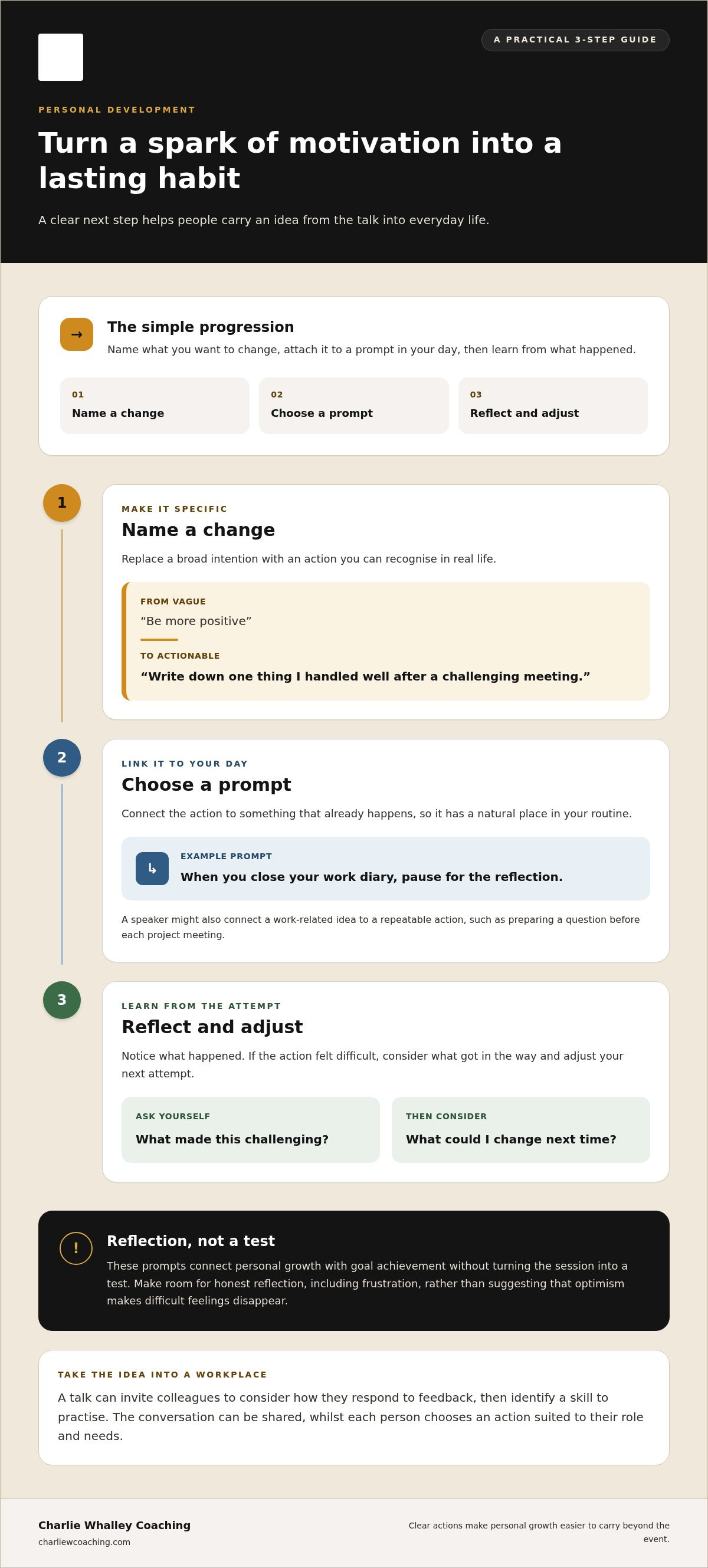
Motivation can make change feel possible, but lasting habits need clear next steps. A personal development speaker can help an audience connect an idea with a repeatable action. For example, someone who wants more confidence at work could prepare a question before each project meeting. The speaker can make that action relevant, realistic and memorable.
There is no single credential required for every speaker or subject. Consider relevant experience, clear examples of their work and how well they explain their approach. A speaker discussing career development, for instance, should connect personal growth with decisions people face at work. Ask what attendees could take away and how the talk will suit their experience.
A useful session gives people ways to apply its message to their own circumstances. One approach is to invite attendees to:
- Name a specific change. Replace “be more positive” with “write down one thing I handled well after a challenging meeting”.
- Choose a prompt. Connect the action to something already in the day, such as closing a work diary.
- Reflect on what happened. If the action felt difficult, consider what made it challenging and adjust the next attempt.
These prompts connect personal growth with goal achievement without turning the session into a test. A keynote on positivity is most useful when it acknowledges frustration and helps people consider a constructive response. Look for a personal development speaker who makes room for honest reflection rather than implying that optimism makes difficult feelings disappear.
For a workplace audience, connect the theme to culture and learning. A talk might invite colleagues to consider how they respond to feedback, then identify a skill they want to practise. This can open a shared conversation about learning, while leaving each person to choose an action that suits their role and needs.
Speaker fees depend on factors such as the event format, preparation, travel and the speaker’s experience. To request a quote, share the audience, event goals and practical requirements so the proposal reflects the occasion.
Self-help books can give attendees another way to explore an idea after an event. James Clear, author of the number-one New York Times bestseller Atomic Habits, is one example of an author whose work focuses on habits. A personal development speaker might use a book to prompt discussion, then invite attendees to reflect on one idea during their working week.
To find speakers for your event, start with its location, audience and format. Compare biographies, talk topics and examples of previous work with your needs. Then discuss how the keynote could address a specific challenge, such as helping a team adjust to new responsibilities.
Resilience and overcoming adversity
A resilience talk is most useful when it respects the complexity of adversity rather than packaging hardship as a simple success story. For audiences facing change, a speaker can explore how people respond to setbacks, seek support and take manageable next steps. The aim is not to suggest that every challenge has an easy answer, but to help people notice where they still have choices.
Anthony Trucks entered foster care at age three, giving his story a specific starting point. A speaker sharing experiences like this can explore how identity, opportunity and support shape a person’s path. The important question for event organisers is how the story serves the audience: does it invite reflection and useful action, rather than asking people to compare their hardships with someone else’s?
Homelessness also calls for care. A talk should centre lived experience, avoid treating housing insecurity as a motivational prop, and acknowledge the circumstances that can shape someone’s options. For example, a speaker might describe rebuilding routines after a period without stable housing, including the role of practical support and trusted relationships. Audiences need compassion, not a tidy “just keep going” message.
Anxiety can make a workplace presentation, difficult conversation or career decision feel daunting. A speaker can acknowledge that strain without promising to cure it. For example, a new manager who fears giving feedback could prepare one clear point, practise with a trusted colleague, then reflect afterwards. This is specific and manageable. It does not dismiss anxiety or make confidence a prerequisite for beginning.
Limiting beliefs often sound like fixed conclusions: “I’m not a leader” or “I always fail at selling”. A thoughtful talk helps listeners examine these statements as beliefs, not facts they must obey. Invite the audience to consider the evidence, name a skill to practise and choose a low-risk opportunity to try a different response. A founder can learn from a rejected pitch and refine the next presentation, rather than treating rejection as proof of inability.
When choosing a resilience keynote, consider whether its examples offer dignity, context and practical reflection. Ask how the speaker handles sensitive stories, what participants can take away and how the message fits your event’s culture. A useful follow-up could be a private written prompt: “What support, skill or next action would help me meet this challenge?” This gives people space to respond without sharing personal details publicly.
If your audience would benefit from continued reflection beyond the event, explore coaching support for navigating change. It can offer a setting to consider personal challenges and identify a constructive next step.
Self-discovery and unlocking inner potential
Personal growth starts with noticing how you think, respond and make choices. A thoughtful talk can help an audience turn those observations into clearer direction at work and beyond.
Emotional intelligence and self-awareness
Self-awareness means examining your own reactions alongside their effect on other people. Tasha Eurich’s research suggests around 95 percent of people believe they are self-aware, whilst only 10 to 15 percent are actually self-aware. A useful session helps listeners compare their intentions with observable behaviour, such as how they respond when a colleague disagrees.
For an executive, entrepreneur or team leader, reflection can reveal patterns worth changing. A speaker might invite attendees to recall a recent tense exchange, identify the emotion they felt and consider how they responded. Look for a talk that makes self-knowledge practical, rather than presenting emotional intelligence as a label or fixed strength.
Continuous learning and self-improvement
Self-improvement becomes more grounded when people see abilities as developable through intentional learning. A growth mindset involves embracing challenges, learning from criticism, drawing inspiration from others’ success and persisting through setbacks. Look for keynote examples that show how these principles apply to everyday choices, such as asking for specific feedback after presenting a new idea.
Daniel Goleman’s Emotional Intelligence has sold more than five million copies, showing broad interest in understanding emotion and behaviour. A talk can use the subject to prompt personal reflection, but what matters is what attendees can practise afterwards. For example, they might pause before replying to a difficult message and choose a response that reflects their values.
That pause is one form of emotional regulation. It does not mean suppressing frustration; it creates room to name the feeling and decide what to do next. A speaker could illustrate this with a workplace example: an employee receives critical feedback, takes time to process it, then asks a focused question about improving their work. Small choices can shift familiar responses.
Self-discovery can also help people question assumptions about their potential. An author might share how rejection shaped a manuscript, while an entrepreneur could describe adapting a business idea after customer feedback. These stories are most useful when they show the decisions and learning behind progress, not just the outcome. Consider whether the examples help your audience recognise strengths they can build on.
For learning to continue beyond the event, invite attendees to choose one insight, one action and one way to notice their progress. They might practise a new listening habit in their next team meeting, then reflect on what changed. A personal development talk should help people see new possibilities while leaving them in charge of their next steps.
Purpose and finding inspiration
Purpose can offer a steadier direction than pursuing success as other people define it. A keynote on inspiration should help audiences connect personal values with choices at work, in relationships and in daily life. For example, someone who values contribution might look for a way to mentor a colleague, rather than measuring progress only through status or recognition.
Spirituality may be part of that conversation, but it means different things to different people. A respectful speaker makes room for faith, reflection and secular perspectives without presenting one path as universal. Organisers can assess whether a talk invites personal thought instead of prescribing beliefs. A prompt such as “What matters enough to shape my next decision?” lets each attendee find their own answer.
Purposeful living becomes practical when reflection informs action. Invite participants to name a value, identify a current choice connected to it, then consider an adjustment. Someone who values family but routinely works through planned evenings might set a clearer boundary around a regular commitment. The point is not to judge the choice, but to notice whether daily patterns reflect what matters to the person.
Stories can make these questions feel tangible. Daymond John took out a $100,000 mortgage on his mother’s house to build FUBU. A speaker can use that example to explore commitment, personal risk and the reasons behind an ambition, rather than suggesting that every audience member should make a similar decision. Ask whether stories are followed by thoughtful questions about context, priorities and consequences.
Sport can offer another perspective on purpose and sustained effort. Dave Scott won the Ironman World Championship six times. That achievement could prompt an event discussion about the meaning an individual attaches to training, discipline and competition. The useful lesson is not that success looks the same for everyone, but that people can examine what gives their own effort direction.
Inspiration also needs room for change. A goal that once felt meaningful may no longer fit after a new role, a family change or a shift in priorities. A speaker can help participants revisit their definition of success without treating change as failure. One reflection exercise is to complete two prompts: “I want more of…” and “I’m ready to reconsider…”. The answers may reveal a possible next step.
Alex Banayan wrote the number-one international bestseller The Third Door. His example can introduce a conversation about unconventional routes towards ambition. To keep it grounded, invite attendees to identify a meaningful goal, an assumption about how to reach it and an alternative worth exploring. A purpose-led talk should leave people free to choose, not pressure them to follow someone else’s map.
What does a personal development speaker do?
A speaker shapes a message around an audience’s needs, then delivers it in a way people can use. For a team adapting to new responsibilities, that might mean exploring confidence, communication and decision-making. A personal development speaker does more than tell an inspiring story: they connect ideas with the choices attendees face at work.
Before the event, the speaker and organiser clarify the audience, purpose and desired takeaways. A session for new managers may focus on giving feedback, while a career event may centre on identifying strengths and direction. Share the event theme and audience context so the speaker can select relevant stories, examples and practical exercises.
During a keynote, the speaker may combine personal experience with structured reflection. After discussing a difficult decision, for example, they could invite attendees to write down a value they want to honour in a similar situation. This gives people a moment to connect the story with their own lives. A personal development speaker can make room for reflection without pressuring anyone to share private experiences publicly.
Depending on the event format, a speaker may also lead questions, discussion or a short activity. Each element should support the central message, not compete with it. An organiser can consider whether the speaker:
- Explains the talk’s purpose and main ideas clearly.
- Uses examples relevant to the audience’s work or goals.
- Offers a practical prompt attendees can reflect on afterwards.
- Adapts their delivery to the room and event format.
After the keynote, the speaker may leave the audience with a reflection or next step. A session on career confidence, for instance, could prompt attendees to identify a skill they want to use more often. Reinforce the message through a follow-up discussion or team conversation to connect an individual insight with the wider event experience.
Look beyond a compelling biography when choosing a speaker. Review the proposed topic, sample delivery and relevance of their experience. Ask what attendees will hear, consider and be invited to do. A personal development speaker discussing leadership should make the subject meaningful to your audience, whether they are emerging managers or experienced executives.
A keynote can open a conversation, while individual reflection may help someone decide what comes next. If you’re ready to explore a more personal approach to growth, book a discovery call to discuss how it could work for you.
Charlie Whalley Coaching: Life & Leadership Coaching
Charlie Whalley offers life and leadership coaching for people seeking greater confidence, clarity or direction in their personal and professional lives. If you are considering a career change, Career Transition Coaching can help you explore your next steps. Kids Coaching and Speaking & Events are also available for young people, families and audiences seeking growth-focused support.
Coaching can be a useful next step if an event has raised questions you want to explore further, or if you want support applying new perspectives to everyday decisions. In one-to-one coaching, the focus is on your circumstances and goals, helping you consider how to move forward with greater intention.
Ready to explore what could work for you? Contact Charlie Whalley Coaching to start a conversation.
Choose the next step with intention
The most valuable event offers more than a moment of inspiration. It can create space for a new conversation, a clearer decision or a different way to approach a familiar challenge. As you plan, consider what you hope your audience will carry into the weeks ahead. That intention can guide your choice of a personal development speaker and shape an experience around what matters to your people.
Growth also continues beyond the stage. If you’re considering support for your own next step, Charlie Whalley Coaching offers a thoughtful place to begin. You don’t need to have every answer ready; a conversation can help you explore what you’re looking for and whether coaching fits your situation.
Contact Charlie Whalley Coaching to start a conversation. Your next step can be a small one, and it can still move you towards a more purposeful direction.
Frequently Asked Questions
How Do You Choose the BEST Speaker for Your Event?
Start with the change you want the event to support, then assess speakers against that purpose. A personal development speaker for a leadership retreat might need to encourage thoughtful discussion, while a conference opener may call for an energising keynote. Consider whether the message suits your organisation’s values and audience. A short content outline can help you judge its relevance before deciding.
Need more inspiration for your next event?
Give the event a unifying question, such as how teams can communicate through change. You could pair a keynote with a facilitated conversation, then invite attendees to note one idea they want to raise with a colleague. This connects the event instead of making it feel like a series of separate presentations. Choose a theme that reflects a real audience concern, not simply a fashionable topic.
What is the difference between a traditional motivational speaker and a personal growth expert?
A motivational speaker often focuses on encouragement and renewed energy, while a personal growth expert may explore how people understand their choices, values or behaviour. The roles can overlap, so focus on the session’s purpose rather than relying on labels. If your audience needs renewed momentum, a motivating talk may fit. If they need space to reflect on patterns, choose content that makes room for exploration.
Why should a corporation invest in personal growth keynotes for its employees?
A keynote can give employees and managers a shared starting point to discuss a workplace priority, such as feedback or communication across teams. After a session on listening, for example, a department could reflect on how it discusses decisions at its next meeting. The value depends on how well the topic fits the organisation’s needs and whether leaders make room for the conversation to continue.
How much does it cost to hire a personal development speaker?
The fee depends on the event’s requirements, including format, preparation, travel and the speaker’s experience. Request a quote with a clear outline of the audience, objectives, location and any requested session elements, then review what the proposal covers. This helps you understand how the proposed work fits your event, rather than comparing figures without knowing what each engagement includes.
How do I choose the right speaker for an event?
Write a short brief describing your audience, event purpose, preferred tone and any sensitive subjects. Then compare the proposed content with that brief. A personal development speaker should explain how their examples and session approach relate to your attendees. A talk for experienced managers, for instance, may need different workplace scenarios from one for people beginning their careers.
What topics do personal development speakers cover?
Common themes include leadership, confidence, resilience, mindset, communication, self-awareness, purpose and career growth. The right topic depends on what attendees are facing. A group preparing for organisational change may benefit from exploring uncertainty, while a leadership gathering might focus on presence and feedback. Ask the speaker to define the session’s scope so the event has a clear focus.
How do personal growth talks compare with motivational speaking and life coaching?
A talk brings ideas to a group, while life coaching offers individual, tailored conversations focused on a person’s aims and circumstances. Motivational speaking may emphasise encouragement; personal development talks can also invite reflection and discussion. These approaches can overlap, but they serve different formats. Choose a group presentation for a shared event experience, or coaching when someone wants space to explore personal decisions in greater depth.