
Corporate leadership speakers for organizational change

The most memorable keynote isn’t always the one that leads to lasting change. The right corporate leadership speaker understands workplace behaviour, connects with your people and shares practical ideas leaders can apply. Choose someone whose message fits your audience and the change your organisation wants to make.
When you’re balancing a major transition with the everyday work of keeping people informed, motivated and connected, it can be hard to know which speaker will genuinely help. A corporate leadership speaker whose approach suits your team can make the message more relevant. A compelling talk can spark reflection, but what happens afterwards also matters.
This guide explains how to assess a speaker’s experience, audience fit and communication style, and how to turn a keynote into practical steps for workplace culture and organisational change. It also covers planning the session and its follow-through, so the corporate leadership speaker you choose supports more than a memorable day.
Key Takeaways
- Match the speaker’s experience and communication style to the change your organisation is navigating.
- Look beyond an inspiring presentation: prioritise ideas leaders can put into practice at work.
- Consider how the speaker’s background will connect with your audience and workplace culture.
- Plan follow-through so useful insights can become everyday leadership habits.
- Choose an approach that supports trust, clear communication and lasting progress through change.
Criteria for choosing a leadership keynote speaker
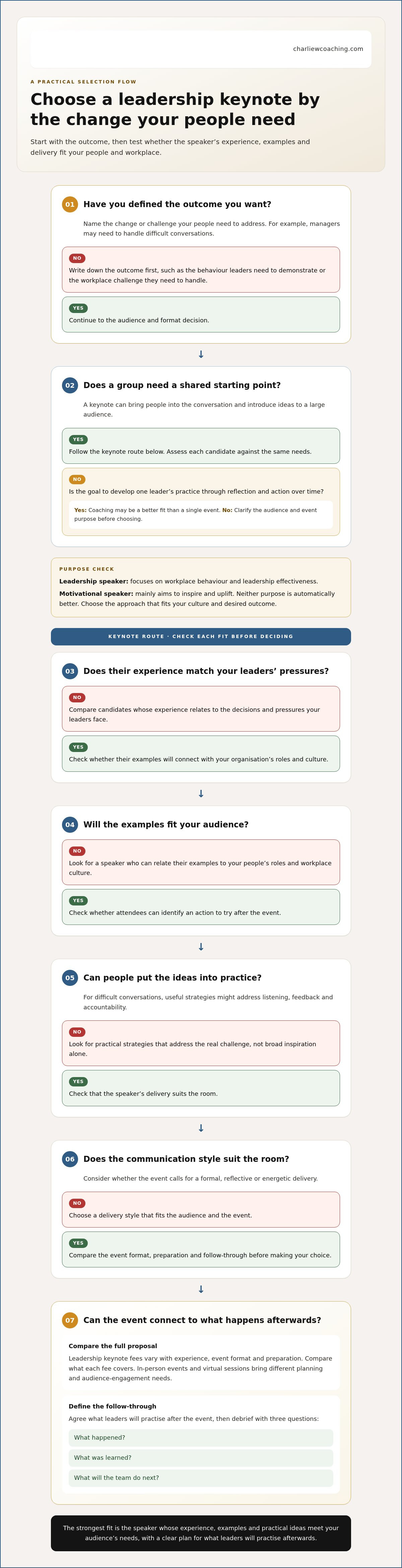
Choose a speaker based on the change your people need to make, not simply their profile. A clear purpose helps you assess their experience, audience fit and practical value.
Before comparing keynote speakers, write down the outcome you want from the event. If managers need to handle difficult conversations, for example, look for someone who can share useful strategies for listening, feedback and accountability. A corporate leadership speaker who addresses that challenge can make the keynote relevant to people’s day-to-day work.
- Relevant experience: Does the speaker understand the decisions and pressures your leaders face?
- Audience fit: Will their examples connect with your organisation’s roles and culture?
- Practical takeaways: Can attendees identify an action to try after the event?
- Communication style: Does their delivery suit the room, whether formal, reflective or energetic?
These criteria give your selection process a purpose beyond choosing the most recognisable name. They also help you compare candidates against the same needs, rather than relying on a memorable video clip alone.
Speaker fees by range and format
Leadership keynote fees vary according to the speaker’s experience, event format and preparation involved. In-person events and virtual sessions bring different planning and audience-engagement needs. Compare what each proposed fee covers, including preparation and format, rather than treating the headline figure as the whole decision.
Evaluating keynote speakers
Review a speaker’s biography, talk topics and available footage, then assess each against your event’s purpose. Do their strategies address your leaders’ real challenges and give attendees something they can apply? A strong corporate leadership speaker should explain how the keynote connects with your audience, not rely on broad inspiration alone.
Consider what support you need next. A keynote can introduce ideas to a large audience, while executive coaching supports an individual leader through reflection and action over time. If your goal is to develop one person’s leadership practice, coaching may be a better fit than a single event. If you need a shared starting point for a group, a keynote can bring people into the conversation.
Leadership speaker options
There is no single speaker who suits every organisation. In the United States, examples of leadership speakers include Mike Abrashoff, Molly Fletcher, Chad E. Foster, Alison Levine and Josh Linkner. Their varied backgrounds offer different perspectives, so consider which experience best fits your event’s purpose and audience.
Treat those names as starting points, not a universal ranking. For each candidate, connect their background to a specific audience need, such as leading under pressure or encouraging innovation. Then assess their delivery and practical strategies. That comparison helps you choose a keynote for its relevance, not just its recognition. A corporate leadership speaker should suit your event.
Leadership, organisational change, and workplace culture
A leadership keynote can give people shared language for change, but its value depends on the culture it enters. Before planning the event, identify a behaviour you want leaders to model, such as explaining decisions openly or listening to staff concerns.
Company culture shapes how employees experience change in everyday moments. If a team says it values openness but managers rarely explain decisions, a talk about transparency may feel disconnected. Ask leaders and employees for examples of what helps or hinders communication. Use those examples to help the speaker connect the message with real working relationships, not just general inspiration.
A high-performing culture is not simply a demanding one. It gives people clarity about a shared purpose, supports constructive feedback and makes accountability part of daily work. A keynote on collaboration, for example, could encourage managers to invite quieter colleagues into discussions. That is more actionable than telling teams to “work better together”. The speaker should offer ideas leaders can turn into visible habits.
Organisational health also shows in how teams handle tension. Leaders who listen actively, give feedback and address issues before they escalate can help stop misunderstandings from becoming persistent friction. A practical session might use a familiar scenario, such as a missed handover, to practise listening before responding. Ideas about workplace behaviour should help people notice what they do, not just what they intend.
To match a keynote to your culture, work through these steps:
- Name the change: Describe the behaviour leaders need to demonstrate during the transition.
- Identify the audience: Separate the needs of senior leaders, managers and frontline teams.
- Choose a relevant example: Share a real workplace challenge the speaker can address.
- Define the follow-through: Agree what leaders will practise after the event.
Leadership speakers focus on workplace behaviour and leadership effectiveness; motivational speakers mainly aim to inspire and uplift. Neither purpose is automatically better. Choose the approach that fits your culture and desired outcome. If leaders need to make feedback more useful, look for a session that teaches and models that skill.
After the event, use three debrief questions: what happened, what was learned, and what will the team do next? A weekly 30-minute reflection can help managers revisit commitments and discuss obstacles. Keep the conversation specific, such as whether leaders have explained a difficult decision clearly. That way, the keynote becomes a starting point for cultural practice, not an isolated event.
Speaker backgrounds and leadership experience
A corporate leadership speaker delivers a keynote that shares leadership perspectives and helps an audience consider workplace challenges. Book 3 to 6 months in advance, allowing time to align the speaker’s expertise and message with your event.
Speaker expertise and topics
Start with the leadership challenge your audience needs to explore. Topics may include decision-making, team performance, resilience or innovation, shaped by experience in business, sport, public service or the military. Alison Levine’s leadership experiences at 29,000 feet offer a distinctive perspective on preparation and decisions under pressure.
Check that the speaker’s expertise matches the subject, rather than choosing a topic solely for its appeal. A corporate leadership speaker discussing uncertainty should connect their stories to the choices leaders face at work. Ask what attendees will be invited to consider, and whether the examples can prompt useful discussion beyond the stage.
Corporate credibility and experience
Look beyond a polished biography. Consider the responsibilities behind a speaker’s achievements and how those experiences relate to your organisation. Tony Dungy became the first African-American head coach to win a Super Bowl when the Indianapolis Colts won in 2007. That milestone offers context for his leadership background, but relevance depends on your event’s purpose.
Credibility also comes from explaining lessons honestly and clearly. A corporate leadership speaker should be able to describe the challenges behind a success, not only its headline outcome. When reviewing a biography or talk footage, notice whether the speaker links personal experience to practical leadership ideas your audience can understand and discuss.
The speaker’s role
A speaker brings a focused perspective to an event, shares ideas with a group and can prompt reflection on leadership behaviour. A keynote may inspire attendees, but it doesn’t replace ongoing coaching or organisational decisions. A corporate leadership speaker can introduce a shared theme, while leaders remain responsible for deciding how to apply it at work.
Military and public-service backgrounds can bring lessons about responsibility, uncertainty and decision-making. Mike Pompeo served as U.S. Secretary of State from 2018 to 2021 and was Director of the CIA from 2017 to 2018. These roles offer context for his experience, though the useful question is how that perspective connects with your audience’s concerns.
Before booking, compare each candidate’s expertise, responsibilities and speaking style. Share the event’s purpose, audience and current challenges, then consider whether their examples will feel relevant. Allow time for that conversation: booking 3 to 6 months in advance can give organisers and speakers space to shape a fitting keynote. The right choice brings more than motivation; it helps people examine leadership ideas through a perspective they can carry into their work.
Long-term behaviour change and organisational impact
To assess a leadership speaker’s impact, choose observable behaviours before the event and review them afterwards. For example, note whether managers explain decisions more transparently during a change programme.
Leading through uncertainty and change
During organisational change, leaders need to communicate clearly, acknowledge concerns and guide teams with empathy. A keynote can help managers consider how they respond when plans shift, questions remain unanswered or employees feel unsettled. Use a scenario from your organisation, such as a restructure, to make the discussion relevant.
After the event, ask each leader to write down three changes they’re willing to take on. These commitments turn a useful thought into a visible intention. Keep them practical: a manager might share the reason behind a decision, invite concerns in a team meeting or explain what happens next.
Agree how you’ll follow up. Check in with leaders 30 days and 90 days after the keynote to discuss progress, barriers and examples of changed behaviour. The aim isn’t to measure enthusiasm in the room. It’s to learn whether people are applying the ideas in real conversations and decisions.
Change and innovation
Change can create room for innovation, but new ideas need collaboration and follow-through. A speaker might invite teams to examine an existing process, identify a point of friction and suggest an improvement. Leaders can then discuss which idea to test, who will take responsibility and what they can learn from the result.
Technology-driven disruption is changing work, so leaders need to help teams adapt. A keynote can frame innovation as a series of considered actions, not a demand to change everything at once. Choose a message that recognises the human side of change, including uncertainty about new tools and altered responsibilities.
To connect the event with lasting organisational impact, select two or three practical habits from the keynote. Assign an owner and deadline to each. For instance, a team could commit to sharing lessons from a new process during an existing meeting. Clear ownership makes the next step easier to see.
Review commitments at follow-up points and note specific examples. Did managers invite questions? Did teams share learning across roles? These observations help you assess progress and decide what support could help next. If a habit hasn’t taken hold, discuss the obstacle without blame and agree a practical adjustment. Behaviour change grows through repeated action, reflection and collaboration, not inspiration alone.
A simple debrief can keep the learning grounded: what happened, what did the team learn, and what will it do next? Use the answers to refine future actions, so the keynote supports the organisation’s direction instead of becoming a stand-alone event.
Why the choice of corporate leadership speaker matters
A keynote does more than fill a slot in the event programme. The right speaker can shape how audiences think about a challenge, which skills they practise and whether the event leads to action. A mismatch can leave people inspired for the moment but unsure how the message applies to their work.
Start with the decision your organisation needs people to make differently. If a merger is creating uncertainty, for example, a talk about leading through change may be more relevant than a broad presentation on personal success. This helps you choose a speaker whose experience and stories support the event’s purpose.
Audience expectations matter, too. Senior leaders may want a fresh perspective on accountability, whilst frontline teams may need practical ways to raise concerns. A single keynote can address both groups, but the message needs clear examples connecting leadership principles with everyday interactions. If attendees cannot see their own work in the stories, useful ideas may remain abstract.
The speaker also influences the tone of the conversation. A calm, candid account of a difficult decision can create room for honest reflection. A high-energy talk may suit an event intended to build momentum. Choose a style that respects how people are experiencing change, rather than assuming every audience needs the same kind of motivation.
Before confirming a speaker, use these steps to test the fit:
- Define the moment: Describe the change or leadership challenge the event addresses.
- Name the audience: Identify who will attend and what each group needs to take away.
- Set an action: Choose a behaviour attendees can practise after the keynote.
- Connect the message: Link the speaker’s examples to decisions your people face.
- Plan follow-through: Decide how managers will revisit the learning at work.
After a keynote on trust, for instance, a leadership team could agree to explain the reasoning behind difficult decisions. This bridges the speaker’s ideas and the conversations employees actually experience. The event then becomes part of the organisation’s thinking, not a separate moment of inspiration.
A thoughtful choice also helps organisers use the event well. A 45-minute motivational talk can introduce a shared idea, but the programme should make space for attendees to reflect and discuss its relevance. That might mean a facilitated conversation, a team commitment or time for questions. The format should reinforce the purpose, not compete with it.
If you’re considering how leadership development can support people beyond an event, explore leadership coaching as a way to work through individual challenges and build practical next steps.
Charlie Whalley Coaching: Life & Leadership Coaching
Charlie Whalley Coaching offers Life & Leadership Coaching for people navigating professional change, leadership challenges or self-doubt. If a keynote has helped you identify what needs to shift, coaching can give you space to explore your next steps and build confidence as you put them into practice.
For organisations planning an event, Charlie Whalley’s Speaking & Events offer a way to bring leadership ideas to a wider audience through talks and workshops. For individual leaders, coaching provides different support, centred on their goals and circumstances. The right next step depends on whether you’re planning an event or seeking focused support for your development.
To explore what could help, book a free discovery session with Charlie Whalley Coaching.
Choose the next step that keeps change moving
The event is one moment in a larger process. Once you’ve chosen a corporate leadership speaker, give your team a clear way to carry useful ideas into everyday decisions. A small, deliberate action can help leaders begin, whether that means opening a more honest conversation or making space for different perspectives.
Not every challenge needs a keynote. If you’re looking for continued personal support as you navigate leadership or a career change, Charlie Whalley Coaching offers Life & Leadership Coaching, Career Transition Coaching and Kids Coaching. The right kind of support depends on the person and the change they’re working through.
You don’t need to have every next step mapped out before starting a conversation. Share what you’re navigating and explore what might help.
Contact Charlie Whalley Coaching to discuss a possible next step. Change can begin with one thoughtful conversation.
Frequently Asked Questions
How much does it cost to hire a corporate leadership speaker?
A speaker’s fee depends on experience, event format, preparation and the scope of the engagement. In-person and virtual events can have different requirements, so compare the full scope rather than just the headline fee. Set out your event needs when requesting a quote; the price depends on the engagement.
How do I find and evaluate a corporate leadership speaker?
Start with the event’s purpose, then shortlist speakers whose experience relates to that need. A leadership team facing a restructure, for example, may value a speaker who can discuss communicating through uncertainty. Review biographies, topic descriptions and speaking footage, then assess whether the examples feel relevant to your audience. A clear event brief makes it easier to judge fit.
What topics do corporate leadership speakers cover?
Topics often include leadership effectiveness, workplace behaviour, communication, feedback, decision-making and guiding teams through change. The most useful focus depends on your audience and the event’s aim. If managers need to encourage candid conversations, for instance, a session on listening and feedback may be more relevant than a broad talk about ambition. Ask how the speaker will frame the subject for your attendees.
How do keynote speakers differ from leadership trainers and consultants?
A keynote speaker gives a presentation to share ideas and prompt reflection across an audience. A leadership trainer typically focuses on practising specific skills, whilst a consultant analyses an organisational challenge and advises on responses. These roles can complement one another, but they aren’t interchangeable. Choose a keynote for a shared event message, and training when attendees need structured practice.
What questions should I ask before hiring a leadership speaker?
Ask how the speaker will adapt their talk to your event, which examples they might use and what attendees can take away. Clarify the format, preparation process and any venue or virtual platform requirements. You can also ask how the talk might connect with existing leadership priorities. These questions help you understand what the event involves before making a decision.
What factors affect a corporate speaker’s fee and availability?
Fees can reflect the speaker’s experience, event format, preparation needs and the scope of the engagement. Availability depends on the speaker’s existing commitments and your preferred event date. A virtual session may involve different arrangements from an in-person event. Share your date, audience, format and goals when requesting a quote, so the proposed engagement can reflect your needs.