
Personal Development Events for Beginners and Self-Discovery

Yes, you can start exploring personal development events through local meetups and practical workshops. In Miami, Open Men’s Circle gatherings are scheduled in South Miami for Tuesday, 3 November at 7:00 pm EST and in Midtown Miami for Wednesday, 11 November at 6:30 pm EST. These are examples of local events, while the right fit depends on what you’re hoping to explore.
Taking a first step can feel daunting when you’re unsure what to expect or whether you’ll feel comfortable. That hesitation is understandable, and you don’t need to have everything figured out before you begin. This guide explores personal development events, from beginner-friendly meetups and leadership workshops to gatherings centred on purpose and self-discovery. You’ll also find ways to assess which format suits you, whether you want a welcoming group conversation, practical skills or space to reflect on your next direction.
Key Takeaways
- Choose a welcoming meetup or practical workshop based on what you want to explore, rather than feeling you need a clear plan before you go.
- Compare leadership events by their focus: a workshop may centre on skills such as communication, public speaking or professional branding.
- Use questions about your values, interests and next steps to decide whether a purpose-focused event feels right for you.
- Before booking, consider the event format, its aims and what you hope to take away from the experience.
- If you want ongoing support to build confidence or navigate change, explore whether coaching could complement what you learn at an event.
Leadership workshops
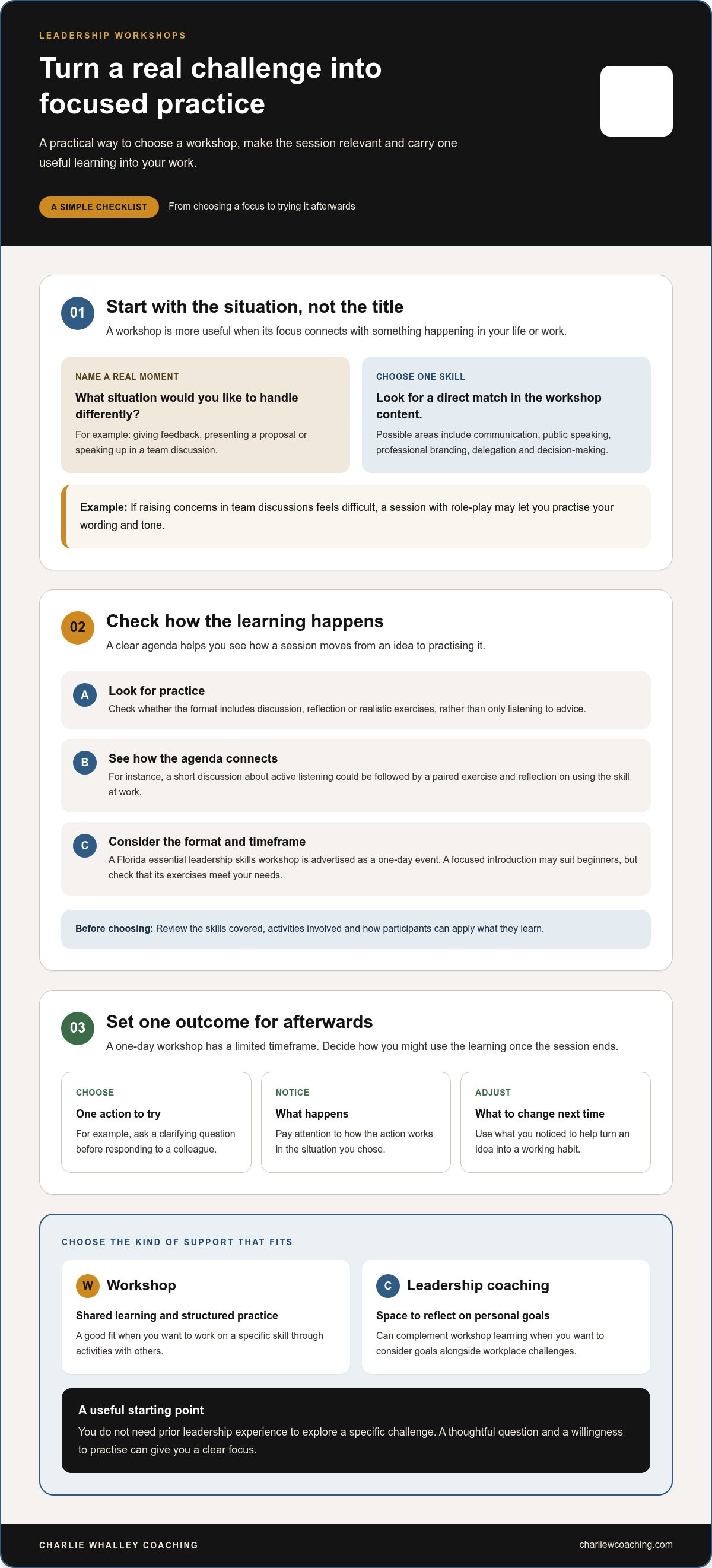
A leadership workshop can help you practise a specific skill rather than simply listen to advice. In Florida, an essential leadership skills workshop is advertised as a one-day event. This format may suit beginners looking for a focused introduction before committing to longer development. The title alone, however, won’t tell you whether the exercises meet your needs. Check which skills are covered, what activities are involved and how participants can apply what they learn.
Leadership isn’t limited to managing a team. You might want to speak more clearly in meetings, give useful feedback, handle difficult conversations or make decisions with greater confidence. A workshop focused on one of these situations offers a practical starting point. For example, if you avoid raising concerns in team discussions, role-play could help you practise your wording and tone. If you’ve recently taken responsibility for a project, exercises in delegation may be more relevant than general leadership theory.
Before choosing an event, use these steps to connect its content with your goals:
- Name the situation: Identify a real moment, such as giving feedback or presenting a proposal.
- Match the skill: Check whether the workshop addresses that situation directly.
- Look for practice: Notice whether the format includes discussion, reflection or realistic exercises.
- Choose one outcome: Decide what you want to try differently after the session.
These steps can also help you judge whether a workshop suits a first-time attendee. A clear agenda shows how the day moves from learning a concept to practising it. For example, a short discussion about active listening might be followed by a paired exercise and reflection on using the skill at work. You don’t need prior leadership experience to explore a specific challenge. A thoughtful question and a willingness to practise can give you a useful focus.
One-day workshops have a limited timeframe, so consider how you’ll apply the learning afterwards. Write down one action to try, such as asking a clarifying question before responding to a colleague. Then notice what happens and what you might adjust next time. This follow-through can help turn an idea into a working habit. For broader development, leadership coaching offers space to reflect on personal goals alongside workplace challenges. A workshop, by contrast, is better suited to shared learning and structured practice.
The most useful choice connects with a real situation in your life. Finding a leadership skill difficult doesn’t mean you’re unsuited to leading. It gives you a clear place to begin. A workshop can help you practise, and your next steps can build on what you learn.
Personal development events
In the United States, personal development events range from small-group conversations to practical skills sessions. The right format depends on whether you want to reflect, practise or connect with others.
Choosing an Event or Coach
Start with a clear aim, such as building confidence, exploring a career change or practising communication. Then compare the event description with that aim: check its format, activities and focus. If you’re considering coaching, look for an approach centred on your goals and practical next steps. Before registering, read the event’s cancellation terms so you understand the rules.
Be cautious of pressure to commit quickly, unclear event details or promises of guaranteed personal change. A grounded event explains its purpose and gives you space to decide whether it suits you.
Online and In-Person Formats
Both formats appear in the US event examples. The virtual Improv Development class is scheduled for Wednesday, 4 November, at 7:15 pm EST; the online speaking event “From Nervous to Natural” is scheduled for Saturday, 31 October, at 11:00 am EDT. These give you options for joining remotely.
In-person examples include Open Men’s Circle in South Miami on Tuesday, 3 November, at 7:00 pm EST, and Midtown Miami on Wednesday, 11 November, at 6:30 pm EST. Choose online for remote participation, or in person if meeting others face-to-face matters to you.
Available Event Types
US listings include group conversations, speaking practice, improv classes, spiritual reflection and professional development. For instance, “Let’s Share and Connect: Perfectionism” is scheduled for Sunday, 8 November, at 2:00 pm EST. It offers a specific theme to consider when deciding whether a group discussion matches your interests.
Other listings focus on business or professional growth. “FROM OPERATOR TO OWNER” is scheduled in Doral for Friday, 13 November, while “Professional of the New Era” is scheduled in North Miami Beach for Saturday, 27 February 2027. Compare each event’s stated focus with the question you want to explore.
To register, follow the organiser’s event registration process and review the cancellation terms before completing your booking. Those terms explain how cancellations are handled for that event. If you’re drawn to a facilitated group experience, explore reflective event conversations as one way to take your next step.
Personal purpose and self-discovery
A purpose-focused event can give you a structured pause to notice what matters. Rather than expecting a complete life plan, choose one question to explore, such as what gives your work meaning or where you want greater balance. The scheduled Spanish-language spiritual reflections event on Tuesday, 3 November, at 7:00 pm EST offers one example of a reflection-centred format. Its language and theme are useful factors to consider when deciding whether an event feels relevant.
Connect your choice to a real moment in your life. If you feel disengaged at work, ask which parts of your role still feel meaningful. If you’re considering a change, identify what you want more of, such as creative work, contribution or time for family. Writing down a question gives you a steadier focus than arriving under pressure to discover one defining purpose. You’re there to explore, not produce a perfect answer.
Event titles can help you identify a theme, but your own intention makes the experience more personal. “Breathe. Heal. Transform.” is scheduled for Thursday, 19 November, at 7:00 pm EST. You might use a title like this as a prompt, then write down what you hope to reflect on. Keep the intention practical: for example, notice which commitments feel aligned with your priorities and which leave you feeling disconnected.
- Before the event: Write one question you want to explore, such as what gives you energy during a typical working week.
- During the event: Note ideas that resonate, without treating every suggestion as something you must adopt.
- After the event: Choose one small action, such as protecting time for a valued activity or starting a conversation.
This simple sequence helps turn reflection into a choice you can examine in everyday life. For instance, if connection matters to you, notice whether making time for a friend feels consistent with that value. One observation can inform your next decision without requiring a sudden career or lifestyle change. Keep your notes specific so you can distinguish an insight from a broad statement such as “I need more balance”.
Self-discovery can also mean noticing patterns that make you hesitate. If you often avoid sharing ideas because you fear criticism, write down what you might contribute in a supportive setting. A reflective event may help you consider that pattern from a fresh angle. Your next step could be modest, such as voicing one suggestion in a meeting. A purposeful choice begins with what matters to you, then finds a practical expression.
Use an event’s language, theme and format to decide whether it fits your question. A Spanish-language reflection session may suit someone who prefers exploring ideas in Spanish, while a broader personal-growth gathering may suit another aim. The clearest benefit comes from matching the event to a question you genuinely want to explore, then carrying an insight into your daily choices.
How much do personal development events typically cost?
There isn’t one standard fee for an event focused on growth or self-discovery. The cost depends on its format, length, subject and activities. A short online discussion and an in-person workshop with guided exercises, for example, may have different fees. Compare the stated price with what the event offers rather than judging its value by the title alone.
Several details can affect an event’s price. An online session may have different practical costs from an in-person gathering using a venue. The programme’s duration, facilitator’s involvement and included materials can also shape the fee. A public-speaking workshop, for instance, may involve structured practice, while a reflective group session may focus on facilitated conversation. These formats offer different experiences, so compare like with like.
Before booking, use this simple process to understand the commitment:
- Read the event description: Note the format, duration, topic and activities included.
- Compare similar options: Set a speaking workshop beside another speaking workshop, not a retreat or group discussion.
- Review extra expenses: Consider travel, accommodation or materials if the event involves attending in person.
- Check booking terms: Read the cancellation policy and any payment conditions before registering.
For example, an online event may remove the need to travel, while an in-person event may require transport to the venue. That difference can affect your overall budget, even when the advertised fee is clear. A day-long workshop also involves a different time commitment from a shorter group discussion. Consider the full cost in money, travel and time before deciding.
Value depends on how closely an event matches your goal. If you want to practise speaking, an event with active exercises may be more relevant than one based mainly on discussion. If you want space to reflect, a themed gathering may suit you better. Write down the outcome you hope for, then compare the description with that aim. This keeps your decision grounded in usefulness, not pressure to choose the most expensive or longest option.
Coaching fees depend on the individual case and are provided after a quote request. Relevant factors can include the type of support and the scope of the work. This differs from booking a public event, where the organiser’s listing sets out the fee and terms. Keep the decisions separate: compare event costs by format and content, and consider coaching separately if you want individual support.
How do I choose a reputable personal development event or coach?
A useful choice starts with a clear purpose, not a promise of instant change. Before booking, write down the situation you want help with, such as speaking up at work or deciding on a career direction. Then compare the event’s or coach’s stated focus with that goal. A clear match makes it easier to judge whether the time and commitment feel worthwhile.
For an event, read the description closely. Look for its agenda, format, facilitator details and planned activities. A session on confidence, for example, should explain whether it involves discussion, exercises or individual reflection. Those details help you picture the experience and decide whether it suits your preferred way of learning. If the description makes broad promises but offers little practical detail, pause before booking.
For a coach, consider how the first conversation is framed. A constructive discussion makes room for your priorities, current challenges and desired next steps. Notice whether the coach listens carefully and explains how the work could relate to your goals. You should be able to describe what you want to explore without feeling pushed into a decision or asked to accept a guaranteed outcome.
Use this checklist to assess fit and clarity:
- Purpose: Can you explain what the event or coaching is designed to address?
- Approach: Are the activities or coaching process described in practical terms?
- Expectations: Are the time commitment, costs and booking terms clear?
- Choice: Do you have room to consider the offer without pressure?
- Next step: Can you identify how the experience might apply to a real situation?
Red flags include pressure to pay immediately, vague descriptions and claims that one event will solve every personal or professional challenge. Treat dramatic guarantees with caution. Personal growth depends on your circumstances, choices and what you put into practice afterwards. A reputable facilitator describes an event’s aims without claiming to control your results. Clear cancellation terms also help you understand the booking before you commit.
After reviewing these points, ask yourself whether the format feels suitable and the purpose matters to you. For example, a structured group discussion may fit someone who wants to hear different perspectives, while individual coaching may better suit a personal challenge requiring focused reflection. If you’re ready to explore a guided event experience, take a next step with event conversations.
Charlie Whalley Coaching: Life & Leadership Coaching
If an event has helped you identify a change you want to make, but you’d value individual support, Charlie Whalley Coaching may be a natural next step. Life & Leadership Coaching offers space to explore self-doubt, build confidence and work through personal or professional challenges. If you’re considering a change in your working life, Career Transition Coaching may be relevant. Speaking & Events offers another way to engage with development through shared learning.
You don’t need to arrive with every answer. A clear starting point, such as a leadership challenge or a decision about your next career step, can help shape the conversation. If you’d like to explore whether coaching or an event is right for you, contact Charlie Whalley Coaching or visit charliewcoaching.com.
Take your next step at your own pace
You don’t need a complete plan before deciding what comes next. Let your most important question guide you: perhaps you want to lead with greater confidence, change careers or support a child through a new challenge. Personal development events can open up fresh perspectives, while ongoing support may help you turn reflection into considered action.
Charlie Whalley Coaching offers Life & Leadership Coaching, Career Transition Coaching and Kids Coaching. Each speaks to a different stage or challenge, so you can explore the kind of support that feels relevant to your circumstances. There’s no need to have every detail worked out before taking that first step. A conversation can help you put your priorities into words and consider a way forward.
Contact Charlie Whalley Coaching to start a conversation. Your next step can be small, thoughtful and entirely your own.
Frequently Asked Questions
Are there beginner-friendly personal development meetups available locally?
Yes, local meetups can offer a welcoming way to explore personal growth with others. In Miami, for example, Open Men’s Circle holds gatherings in South Miami and Midtown Miami. To find personal development events suited to a first visit, look for small-group discussions or sessions with a clearly stated theme. A topic such as confidence or work-life direction can help you decide whether the conversation feels relevant.
What skills do personal development workshops focus on improving?
Workshops can focus on communication, public speaking, professional branding, leadership, and giving or receiving feedback. For example, a feedback session may help you prepare for a conversation with a colleague, while a speaking workshop may give you a chance to practise presenting an idea. Check the event description for activities as well as topics. The format shows whether you’ll practise a skill, reflect on it or learn through discussion.
Where can professionals find networking events tailored for career growth?
Start with professional associations, industry groups, community organisations and event calendars for your city or sector. Search for a specific goal, such as leadership development or career change, rather than networking alone. Before attending, read the event description to understand who it’s intended for and whether it includes structured introductions, discussion or talks. A focused event can help you start relevant conversations and explain what you hope to learn.
What are the best personal development conferences and workshops in 2026?
“Best” depends on the outcome you want, so compare the focus and format before choosing. Unleash The Power Within is scheduled in Miami for Thursday, 5 November, at 8:00 am EST. Florida listings also include one-day public speaking skills training and workshops on professional branding. If you’re new to these events, choose a subject connected to a current goal, then review the agenda to understand what you’ll take part in.
Where can I find personal development events near me?
Search event listings using your town or city alongside an interest, such as leadership, purpose or communication. Include nearby areas if you can travel, and add “online” if you’d consider joining remotely. For example, someone in Miami could search by neighbourhood for local discussion groups, while a remote attendee could explore virtual classes. Compare each event’s location, format and theme with what you want from the experience.
What topics are covered at personal growth workshops and seminars?
Topics can include purpose, self-awareness, confidence, perfectionism, mindset, leadership and communication. Some personal development events use a shared theme to prompt reflection, while others focus on practising a specific skill. For instance, an event about perfectionism may invite participants to consider how high expectations affect their choices. Read the description to understand its focus, then choose a topic connected to a question or situation you’re already considering.
What should I bring and expect at an event?
Bring the event details, something to take notes with and a question you’d like to explore. For an online session, keep the joining information accessible and choose a space where you can focus. Depending on the format, you may listen, reflect, discuss or take part in practical exercises. Participate at a level that feels comfortable; you don’t need a polished personal goal to benefit from thoughtful reflection.