
Coaching for young people and the transition to independence

Coaching for young people should last long enough to support meaningful progress, without undermining independence. There is no single timetable that suits everyone: the focus is on helping a young person build skills and confidence they can use beyond coaching.
If you’re wondering whether coaching could help, it’s natural to want a clearer picture of the process and when it may be right to step back. Moving towards independence can bring questions about goals, everyday skills, work and emotional wellbeing all at once. Uncertainty does not mean a young person is falling behind.
This article explains how coaching can help young people find direction, turn goals into practical steps and build confidence. You’ll also learn what can shape the coaching process, how career readiness and emotional wellbeing may fit into the work, and what a considered move towards greater independence can look like.
Key Takeaways
- Turn broad ambitions into manageable goals, with regular reflection to recognise progress and adjust next steps.
- Support children and teenagers with practical coaching techniques that respect their voice and growing independence.
- Explore interests and strengths to make career planning and preparation for work feel more focused.
- Build emotional awareness and stress-management skills, while recognising when coaching may need to sit alongside other support.
- Understand why coaching often lasts a few months and how progress can help a young person move towards managing change independently.
Goal setting and accountability
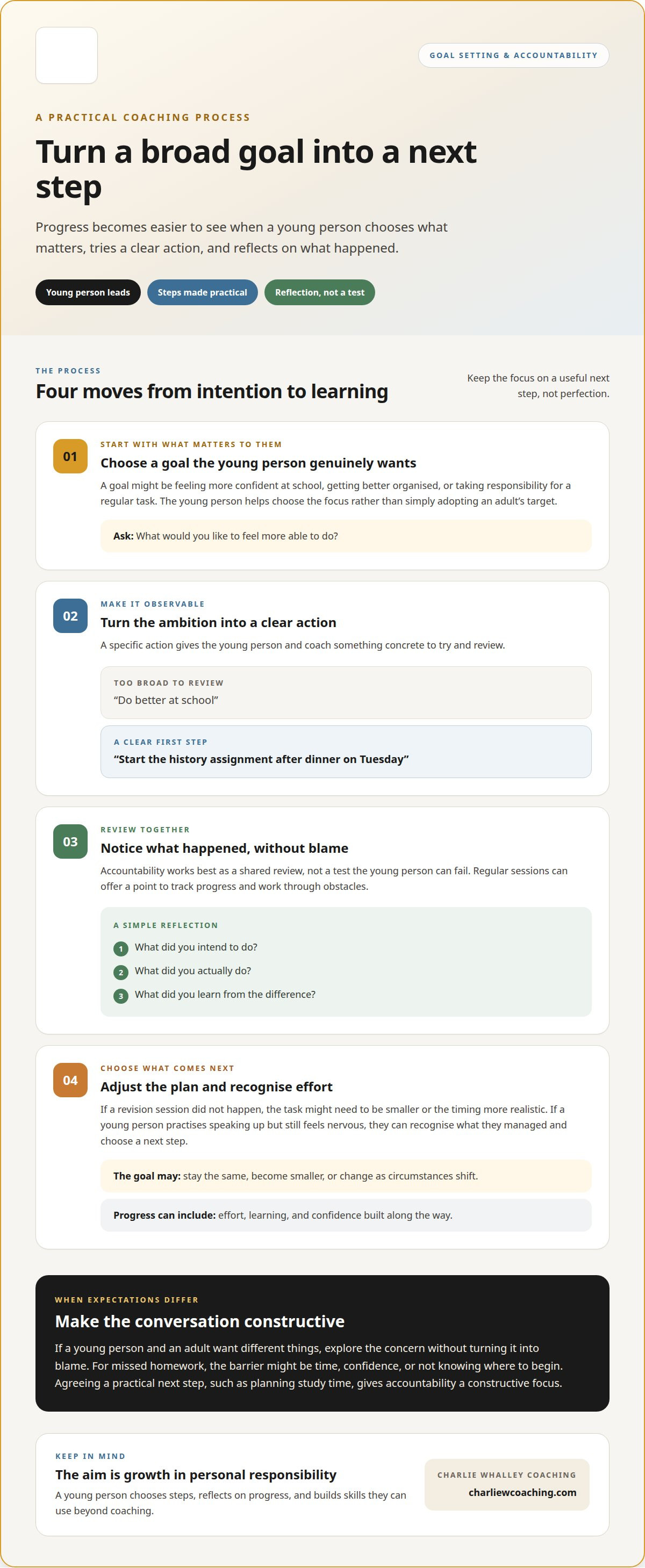
Goals feel more manageable when a young person connects them to everyday choices. A student might want to feel more confident at school, become better organised or take responsibility for a regular task.
Motivation and Personal Responsibility
Coaching helps a young person identify what matters to them, rather than simply adopting an adult’s target. For example, a student who wants to avoid last-minute stress could pack their school bag each evening. A coach can help break that aim into clear actions and review what helped. Personal responsibility grows when the young person chooses the steps and reflects on their progress.
Difficult Conversations About Goals
Goals can reveal differences between what a young person wants and what parents or teachers expect. A conversation about missed homework, for example, can explore whether the barrier is time, confidence or not knowing where to begin. A coach can help each person express their concerns without turning the discussion into blame. Agreeing a next step, such as planning study time, gives accountability a constructive focus.
A practical coaching process turns a broad ambition into an observable action. “Do better at school” is hard to review; “start the history assignment after dinner on Tuesday” gives the student a clear first step. The coach and young person can then discuss what happened, what got in the way, and whether the plan needs adjusting. Weekly sessions can provide a regular point to track progress and troubleshoot obstacles.
Accountability works best as a shared review, not a test the young person can fail. A coach might ask what the student intended to do, what they actually did and what they learnt from the difference. If a planned revision session did not happen, the next step might be to make the task smaller or choose a more realistic time. This keeps the focus on problem-solving and personal responsibility.
Progress also means recognising effort and learning, not just completing the original goal. If a young person practises speaking up in class but still feels nervous, they can identify what they managed and choose a next step. That reflection can strengthen confidence and resilience. The goal may stay the same, become smaller or change as circumstances shift.
- Choose one goal the young person genuinely wants to work towards.
- Turn it into a specific action, such as preparing school materials the night before.
- Review what happened, identify obstacles, and agree the next practical step.
Coaching skills and techniques for children and teens
Useful coaching connects a young person’s interests with practical skills they can practise. Sessions may focus on routines, relationships, academic confidence or everyday decisions.
Building Independence Skills and Habits
Independence develops through repeated actions, such as organising school materials or asking a teacher for help. A coach can help a young person choose a habit, anticipate what might interrupt it and decide how to resume after a missed attempt. Look for coaching that gives the young person a voice in choosing these steps, rather than simply setting rules for them.
For a minor, parent or guardian consent depends on local requirements and the coaching arrangement. Parents may be involved where appropriate, while the young person’s views and growing autonomy remain central.
Time, Money and Daily Life Skills
Practising everyday tasks can make abstract advice easier to use. A teenager might plan homework around an after-school activity, prepare their belongings the evening before or practise following a simple spending plan. A coach can break each task into manageable steps and help the young person notice what worked. These skills provide a foundation for taking on more responsibility over time.
Skills for Coaching Teenagers
Effective sessions use attentive listening, open questions and clear, age-appropriate activities. A coach might invite a teenager to map a difficult interaction at school, then practise how to ask for clarification. Youth programmes set their own age ranges; readiness depends on whether a young person can engage with the focus and activities. Sessions may include a check-in, a chosen topic, practical work and an agreed next step.
Coaching is forward-focused skill-building, not therapy. If anxiety, depression or trauma is present, therapy should accompany coaching rather than be replaced by it.
Choosing a Coaching Focus
Choose an academic focus for study routines or classroom confidence, a career focus for exploring work interests, a life focus for habits and relationships, or a sports focus for performance goals. Start with the challenge the young person wants to address, then consider which coach’s approach matches it. If school pressure affects several areas, agree a manageable first priority together.
Warning signs include pressure to keep sessions secret, unclear boundaries, promises of guaranteed change, or an adult dismissing the young person’s concerns. A respectful process explains confidentiality and its limits, welcomes appropriate parent involvement, and lets the young person ask questions. A practical, autonomy-centred approach can also be part of Kids Coaching.
Career exploration and job readiness
Young people can access academic, career, life and sports coaching, depending on the challenge they want to address. Career-focused coaching helps them explore work interests, choose a direction and practise steps towards employment or further study.
Career uncertainty can feel especially difficult when school, family expectations and personal interests point in different directions. A structured process starts with what the young person enjoys, values and wants to learn. For example, someone who likes solving practical problems might explore hands-on roles, then identify what training or experience could help them understand those options.
Career exploration does not require an immediate, final decision. A young person can compare a college course, an apprenticeship and entry-level work by considering daily tasks, learning opportunities and the lifestyle each path involves. The aim is to replace a vague worry, such as “I don’t know what to do”, with a useful next step, such as researching a course or speaking to someone in a field of interest.
Job-readiness coaching can turn a direction into manageable preparation. A coach might help a young person describe their strengths, prepare a CV, practise interview answers and plan how to follow up after an application. A student with limited work experience could draw examples from a school project, caring responsibilities or volunteering, then practise explaining what they contributed and learnt.
Practice can make unfamiliar conversations easier to approach. In a mock interview, a young person could rehearse answering, “Tell me about a time you solved a problem.” A coach can help them shape a clear response using a real example, rather than memorising a script. They might also practise how to introduce themselves when asking about work experience.
Career coaching can help young adults who feel stuck between options or need support turning an idea into action. Career transition coaching can also support someone considering a change in direction. The work stays grounded in the individual’s interests and circumstances, rather than assuming there is one right route for everyone.
Coaching can support practical progress, but it cannot promise a particular job or admission outcome. One coaching example describes a young person securing a part-time job by the sixth week. That illustrates how preparation and follow-through may come together, not a timetable every person should expect.
A simple sequence keeps career planning active without making it overwhelming:
- Identify a strength, interest or question to explore.
- Choose one route to investigate, such as a course or role.
- Prepare a practical action, such as a CV draft or interview example.
- Review what was learnt and decide the next step.
Small actions build useful habits: researching an option, asking for guidance or practising an answer. Each step can make the next conversation about work or study more focused.
Emotional intelligence and stress management
Emotional intelligence helps a young person notice and name feelings, then choose how to respond. During a demanding transition in education, this can make stress easier to understand and discuss.
Coaching can give young people a structured space to explore how emotions affect everyday choices. For example, a student might notice that worry about an assignment leads to putting it off. Naming the feeling and identifying a manageable next action can turn vague pressure into something they can address. The aim is not to remove every difficult emotion, but to build awareness and practical ways to respond.
A useful starting point is to connect a feeling with its trigger and effect. A coach might invite a young person to describe what happened before they felt overwhelmed, what they noticed in their body and what they did next. If an argument with a friend affects concentration at school, they can consider what they need before replying. This reflection can support clearer communication and more considered decisions.
Emotional regulation is a skill that can be practised. A young person who feels tense before a presentation might pause, take a few slow breaths and rehearse their opening sentence. Another might step away briefly after a disagreement, then return to the conversation with a calmer explanation. The most useful technique depends on the situation and what feels workable to that young person.
Parents and other trusted adults can support this learning by listening without immediately trying to solve the problem. If a teenager says a school deadline feels impossible, an adult can acknowledge the pressure and help them identify one task to begin. Coaching can help the young person practise expressing needs, setting boundaries and asking for support, while keeping their perspective at the centre.
Mental wellbeing and mental health matter, but coaching is not therapy or clinical mental health counselling. When a young adult has anxiety, depression or trauma, therapy should accompany coaching rather than be replaced by it. Coaching can still focus on forward-looking goals, such as preparing for a transition, while therapy supports mental health needs.
A practical reflection after a stressful moment might include:
- What happened just before the feeling appeared?
- What emotion did the young person notice?
- What response helped, or made the situation harder?
- What could they try the next time a similar trigger occurs?
These questions can help a young person recognise patterns without treating stress as a personal failure. For instance, if busy school days repeatedly leave them drained, they might explore which commitments could be planned differently or when to ask an adult for help. Small adjustments offer a way to practise self-awareness and build confidence through real situations.
Over time, recognising emotions earlier can make it easier to explain what is happening and choose a response. This skill can support relationships, education and the move towards greater independence.
Coaching duration and transition to independence
Coaching for young adults commonly runs for a few months, with the focus on progress they can maintain independently. The useful question isn’t only how many sessions happen, but what the young person can manage between them.
The right duration depends on the goals, challenges and opportunities in a young person’s life. Someone preparing for college may need support organising a move, while another person may be developing confidence with everyday decisions. A coach and young person can agree a focus, review what is changing and adapt the work as circumstances shift.
One example describes a 21-year-old who worked with a coach for eight weeks. That gives a sense of how a defined period can support a particular transition, not a set timetable for everyone. If the young person faces a new challenge during the process, sessions can help them consider what to do next and practise making decisions.
Progress is easier to see when the young person can use a skill outside sessions. For example, they might plan their week, follow through on an agreed task and adjust when an unexpected commitment appears. The coach can explore which strategies worked and where the plan needs to change. These reviews help the young person develop ways to move forward without relying on reminders or direction from someone else.
A move towards independence can include setbacks. A missed appointment or unfinished task can become useful material for discussion: what got in the way, what could make the next attempt easier and what support is still helpful? This keeps the focus on learning and responsibility, rather than treating one difficult week as proof that nothing has changed.
Coaching can draw to a close when a young person can sustain progress independently. Signs may include setting their own priorities, responding to everyday challenges and knowing how to choose a next step when plans change. The aim is not to avoid all future uncertainty, but to develop confidence in handling it.
To make the transition clear, coach and young person can review:
- Which goals feel important now, and which have changed?
- What can the young person manage without session support?
- Which strategies help when a familiar challenge returns?
- What would prompt them to seek support again?
These reflections can shape a gradual ending, with sessions spaced or concluded as the young person takes ownership of their next steps. If you’re considering support for this transition, explore coaching options.
Charlie Whalley Coaching
Charlie Whalley Coaching supports young people as they build confidence, explore goals and move towards greater independence. If a young person needs help with everyday challenges, Kids Coaching offers a space to develop practical ways forward. When the focus is future study or work, Career Transition Coaching can support reflection on direction and change. Life & Leadership Coaching may also suit someone working through personal goals and decisions.
The right starting point depends on what the young person wants to work on, whether that is clearer goals, stronger habits or greater confidence in their next steps. Coaching is collaborative, with the young person’s own priorities shaping the conversation.
If you’d like to explore whether coaching could support a young person in your life, contact Charlie Whalley Coaching for a conversation.
Take the next step at their pace
Moving towards independence is not a single decision. It is a gradual process of trying things, learning what feels manageable and adjusting as life changes. If a young person seems unsure where to begin, start by talking about what they would like to feel more confident handling. Their answer can shape a useful first step without requiring them to have their whole future mapped out.
Coaching for young people can offer a supportive space to explore that next step and build ownership of it. The young person’s priorities matter, even when adults are helping them find the right support. A calm conversation can clarify whether coaching feels relevant now, what they hope to work towards and how they would recognise progress.
Charlie Whalley Coaching supports individuals through personal and professional change. If you’d like to discuss whether coaching could be a helpful fit, contact Charlie Whalley Coaching. A thoughtful first conversation can help you find a way forward, one step at a time.
Frequently Asked Questions
How long is the programme?
Coaching for young adults often runs for a few months, but the focus and pace shape the length. A useful programme has a clear purpose and reviews progress as the young person’s needs change. For example, someone preparing for a new course may need a different focus from someone developing confidence with everyday decisions. The work can end when they can maintain progress independently.
What if I don’t know what I want to do with my life?
You do not need a finished career plan to begin. Coaching can help you explore what interests you, what matters in your daily life and which possibilities you would like to understand better. You could start by choosing a small experiment, such as learning about a course or trying a new responsibility. What you discover can shape the next decision without demanding a permanent answer now.
What qualifications do coaches have?
Qualifications vary between coaches, so look for clear information about relevant training, experience and professional standards. Charlie Whalley is an ICF Professional Certified Coach (PCC), holds ICF ACC-level accreditation and a diploma in Transformational Coaching from Animas Coaching Centre. She is also a licensed Firework Career Coach™. These credentials describe her training and coaching background, not a promise of a particular outcome.
When is coaching not enough on its own?
Coaching is not a substitute for therapy or clinical mental health care. If a young adult is experiencing anxiety, depression or trauma, therapy should accompany coaching rather than be replaced by it. Coaching may then focus on forward-looking aims, such as planning a transition, alongside appropriate mental health support. Active substance use can also mean coaching alone is not enough, so the young person’s support needs should be considered carefully.
How much does coaching for young people cost in the United States?
There isn’t one price that applies to every coaching arrangement. Fees depend on the coaching goals and the support involved, so avoid assuming that one provider’s rate represents the wider market. Charlie Whalley Coaching offers a free discovery session to discuss whether coaching may be a suitable fit. Any coaching fee depends on the case and is given after a quote request.
How do I find a qualified coach for a young person?
Start by clarifying what the young person wants help with, such as confidence at school or planning a transition. Then review a coach’s training, relevant experience with young people, approach to confidentiality and professional boundaries. A first conversation can help you understand how sessions work and whether the young person feels comfortable. A good fit includes mutual chemistry and respect for the young person’s voice.
What credentials or training should a youth coach have?
Look for relevant coach training, experience working with young people and a clear ethical approach. Ask how the coach adapts conversations for a young person’s age and involves parents when appropriate. They should explain the boundaries of coaching and how they handle concerns beyond its scope. No single credential answers every question, so consider training alongside experience, communication and the young person’s comfort.
How is youth coaching different from counselling or therapy?
Youth coaching is generally forward-focused: it helps a young person clarify an aim, explore options and take practical steps. Therapy can address mental health needs and support healing from distress or past experiences. The two are not interchangeable. For example, a teenager building routines might use coaching to plan actions, while anxiety, depression or trauma calls for therapy alongside coaching, rather than coaching replacing it.