
How to Define Your Personal Leadership Philosophy and Purpose

What if the clearest guide to how you lead isn’t a particular leadership style, but a set of principles you can return to when decisions get difficult? A personal leadership philosophy brings together what you believe about leadership, how you treat people and the behaviours you want to practise. Developing a personal leadership philosophy can help you lead with greater intention, especially when there isn’t an easy answer.
You may already know what matters to you, yet find it harder to put those values into words when pressure rises or different people need different things from you. That tension is understandable. Your philosophy doesn’t need to be perfect or fixed; it needs to feel honest and useful in the situations you face.
In this article, you’ll learn how to shape a leadership philosophy around your values, principles, feedback, coaching and experience. You’ll also explore how to turn those reflections into practical guidance for your decisions and relationships, then refine it as you grow. The aim isn’t to follow someone else’s formula, but to find a way of leading that feels clear, consistent and genuinely yours.
Key Takeaways
- Understand how a leadership philosophy can guide your decisions, behaviour and relationships with your team.
- Explore how different leadership styles work, and consider which approaches align with your values and the needs of the people you lead.
- Turn your values into clear principles by reflecting on the experiences and behaviours that matter most to you.
- Use feedback from others to notice the gap between your leadership intentions and how your actions are experienced.
- Keep refining your approach through coaching, reflection and real-world experience as your responsibilities and circumstances change.
What Is a Leadership Philosophy?
A leadership philosophy is a set of beliefs and principles that guides how you lead. Avoid copying a mentor’s approach without reflection or treating one style as right for every situation. Instead, connect your values with practical behaviours, such as explaining decisions clearly or inviting your team’s views.
- Separate your philosophy from your style. Your philosophy explains why you lead; your style describes how you lead in practice. For example, if you value trust, you might give an experienced colleague autonomy on a project. That choice reflects a style, while trust is the principle behind it. When developing a personal leadership philosophy, keep both in view.
- Compare the benefits and trade-offs of different styles. Democratic leadership brings team members into decisions, drawing on varied perspectives but potentially taking longer. Autocratic leadership keeps decisions with the leader, which can help when quick direction is needed but gives the team less input. Laissez-faire leadership offers substantial autonomy, though limited guidance may leave people unsure of priorities.
- Match your approach to the situation. Strategic leadership balances high-level operations with team oversight. Transformational leadership can suit work focused on change, new goals and improved practices. Transactional leadership uses agreed rewards to encourage progress towards goals. For example, a leader might invite ideas during a process review, then set clear responsibilities for delivering the agreed changes.
- Choose a style that fits your values and your team. Ask what the situation requires, how much input people need and what support they have to act. If your team has relevant expertise, a democratic approach may help draw on it. If a deadline demands a prompt decision, clearer direction may be more useful. A philosophy rooted in respect should still make expectations understandable.
- Put your chosen approach into observable practice. Explain the purpose of a decision, invite questions when appropriate and make responsibilities clear. Then notice how the team responds. A common mistake is to claim openness while dismissing disagreement; another is to change your approach without explaining why. Use feedback and real examples to adjust your behaviour, rather than treating a leadership style as a fixed identity.
Articulating personal values and principles
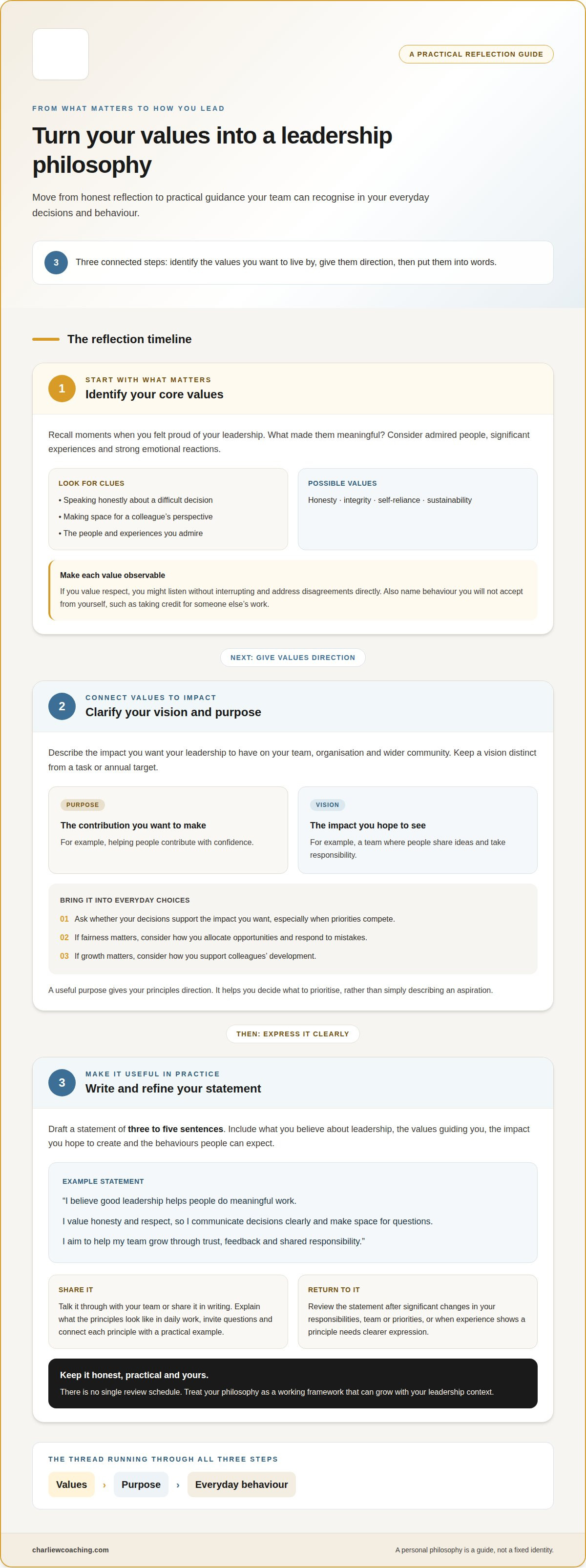
Turn reflection into practical guidance by identifying your values, clarifying your purpose and expressing both in words. The steps below connect what matters to you with how you lead.
-
Identify core values
Start by recalling moments when you felt proud of your leadership, then note what made them meaningful. Perhaps you spoke honestly about a difficult decision or made space for a colleague’s perspective. Consider admired people, significant experiences and strong emotional reactions. These can reveal values such as honesty, integrity, self-reliance or sustainability.
Next, choose the values you want to guide your conduct, rather than selecting words because they sound impressive. For each one, name an observable behaviour. If you value respect, you might listen without interrupting and address disagreements directly. Also identify behaviour you won’t accept from yourself, such as taking credit for another person’s work. Reviewing real decisions helps show which values already guide you and which need more attention.
-
Clarify vision and purpose
Describe the impact you want your leadership to have on your team, organisation and wider community. Keep this vision distinct from a task or annual target. A purpose might be to help people contribute with confidence, while a vision could describe a team where people share ideas and take responsibility.
Now connect that purpose to your chosen values. Ask whether your everyday decisions support the impact you want, especially when priorities compete. If fairness matters, consider how you allocate opportunities and respond to mistakes. If growth matters, consider how you support colleagues’ development. A useful purpose gives your principles direction; it should help you decide what to prioritise, not simply describe an aspiration.
-
Write a philosophy statement
Draft a statement of three to five sentences. Name what you believe about leadership, the values guiding you, the impact you hope to create and the behaviours people can expect. For example: “I believe good leadership helps people do meaningful work. I value honesty and respect, so I communicate decisions clearly and make space for questions. I aim to help my team grow through trust, feedback and shared responsibility.” Adapt the wording to reflect your own experience.
Share the statement with your team in conversation or writing, then explain what its principles look like in daily work. Invite people to ask questions and connect each principle with a practical example. Review the statement after significant changes in your responsibilities, team or priorities, or when experience shows a principle needs clearer expression. There’s no single review schedule; return to it when your leadership context changes.
Definition and purpose of a personal leadership philosophy
Think of your leadership philosophy as a working framework, not a slogan. Its four connected elements are your theory of leadership, attitude towards people, guiding principles and everyday behaviours.
- Use the framework to guide real decisions. A philosophy connects what you believe with what you do, especially when competing priorities make a choice difficult. If you believe people deserve clarity, explain a change before assigning new responsibilities. If you value shared ownership, invite colleagues to shape the plan. Your philosophy gives your actions a reason, while repeated practice shows whether they reflect your beliefs.
Its purpose isn’t to supply a perfect answer for every situation. Instead, it helps you decide what deserves attention and how to act consistently. For example, after a missed deadline, you might first establish what happened, then distinguish a preventable mistake from a process problem. Your principles can help you respond fairly without ignoring the work that still needs doing.
- Describe the long-term impact you want to create. A leadership goal should express the difference you hope to make for your team, organisation or wider world. “Complete the quarterly plan” is a task; “help my team make thoughtful decisions with confidence” describes an intended impact. The second can guide choices across different roles and changing priorities.
Make the goal specific enough to shape your decisions, but broad enough to remain meaningful as your responsibilities change. Ask whose experience you want to improve and what you hope people will be able to do. For instance, you might aim to build a team where colleagues share concerns early and take responsibility for solutions. That goal gives your philosophy direction beyond immediate results.
- Test whether your philosophy is clear and usable. Read each principle alongside a real leadership choice, such as handling disagreement about a project deadline. Ask whether the statement would help you choose a response, explain your reasoning and set expectations. If it only sounds admirable but offers no guidance, add a behaviour that makes it actionable.
A useful philosophy can be a short paragraph or a longer document, depending on your needs. Its value comes from helping you lead, not from its length. Keep the wording understandable to someone joining your team, and check that your actions give the principles meaning. A promise of openness, for example, must include listening when feedback challenges your first view.
- Learn from examples, then make the language your own. Effective statements pair a belief with a visible commitment. “I lead with curiosity, ask before assuming, and make room for different perspectives” gives colleagues a behaviour to recognise. “I want people to succeed” becomes more useful when you explain how you’ll support their growth and invite them to contribute.
Use examples as prompts, not scripts. A statement that suits one leader may not reflect your purpose or the people you lead. Read your draft aloud and imagine using it during a difficult decision. If its language helps you explain what matters and what you’ll do next, it can serve as a practical guide rather than a polished statement left unused.
Asking others how they perceive your leadership
Feedback can reveal whether your intentions match people’s experience. Use these steps to invite specific observations and turn them into considered changes.
- Choose people who see different parts of your leadership. Ask team members who work closely with you, alongside colleagues who experience your decisions from another perspective. For example, a project partner may notice how you handle disagreement, while a direct report may see how clearly you set expectations. Explain that you’re seeking useful observations, not praise. A range of viewpoints can help you avoid building your understanding around one relationship or one recent challenge.
- Ask about specific behaviours rather than broad impressions. Questions such as “When do my decisions help you move forward?” or “What could I do differently in team meetings?” invite concrete examples. You could also ask what you should continue, change or stop. If you ask only, “Am I a good leader?”, people may offer a general opinion rather than describe what they experienced. Clear prompts make feedback easier to connect with your daily actions.
- Offer an anonymous route for candid responses. An anonymous survey can give team members a way to share what they appreciate and what could improve. Keep prompts focused on observable moments, such as how you communicate priorities or respond to concerns. Include space for an example, so a comment like “meetings feel rushed” can point to a specific situation. Avoid asking for personal details that aren’t needed to understand the feedback.
- Listen without defending your intentions. If someone says you dismiss ideas, resist immediately explaining that you meant to keep the discussion focused. Ask for an example, such as a meeting where they felt unheard. You can recognise the impact without agreeing with every interpretation. Note repeated themes separately from one-off comments, and compare them with your own observations. That distinction helps you identify a genuine pattern without treating every piece of feedback as a complete picture.
- Choose one behaviour to practise and report back. Select a change that responds to a clear theme, such as pausing for questions after presenting a decision. Tell the team what you heard and what you’ll try, without naming individual contributors. After using the new approach in meetings, ask whether it has made discussion easier. This follow-through shows that feedback has informed action, while giving you another opportunity to learn how your leadership is experienced.
Leadership development through coaching and experiential learning
Your philosophy becomes more useful when real experience tests it. Coaching, reflection and purposeful challenges can help you notice what holds up, what needs adjustment and how your leadership affects others.
- Use coaching to examine a live leadership challenge. Bring a specific situation, such as a difficult conversation or a decision affecting your team. A coach can help you explore your assumptions, consider different responses and connect your choices with your principles. The aim isn’t to receive a script, but to see the situation more clearly and decide what action feels consistent with your values.
Before the conversation, identify what you want to understand. Afterwards, note which questions helped you think differently and what you chose to do. This makes coaching part of your learning process, rather than a detached discussion about leadership in general.
- Choose a stretch assignment with a clear learning purpose. Take on a task that asks you to practise a behaviour you want to strengthen. If you usually make decisions alone, for example, invite colleagues to shape a project plan. If you tend to hold back, lead a meeting where the team must agree priorities. A meaningful challenge should extend your comfort zone while giving you a genuine opportunity to learn.
Agree on the desired outcome and available support before starting. After the task, consider what your actions taught you about delegation, communication or trust. The experience can show whether a principle works under pressure, not just in theory.
- Review mistakes as opportunities to improve your approach. After a missed handover, identify what happened, its effect and what could prevent a repeat. Treat an honest mistake as a prompt for learning and training, rather than assuming poor intent. At the same time, distinguish a learning opportunity from repeated disregard for agreed responsibilities. Your response should reflect the circumstances and the standards you have communicated.
Ask what made the process difficult, then agree on one practical adjustment. For instance, clarify who owns the next step and how updates will be shared. This helps turn an experience into a change people can use.
- Learn by helping someone else develop. Give a colleague a task that builds a skill they want to practise, such as presenting a recommendation or coordinating a workstream. Set out the goal, offer appropriate guidance and leave room for them to make decisions. Afterwards, discuss what they learned and what support would help next time.
Developing others can reveal whether your philosophy makes space for autonomy and growth. If you step in at the first sign of difficulty, consider what support is useful without taking ownership away. That reflection can inform your next opportunity to delegate.
- Update your philosophy as experience changes your perspective. After a demanding project, a team change or a new responsibility, compare your actions with your stated principles. Note where your approach helped and where circumstances called for flexibility. A philosophy is a foundation, not a fixed set of instructions. Keep its core values in view while adapting how you express them in different situations.
Choose one adjustment to practise, then observe its effect in your next relevant decision. This cycle of experience, reflection and action keeps your leadership philosophy connected to the work and people it is meant to guide.
Charlie Whalley Coaching: Life & Leadership Coaching
Charlie Whalley Coaching offers Life & Leadership Coaching for people who want to lead with greater clarity, build confidence or navigate change. If you’ve reflected on your values but find it hard to put them into practice at work, coaching can help you explore what’s holding you back and consider an aligned way forward.
You might turn to leadership coaching when a new responsibility, difficult decision or period of self-doubt makes your next step feel unclear. The focus is on your individual circumstances and the changes you want to make, not on following someone else’s leadership formula.
If you’d like support with your leadership direction, contact Charlie Whalley Coaching to start a conversation.
Put your leadership purpose into practice
A leadership philosophy becomes meaningful through the choices you make next: how you respond to a challenge, create space for others and act on what you’ve learned. Developing a personal leadership philosophy isn’t about getting every decision right. It’s about staying curious, noticing when your actions drift from your values and choosing how you want to respond.
If you’d value a supportive space to explore your next step, Charlie Whalley Coaching offers Life & Leadership Coaching, Career Transition Coaching and Kids Coaching. The right focus depends on the change or development you’re working towards. Coaching can help you reflect on your direction and consider practical ways forward.
Contact Charlie Whalley Coaching to explore your next step. You can begin with one thoughtful choice, then build from there.
Frequently Asked Questions
What is a personal leadership philosophy?
A personal leadership philosophy is the set of beliefs you use to guide how you lead, particularly when choices feel difficult. Think of it as a decision filter rather than a slogan. For example, if you value transparency, you might explain why a project’s priorities have changed, even when the conversation feels uncomfortable. Its usefulness comes from helping you act deliberately, not from having a perfect answer for every leadership challenge.
What are the core elements of a leadership philosophy?
A leadership philosophy brings together what you believe leadership is for, how you regard the people you lead, the principles you rely on and the actions that express them. These parts should work together. If you believe people can take responsibility, for instance, your practice might include sharing relevant information before delegating a decision. Notice when your stated beliefs and daily habits point in different directions, then decide what behaviour needs to change.
How do I identify my leadership values and principles?
Look for the qualities you want to protect when priorities compete. Recall a workplace decision that left you uneasy, then ask what felt compromised. If you delayed giving difficult feedback to preserve harmony, perhaps honesty or accountability needs a clearer place in your approach. Turn each value into a principle you can apply, such as raising concerns respectfully and promptly. A value becomes more meaningful when it guides a real choice.
What questions help define my leadership purpose and vision?
Ask what you want people to experience because of your leadership, and what you hope your team can achieve together. Consider: “What contribution do I want this team to make?” and “What should colleagues feel able to do here?” For example, you might want people to raise risks early rather than hide problems. Your purpose describes why that impact matters; your vision gives you a picture of what it could look like in practice.
How do leadership philosophies differ by leadership style?
A philosophy explains the beliefs behind your leadership, while a style is the way those beliefs show up in a particular setting. Two leaders may both value respect, yet express it differently: one may invite discussion before deciding, while another gives clear direction and explains the reasoning. The useful question isn’t which style sounds best, but whether your approach fits the decision, the team’s needs and the principles you want people to experience.
How can I align my leadership philosophy with my actions and decisions?
Choose a principle and connect it to a behaviour you can notice in your working day. If you value shared responsibility, for example, ask a colleague to recommend a course of action rather than simply handing them a task. After an important decision, consider whether your behaviour matched the principle and what you might do differently next time. If you fall short, acknowledge it and explain how you’ll approach a similar situation in future.