
Managing Executive Stress with Movement, Balance, and Support

In DDI’s Global Leadership Forecast 2025, 71% of leaders said their stress had grown since taking on their current role. Managing executive stress isn’t about pushing through every demand alone; movement, clearer boundaries and support can help you respond to pressure with more steadiness. The strain is real, but it isn’t a personal failing.
If you’re carrying difficult decisions, team concerns and a workload that follows you home, it can be hard to find room to reset. Managing executive stress starts with understanding why leadership roles feel demanding and identifying practical ways to protect your energy. Movement, clearer work-life boundaries and trusted support can help you make space for recovery and feel less alone in the responsibilities you carry.
Key Takeaways
- Build brief opportunities for movement and mindful breathing into your routine to create pauses between demanding tasks.
- Set clearer limits around work communications and recovery time so professional pressures have less room to spill into home life.
- Reduce decision fatigue by clarifying priorities, delegating where appropriate and making space for strategic thought.
- Share leadership pressures with trusted peers or a coach to gain perspective and feel less isolated in difficult decisions.
- Notice changes in your sleep, mood and behaviour as possible signs that your current workload and support need attention.
1. Exercise, yoga, and breath-focused movement
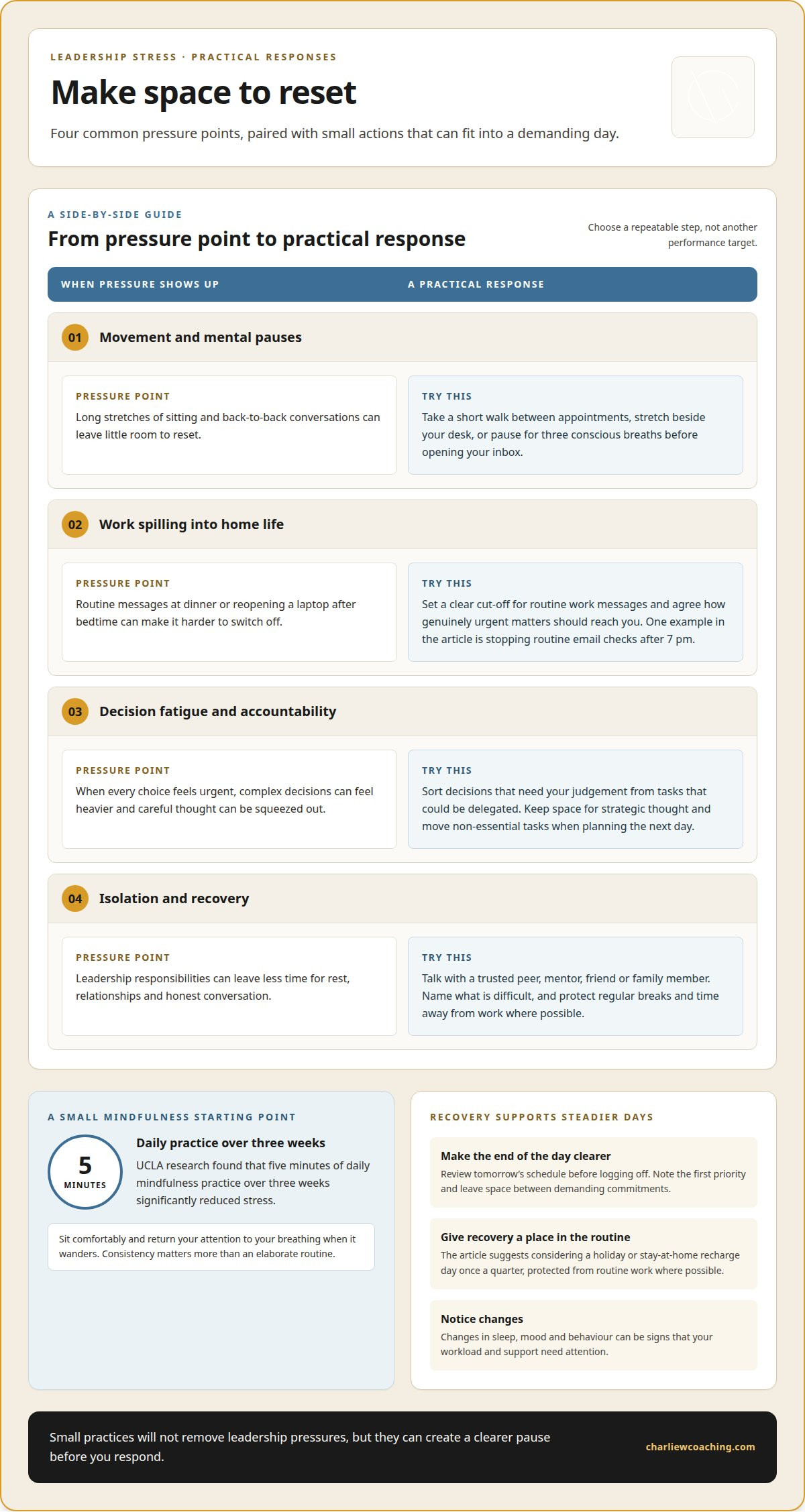
During a demanding workday, executives can manage stress with brief movement, mindful breathing or meditation between meetings. A short walk can interrupt hours of sitting and help you reset before the next conversation. If you can’t leave the office, stand, stretch your shoulders and walk along the corridor.
Movement doesn’t need to become another performance target. A brisk lunchtime walk, a few yoga stretches beside your desk or taking the stairs can fit around leadership responsibilities. Choose something you can repeat on a busy day. For example, schedule a walk between appointments rather than waiting for a free afternoon that may never come.
Breath-focused movement can create a brief pause when pressure rises. Before opening your inbox, take three conscious breaths and notice whether your shoulders or jaw feel tense. Between meetings, try a mindful walk: feel your feet on the ground and bring your attention back whenever your mind jumps ahead. Breathwork, meditation and mindful walking can also support focus and relaxation.
Research-supported approaches include exercise, mindfulness, meditation and relaxation techniques. UCLA research found that five minutes of daily mindfulness practice over three weeks significantly reduced stress. That offers a manageable starting point: set aside five minutes, sit comfortably and return your attention to your breathing when it wanders. Consistency matters more than creating an elaborate routine.
Yoga can combine gentle movement with attention to breathing, helping you step out of decision mode for a moment. Choose a short sequence that feels comfortable, such as a seated twist, shoulder rolls and a standing stretch. Treat it as a transition between tasks, not a test of flexibility. If a movement feels uncomfortable, leave it out.
Recovery also depends on the basics. Sufficient sleep, regular exercise and a healthy diet can support your ability to handle stress. A demanding schedule can make meals and rest feel negotiable, so give them a place in your routine. For instance, keep a lunch break in your calendar and prepare a simple meal before a day of back-to-back discussions.
Start with one repeatable action: a short walk, a few steady breaths or a brief mindfulness practice. Pair it with an existing cue, such as finishing a meeting, so movement has a natural place in your day. Small practices won’t remove leadership pressures, but they can give you a clearer pause before responding.
Isolation and work-life balance strain
Executive responsibilities can stretch beyond office hours, including weekends and holidays. When colleagues rely on you for decisions, switching off may feel like leaving something important unattended. The result can be less time for family, rest and friendships, even when you’re at home. First, notice when work regularly crosses into personal time, such as answering messages during dinner or reopening your laptop after bedtime.
A boundary works best when it is specific and communicated. Choose a daily cut-off for work messages, then tell colleagues how to reach you if an issue is urgent. For example, you might stop checking routine emails after 7 pm and leave genuinely urgent matters to an agreed channel. A clear limit gives your team a practical expectation, rather than leaving everyone to guess when you’re available.
Make the end of the working day easier to protect by reviewing tomorrow’s schedule before logging off. Note the first priority, move non-essential tasks and leave space between demanding commitments. You could also review a week of calendar entries and responsibilities. This can reveal recurring late meetings, overloaded days or tasks that need new owners.
Recovery needs more than an evening boundary. Regular breaks during the day and time away from work can help you disconnect and recharge. One practical approach is to schedule a holiday or a stay-at-home recharge day once a quarter. Protect that time from routine work where possible, and use it for activities that help you feel rested, rather than catching up on postponed tasks.
Your sleep routine is another part of the work-life pattern. Jackie Yeaney aims for 7-8 hours of sleep each night and keeps devices out of the bedroom at bedtime. Those examples point to simple choices: set a consistent wind-down time, charge your phone outside the bedroom and avoid turning late-night messages into a habit. A calmer evening routine can make the boundary between work and rest more tangible.
Isolation can grow when leadership responsibilities leave little time for honest conversation. Reconnect with a mentor, peer, friend or family member, and be specific. You might say, “I’m finding it hard to switch off after board meetings,” rather than offering a quick “I’m fine”. A trusted person can listen and help you see pressure from another angle. If the week keeps overflowing, discuss meeting structures or timelines with your team and protect room for recovery.
3. Decision fatigue and leadership accountability
Executive stress can make complex decisions feel heavier and leave less room for careful thought. Poor sleep, irritability in meetings and a short fuse at home can also affect how you lead and respond.
Responsibility weighs heavily when decisions affect a company, its employees and its future direction. A financial target, staffing change or difficult conversation may carry consequences beyond the meeting room. When every choice feels urgent, it becomes harder to distinguish an important decision from one that can wait. That pressure can follow you into the next discussion, reducing the attention available for new problems.
A deliberate approach to managing executive stress starts with sorting the decisions in front of you. Identify which ones need your judgement and which could be delegated. For example, a strategic investment may require your attention, whilst a routine update could be handled by a capable team member. Delegating draining tasks can protect your energy for work that depends on your leadership, while giving colleagues appropriate responsibility.
Clarity helps when several priorities compete. Name the outcome that matters most, the decision needed to move towards it, and who owns the next action. If a deadline can’t be met, explain the constraint and a realistic timeline to stakeholders. Open conversations can ease the pressure to promise everything at once and help teams plan around actual capacity.
Your calendar can either protect thoughtful leadership or keep you reacting all day. Review a typical week and notice whether strategic thinking, relationship-building and recovery have space alongside meetings. If routine discussions crowd out planning, consider changing meeting structures or delegating attendance where appropriate. Leave room between difficult conversations to record decisions and prepare for what follows.
Managing executive stress also means recognising which demands are avoidable. Saying no to a low-priority request, adjusting a workflow or clarifying ownership can reduce unnecessary strain. A peer group can offer space to discuss difficult choices with people who understand leadership pressures. You don’t have to reach every conclusion alone. Deliberate priorities, realistic expectations and shared responsibility support steadier decisions when the stakes feel high.
Mindfulness may also support better judgement: a Harvard Business Review study reported that mindful leaders make 89% more effective strategic decisions. Peer advisory groups or mastermind circles can help leaders share experiences and discuss difficult choices. Redesigning a schedule around strategic thinking, relationship-building, and rest, while staying realistic about what can be achieved and communicating timelines and outcomes openly to stakeholders, can help protect bandwidth. Delegating, saying no, or restructuring workflows can reduce avoidable stressors.
4. Executive coaching and peer support
Leadership pressure can be difficult to discuss with colleagues who depend on your decisions. A trusted peer or coach can offer space to express concerns, examine your thinking and consider a different response. For example, you might talk through a difficult board conversation before deciding how to approach it.
In the United States, there isn’t one typical cost for executive stress coaching or therapy. Fees depend on factors such as the practitioner, session format, session length and the support involved. Coaching and therapy are different forms of support, so compare what each is intended to address rather than treating them as interchangeable.
Coaching can help you reflect on leadership habits, priorities and boundaries. A session might explore which decisions are draining your energy, what you can delegate and how you want to handle a challenging relationship at work. Bring a current concern and a clear goal, such as leaving meetings with agreed next steps, to give the conversation a practical focus.
Seek help from a mental health professional when stress feels overwhelming or is affecting your wellbeing. Persistent anxiety, low mood, disrupted sleep or difficulty managing everyday responsibilities are reasons to reach out. A therapist can offer a confidential space to process pressure and develop coping strategies. A psychiatrist can assess whether medication support may be appropriate when stress develops into anxiety or depression. Coaching can support leadership reflection, but it doesn’t replace mental health care.
Peer support can make leadership feel less solitary. A mentor, trusted colleague or peer group may help you examine a decision without carrying it alone. To make a conversation useful, describe the situation, name what feels difficult and ask for perspective rather than an immediate solution. For instance, ask a peer how they would weigh competing priorities, then decide what fits your own context.
Organisations can reduce executive strain by improving access to mental health resources, coaching and practical work-life balance measures. A supportive culture matters too. Leaders need space to speak honestly about workload, and teams need workable expectations around meetings, deadlines and availability. For example, an organisation could review a recurring meeting that leaves no time for focused work, then adjust its format or attendance. These changes address workplace pressures rather than placing the entire responsibility for recovery on one executive.
Before a conversation with a coach or peer, write down one pressure point, its effect on your work and the change you want to explore. This preparation can turn a broad feeling of strain into a clearer discussion about priorities, support and a more sustainable way forward.
5. What are the common causes and symptoms of executive stress and burnout?
Executive stress can build when financial targets, shareholder expectations and team needs compete for your attention. Overseeing several departments may mean switching between budgets, staffing decisions and internal conflicts in a day. Public scrutiny can add another layer, particularly during a crisis. These demands are part of the role, but their combined weight can make recovery harder.
The National Institute for Occupational Safety and Health describes job stress as arising when job requirements don’t match a worker’s capabilities, resources or needs. For an executive, that mismatch might mean owning a major delivery deadline without enough staff or decision-making time. The Centers for Disease Control and Prevention says burnout can develop when demands exceed available resources. Both perspectives point to work conditions, not personal weakness.
In DDI’s Global Leadership Forecast 2025, 71% of leaders said their stress had grown since taking on their current role. The figures underline why it’s useful to notice patterns, not just isolated difficult days. For example, a leader might feel increasingly tense before recurring board meetings or struggle to recover after consecutive high-pressure decisions.
Burnout and stress can show up in everyday behaviour. You might become irritable in meetings, sleep poorly or find yourself unusually short-tempered at home. A familiar task, such as reviewing a team proposal, may suddenly feel overwhelming. These changes can affect communication and concentration, making it harder to listen carefully or weigh options. Notice when the pattern appears and what tends to precede it.
In 2024, 56% of leaders experienced burnout, while 74% of healthcare executives reported extreme stress. These figures describe different groups and experiences, but both suggest the strain deserves attention. They don’t tell you what one person is feeling. Your own signs might include persistent exhaustion, reduced patience or losing interest in work that once felt meaningful.
Meeting load can be one pressure point: executives face an average of 17 meetings per week. Consider a week with packed discussions, urgent messages and little time to complete follow-up work. That pattern can leave decisions unfinished and the working day feeling uncontained. A useful first step is to track which commitments drain your energy, then identify where workload, resources or expectations could be discussed.
If these changes persist or affect your wellbeing, take them seriously and seek appropriate support. Stress isn’t a verdict on your ability to lead. It can signal that demands, resources and recovery need closer attention, whether that means addressing workload, getting support or revisiting how responsibilities are organised.
Charlie Whalley Coaching
Charlie Whalley Coaching can help you reflect on leadership pressures, rebuild confidence and find a more sustainable way forward through Life & Leadership Coaching. If stress is making it harder to set priorities, maintain boundaries or feel steady in your role, coaching offers a space to explore what needs to change and identify practical next steps. It can also support you through broader professional or personal transitions when your current path no longer feels right. Coaching is not a substitute for mental health care when stress is affecting your wellbeing; a mental health professional can provide support for those needs. You don’t have to work through every leadership challenge alone. If you’d like to explore whether coaching could support you, contact Charlie Whalley Coaching.
Choose a steadier way forward
Leadership doesn’t require you to carry every pressure silently. A sustainable approach to managing executive stress starts with noticing what is no longer working and choosing one change to begin. That could be a clearer priority, a conversation you’ve been postponing or support that gives you room to think.
Give yourself permission to treat your wellbeing as part of how you lead, not a reward you must earn after everything is done. You might take a moment to consider what would make the next working week feel more manageable. A small, considered step can help you move towards greater clarity without expecting yourself to solve everything at once.
If you’d value a supportive space to reflect on leadership or change, Charlie Whalley Coaching can help you explore a way forward that feels right for you. Contact Charlie Whalley Coaching to start a conversation. You can take the next step at your own pace.
Frequently Asked Questions
How stressful is being an executive?
Being an executive can be highly stressful because important decisions affect people, finances and the organisation’s direction. The pressure often feels sharper during a restructure, a conflict between teams or a difficult conversation with a board. Strain varies with responsibilities, resources and support. Notice whether work pressure is changing how you sleep, communicate or make decisions, rather than judging yourself for finding the role demanding.
What are the 5 R’s of stress management?
A practical approach is to recognise what is causing strain, release immediate tension, reframe what you can control, respond with a deliberate next step and recover afterwards. For example, before replying to a tense message, identify what triggered your reaction, pause, separate facts from assumptions, choose a considered response and take a moment to reset. Treat these as useful prompts, not a universal clinical model.
What are the most effective ways for executives to manage stress?
Effective approaches address both personal responses and workplace pressures. Start by identifying a recurring stress trigger, such as unclear ownership of a project, then agree who can make the next decision. Use short pauses before high-stakes conversations, and review whether expectations match available resources. If strain continues to affect your wellbeing, add professional support rather than relying only on self-management. The right combination depends on what is driving the pressure.
How can executives set boundaries and delegate to reduce stress?
Make a boundary specific, explain its purpose and agree how exceptions will work. For example, tell your team you’ll reserve a regular block for focused planning, and name the channel for genuinely urgent decisions. When delegating, state the desired outcome, decision-making authority and deadline. A team member handling a client update, for instance, needs clarity about what they can approve independently and when to escalate an issue.
What are the best executive coaching and mental health resources for stress management?
Choose support according to the need: an executive coach can help you examine leadership challenges, while a mental health professional can support concerns affecting emotional wellbeing. Charlie Whalley Coaching’s Life & Leadership Coaching may suit reflection on confidence, workplace change or leadership direction. Sessions take place face-to-face or via Zoom, and mutual chemistry matters. If coaching isn’t the right fit, Charlie may refer you to another professional.