
How to Build Psychological Safety Through Team Norms

What if a team could disagree openly without anyone fearing embarrassment or blame? Psychological safety means people feel able to speak up, ask for help and admit mistakes without punishment or rejection. Learning how to build psychological safety in a team starts with clear, shared norms that make these behaviours part of everyday work.
Psychological safety doesn’t mean avoiding challenge or expecting everyone to agree. People can feel safe and still find difficult conversations uncomfortable. What matters is whether they can raise a concern, question an idea or offer a different view and be treated with respect. Trust grows through consistent actions, not a single team-building exercise.
This article explores practical ways to create supportive team norms, invite more voices into conversations, respond constructively when things go wrong and use training to help leaders and colleagues build better habits. Everyday choices about listening, feedback and learning from mistakes can help people contribute with confidence.
Key Takeaways
- Invite quieter voices into discussions, listen without rushing to respond, and build on colleagues’ ideas.
- Show that speaking up is welcome by responding to concerns with curiosity and recognising thoughtful contributions.
- Use practical training and clear communication habits to help leaders and teams make respectful behaviour consistent.
- When something goes wrong, focus on understanding what happened and what the team can learn, rather than assigning blame.
- Notice how openness, learning and participation affect the way your team works, then adjust its shared norms as needed.
What does this mean for meetings and events?
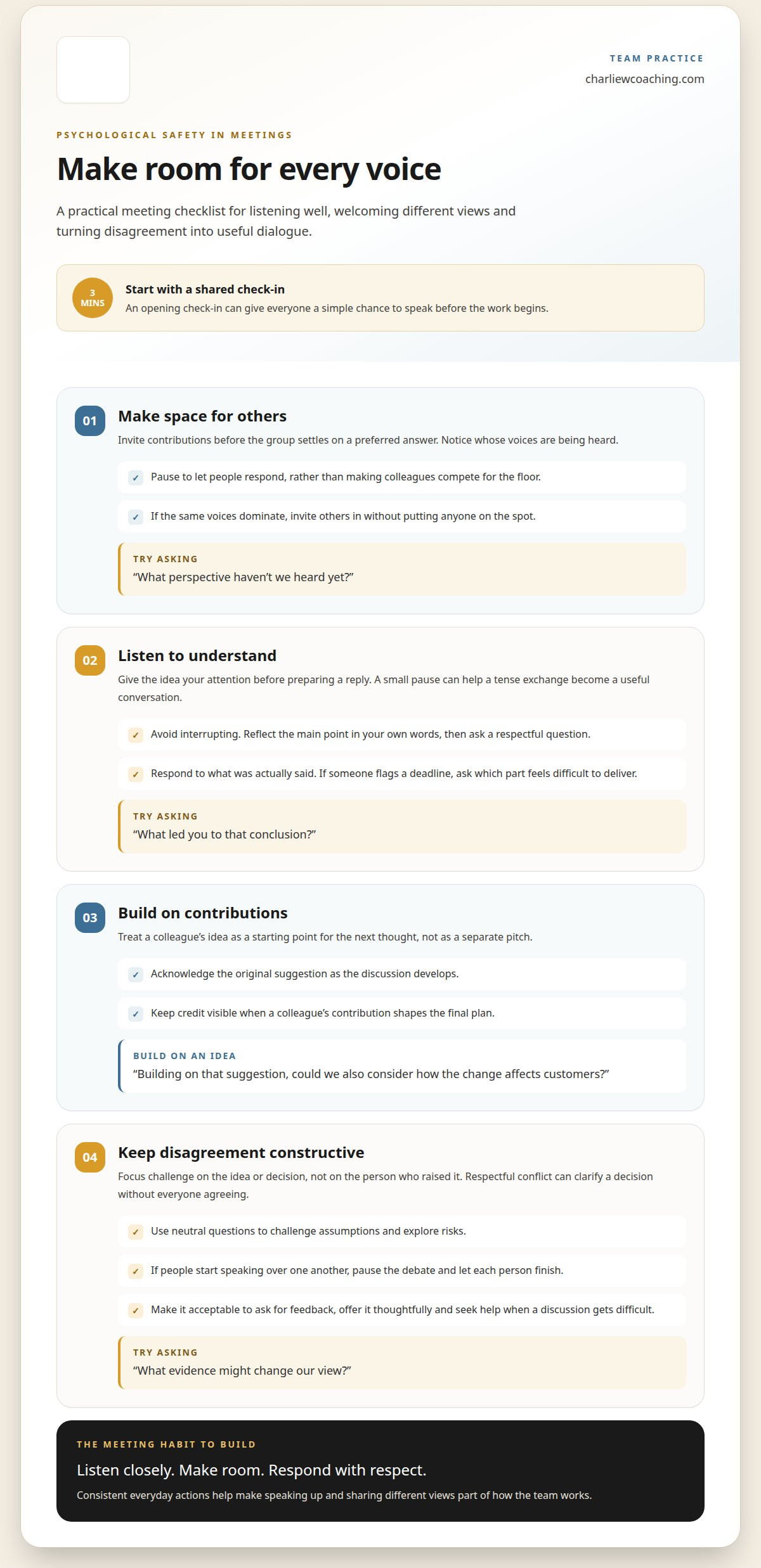
Use meetings to practise listening, invite contributions and handle disagreement respectfully. For example, begin with a shared check-in, then make space for different views before deciding.
-
Make space for others
Invite each person to contribute before the group settles on a preferred answer. In a planning meeting, ask, “What perspective haven’t we heard yet?” and pause to let people respond. This gives employees room to offer ideas without competing for the floor.
Notice who speaks first and whose suggestions receive attention. If the same voices dominate, invite others to contribute without putting anyone on the spot. At an in-person meeting, an opening check-in can take about three minutes, giving everyone a simple chance to speak before work begins.
-
Listen actively to colleagues
When a colleague shares an idea, listen to understand it before preparing your reply. Avoid interrupting, reflect the main point in your own words, then ask a respectful question, such as, “What led you to that conclusion?” This shows you’ve heard the contribution, even if you hold a different view.
Check that your response addresses what the person actually said. For example, if someone raises a concern about a deadline, don’t immediately defend the plan. Ask which part feels difficult to deliver. That small pause can turn a tense exchange into a useful conversation.
-
Build on others’ contributions
Use a colleague’s idea as the starting point for the next thought. You might say, “Building on that suggestion, could we also consider how the change affects customers?” This acknowledges the original contribution and helps the group develop it, rather than treating each comment as a separate pitch.
Keep credit visible as the discussion develops. If a team member spots a risk that shapes the final plan, acknowledge their contribution when summarising the decision. A jazz dialogue offers a useful model: participants listen closely, speak less and respond to ideas as they emerge, rather than relying only on prepared points.
-
Promote dialogue and constructive conflict
Frame disagreement around the idea or decision, not the person who raised it. Ask, “What evidence might change our view?” or “Which risks are we missing?” These neutral questions invite employees to challenge assumptions while keeping the discussion focused on finding the best solution.
Set a shared expectation that colleagues can ask for feedback, offer it thoughtfully and seek help when a discussion becomes difficult. For example, pause a debate if people start speaking over one another, then invite each person to finish. Respectful conflict can clarify a decision without requiring agreement on every point.
What Is Psychological Safety at Work?
Psychological safety is a shared belief that team members can speak up without fear of embarrassment, rejection or punishment. Common mistakes include dismissing concerns, reacting angrily to errors and inviting feedback without responding to it.
- Set clear expectations for speaking up. Tell employees how to raise concerns, ask for help and offer feedback, then follow those expectations yourself. For example, explain that a project risk can be raised in a meeting or directly with a manager, and clarify how the team will discuss it. Clear routes make speaking up less uncertain.
When a suggestion can’t shape the decision, explain why. Share the factors behind the choice rather than leaving contributors to assume their views were ignored. This shows that honest input is welcome, even when the final decision differs.
-
Model vulnerability as a leader
Admit when you don’t have an answer, and ask the team to help you think it through. For instance, say, “I may have missed something. What should we consider before deciding?” Then listen without becoming defensive. Leaders who acknowledge uncertainty show that expertise and openness can go hand in hand.
Match that invitation with your behaviour. If you ask for feedback but interrupt or dismiss critical responses, employees may learn that disagreement carries a cost. Thank the person, ask a follow-up question and explain what you’ll do with their input. Consistency matters more than a carefully phrased invitation.
- Pay attention to the emotional cues you set. Your response to difficult news can shape whether others speak honestly next time. If a team member reports a delay, pause before reacting, ask what happened and explore what support would help. A measured response encourages discussion; visible irritation can discourage it.
Leaders don’t need to remove every uncomfortable moment. They can make challenges easier to navigate by staying curious and respectful. For example, separate a critique of a proposal from a judgement about the colleague who raised it. This keeps the discussion focused on the work.
-
Learn from mistakes
When a mistake happens, acknowledge it and lead a discussion about what the team can learn. Describe what you would do differently next time, then invite others to identify contributing factors. Discussing mistakes can help teams learn from them rather than hide them.
Avoid treating every error as carelessness or assigning blame before understanding the circumstances. Ask what information, process or decision shaped the outcome, then agree on a practical correction. Leaders who share what they’ve learned make it easier for employees to raise problems early.
- Use feedback and observation to notice patterns. Ask employees whether they feel able to raise concerns, admit mistakes and request help. An anonymous survey can make it easier to share candid views, while regular conversations can reveal specific examples. Look for gaps between leaders’ intentions and employees’ day-to-day experiences.
Review what happens after someone speaks up. If concerns receive acknowledgement, an update and an explanation when action isn’t possible, employees can see their input was taken seriously. That follow-through helps turn leadership expectations into everyday practice.
Organisational training and communication practices
Train leaders and employees in practical behaviours, then build them into everyday communication. Shared norms work best when they suit the team’s needs and are revisited as its culture changes.
-
Adapt practices to individual differences
Ask employees how they prefer to contribute, and offer more than one way to share ideas. For example, invite spoken contributions during a meeting and allow written comments afterwards. This gives people with different communication styles or confidence levels a fair opportunity to participate.
Apply the same care in remote and hybrid workplaces. Set clear expectations for responding in virtual meetings, and make space for colleagues joining remotely before moving to a decision. Don’t assume silence means agreement or lack of interest. Someone may need a different route or more time to contribute.
-
Use inclusive meeting practices
Agree practical meeting norms, such as not interrupting, inviting different viewpoints and explaining how decisions will be made. These shared expectations help employees know how to contribute and what respectful disagreement looks like. For instance, a chair can ask which perspective hasn’t been considered before closing a discussion.
Build training around real conversations rather than abstract instructions. Leaders can practise asking neutral questions, receiving feedback without defensiveness and acknowledging concerns. In a hybrid meeting, they can pause before moving on, check whether remote participants want to add anything and explain how colleagues can follow up afterwards.
-
Practise behaviours and reassess progress
Choose specific behaviours for the organisation to practise, then discuss whether they happen consistently. A team might focus on acknowledging concerns, inviting input from quieter colleagues and giving an update after feedback. Managers can reinforce these actions in team discussions and organisation-wide communications by recognising employees’ distinct skills and contributions.
Revisit the practices after a project or challenging meeting. Ask employees what helped them contribute and what made participation harder. For example, if colleagues felt rushed during decisions, allow more time for questions next time. Adjusting a norm in response to feedback shows that inclusion is an active responsibility.
-
Measure safety and reassess team culture
Use an anonymous survey to ask whether employees can raise problems, seek help and share different views. Amy Edmondson’s original psychological safety scale contains seven items. Another approach rates responses on a scale from one to 10, then averages answers to identify strengths and areas needing attention.
Treat survey results as a starting point for conversations, not a complete picture of workplace culture. Compare responses with what happens in meetings: who contributes, how leaders respond to concerns and whether feedback receives an update. Repeat the assessment periodically, then adjust training or team norms where employees’ experiences point to a gap.
Establishing norms for handling failure
Leaders encourage speaking up by inviting concerns, admitting their own mistakes and responding respectfully. In a new team, agree how to raise risks, handle disagreement and learn from failure. When bad news arrives, managers should acknowledge it, ask what happened and focus on solutions.
-
Establish shared team norms
Agree practical expectations together, rather than imposing rules without discussion. Ask team members what respectful behaviour looks like when someone makes an error, asks for help or challenges a decision. Record the agreements somewhere everyone can refer to, such as shared meeting notes.
Make each norm observable. “Show respect” becomes “let colleagues finish speaking” or “ask before assuming why an error happened”. In a new team, revisit these agreements after working together on a task. Check that everyone understands how to raise a concern and what happens next.
-
Set norms for disagreement and speaking up
Make it acceptable to question a proposal without attacking the person who suggested it. A team might agree to explain the concern, ask a genuine question and consider the response before deciding. This gives disagreement a constructive purpose: improving the work rather than proving someone wrong.
Invite team members to raise risks early, even when they’re unsure whether a concern matters. For example, a colleague who spots a possible delay should be able to flag it without being labelled negative. Don’t treat silence as agreement; ask whether anyone sees a different risk or option.
-
Build peer support into team norms
Ask everyone to offer practical help when a colleague encounters a problem. If a team member admits an error, peers can ask what support would help, share relevant knowledge and agree who will take the next action. This makes asking for help a normal part of collaboration, rather than a sign of weakness.
Set a norm for thoughtful feedback between colleagues. For example, describe the impact of a missed handover, then discuss how to prevent another one. Avoid gossip or private blame after a mistake. Addressing the issue directly and respectfully helps the team learn together.
-
Respond constructively to dissent and bad news
When someone challenges a decision, thank them for raising the concern and ask what information supports it. If a colleague reports a failure, acknowledge the impact before exploring causes. Questions such as “What can we do now?” keep attention on action without dismissing what happened.
Explain the next step, even when the team can’t immediately change the decision. For example, say what will be reviewed, who will follow up and when the team will discuss the outcome. Avoid anger, ridicule or silence after difficult news; those reactions can teach people to hide problems next time.
Psychological safety and team effectiveness
Psychologically safe teams can raise problems, test ideas and adapt together. Understanding how to build psychological safety in a team means treating openness as part of effective work, not as a separate initiative.
- Make it easier to share useful information. In Gallup’s 2025 engagement survey data, three out of ten employees strongly agreed that their opinions count at work. Invite people to explain what they know before decisions are final. For example, ask a project team what risks it sees, then show how those views shaped the plan.
- Use speaking up to support learning and innovation. A team member who can question an assumption may help the group find a better route. For instance, a colleague might flag that a proposed process excludes a customer group. Discussing that concern gives the team a chance to adjust before the decision becomes harder to change.
- Connect safety with engagement, not comfort alone. Gallup reports that psychologically safe teams are 76% more engaged. This does not mean avoiding challenge: a demanding project can still feel worthwhile when people can ask for help and raise concerns. Look at whether employees take part in decisions, not simply whether meetings feel pleasant.
- Notice how the team handles different viewpoints. Google’s Project Aristotle studied 180 teams over two years to explore team effectiveness. Use that focus on how teams work together: observe whether members can contribute, question an approach and respond to one another. If only the most senior voices shape a decision, useful knowledge may remain unheard.
- Turn openness into a working advantage. After a project decision, ask which contributions changed the team’s understanding and what it missed. For example, if a frontline employee’s observation prompts a safer or simpler process, share that learning with the group. These conversations help make openness part of how teams improve their work.
If you’re reflecting on how your leadership shapes team trust, explore leadership coaching as a space to build confidence and navigate workplace challenges.
Make room for difficult issues before they harden into assumptions: team members should be able to openly address problems and difficult issues. Gallup’s 2025 engagement survey data found that 3 out of 10 employees strongly agreed that their opinions count at work, a reminder that invitations to contribute need to be visible in everyday decisions. Psychological safety can help teams innovate, benefit from diversity, and adapt to change; those gains depend on treating questions as useful information rather than resistance.
Google launched Project Aristotle in 2012 to study hundreds of teams and identify factors associated with team success. Google reported that teams with high psychological safety showed a 27% reduction in turnover. The Tenerife Los Rodeos airport disaster in 1977 illustrates how power gradients can inhibit speaking up. Teams can use that lesson by making it possible to question decisions across levels of authority, especially when an emerging concern could change what the group does next.
Charlie Whalley Coaching
Charlie Whalley Coaching can help you reflect on how your leadership habits shape communication, confidence and change at work. If you’re finding it difficult to speak up, respond to challenge or build confidence in a leadership role, Life & Leadership Coaching offers space to explore your priorities and consider practical next steps.
Coaching can be useful when team conversations bring up self-doubt or when you’re navigating a change in your professional life. It won’t replace the shared agreements and consistent actions a team needs, but it can support your reflection as you decide how you want to lead and communicate.
If you’d like to explore what support could look like, contact Charlie Whalley Coaching.
Take one thoughtful step towards a more open workplace
Building psychological safety doesn’t require changing every team habit at once. Choose one behaviour you can practise consistently, such as asking for a perspective you haven’t heard or acknowledging when you need to reconsider a decision. Those small, intentional moments can help you lead with greater clarity and confidence.
If you’re exploring how to build psychological safety in a team, reflect on what makes speaking up feel difficult for you. Leadership coaching can offer space to work through self-doubt, navigate professional change and consider how you want to show up with colleagues. Charlie Whalley Coaching also offers Career Transition Coaching and Kids Coaching for different personal and professional needs.
You don’t need to have everything figured out before taking a next step. Explore whether coaching with Charlie Whalley Coaching feels right for you, and keep building a workplace where people can contribute with confidence.
Frequently Asked Questions
What is psychological safety in a team?
Psychological safety is a shared expectation that speaking candidly won’t lead to humiliation or punishment. In practice, a new team member can say, “I’m not sure how this handover works,” without being treated as incapable. It doesn’t mean avoiding challenge or removing accountability. It means people can ask questions, admit uncertainty and take appropriate interpersonal risks while remaining responsible for their work.
What are the key behaviours that build psychological safety at work?
Make it easier to raise small uncertainties before they grow into problems. For example, during a handover, invite the next person to identify missing information, then respond without blame if something needs correcting. Leaders can also acknowledge when their assumptions were wrong and explain what they’ll change. What matters is the pattern: people see that honest contributions receive attention and practical follow-through.
What does research say about psychological safety and team performance?
The Center for Creative Leadership studied nearly 300 leaders and found that teams reporting high psychological safety also reported higher performance and lower interpersonal conflict. That finding connects open communication with how teams work together: people can share concerns and different perspectives instead of letting avoidable misunderstandings persist. For a team, the useful question is how its everyday interactions support learning, collaboration and effective work.