
Jobs with less talking for an introvert career change

What if the right career isn’t one where you never speak, but one where conversations have purpose and room to breathe? A career change for introverts can lead to roles built around focused work, problem-solving, writing or research, with fewer large-group interactions and more independent time. Some people prefer work centred on one-to-one conversations or small teams. A quieter fit is possible.
If constant meetings or social demands leave you drained, that doesn’t mean you lack confidence or ambition. The key is finding work that suits how you think and connect, rather than reshaping yourself around an exhausting role. This guide explores careers with less day-to-day talking, including analytical and adaptable paths, and explains how to weigh pay, job outlook, skills and working style. You’ll also find practical ways to narrow your options and explore a change at a manageable pace.
Key Takeaways
- Look for roles where communication is purposeful and focused, rather than assuming you need a job with no interaction.
- Explore adaptable careers that draw on your existing strengths and allow you to build skills in a new direction.
- Use your interest in patterns, systems or detail to identify analytical paths worth exploring.
- Compare salary and job outlook alongside daily tasks, working environment and the training a role may require.
- Shortlist roles, study what employers ask for and speak with people in the field before deciding on your next step.
1. Jobs with less talking
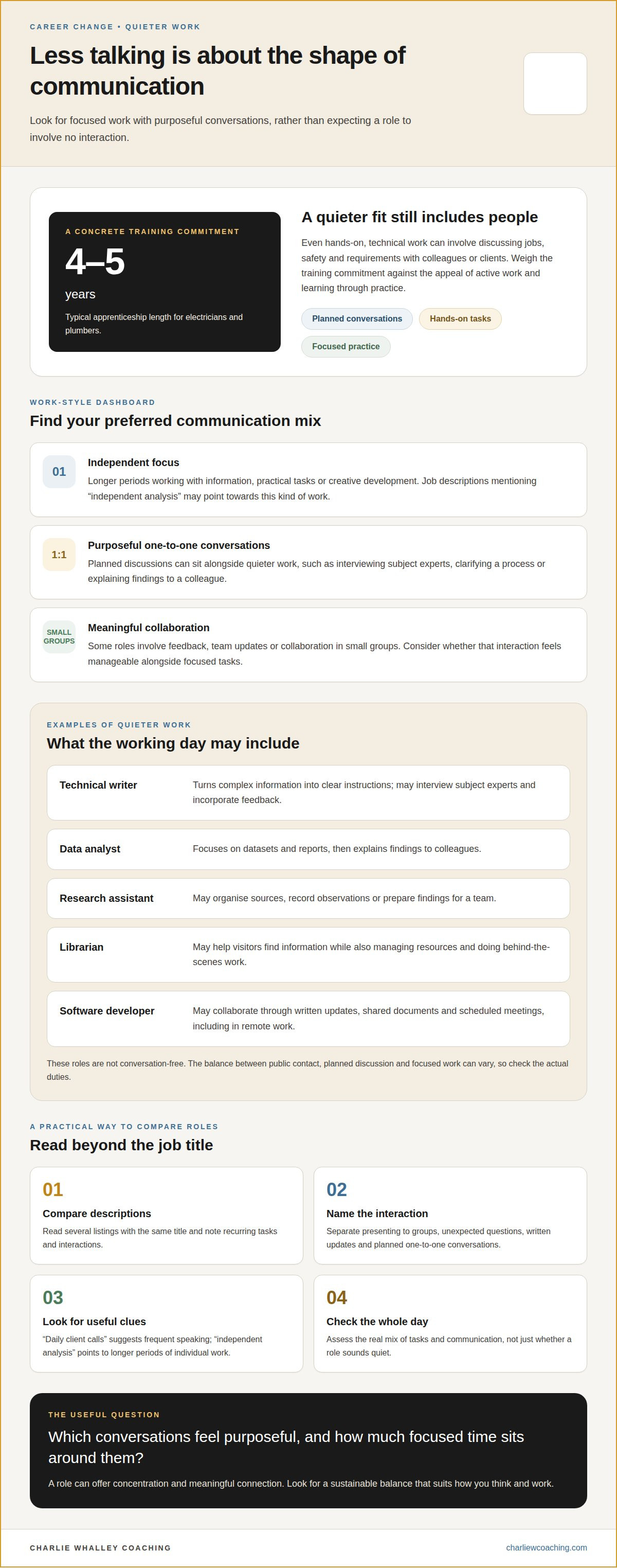
Data analysis, technical writing, software development, research and skilled trades may involve less continuous conversation than customer-facing roles. For a career change for introverts, look for purposeful one-to-one discussions or small-group collaboration, rather than expecting work to involve no communication.
Daily tasks matter more than job titles. A technical writer may spend much of the day turning complex information into clear instructions, but still need to interview subject experts and incorporate feedback. A data analyst might focus on datasets and reports, then explain findings to colleagues. Consider whether those planned conversations feel manageable alongside quieter work.
Some roles involve hands-on tasks and practical, focused communication. Electricians and plumbers, for example, need to discuss jobs, safety and requirements with colleagues or clients, even when much of their work is technical. Apprenticeships in both trades typically take four to five years. Weigh that training commitment against the appeal of active work and learning through practice.
Research and library work can also suit people who enjoy sustained concentration. A research assistant might organise sources, record observations or prepare findings for a team. A librarian may help visitors find information while also managing resources and doing behind-the-scenes work. Neither role is conversation-free, so look closely at the balance between public contact and focused tasks.
Remote work can change where conversations happen, but not necessarily how often. A software developer may collaborate through written updates, shared documents and scheduled meetings. A remote technical writer may still need calls to clarify a process. Look for clues in job descriptions: phrases such as “daily client calls” suggest frequent speaking, while “independent analysis” points to longer periods of individual work.
When considering a role, separate communication into types. Note whether the work involves presenting to groups, answering unexpected questions, writing updates or having planned one-to-one conversations. Someone who enjoys explaining a detailed idea to one colleague, for example, may find large meetings tiring yet thrive in a role requiring regular collaboration.
Assess fit by examining the actual working day, rather than assuming a role suits you because it sounds quiet. Compare several job descriptions with the same title, then identify recurring tasks and interactions. This can reveal whether a career offers the concentration you want alongside a sustainable level of communication.
Carefully evaluate job listings by focusing on the amount and kind of interaction they describe, paying particular attention to whether conversations are planned and purposeful. Introverts and sensitive people may thrive in environments where interactions are mostly 1:1 or in small groups with meaningful connection. Use that preference as a guide when comparing roles, while checking that the full mix of tasks and communication feels sustainable.
2. Adaptable careers
Some career paths let you transfer existing strengths to a different setting instead of starting again. Design, writing, digital marketing, research, coaching and technical work can draw on skills developed in other fields. The best match depends on what you enjoy, such as organising information, solving problems or creating clear messages.
Consider how your current experience might transfer. A teacher who enjoys developing resources could explore instructional design or educational writing. An administrator who spots inefficient processes might move towards project coordination or operations. These transitions use familiar strengths in new ways, while the work environment and daily communication may change.
Design roles can suit people who prefer thoughtful, focused creation. A graphic designer might shape visual material from a clear brief, then refine it through feedback. A UX designer combines research, layout and user needs to improve digital experiences. Both roles involve collaboration, but much of the preparation and creative development can happen independently.
Writing and digital content offer another route. Someone experienced in explaining complex subjects could consider content writing, editing or technical communication. Digital marketing also includes varied tasks, such as planning content, reviewing campaign results and improving website material. Check the duties, since some marketing positions involve frequent client contact or presentations.
Training needs depend on the role and your existing knowledge. A portfolio can demonstrate design or writing ability, while a course may help you build practical skills in areas such as user research or digital tools. Some technical roles require specific qualifications, while other employers prioritise relevant experience and examples of completed work.
Education costs vary by provider, course format, subject and existing qualifications. Compare the learning required with the tasks employers describe, then focus on the gaps that matter for your chosen direction. This helps you avoid committing to training that adds little to your transition.
Writing, design, digital marketing, research and some technical roles can be done remotely or in hybrid arrangements. Availability depends on the employer, role and practical requirements. A designer may collaborate online, for example, while a research position could require on-site access to equipment or materials.
To assess how adaptable your skills are, choose a role such as UX design or content writing and map its core tasks against your current strengths. Mark which abilities already transfer and which need practice. This comparison can turn a broad career idea into a clearer, more manageable direction.
3. Analytical careers
If you enjoy finding patterns, testing ideas or making sense of complex information, analytical roles may feel rewarding. Cybersecurity analysts investigate suspicious activity, assess vulnerabilities and help protect computer systems. In the United States, cybersecurity analyst employment is projected to grow 21 percent from 2025 to 2035. The work demands concentration, but communicating risks clearly remains part of the job.
Operations research analysts use mathematics and structured analysis to help organisations solve practical problems. They might model delivery routes, review staffing needs or compare ways to use resources. The role suits people who like exploring a problem before recommending a course of action.
Actuarial work offers another path for people who enjoy probability and careful reasoning. Actuaries use data to assess financial risks, then explain their calculations to colleagues or clients. Accountants also rely on accuracy and consistent processes, while business analysts investigate how an organisation works and where changes could help. Each role involves communication, usually tied to evidence or decisions.
To compare these paths, picture a task from a typical working day. A cybersecurity analyst might examine a security alert; an actuary could assess a risk model; an accountant might reconcile records. Ask which activity holds your attention, and whether you prefer clear procedures, open-ended investigations or explaining findings to others.
Analytical work is not automatically solitary. A statistician may discuss methods with a research team, while a business analyst gathers requirements from colleagues. Cybersecurity teams coordinate responses when a threat appears. The useful distinction is the kind of interaction involved: scheduled technical discussions may feel different from frequent persuasion, customer service or unscripted group conversation.
Before pursuing a role, review several job descriptions and underline recurring tools, tasks and communication duties. For cybersecurity, note references to monitoring, incident response and risk assessment. For operations research, look for modelling, optimisation and recommendations. Comparing these details can show whether the daily work matches your interests, rather than relying on the job title alone.
Then find a small way to test your interest. An accountant could try a sample bookkeeping exercise, while someone considering cybersecurity might work through an introductory security lab. For operations research, try mapping a familiar problem, such as scheduling tasks, into constraints and possible solutions. These exercises can show whether you enjoy the work before committing to a larger change.
Finally, connect your experience to the role’s core demands. Careful record-keeping can support accounting; process improvement may transfer to operations research; investigating complex issues can be relevant to cybersecurity. List examples from your work that demonstrate these strengths. Clear evidence makes it easier to assess your fit and describe your value to an employer.
4. Career salaries and job outlook
Salary and projected employment growth can help you compare career options, but neither tells the whole story. In the United States, data scientists have a median salary of $120,230, according to the U.S. Bureau of Labor Statistics. The Bureau reports a median salary of $135,980 for software developers and $90,390 for technical writers. These figures offer a useful comparison, not a promise about individual earnings.
Outlook adds another perspective. The U.S. Bureau of Labor Statistics projects data scientist employment to grow 35 percent from 2025 to 2035. For software developers, it projects growth of 10 percent over the same period. Technical writer employment is projected to grow 1 percent from 2025 to 2035, according to the Bureau. Growth rates describe employment projections, not how easy a particular job will be to secure.
For software developers, the salary figure may look compelling, but consider the work behind it. Employers may seek evidence of coding ability, problem-solving and collaboration. If you’re changing careers, compare job descriptions, identify recurring technical requirements and build examples that demonstrate relevant skills. This puts salary data in context: preparation and role requirements matter alongside the headline median.
Technical writing combines subject knowledge with the ability to explain processes clearly. Its median salary is $90,390, while projected employment growth is 1 percent from 2025 to 2035, according to the U.S. Bureau of Labor Statistics. If you enjoy making complex material easier to use, review job duties carefully. Some roles focus on documentation, while others require regular contact with technical teams.
A separate U.S. Bureau of Labor Statistics figure lists an annual wage of $98,540. Compare this value cautiously with the role-specific median salaries above, because the figures are presented differently. Before using any wage figure to plan a transition, note the occupation, measure, date and location attached to it. Those details help prevent an apples-to-oranges comparison.
For someone with little experience, data science and software development may offer attractive salary potential, but median figures do not represent entry-level pay. Review the skills and experience required in actual vacancies, then identify evidence you can build through relevant projects or training. Technical writing may suit people who can demonstrate clear writing and subject knowledge, though its outlook differs from data science.
Make a simple comparison before choosing: record each role’s salary measure, projected growth, typical tasks and skill requirements. For example, compare data science with technical writing if you enjoy both analysis and clear explanations. Add the daily working style, including independent focus and team communication. This can help you weigh financial prospects against the work you want to do.
5. Choosing and exploring a career path
Without a college degree, possible paths include technical writing, digital marketing, bookkeeping, IT support and skilled trades. Employers set different requirements, so examine the skills and qualifications for each role. Electrician and plumber apprenticeships typically take four to five years, making them longer-term routes that combine practical training with work.
Common career changes draw on clear writing, organisation, research, design or technical problem-solving. A portfolio can demonstrate writing or design ability, while practical examples can show how you analyse information or improve a process. Start by identifying skills repeated in job postings, then compare them with evidence from your current or past work.
To narrow your options, shortlist two or three roles and read twenty job postings for each. Note recurring duties, qualifications, tools and communication demands. Then speak with three to five people already working in a role that interests you. You can request twenty minutes and prepare three specific questions to keep each conversation focused.
If in-person networking feels draining, contact people online who attended events in your target industry. A brief message about a shared professional interest gives the conversation a clear starting point. For interviews, prepare a 90-second answer to “tell me about yourself” and practise it aloud. Music, anchors or power poses can also form part of your preparation routine.
Changing careers can bring practical challenges: unfamiliar tasks, training demands and the effort of explaining transferable experience. Networking and interviews may also feel tiring, especially alongside applications. Make time to recharge after interviews or application sessions, and plan around the communication and learning demands of the roles you’re considering.
To limit financial risk, research role requirements before paying for training, and choose learning that addresses a specific skills gap. Consider how a transition could affect your current income and regular commitments before deciding when to move. Where practical, a gradual plan can help you develop relevant skills and experience while maintaining your existing work.
Personality insights and feedback from people close to you can help uncover strengths you may overlook. Ask trusted friends what qualities they value in you, then connect their examples to tasks in your shortlisted roles. A coach or supportive community can also help you assess readiness and identify gaps to address. If you want structured support as you weigh your options, explore career transition coaching.
Understanding your personality can help you identify strengths and transferable skills for a career change. Options to explore when looking for work that may suit introverts and highly sensitive people include counselling, coaching, writing, design, technical work, research and physically active jobs.
Work involving nature or animals may also appeal to sensitive people. Ask close friends what they value about you, then use their answers to identify qualities that could transfer to a new career. To keep your exploration focused, shortlist two or three roles and read twenty job postings for each.
Charlie Whalley Coaching: Career Transition Coaching
Charlie Whalley Coaching offers Career Transition Coaching for people considering a new direction, translating their strengths or building confidence through professional change. Coaching can help you clarify what matters in your next role, explore options that suit your working style and identify practical steps towards a transition.
This support may be useful if you have several possible paths but feel unsure which fits, or if self-doubt makes it hard to act on a decision. Coaching offers space to consider your priorities and move forward with greater clarity. It supports your career decisions rather than providing recruitment or job placement services.
If you’re ready to explore your next steps, book a discovery call with Charlie Whalley Coaching.
Make your next move with intention
A career shift doesn’t need to begin with a dramatic resignation or a fully formed plan. Give yourself room to test an idea, notice which tasks energise you and decide what a sustainable working day would look like. That reflection can make a career change for introverts feel less like a leap into the unknown and more like a direction you’re choosing deliberately.
You’re allowed to take your time. A role that suits you should make space for your strengths, priorities and preferred ways of working, not just look appealing on paper. As your thinking becomes clearer, choose a practical next step, such as exploring a skills gap or talking through your options with someone supportive.
If you’d value a thoughtful conversation as you consider what comes next, contact Charlie Whalley Coaching to explore whether career transition support feels right for you. Your next chapter can begin with one considered step.
Frequently Asked Questions
What jobs require little talking?
Roles such as medical records specialist, archivist and software test engineer can centre on detailed, independent tasks. A medical records specialist may organise and review patient information, while an archivist manages documents for access and preservation. Both roles still involve communication, such as clarifying a record or helping someone find material. Read each vacancy’s daily duties to understand whether conversations are planned, occasional or central to the work.
How can introverts identify transferable skills and choose a new career?
Start with specific examples of work you already do well, then name the skill behind each one. If you regularly organise complex information, for instance, that ability could apply to records management, research or project support. Compare those strengths with the tasks in roles that interest you, not just the titles. A short list of energising and draining activities can also reveal what you want more of in your next working day.
How much do introvert-friendly careers pay in the United States?
Pay differs by occupation, and a national median is a comparison point rather than a personal salary prediction. In the United States, actuaries had median pay of $130,000 in May 2025; occupational therapists had median pay of $100,330 per year in May 2025. Editors had median pay of $77,920 per year in May 2025. Experience, location and employer affect what an individual role offers, so compare figures with the specific job and its requirements.