
Is it too late to change career at 50? How to decide

Turning 50 doesn’t mean your working life has to stay on its current track. If you’re asking yourself, “Is it too late to change careers at 50?”, the short answer is no: age alone doesn’t decide whether a change is right for you.
Still, it’s understandable to weigh the risks carefully. You may be balancing financial commitments, family responsibilities and the confidence to start somewhere new, while wondering whether your experience will transfer to another field. Those are practical concerns, not proof that you’ve missed your chance.
This article will help you decide whether a career change could suit you and what to consider before taking action. We’ll look at what’s prompting the change, how your skills might transfer and how to explore a new direction while making a considered plan. You don’t need every answer today; identifying a useful next step is a good place to begin.
Key Takeaways
- Clarify what you want your next working chapter to offer, and whether the change is about your role, workplace or career direction.
- Identify the skills you can carry into a new field and the gaps you may need to address before making a move.
- Explore possible roles in practical, lower-commitment ways before deciding on a major transition.
- Build your plan around your financial commitments and the changes a transition could bring to your working life.
- In the US, workers aged 40 and older are protected from discrimination in hiring, pay and training under the Age Discrimination in Employment Act, according to the U.S. Equal Employment Opportunity Commission.
Is it too late to change careers at 50
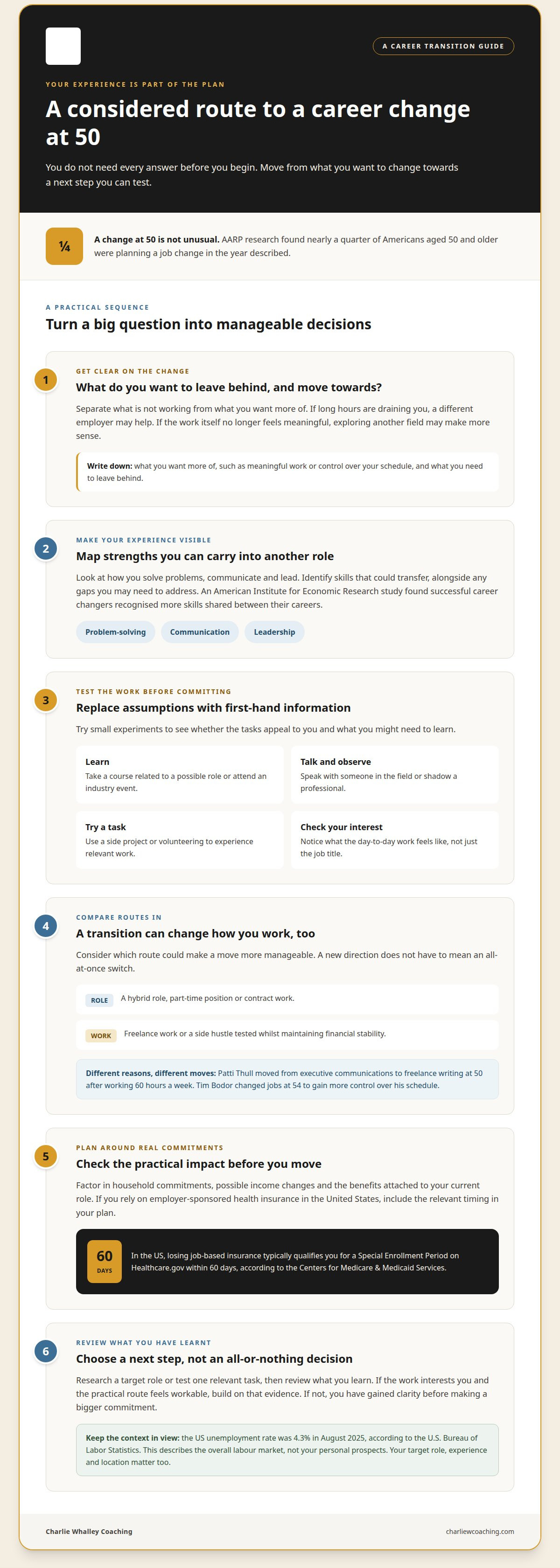
If you’re wondering whether it’s too late to change careers at 50, age alone doesn’t settle the question. A better test is whether a different role could meet your needs, and whether you can build a realistic route into it. Your accumulated experience is part of that route, not something you need to erase. A career change can mean moving industries, changing responsibilities, or reshaping how you work.
Start by separating what you want to leave behind from what you want to move towards. If long hours are draining you, for example, a different employer might address the problem without requiring a new profession. If the work itself no longer feels meaningful, exploring a new field may make more sense. Naming the specific change you want can help you avoid making a major decision in response to one difficult week.
Age-related bias can be a concern, but US law provides a specific protection. The U.S. Equal Employment Opportunity Commission says the Age Discrimination in Employment Act protects workers aged 40 and older from discrimination in hiring, pay and training. This protection does not guarantee a particular job, but it means age-based discrimination in those areas is prohibited. In the US, the unemployment rate was 4.3 percent in August 2025, according to the U.S. Bureau of Labor Statistics. That figure describes the overall labour market, not your personal prospects; your target role, experience and location matter too.
Real career changes can take different forms. Patti Thull moved from executive communications to freelance writing at age 50, after working 60 hours a week. Her example shows that a transition might change the working arrangement as well as the subject of the work. Tim Bodor changed jobs at age 54 to gain more control over his schedule. His decision illustrates another possibility: a move can be driven by the shape of daily life, not only by a new professional identity.
Use small experiments to replace assumptions with useful information before choosing a direction. Try a course related to a possible role, attend an industry event or speak with someone who does that work. A side project or volunteering can help you test whether the tasks appeal to you. Shadowing a professional may reveal details that a job title or description cannot. These steps can help you assess your interest and identify what you would need to learn before committing.
- Clarify the goal. Write down what you want more of, such as meaningful work or control over your schedule, and what you need to leave behind.
- Map transferable strengths. An American Institute for Economic Research study found successful career changers recognised more skills shared between their careers. Consider how your experience solving problems, communicating or leading could apply elsewhere.
- Test the work. Use a course, a side project or volunteering to experience relevant tasks before making a larger change.
- Compare routes in. Consider whether a hybrid role, freelance work, part-time position or contract could make the transition more manageable.
Practical planning also includes benefits, particularly if you rely on employer-sponsored health insurance in the United States. Losing job-based insurance typically qualifies you for a Special Enrollment Period on Healthcare.gov within 60 days, according to the Centers for Medicare & Medicaid Services (HealthCare.gov). Include that timing in your transition plan, alongside household commitments and any income changes. Understanding the conditions attached to your current role can help you choose when and how to move.
A useful decision is not necessarily the fastest one. Set a clear next step, such as researching a target role or testing one relevant task, then review what you learn. If the work interests you and the practical route feels workable, build on that evidence. If your experiments point elsewhere, you have gained clarity before making a bigger commitment. At 50, experience can inform the decision; it doesn’t have to dictate staying where you are.
Compare possible roles with a transition style that suits you. Nearly a quarter of Americans age 50 and older were planning a job change in the year described by AARP research. People in their 50s and 60s are retraining as teachers. Online courses, shadowing professionals, a side project while employed, volunteering, or industry events can help test possible roles. Hybrid roles, freelance opportunities, part-time work, or contract work offer flexible transition options. A side hustle can let you test a business concept while maintaining financial stability.
Charlie Whalley Coaching: Career Transition Coaching
Charlie Whalley Coaching offers Career Transition Coaching for people considering a change and wanting support to make their next steps clearer. If you’re weighing a new direction but feel pulled between what you want, what you’re responsible for and what feels realistic, coaching can help you explore those competing priorities.
In coaching with Charlie Whalley, you can reflect on what matters in your next chapter, recognise strengths that could transfer to a different role and build confidence as you consider your options. This may be useful if you have ideas but feel unsure which to pursue, or if self-doubt is making it harder to move from reflection to action. The aim is to help you navigate change with greater clarity, not to prescribe a career path.
Ready to speak? Book a discovery call to find out how career transition coaching can work for you.
Take the next step at your own pace
If you’re still asking whether it’s too late to change careers at 50, let the question lead to a small, considered action rather than an all-or-nothing decision. You might write down what you want your working life to feel like, or choose one conversation that could help you understand a possible direction. Progress can begin with clarity, not certainty.
A career shift can also raise questions about confidence, identity and how your ambitions fit with the rest of your life. You don’t have to resolve every question before moving forward. Give yourself room to explore what matters, notice what feels workable and choose a next step that reflects your circumstances.
If a supportive conversation would help you find that clarity, book a discovery call with Charlie Whalley Coaching to find out how it can work for you. Your experience is part of what you bring to a new chapter, and you can shape what comes next thoughtfully.