
Five ways to return to work after a career break

A career break is not a blank space in your story. Returning to work after a career break can raise questions about your confidence, current skills and how employers will view your time away. Yet experience gained beyond paid work can also help you recognise what you value and what you can bring to your next role.
If the first steps feel daunting, that’s understandable. You may be weighing practical decisions while wondering whether your industry has moved on or how to explain your career history. You don’t need every answer before you begin.
This guide shares five practical ways to make your return more manageable: find employers open to returners, reconnect with people in your field, refresh relevant skills, build a sense of community and present your career break as part of your experience. Each can help you move forward with greater clarity and a more confident account of what you offer.
Key Takeaways
- Look for employers and returnship programmes that recognise the value of experience gained during a career break.
- Use coaching to prepare for networking conversations and reconnect with people in your field with greater confidence.
- Identify relevant skill gaps and shape your CV around the strengths you can bring to your next role.
- Build connections with fellow returners so you can share perspectives and feel less alone in the transition.
- Present your career break as part of your story, highlighting the resilience, perspective and transferable experience it may have developed.
How career transition coaching can help you find returner-friendly employers and returnship programmes
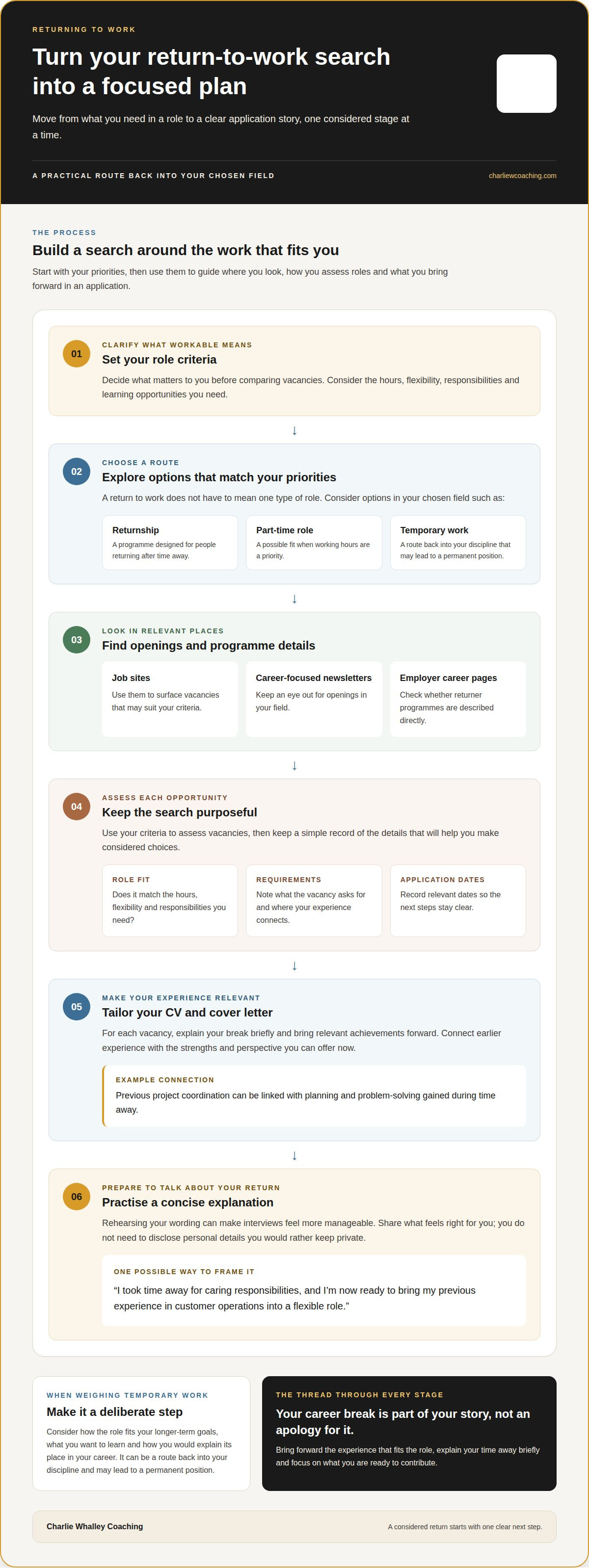
Searching for work after time away can feel exposing, particularly when you’re unsure how employers will interpret the gap. Career transition coaching can turn a broad search into a focused plan based on your experience, priorities and responsibilities. Options might include a returnship, a part-time role or temporary work in your chosen field.
Start by defining what a workable role needs to offer. A coach can help you consider the hours, flexibility, responsibilities and learning opportunities that matter to you, then use those criteria to assess vacancies. Job sites and career-focused newsletters can surface openings, whilst employer career pages may describe returner programmes directly. Keep a simple record of suitable roles, their requirements and application dates, so the search stays purposeful rather than overwhelming.
Some employers look beyond a career gap and value the perspective and resilience a candidate brings. Others may need help understanding how your experience fits their current needs. A coach can support you to tailor your CV and cover letter to each vacancy, explain the break briefly and bring relevant achievements forward. For example, a returner applying for project work could connect previous project coordination with planning and problem-solving gained during time away.
Temporary work can also offer a route back into a chosen discipline, and may lead to a permanent position. Coaching can help you weigh this option against your longer-term goals, identify what you want to learn and prepare to explain why the role makes sense. The focus is on presenting it as a deliberate step, not an apology for your career history.
Rebuilding confidence can begin with practice. A coach might help you rehearse a concise explanation such as, “I took time away for caring responsibilities, and I’m now ready to bring my previous experience in customer operations into a flexible role.” You can then refine the wording to reflect your own circumstances, without sharing personal details you’d rather keep private. Having a prepared response can make interviews feel more manageable.
What salary should you expect? There’s no single salary for returning to work after a career break. Pay depends on the role, sector, location, working hours and relevant experience. Assess each opportunity against its responsibilities and your needs.
How can you balance caregiving or other responsibilities? Discuss the hours and flexibility you need, and consider part-time work, job sharing or flexible roles. A coach can help you clarify your priorities and communicate them confidently to employers.
For a broader view of career mobility, the U.S. Department of Labor and U.S. Department of Commerce describe short-term credentials, stackable training and pathways that recognise prior experience and demonstrated ability. A coach can help you decide whether a credential or training step supports your target roles, rather than adding study without a clear purpose.
How coaching can support networking and informational conversations
After time away, a familiar industry can feel unfamiliar: its language, priorities and professional connections may have shifted. A career transition coach can help you decide which conversations would be most relevant, then prepare you to approach them with purpose. Rather than trying to reconnect with everyone, you might focus on former colleagues, people in a target role or contacts who understand a changing sector.
A useful first step is refreshing your awareness of the field. Newsletters, industry alerts, blogs and networking events can reveal current themes and useful contacts. A coach can help you choose sources that match your interests, then turn what you learn into conversation points. For example, if you’re exploring project management, you might follow updates about delivery methods and ask a former colleague how their team’s work has changed.
Reaching out can feel awkward if you haven’t spoken to someone for years. Coaching can help you draft a warm, direct message that acknowledges the time apart and makes a clear, manageable request. You could ask for a short conversation about their career path, a recent change in the sector or the skills their team values. The aim is to learn, not to ask immediately for a job.
Before an informational conversation, a coach can help you shape a concise career story: what you did before your break, what you’re interested in now and what you hope to explore. Practising this aloud can make it easier to respond naturally. Prepare a few relevant examples too, such as a project you delivered, a challenge you handled or a capability you’re keen to use again.
Coaching can also help you listen for useful detail. If someone mentions a new system, team structure or skill requirement, note the exact point and ask a follow-up question. A conversation with a former colleague might reveal which professional groups they attend; another contact could suggest a publication or specialist to follow. These small insights give your next networking step a clearer direction.
Success in networking doesn’t depend on making every interaction lead to an opportunity. A thoughtful exchange can update your understanding, renew a connection or help you decide which roles suit your priorities. A coach can help you reflect after each conversation, identify what you learned and adjust your approach, so your network grows through genuine, relevant contact.
If planning these conversations feels like the hardest part, Career Transition Coaching can help you prepare a confident introduction and choose a practical next step.
How career transition coaching can help with updating your CV and identifying skill gaps
A career break can leave you wondering whether your experience still matches current expectations. A career transition coach can compare your target roles with your previous responsibilities, then help identify which skills remain relevant and where your knowledge may need refreshing. For example, a returner targeting communications might review experience in writing, stakeholder relationships and campaign planning against recent job descriptions.
What CV format should you choose after a long employment gap, and how can a coach help? A clear chronological CV can still work well when it shows your experience and achievements plainly. A coach can help organise it around the role you want, make the break easy to understand and bring transferable skills forward without disguising your employment history.
The process can begin with a role-specific skills map. A coach reviews the responsibilities employers request, then compares them with your past work and current strengths. If vacancies repeatedly ask for a particular software skill, for instance, that points to a focused learning need. If they emphasise communication or problem-solving, examples from earlier roles may already demonstrate those abilities.
Industry tools and working practices can change during time away. Your coach can help distinguish essential updates from skills that are simply familiar or desirable. For a return to finance, this might mean identifying a new reporting platform; for a move into digital marketing, it could involve current analytics practices. The aim is a practical learning priority linked to the work you want.
Your CV should show what you can contribute, not just where you’ve worked. When changing fields, bring transferable skills to the fore instead of relying only on employment history. A bullet point might explain how you coordinated competing deadlines, supported colleagues or resolved customer concerns. Specific examples make your abilities easier for employers to recognise.
Refreshing your knowledge of the field can strengthen applications and interview responses. Use industry newsletters, blogs and conversations with former colleagues to identify relevant developments. If a colleague recommends an expert or useful reading, use that as a starting point for further learning. Following thought leaders on social media can also help you track news and trends in fields that interest you.
Interview preparation gives this work a clear purpose. Employers may ask whether your knowledge is current, so coaching can help you respond with evidence: a recent course, a project, or a considered example of how you’ve applied a skill. The coach can also help refine your CV for each role, ensuring the strongest evidence appears prominently rather than getting lost in a general career history.
A career break doesn’t erase what you know. A focused skills review, relevant learning and a CV shaped around the role can help your experience tell a clearer story of readiness.
How coaching can help you build a community of fellow returners
A career break can change more than your work history. You may also miss the everyday conversations that once helped you feel connected to your field. A supportive community offers space to compare experiences, share practical ideas and see that others are navigating similar questions. For example, another returner might explain how they approached a new application system or found a role that fitted family commitments.
A coach can help you decide what kind of connection would feel useful, rather than treating networking as another demanding task. You might want peers in the same sector, people returning after caregiving, or professionals exploring a new direction. Naming that interest makes it easier to find relevant groups and start conversations that feel natural. It also helps you set boundaries, such as choosing an online discussion over an evening event.
Community can grow through professional associations, local career events, online groups or introductions from former colleagues. A coach can help you identify which spaces fit your goals and prepare a simple introduction. For instance, you could say that you’re returning to customer operations and would value hearing how the role has changed. That gives others a clear starting point without requiring you to share personal details.
Building trust takes more than joining a group. Turn a useful conversation into an ongoing connection by following up with a thank-you, sharing a relevant article or suggesting another discussion. You might also offer your own perspective, such as describing how you managed a complex project before your break. Mutual exchange can make a community feel less like a job-search exercise.
How can a coach help you update your skills and professional certifications after time away? A coach can help match your target roles with the skills and credentials they request, then prioritise relevant learning. The U.S. Department of Labor and U.S. Department of Commerce describe career mobility pathways that recognise prior experience, demonstrated ability and short-term credentials.
That guidance can help you avoid retraining without a clear purpose. If roles in your area require a particular certification, coaching can help you weigh its relevance against your experience and goals. If you’re changing fields, a small project may build evidence alongside formal learning. For example, someone moving towards communications might develop a sample campaign plan to practise research, writing and audience awareness.
You can also build confidence with technology through focused practice. Identify the digital tasks that matter for your target roles, such as using a collaboration platform, updating spreadsheets or joining video meetings. Then create a realistic practice plan around those tasks. A former colleague may be able to suggest which tools are used in their field, helping you focus on relevant skills.
For a new direction, projects in your spare time can help turn learning into experience. A coach can help define a manageable project, connect it to your interests and reflect on the skills it demonstrates. Sharing progress with a returner community can bring useful feedback and encouragement, whilst giving others a practical example to learn from.
How career transition coaching can help you reframe career breaks as transferable experience
A career break can feel like a gap you must defend, especially when an application focuses on dates. A more useful starting point is to separate time away from the skills you can bring to work. A coach can help you identify evidence from your career and life, then connect it honestly to the role you want. The break remains part of your story, but it doesn’t have to define your candidacy.
Begin with responsibilities you held during your break, if you’re comfortable discussing them. Caring for a family member, organising a move or managing a community commitment may have involved planning, communication or adapting to change. You don’t need to present these experiences as equivalent to paid employment. Find a clear, truthful way to describe relevant strengths without overstating what you did.
Next, connect each strength to an employer’s needs. If a role asks for coordination, you might describe how you balanced appointments, schedules and competing priorities. If it requires sound judgement, you could draw on a specific decision you made during a community project. A coach can help you choose examples that show what you did, how you approached it and why it matters to the position.
The same approach can shape your explanation in an interview. Instead of apologising for time away, practise a concise account: “I took a career break for family responsibilities. I’m now ready to return, bringing my previous experience in client support and stronger skills in prioritising complex needs.” A coach can help you adjust the wording to your circumstances, keep personal details private and deliver it naturally.
Reframing also means recognising what you still want to learn. Resilience, perspective and clarity can grow through a career break, but they don’t replace role-specific knowledge. A coach can help you distinguish between transferable experience and skills that need refreshing, so your story feels credible. For example, you might pair a project-planning strength with recent practice using a tool required in your target field.
Try shaping each example around a simple sequence: the situation, your action and the outcome. A former volunteer role might show how you brought people together to organise an event; a previous job could demonstrate how you resolved a customer concern. Coaching gives you space to test which examples feel authentic, relevant and easy to explain. That practice can help your CV and interview answers tell the same coherent story.
Your career break is one part of your professional journey, not a measure of your potential. If you’d like support turning your experience into a confident career narrative, explore coaching for your career transition.
Charlie Whalley Coaching: Career Transition Coaching
Charlie Whalley Coaching offers Career Transition Coaching to help you make sense of your next steps after time away from work. If you’re weighing different roles, unsure how to present your experience or finding it difficult to move from planning to action, coaching can help you explore your priorities and build a considered way forward.
Sessions can focus on the challenges that matter to you, from clarifying your direction to preparing for conversations with employers. The aim is to help you recognise your strengths and approach your transition with greater confidence, while keeping your choices grounded in your circumstances.
If you’d like to talk about support for your return to work, contact Charlie Whalley Coaching.
Let your next step be small and deliberate
Returning to work after a career break doesn’t mean you need your whole future mapped out before you begin. Start by choosing one decision that feels useful now, such as the contribution you want to make or what you need from your working life. That can give your next conversation, application or learning opportunity a clearer purpose.
If you’re ready to explore that next step with support, contact Charlie Whalley Coaching to discuss career transition coaching. You can bring the questions you’re carrying and work towards a direction that feels right for you. Your experience still matters, and you’re allowed to build what comes next at your own pace.
Frequently Asked Questions
How can a career transition coach help me explain a career break on my CV and in interviews?
A coach can help you describe your break honestly, with the emphasis on information relevant to the role. You decide how much personal context to share. For example, if you stepped away to care for someone, you can state that briefly before returning to your professional skills and current direction. Coaching can also help you keep the wording consistent across your CV, application and interview, without making your break sound like an apology.
How can a career transition coach help me prepare to return to work after a career break?
A coach can help you turn a general wish to return into choices you can act on. Together, you can clarify what matters in your next role, such as the type of work, working pattern and responsibilities that fit your circumstances. You can then consider what feels uncertain and decide which issue to address first. This makes preparation more focused, whether your immediate priority is exploring roles or building confidence in interviews.
How can a career transition coach help me find employers that welcome candidates returning after a career break?
A coach can help you look for useful signals in vacancies and employer information, rather than relying on a company’s general description of itself. You might notice explicit returner programmes, wording about career breaks, or flexibility that matches your needs. The coach can help you weigh those details against your priorities and shape an application for the role. This keeps your search focused on a genuine fit, not just an employer’s broad claims.
How can coaching help me rebuild my professional network after time away?
Coaching can help you choose an approach that suits each relationship, instead of sending the same message to everyone. For a former manager, you might ask how the team has changed; for a professional acquaintance, you could request their perspective on a role you’re considering. A coach can help you prepare for different responses and decide how to follow up respectfully. This can make reconnecting feel more personal and less like asking contacts for favours.
What challenges do people face when returning to work, and how can they address them?
Common challenges include self-doubt, uncertainty about changing workplace expectations and concerns about balancing work with other responsibilities. These issues can feel tangled together. Separate them: a question about current skills may call for focused learning, while uncertainty about working patterns may need a clearer conversation about priorities. Naming the specific concern makes it easier to choose a practical next step and explain your needs confidently.