
Navigate professional change with models and self-awareness

What if uncertainty about a professional change isn’t a sign that you’re falling behind, but an invitation to understand what matters to you now? To navigate professional change, look beyond the change itself and notice how your perspective, priorities and confidence may be shifting.
A new role, a changing workplace or the feeling that your current path no longer fits can leave you caught between what’s familiar and what might come next. That tension is understandable. Change takes time to make sense of, and you don’t need every answer before you begin to find direction.
Different perspectives and change models can offer a useful structure, while self-awareness can help you respond to uncertainty with greater clarity. Recognising your needs, values and strengths can shape how you approach what lies ahead. The aim isn’t to force a quick decision, but to find a steadier, more considered way forward.
Key Takeaways
- Notice how your perspective and priorities shift as your work changes, and allow yourself time to adapt.
- Weigh emerging opportunities against your current responsibilities before deciding whether to explore or observe.
- Use change models to make complex transitions feel more structured and manageable.
- Recognise that resistance and uncertainty can signal a need for clarity, support or stability.
- Build self-awareness around your strengths, needs and values to find a more considered direction.
1. Adapting to changing perspectives over time
Professional change can alter how you see your skills, ambitions and place at work. A role that once felt secure may begin to feel limiting after a restructure, a shift in priorities or a new interest. Common reasons for changing careers include seeking more meaningful work or progression, responding to redundancy, or wanting better alignment with personal values. The reasons are individual and may evolve as your circumstances change.
Lewin’s Change Management Model offers a useful way to understand this adjustment. The unfreeze stage challenges established assumptions, the change stage introduces new behaviours, and refreeze helps make a new pattern familiar. For example, a manager considering a different field might first question what success means, then test new responsibilities before settling into a changed professional identity. The stages are a framework, not a demand to feel ready all at once.
Leadership commitment matters because employees take cues from what leaders explain and demonstrate. If a team is adopting new systems, leaders can explain the broader purpose, show how the change supports future goals and invite questions about its day-to-day impact. Commitment also means listening when reality differs from the plan. When people understand the reason for a change, learning can become part of the work rather than an extra burden.
A career transition coach can help turn a broad wish for change into a considered plan. They can support you to clarify what you want, identify transferable skills, explore possible directions and break the transition into manageable steps. For example, someone moving from project coordination into learning and development could map relevant experience and identify gaps to address before pursuing roles.
Coaching can also make networking feel more purposeful. A coach can help you identify people connected to a target field, prepare a clear introduction and practise conversations that help you explore the work. This supports informed decisions rather than treating every contact as a direct route to a job. When considering an offer, a coach can help you clarify priorities, prepare questions and practise discussing responsibilities, flexibility or development opportunities with an employer.
In the United States, transition support can include public workforce services, career guidance and training programmes. Their relevance depends on your location, eligibility and career goals. A coach can help you identify which support to investigate and how it fits your plan, while training choices should connect to the skills required in your intended field. Keep future options open by exploring a promising direction, gathering feedback and revising your next steps as your perspective develops.
Pausing to reflect can help you assess how change affects the present, your expectations for the future and your next steps. Self-compassion means treating yourself kindly and recognising that adapting takes time.
How a coach can help you choose whether to explore or observe emerging changes
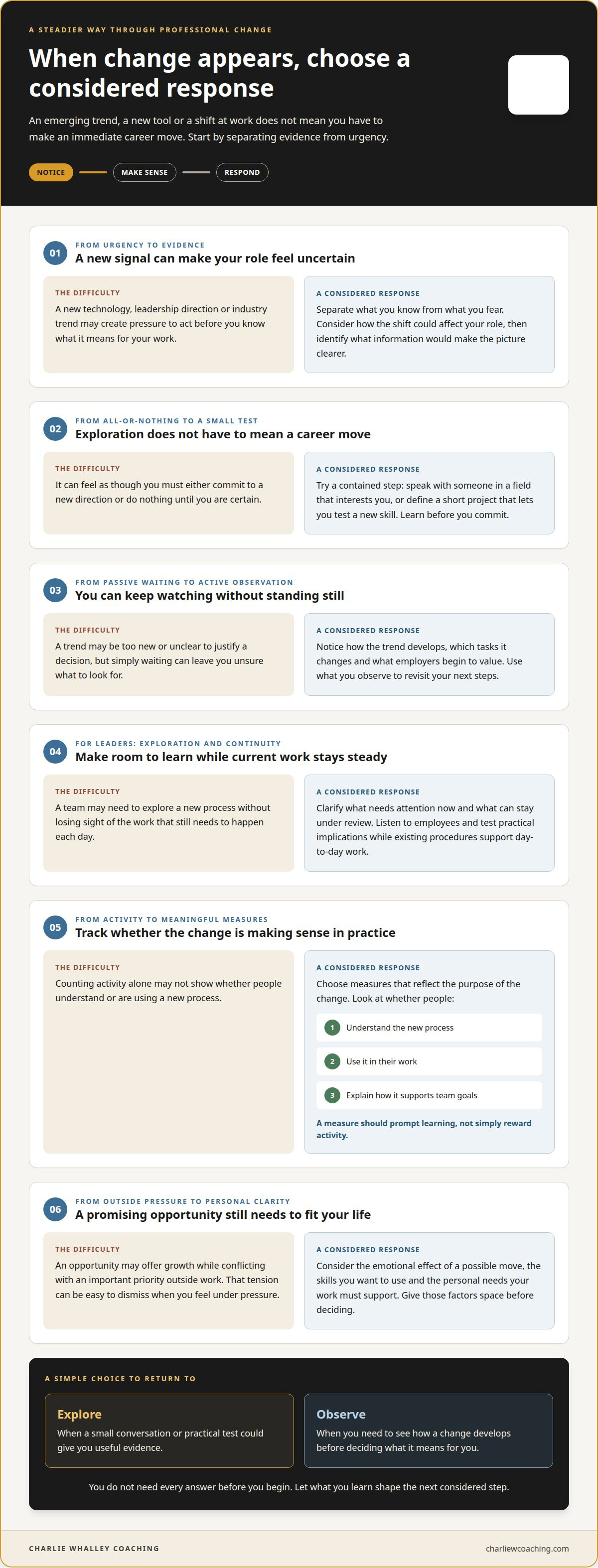
New technology, a change in leadership direction or an industry trend can make your current role feel less certain. But noticing a change doesn’t mean you must act immediately. A coach can help you separate evidence from urgency, consider what the shift could mean for your work and decide whether to explore it or keep observing. For example, a new digital tool may be worth learning about before your organisation decides how to use it.
A career transition coach can help you assess whether it’s time to change jobs or careers by exploring what feels misaligned, what you want more of and which options fit your skills and circumstances. Together, you can distinguish a difficult period in one role from a deeper wish to change direction, then identify what information would make the decision clearer.
Exploration can be a small, contained step rather than an immediate career move. A coach might help you plan a conversation with someone working in a field you’re curious about, or define a short project to test a new skill. Observation can also be active: note how a trend develops, which tasks it changes and what employers begin to value. These steps create useful evidence without requiring you to commit before you’re ready.
For leaders, emerging change brings a balancing act: making room to explore while keeping current work steady. A coach can help clarify what needs attention now and what can remain under review. If a team is adopting a new process, for instance, early exploration might involve listening to employees and testing practical implications while existing procedures continue to support day-to-day work.
Useful measures make progress visible, but they should reflect the purpose of the change. A coach can help leaders choose measures such as whether people understand a new process, use it in their work or can explain how it supports team goals. Accountability is clearer when managers’ and leaders’ performance measures include responsibility for sustaining the change after implementation. A measure should prompt learning, not simply reward activity.
Your own response matters too. A coach can help you consider the emotional effect of a possible move, the skills you want to use, and the personal needs your work must support. If a new opportunity offers growth but conflicts with a priority outside work, that tension deserves attention before you decide. Coaching can create space to weigh those factors and choose a response that feels considered, rather than driven by pressure. You can explore professional coaching support as you work through that decision.
3. ADKAR, Bridges Transition Model, and Kotter’s 8-Step Model
Change models offer different ways to understand what happens during a professional transition. ADKAR focuses on the individual, Bridges Transition Model explores the emotional experience, and Kotter’s 8-Step Model provides a structure for organisational change. A coach can help you choose a useful lens, rather than treating one framework as the answer to every situation.
ADKAR identifies five elements: Awareness, Desire, Knowledge, Ability and Reinforcement. Consider a change to a team’s working process. People may understand why it is happening but still lack the desire, knowledge or confidence to adopt it. A coach can help identify which element needs attention and turn that insight into a practical next step, such as clearer communication or targeted learning.
Bridges’ model describes three transitions: Ending, Neutral Zone and New Beginning. The Ending involves recognising what is being left behind; the Neutral Zone is the unsettled period between old and new; the New Beginning brings a renewed sense of direction. If a restructure removes familiar responsibilities, a coach can help you acknowledge that loss while exploring what the next role could offer. The model makes space for emotional adjustment, not just changes to tasks.
Kotter’s 8-Step Model is designed to guide organisational change. Its steps include creating urgency, building a guiding coalition, forming and communicating a vision, enabling action, generating short-term wins, sustaining progress and anchoring change. For example, a leader introducing a new system could use early wins to show its value, then keep communicating as people learn. A coach can help leaders break a large change into manageable milestones and consider how each affects people.
These frameworks aren’t competing answers. A team may use Kotter’s steps to organise a change, ADKAR to understand what individuals need and Bridges to recognise the transitions beneath visible behaviour. The right focus depends on the challenge: an unclear purpose points towards awareness, while frustration during an uncertain middle phase may call for support and communication. A coach can help you decide what to address first and focus on the parts of change you can influence.
A career transition coach can also help you consider finances as part of a move. Coaching can help you clarify income priorities, compare possible transition paths and prepare questions about timing or training costs. For example, you might weigh a gradual move alongside current work against a full-time change, then identify what information you need to make a grounded decision.
Models work best when they support honest conversation, rather than becoming a checklist to complete mechanically. A coach can help leaders adapt a framework to the relationship between the change and the people affected, then review what is working as circumstances shift. That flexibility matters: professional transitions rarely unfold in exactly the same way for everyone.
4. Resistance to change and uncertainty
Resistance can appear when a change threatens familiar routines, status or confidence. An employee asked to use new software may worry about making mistakes, losing expertise or falling behind colleagues. Those concerns are useful signals, not proof of unwillingness. Naming the specific worry helps leaders respond to the real barrier rather than labelling someone difficult. A focused conversation can reveal whether the person needs clearer information, time to practise or a stronger voice in decisions.
Lewin’s Unfreeze, Change and Refreeze stages offer a way to consider resistance. During Unfreeze, leaders explain why existing habits may need to shift and listen to concerns. In the Change stage, employees practise new behaviours with support. Refreeze reinforces the practices that work. For example, when a team introduces a shared project system, leaders can invite questions before launch, offer guidance during adoption and recognise consistent use afterwards.
Uncertainty can also make ordinary decisions feel harder. A daily routine can provide stability while larger questions remain open. Someone facing a restructure might keep regular planning time, prioritise essential tasks and clarify which decisions are still pending. This doesn’t remove uncertainty, but it can protect attention and make the present feel more manageable. Keeping a clear record of confirmed information also helps separate known changes from assumptions.
For organisations moving away from established norms, trust and transparency matter. If a department changes reporting lines, leaders can explain what is changing, what remains familiar and when people will hear more. They should make room for questions and share updates as decisions develop. Silence can leave employees to fill gaps with speculation. Clear communication helps people understand the purpose of the change and how it affects their work.
Resistance may also point to a problem with implementation. If staff repeatedly bypass a new process, leaders can ask where it creates friction, then adjust training or practical support. Change models aren’t broken simply because a transition feels difficult; implementation can falter when the human impact receives too little attention. Reviewing feedback, adoption and daily obstacles can show whether the plan needs clearer communication or a different approach.
When uncertainty affects your career, it can help to distinguish what you can influence from what you can’t. For example, you may not control a restructure, but you can seek clarity about how your responsibilities could change. Notice whether resistance comes from a specific risk, such as losing flexibility, or from the discomfort of unfamiliar work. That distinction helps you stay focused, make considered decisions and respond to change without expecting yourself to feel comfortable immediately.
5. Change intelligence and self-awareness
Change intelligence is the ability to notice what is shifting, understand its impact and respond thoughtfully. Start by separating external changes, such as a restructure or new technology, from internal changes, such as losing confidence or wanting more meaningful work. For example, a new system may create extra tasks, while your frustration may reveal that your role no longer fits your priorities. Both signals matter, but they call for different responses.
A career transition coach can help identify transferable skills by examining the work you’ve done, the challenges you’ve handled and the strengths you rely on. For instance, coordinating deadlines across teams may demonstrate planning and communication skills that apply in another field. A coach can help connect those examples to potential roles, then identify where further learning or experience could help.
Self-awareness also means noticing how change affects your emotions and choices. If an internal role becomes available, excitement may sit alongside fear of being inexperienced. Naming both feelings can help you ask more useful questions: what attracts you, what concerns you and what evidence could clarify the opportunity? Journalling, exercise or meditation can offer a constructive way to reflect before making a decision.
A simple reflection practice can make patterns easier to see. Set aside 15 minutes for morning meditation, or write a short note after a demanding meeting. Record what happened, how you responded and what you might try next time. If a recurring task leaves you energised, that may point towards work you want to pursue. If it consistently drains you, consider what boundary, support or change could help.
When your career direction is changing, self-awareness helps you distinguish genuine interest from pressure to follow a trend. A course may build a useful skill, but its value depends on how that learning supports the work you want. Before committing, connect the course content to a possible role, speak with someone familiar with that work and reflect on what you learn. This keeps exploration relevant to your goals.
Change intelligence develops through practice, not one perfect decision. You can engage with feedback, notice which responses help and update your approach as circumstances shift. For example, a project that reveals a gap in your experience can guide your next learning choice rather than define your ability. If you’d value support connecting your strengths with a new direction, explore career transition coaching.
Distinguishing external shifts from internal ones can help you map practical next steps, since each may call for a different response. Internal changes, such as starting a relationship or adopting a growth mindset, can also influence your personal and professional life.
As you reflect, ask how a situation may help you grow and what new skills you may gain from it. Exercise, meditation or journalling can help you process emotions constructively. One client practice is meditating for 10 minutes at the start and end of each day. You might also set aside quiet time once a week or once a day to feel relaxed and able to think clearly.
Charlie Whalley Coaching
Charlie Whalley Coaching offers a supportive space to make sense of professional change and decide what direction feels right for you. Through Career Transition Coaching or Life & Leadership Coaching, you can explore your priorities, recognise strengths and build a considered way forward. It may be helpful when uncertainty, self-doubt or competing responsibilities make it difficult to see your next step clearly.
Coaching gives you room to reflect and work through choices at a pace that feels manageable. You bring your questions and experiences; the conversations can help you clarify what matters and identify practical next steps. If you’d like to explore whether coaching could support your transition, book a discovery call with Charlie Whalley Coaching.
Take your next step with greater confidence
As you navigate professional change, you don’t need to force certainty before taking a thoughtful next step. Start with what feels most important now: a conversation, a fresh perspective on your options or space to recognise what you want your working life to make room for. Your direction can become clearer as you learn more about yourself and the possibilities ahead.
There may still be questions, and that’s all right. You can move forward without having every detail settled. What matters is choosing a next step that reflects your priorities, rather than acting only from pressure or fear of getting it wrong.
If you’d value a supportive conversation about what comes next, contact Charlie Whalley Coaching. You can explore your questions at your own pace and consider what kind of support would feel useful. Your next chapter doesn’t have to be mapped out all at once. Begin where you are, and let clarity grow from there.
Frequently Asked Questions
What does navigating professional change mean?
Navigating professional change means making informed choices as your work, role or career direction shifts. It might involve adapting to a new manager, taking on unfamiliar responsibilities or moving into a different field. The process includes understanding what is changing, deciding what matters to you, and choosing how to respond. For example, before accepting a promotion, you might consider how its responsibilities fit your strengths and priorities.
What are the risks and common challenges of changing careers?
Changing careers can bring uncertainty about income, job security, workplace culture and whether your experience will transfer. You may also need to learn new skills or adjust to a different level of responsibility. These challenges are easier to assess when you break the decision into practical questions: what skills does the new role require, what experience can you demonstrate and what would need to change in your current commitments? This helps you plan with fewer assumptions.
How can you negotiate a job offer during a career change?
Clarify your priorities, prepare questions and practise discussing responsibilities, flexibility and development opportunities with the employer.