
Signs of career unfulfillment and ways to explore meaningful work

What if you feel unfulfilled in your career, even after achieving the success you once hoped for? You may value your work and still feel restless, drained or disconnected from what matters to you. That doesn’t mean you’ve failed or need to make a sudden change.
It can be difficult to tell whether you’re ready for a new role, a different direction or simply a clearer understanding of what you need from work. Priorities can shift over time, and noticing that shift is a useful first step.
This article will help you recognise signs of career unfulfilment, uncover what felt satisfying in past jobs and take considered steps towards change. You’ll also find ways to reflect on how work fits with the rest of your life, so you can explore meaningful work at a manageable pace.
Key Takeaways
- Recognise when dissatisfaction may be signalling a need for change, and give yourself space to understand it before making a major decision.
- Look back at moments in past roles when you felt engaged or at ease to spot the work and values that matter to you.
- Build confidence through small, manageable actions that help you explore new possibilities and learn from experience.
- Consider how purpose and fulfilment outside work can shape your sense of direction during a period of transition.
- Reflect on whether a different role or a broader career change better fits your long-term goals.
1. What are the signs that you’re feeling unfulfilled?
If you feel unfulfilled in your career, work can seem increasingly out of step with what matters to you. You might complete tasks and meet expectations, yet feel little interest in the outcome. A promotion, for example, can bring recognition without making your working day more meaningful. Career dissatisfaction describes this gap between outward progress and your sense of purpose, interest or fit.
Disengagement can offer one clue, though it doesn’t explain every person’s experience. The figures in this article’s research brief report that 79% of workers globally are disengaged, whilst 21% are engaged. Those figures don’t define your situation. Your own patterns matter: notice whether you feel energised by particular tasks or routinely count the hours until work ends.
Notice changes in your everyday behaviour. You might put off projects you once found absorbing, feel irritable after routine meetings or stop suggesting ideas. Perhaps you value helping people, but spend most of your week on isolated administrative tasks. When your values and daily responsibilities don’t align, you can feel restless even if colleagues see your role as successful.
Treat dissatisfaction as useful information, not a personal failure or an instruction to resign. Pause before making major career or life decisions. Write down what feels difficult, when it happens and what still feels worthwhile. Sharing these observations with someone you trust can ease shame and help you spot patterns.
You can explore a career change whilst keeping your current income: research roles, build relevant skills and try out interests beyond work. For example, take on a small project or explore an internal opportunity before deciding whether to leave. Continue to meet your current responsibilities professionally as you consider what comes next.
Changing careers can involve training costs, time spent developing skills, disrupted income and uncertainty about a new role. The impact depends on your circumstances, including savings, existing commitments and whether you can make the move gradually. Mapping these factors helps you distinguish a manageable transition from a rushed decision.
Your values can change as your responsibilities and circumstances shift. A role chosen for status or stability may no longer feel right. Ask whether your dissatisfaction stems from a specific manager, workload or workplace, or from the work itself. This distinction can point towards changing roles rather than changing careers entirely.
For now, focus on what you can control: notice recurring frustrations, identify a useful conversation and keep your commitments steady. A clear record of examples is more grounded than one difficult Monday or discouraging meeting. You don’t need to solve your whole working life today. Start by understanding what your dissatisfaction is telling you.
Identifying fulfilling aspects of past jobs
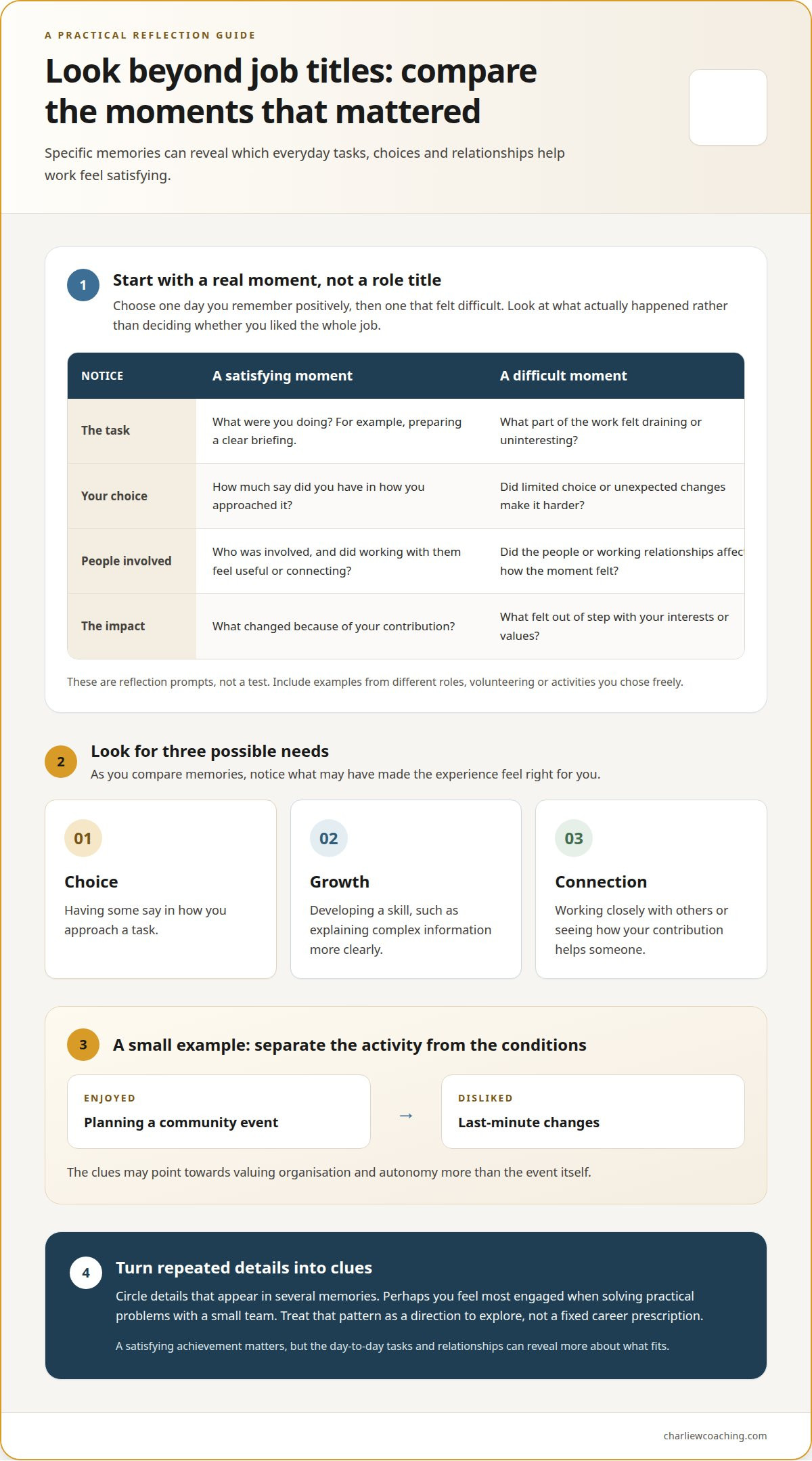
A job title can obscure the details that made a working day satisfying. Rather than asking whether you liked a former role, choose a specific day you remember positively. What were you doing? Who was involved? What changed because of your contribution? You may, for example, have enjoyed preparing a clear briefing more than presenting it to senior leaders.
Look across different roles, including temporary work, volunteering and school activities. Note when you felt focused, useful or at ease. Perhaps you enjoyed solving a customer’s problem, organising a shared project or learning a new system. These examples can reveal preferences that a job title alone cannot.
Childhood memories can offer another clue. Think about activities you chose freely, such as drawing, explaining a game to others or caring for an animal. Don’t assume these activities dictate a career. Instead, identify what appealed to you: making something, teaching, solving a practical problem or helping someone feel safe.
Achievement may not bring fulfilment if the reward matters more than the work itself. A promotion, award or completed target can feel pleasing, yet leave you disconnected if daily tasks conflict with your interests. Imagine a manager who enjoys recognition but dislikes spending most days reviewing spreadsheets. The achievement is real, but it may not meet their deeper needs.
As you review each example, look for three possible needs: choice, growth and connection. Choice means having some say in how you approach a task. Growth might mean developing a skill, such as explaining complex information more clearly. Connection could mean working closely with others or seeing how your contribution helps someone.
Try a simple comparison. Write down a satisfying moment from a past job, describing the task, your independence and the people involved. Then do the same for a difficult moment. If you enjoyed planning a community event but disliked last-minute changes, you may value organisation and autonomy more than the event itself.
Next, circle details that appear in several memories. You might notice that you feel most engaged when solving practical problems with a small team. Treat this as a direction to explore, not a fixed career prescription. It can help you look beyond status and job titles to the everyday activities and relationships a role involves.
3. Building courage and confidence through small actions
Confidence often grows through experience, not by waiting for every doubt to disappear. If presenting ideas feels daunting, start by sharing one suggestion in a small team meeting. Notice what happens, what you learn and what you might try differently next time. Each manageable action gives you evidence about your abilities instead of leaving you to judge yourself by anxious predictions.
Choose a step that stretches you without putting your stability at risk. You could volunteer for a task that uses a skill you want to develop, ask to shadow a colleague or attend a professional event. Treat each experiment as information, not a test of whether you’re capable of changing direction. A conversation with a trusted mentor can help you reflect on what you learned.
To feel more fulfilled in your current job, identify one change you can influence and act on it. You might ask your manager about taking on a more collaborative project or set aside time to practise a skill relevant to work you enjoy. Small adjustments can help you see whether a different balance of tasks would make your role more satisfying.
If you feel comfortable, speak with your boss about internal opportunities or professional advice. Be specific: explain that you want to build experience in a particular area, then ask what projects could help. Someone interested in mentoring, for example, might offer to support a new colleague. This gives you both something concrete to discuss, without making the conversation an ultimatum.
Learning can create a sense of progress whilst you explore. Choose a skill connected to a possible future role, such as improving your presentation or data analysis skills. BJ Fogg has said that becoming an expert in a specific topic can take an investment of 40 to 60 hours. Treat that as a prompt to explore focused learning, not a promise of expertise or a requirement to commit immediately.
Keep a short record of each action: what you tried, what felt energising and what you would change. After contributing an idea, for instance, note whether you enjoyed shaping the proposal or presenting it. These details help you distinguish the discomfort of learning from signs that an activity genuinely doesn’t suit you. Courage can grow through repeated, considered choices.
Choose a next step small enough to take this week. Message a colleague, request a conversation about a project or practise a useful skill. You don’t need complete certainty first. A thoughtful experiment can show you what feels possible whilst keeping your wider career decisions open.
Calling orientations toward work and life
Work can matter to you in different ways. You might value reliable income, opportunities to progress or the sense that your contribution helps others. These priorities can overlap, and none is automatically better. A steady role, for example, may support your family whilst volunteering gives you a stronger sense of purpose.
If your job currently feels like a source of income rather than meaning, consider what happens outside working hours. Coaching a local sports team, caring for a relative or helping with a community garden can give your week a valued focus. These activities don’t replace fair, sustainable work, but they can help you recognise which parts of life feel meaningful.
Choose an activity that reflects something you care about, rather than adding another obligation. If creativity matters, make time for a personal project after work. If connection matters, arrange a regular meal with friends. Notice how each commitment affects your energy and whether it adds purpose without making your responsibilities harder to manage.
A sense of purpose outside work can make a transitional period more manageable. Imagine staying in a routine role whilst considering your next direction. A regular commitment to mentoring a younger person could give you a valued contribution now as you explore what you want from work. It can also remind you that your identity is about more than your job title.
Workplace changes can improve satisfaction and work-life balance when they address a specific source of strain. You could discuss clearer priorities if urgent requests keep displacing planned work, or explore adjusted start times if a long commute limits family time. Agreeing how colleagues share responsibilities may also help if one person regularly carries a disproportionate workload.
Make the conversation practical: describe the issue and suggest a workable adjustment. You might ask your manager to agree which project takes priority when deadlines clash. If evening messages make it difficult to switch off, discuss expectations for routine communication. These changes won’t reshape every aspect of a role, but they can show whether your workplace can better support your needs.
Try a simple weekly reflection: note one moment when work felt worthwhile and one when life outside work felt meaningful. A useful conversation with a friend, for instance, may help you see that connection matters in both settings. Over time, these examples can clarify whether you want more purpose from your job or a balanced life with purpose in several places.
5. How can you tell whether to change jobs or change careers?
Start by separating what troubles you about your workplace from what troubles you about the work itself. If you enjoy designing reports but struggle with an unsupportive manager, a similar role elsewhere might suit you. If the core tasks feel draining in different settings, a broader career change may be worth exploring.
Look for patterns rather than relying on one difficult week. Write down recurring frustrations from recent projects, such as limited autonomy, unclear priorities or little contact with colleagues. Then note which tasks still interest you. If the same concerns recur across projects, the role may be the issue. If they centre on one manager or team, the workplace may be the main factor.
An external job search can help clarify what matters, even before you apply. Read role descriptions and notice which responsibilities attract you or give you pause. A project manager, for example, might find that coordinating teams appeals, whilst constant client pitching does not. That distinction can help you find a better-fitting job without assuming you need an entirely new profession.
Consider your longer-term goals alongside present frustrations. If you want to use your technical knowledge to support public services, compare roles that draw on your expertise with paths requiring new skills. Ask how each option would change your daily work, learning and contribution. A clear connection to your goals makes it easier to assess possibilities beyond an impressive title.
Test your assumptions before making a major decision. Speak with someone doing the work you’re considering, or explore a relevant project in your current organisation. If you’re a designer interested in teaching, for instance, offer to explain a process to colleagues and see whether sharing knowledge energises you. Treat each conversation or project as evidence, not a promise about your future.
A practical comparison can bring the choice into focus. Create two columns: “change jobs” and “change careers”. Under each, record likely daily tasks, the skills you’d use, what you’d need to learn and how closely the option supports your longer-term direction. A new employer may resolve a workplace mismatch; a new field may better fit changing interests.
Avoid handing in your notice in response to one discouraging conversation or demanding project. Give yourself room to gather information, consider internal and external roles, and discuss your thinking with someone you trust. If you’re ready to explore these choices with support, talk through your career transition options.
Charlie Whalley Coaching: Career Transition Coaching
Charlie Whalley Coaching offers Career Transition Coaching for people weighing a new role, a different direction or how to move forward with more confidence. If you’ve identified what feels missing but aren’t sure how to turn that insight into a practical next step, coaching can help you reflect on your priorities and navigate professional change.
You don’t need to have a complete plan before asking for support. It can be helpful when self-doubt or competing responsibilities make it difficult to see your options clearly. The focus is on helping you find a direction that feels more aligned with your working life and personal priorities.
If you’d like support exploring your next step, contact Charlie Whalley Coaching.
Make space for your next direction
If you feel unfulfilled in your career, you don’t have to turn that feeling into an immediate decision. Let it prompt you to consider what you want your working life to make room for, alongside the responsibilities and relationships that matter to you. Your next step can be thoughtful and gradual.
Give yourself time to explore an idea before deciding whether it belongs in your future. A conversation, a new responsibility or a period of learning can help you see what feels worth pursuing. You’re allowed to change direction as your priorities evolve. You don’t need every answer before you begin.
If you’d value support as you consider what comes next, get in touch with Charlie Whalley Coaching. A clearer direction can start with one honest conversation, and you can take it at your own pace.
Frequently Asked Questions
Can you feel unfulfilled even if you’re successful?
Yes. External measures such as a senior title, strong performance reviews or professional recognition don’t always reflect how satisfying your day-to-day work feels. A respected specialist, for instance, may enjoy solving complex problems but spend most of the week on administrative approvals. Success can show that you’re meeting expectations, but it doesn’t necessarily mean your work reflects what you find worthwhile.
What are the signs that you’re feeling unfulfilled?
A useful clue is a recurring gap between what your role demands and what leaves you feeling engaged. You might find that a whole week feels draining, even when no single task or meeting seems unusually difficult. Compare how you feel before work, during specific responsibilities and afterwards. If the same pattern appears across different days, explore what might be contributing to it.
What are common signs of feeling unfulfilled in your career?
Common signs include feeling detached from results, struggling to care about goals you once valued or finding it difficult to imagine progressing in your current field. You may also feel envious when colleagues describe meaningful work. If a successful project brings no satisfaction, for example, note that response alongside the conditions surrounding it, such as its purpose or level of responsibility.
What causes career dissatisfaction or lack of fulfilment?
There isn’t one cause. A role may offer little development, a team’s working style may clash with yours, or the organisation’s priorities may no longer feel meaningful. Life circumstances can also change what you need from work. A schedule that once suited you, for example, may become difficult when caring responsibilities change. Pinpointing the source helps you consider whether the concern is about your job, workplace or broader direction.
How can a career counsellor or coach help with career dissatisfaction, and what do sessions cost?
A coach can help you clarify career priorities, explore options and shape a considered plan for change. Career Transition Coaching supports professionals navigating career shifts. Charlie Whalley Coaching offers a free initial discovery session. For details about coaching fees and to discuss whether this support fits your situation, book a discovery session with Charlie Whalley Coaching.
When can career dissatisfaction be a sign of burnout or a mental health concern?
If exhaustion, detachment or distress persists outside work and affects everyday activities, relationships or your ability to rest, consider speaking with a qualified health professional. Career dissatisfaction alone can’t establish burnout or a mental health condition. Coaching may support career reflection, but it isn’t a substitute for clinical care. In the United States, you can call or text 988 for crisis support.