
Overcoming Impostor Syndrome at Work by Recognizing Its Effects

What if the doubt that makes you work harder is also making it harder to do your best work? Overcoming impostor syndrome at work begins with recognising the pattern: you may dismiss your achievements, credit success to luck, or worry that others will discover you’re not capable, even when your experience says otherwise.
If you’ve ever stayed silent rather than risk asking a question, or felt that one mistake outweighs everything you’ve done well, you’re not alone. Self-critical thoughts can chip away at confidence, and keeping them to yourself can leave you feeling isolated. These responses don’t mean you lack ability; they may signal that you’ve begun to view your contribution too harshly or find it difficult to trust your own judgement.
This article explains how impostor syndrome can show up at work and affect your relationships, confidence and willingness to take opportunities. It also explores practical ways to recognise self-critical thinking, talk about what you’re experiencing and seek support from mentors and colleagues. Small, thoughtful shifts can help you see your work more clearly and move forward with greater confidence.
Key Takeaways
- Recognise how workplace expectations and feelings of belonging can shape self-doubt, without treating it as proof that you lack ability.
- Notice when harsh inner commentary is influencing how you interpret feedback, mistakes or achievements.
- Learn to recognise signs such as dismissing success or fearing exposure, and understand how silence can deepen isolation.
- See how trusted colleagues and mentors can offer perspective, practical feedback and support when asking for help feels difficult.
- Understand how self-doubt can affect confidence, relationships and career opportunities, and why support can help you move forward.
1. What is imposter syndrome?
Impostor syndrome describes persistent doubt about your achievements, such as believing they came from luck rather than skill, alongside a fear of being exposed as incapable. A colleague might lead a successful project but credit the result to an easy brief. Impostor syndrome isn’t a specific medical or psychological diagnosis. Unlike low self-esteem, which can affect your general view of your worth, impostor feelings often centre on competence and achievement. Anxiety and burnout are different experiences, although they can coexist with these feelings.
Your sense of belonging can affect how strongly workplace expectations fuel self-doubt. If you rarely see people with your background represented in leadership, a promotion may feel like evidence that you don’t belong rather than recognition of your contribution. Impostor feelings can affect anyone, but are reported more often among women and people of colour. This doesn’t mean everyone in these groups experiences them; it highlights how social stereotypes and workplace culture can shape confidence.
Career stage can matter, too. New hires may worry that asking questions will expose their inexperience, while trainers, managers and supervisors can feel uncertain in unfamiliar situations. A newly appointed manager, for instance, might assume they should already know how to handle every conversation. In reality, a new role brings new expectations. Recognising that uncertainty may reflect a learning curve, not a lack of ability, can make it easier to participate and thrive.
Self-doubt can affect your choices as well as your feelings. If you put successful work down to luck, you may avoid volunteering for a visible project, applying for promotion or sharing an idea in a meeting. Over time, those decisions can mean missed opportunities to develop skills and show what you can do. Notice the difference between a genuine skills gap and dismissing evidence of your ability. A completed project or positive client response can offer useful evidence.
Impostor feelings can affect workplace relationships, too. If you fear being judged, you may keep quiet, withdraw from colleagues or struggle to delegate. A manager might redo a teammate’s work because they believe only their own standards are safe. This can reduce trust and make collaboration harder. Asking for help or sharing responsibility isn’t proof of incompetence; it can give colleagues clearer ways to contribute and build stronger working relationships.
Feedback offers a practical way to compare your self-perception with other people’s observations. Ask your manager for specific examples of what is working well, as well as constructive suggestions for improvement. If feedback identifies a strength, remember the task, skill and effort behind it. If it highlights something to develop, treat that as information about a next step, not proof that past achievements were undeserved. Both kinds of feedback can help you form a more balanced picture of your work.
2. Noticing self-critical thoughts
Self-critical thoughts can sound like facts: “I only succeeded because the task was easy” or “That criticism proves I’m not good enough.” A coach can help you notice the exact words, what triggered them and how they affect your next decision. After feedback on a presentation, for example, you might focus on one suggested change and overlook what went well. Naming that pattern creates room to consider the feedback more fairly. This is one practical starting point for overcoming impostor syndrome at work.
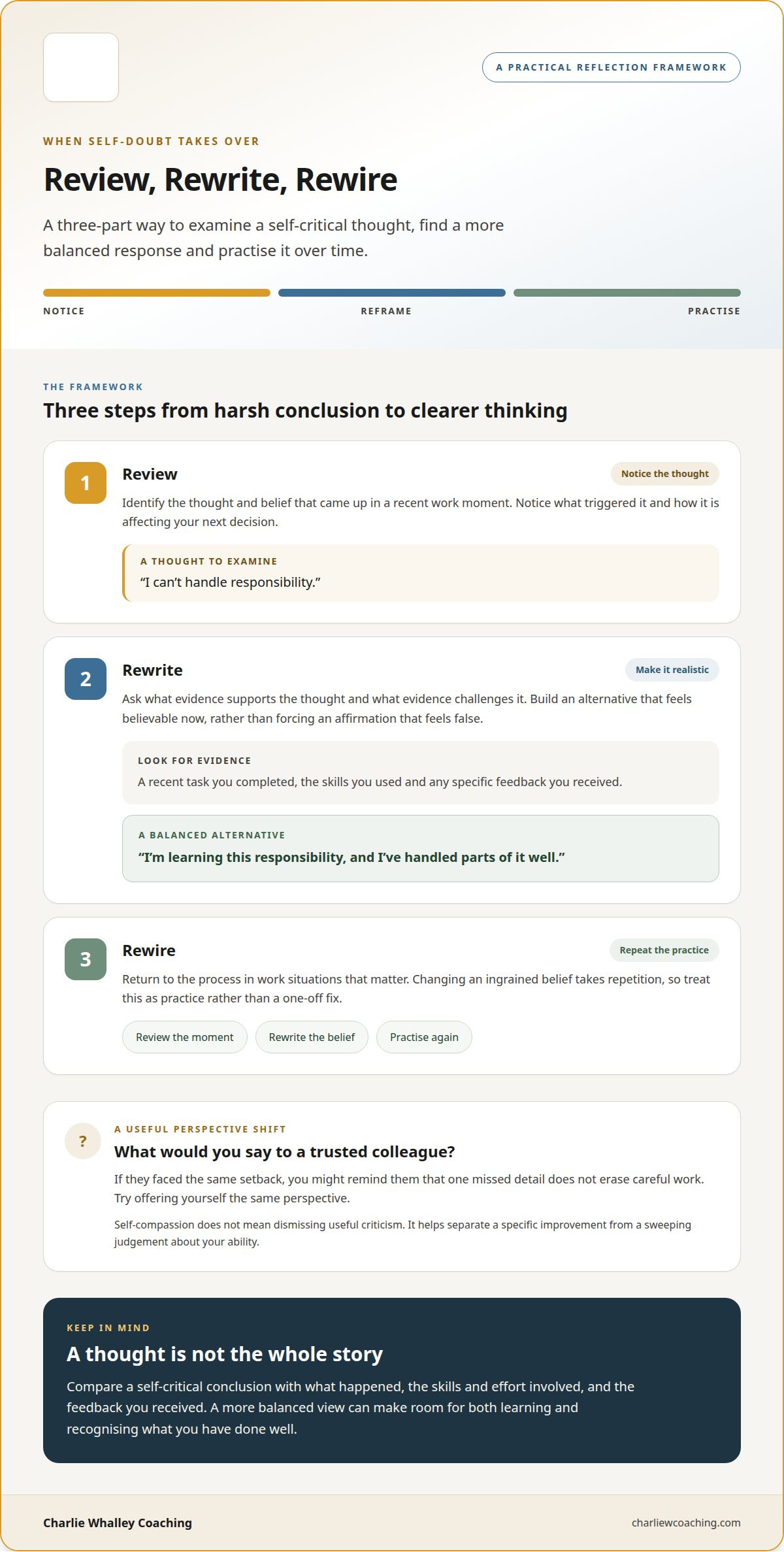
A useful framework is Review, Rewrite and Rewire. First, review the thought and belief that came up. Next, rewrite an unhelpful belief into something realistic enough to believe now, rather than forcing an affirmation that feels false. Then rewire the pattern through repeated practice. A coach can guide you through the process using a recent workplace moment, helping you distinguish what happened from the harsh conclusion you drew. Changing an ingrained belief takes repetition.
A coach might ask what evidence supports a self-critical thought and what evidence challenges it. If you think, “I can’t handle responsibility”, they could explore a recent task you completed, the skills you used and any specific feedback you received. Together, you can form a balanced alternative, such as, “I’m learning this responsibility, and I’ve handled parts of it well.” For some people, overcoming impostor syndrome at work starts with practising this more balanced response in situations that matter.
You can also practise self-compassion with a simple prompt: what would you say to a trusted colleague facing the same setback? If you’d tell them that one missed detail doesn’t erase careful work, try offering yourself the same perspective. This isn’t a reason to dismiss useful criticism. It helps separate a specific improvement from a sweeping judgement about your ability. A coach can help you find language that feels supportive without sounding unconvincing.
Perfectionism can turn a normal mistake into a verdict. A coach can help you identify the expectation beneath it, such as believing every first attempt must be flawless. You can then consider a more workable response: treat the draft as a starting point, use feedback to improve it and recognise what you’ve completed. Small habits can support this shift, such as setting an intention before a demanding task, noting a strength at the start of the day or reflecting on a moment of progress afterwards.
Over time, these habits give you a more balanced way to respond when self-doubt returns. If guided reflection would help you practise them in your professional life, book a discovery call with Charlie Whalley Coaching to explore how coaching could support your thinking and help you build more encouraging self-talk.
3. Breaking the silence and recognizing impostor feelings
Impostor feelings can hide behind capable, reliable work. You might prepare repeatedly for a routine presentation, then decide it went well only because the audience was kind. Other signs include fearing exposure, discounting accomplishments, attributing success to luck or fixating on a small mistake. Recognising these patterns matters: feeling stupid after a difficult task doesn’t mean you are stupid. It may mean you’re judging yourself by an impossible standard.
Silence can make those judgements feel more convincing. If you assume everyone else feels certain, you may hide questions and avoid sharing a concern with a trusted colleague. That can leave you alone with thoughts that might look different when spoken aloud. For instance, saying, “I’m worried one error means I’m not suited to this role,” gives someone you trust a chance to help you examine what happened instead of leaving the worry unchallenged.
A coach can help you recognise strengths that self-doubt keeps out of view. When discussing a recent project, they might ask what you contributed, which decisions you made and what helped the work succeed. You could identify that you clarified priorities, resolved a problem and kept colleagues informed. These details turn “it was just luck” into a more balanced account of your accomplishments and the skills behind them.
To make that perspective easier to revisit, keep a record of completed work and positive feedback. Include the task, your contribution and the result, such as “summarised client needs, aligned the team and delivered the agreed proposal”. Review the record regularly. A coach can help you spot recurring strengths across separate examples, rather than dismissing each success as an exception. Over time, the record becomes a concrete reminder when self-doubt makes your capabilities harder to recognise.
When criticism arrives, separate the specific information from the story you attach to it. If your manager asks for clearer figures in a report, the feedback identifies an improvement, not a verdict on your entire role. A coach can help you reflect on what to change and what the feedback doesn’t say. This approach makes room for learning without pretending mistakes feel comfortable.
Talking about these feelings can help you find useful perspective. You might tell a trusted colleague, “I’ve been dismissing my work as luck, even when I’ve put in considerable effort.” Their response won’t determine your worth, but it may help you see the gap between your self-judgement and observable contributions. With support, you can begin to describe your work more accurately, neither minimising your effort nor claiming perfection.
4. Seeking support from mentors and colleagues
Asking for help can feel risky if you believe a capable colleague should already know the answer. You may stay late trying to solve a problem alone rather than ask a teammate who has handled it before. A coach can help you identify the assumption behind that hesitation, then plan a clear request. For example, “Could you show me how you approach this client handover?” makes asking a practical step, not an admission of failure.
Coaching can also help you decide who might offer the most useful support. A colleague with relevant experience may help with a technical task; a mentor may offer perspective on a career decision. Prepare by naming the situation, what you’ve tried and what guidance you need. Rehearsing that conversation with a coach can build confidence, especially if discussing uncertainty makes you feel exposed.
Managers can support employees by setting clear expectations, giving specific feedback and welcoming questions. During onboarding, for example, a manager can explain how to prioritise a task and introduce a colleague as a point of contact. Regular conversations about what is going well and where support is needed can make it easier to raise uncertainty before it turns into isolation or overwork.
A manager’s response matters. If someone raises a concern, listen without dismissing it, then discuss the facts and agree on a useful next step. A manager might clarify which parts of a presentation were effective and identify an area to develop. They can also recognise effort and skill specifically, rather than offering vague praise. This gives employees practical information to help them understand their contribution.
Support can come from peers, too. A buddy system for a new employee provides someone familiar to ask about everyday processes, team norms and unwritten expectations. Managers can also learn by observing colleagues who approach a task differently. Sharing strategies helps make asking and learning normal parts of workplace behaviour, rather than something associated with weakness.
If asking for help feels difficult, coaching can help you explore what you fear might happen and practise a manageable first conversation. It can support reflection and confidence, but it isn’t a substitute for clinical care. If impostor feelings are difficult to navigate alone, speaking with a counsellor or therapist can offer guidance, particularly if anxiety or low mood is affecting daily life.
5. How impostor syndrome affects work
Impostor feelings can shape your working day long before anyone else notices. If you fear being exposed, you may spend extra time checking a routine email, delay sending a report or avoid asking a question. The pressure isn’t simply about doing good work. It can come from feeling that every task must prove you deserve your role.
That pressure can lead to overwork. You might stay late to perfect a presentation, sacrificing rest or personal time because “good enough” feels unsafe. Working harder can seem like protection, but it may add stress and contribute to burnout. If preparation keeps expanding without improving the result, consider what expectation is driving it. The task may need more work, or fear may be demanding certainty no task can provide.
Career growth can narrow, too. A capable employee may stay quiet in a meeting, decline a stretch assignment or avoid applying for promotion. Each choice can feel safer in the moment, yet reduce opportunities to build skills and demonstrate readiness. A small step, such as sharing a considered view in a discussion, can help you participate without waiting to feel completely confident.
In a team, self-doubt can affect how work is shared. If you believe colleagues will spot a flaw, you may struggle to delegate, check every detail or redo another person’s work. Teammates may feel mistrusted, while you carry more than necessary. Clear responsibilities and agreed review points help distinguish appropriate quality checks from repeated checking driven by fear.
Impostor feelings can also change how feedback lands. You may interpret a specific suggestion about a report as proof of overall incompetence, while dismissing positive comments as politeness. Over time, this uneven reading can weaken motivation and make collaboration feel less safe. Separate the feedback itself from the conclusion you attach to it, so a practical improvement doesn’t become a judgement about your whole career.
These effects can influence mood as well as performance. Impostor syndrome is often associated with anxiety and depression, and may worsen them. Stress, low mood or reduced motivation can make ordinary tasks feel heavier, while exhaustion can make self-critical thoughts harder to challenge. If these difficulties affect daily life, consider speaking with a qualified mental health professional.
The useful takeaway is to look at patterns, not one difficult day. Notice whether fear is repeatedly driving overwork, silence, avoidance or strained teamwork. Then choose a manageable response, such as asking for clearer priorities, sharing a contribution or agreeing a realistic stopping point. If you’d like support exploring these patterns and building a steadier way forward, explore coaching support.
Charlie Whalley Coaching
Charlie Whalley Coaching helps people work through self-doubt, build confidence and navigate professional change. If impostor feelings are shaping how you approach responsibilities, feedback or career decisions, coaching can give you space to explore what’s happening and consider a constructive way forward.
Through Life & Leadership Coaching, you can reflect on the expectations you place on yourself, recognise your strengths and identify practical steps that feel right for your work. Career Transition Coaching may also support you if self-doubt is affecting how you think about a change in direction. The focus is on understanding your situation and building a path that fits your goals.
If you’d like to explore whether coaching could support you, contact Charlie Whalley Coaching.
Choose a next step that feels manageable
You don’t need to wait until every doubt has disappeared before making a change. A useful starting point may be choosing one situation where you’d like to respond differently, such as sharing an idea, accepting a new responsibility or setting a clearer limit on extra work. That small decision can help you practise a more balanced view of your contribution.
Overcoming impostor syndrome at work is not about proving your worth to everyone around you. It’s about making room for your skills and judgement, even when uncertainty is still present. If you’d value a thoughtful space to consider what comes next, contact Charlie Whalley Coaching to explore how coaching might support your professional direction.
Take your next step at a pace that feels right. Your confidence can grow as you move.
Frequently Asked Questions
What is imposter syndrome?
Impostor syndrome describes persistent doubt about your abilities, even when your work shows experience or skill. You might assume a successful outcome came from favourable timing rather than your preparation and judgement. It isn’t a formal diagnosis, and there’s no standard test for it. The term can still describe a recognisable pattern, especially if you repeatedly feel you must prove you deserve your position.
Why Do I Feel This Way?
There isn’t one explanation for these feelings. They may be shaped by demanding expectations, unfamiliar responsibilities, workplace culture or stereotypes about who belongs in particular roles. Joining a team where you’re the only person with your background, for example, may make ordinary uncertainty feel like evidence that you don’t fit. Consider the situation surrounding the doubt, rather than treating the feeling itself as proof of your ability.
What is impostor syndrome at work and what are common signs?
At work, impostor feelings can make you question whether your skills and achievements are deserved. You might dismiss praise, fear colleagues will uncover a supposed lack of ability or replay a small error after a successful meeting. You may also avoid a task that could develop your skills because you don’t feel ready. Look for recurring patterns across different tasks, rather than judging yourself by one unsettled day.
What causes impostor syndrome in the workplace?
Workplace impostor feelings can grow from a mix of personal expectations and working conditions. Unclear responsibilities, a new role, limited feedback or pressure to make no mistakes can intensify uncertainty. Social stereotypes and a lack of visible representation may also affect your sense of belonging. A new team leader without clear guidance, for instance, may interpret normal learning as evidence of failure rather than part of taking on unfamiliar work.
How can coaching help me respond to impostor syndrome when receiving praise or feedback?
Coaching can help you pause and consider what praise or feedback actually says. If your manager commends your careful planning, a coach might help you identify the decisions and preparation behind that strength instead of dismissing the comment as politeness. For constructive criticism, coaching can help you focus on the specific change requested. This supports a more measured response, so one suggestion doesn’t become a judgement about your overall capability.
When should I seek therapy or professional help for impostor syndrome?
Consider speaking with a therapist or counsellor if self-doubt is difficult to manage alone or is affecting your daily life, mood or wellbeing. Persistent anxiety, low mood, disrupted rest or difficulty functioning at work are reasons to seek appropriate support. Impostor syndrome itself isn’t a diagnosis, but related distress deserves attention. Coaching can help with work goals and reflection, while a mental health professional can support emotional or psychological difficulties.