
Coaching for Career Change: Which Career Coach Fits Your Needs

The right career coach may not start with your CV. Coaching for career change helps you understand what you want from work, identify a direction and move towards a new role or career. Some coaches focus on job-search skills; others help you explore your values, confidence and longer-term goals.
If you feel restless, uncertain or ready for a different working life, it can be hard to know what support will help. That uncertainty doesn’t mean you’re failing to make progress. You may simply need space to work out what matters before deciding what comes next.
This guide explains what a career transition coach does and how different approaches meet different needs. You’ll learn to distinguish practical job-search coaching from broader career-direction support, what to consider when choosing a coach, and how to recognise a partnership that could help you make a change with greater clarity.
Key Takeaways
- Clarify what you want from your working life before deciding whether you need practical job-search support or broader career-direction coaching.
- Choose a coach whose approach matches your immediate needs, whether that’s interview preparation, confidence-building or exploring a new direction.
- Understand how coaching can help turn your goals into focused actions and support you through the uncertainty of a transition.
- Use a coach’s guidance to build professional connections and approach networking with greater purpose and confidence.
- Consider whether a full career change or a smaller pivot could bring your work closer to your strengths and priorities.
What Is a Career Transition Coach?
A career transition coach helps you make sense of your working life, define a direction and plan practical steps towards change. Coaching may bring together career clarity, professional goals, identity, values and exploration of suitable opportunities.
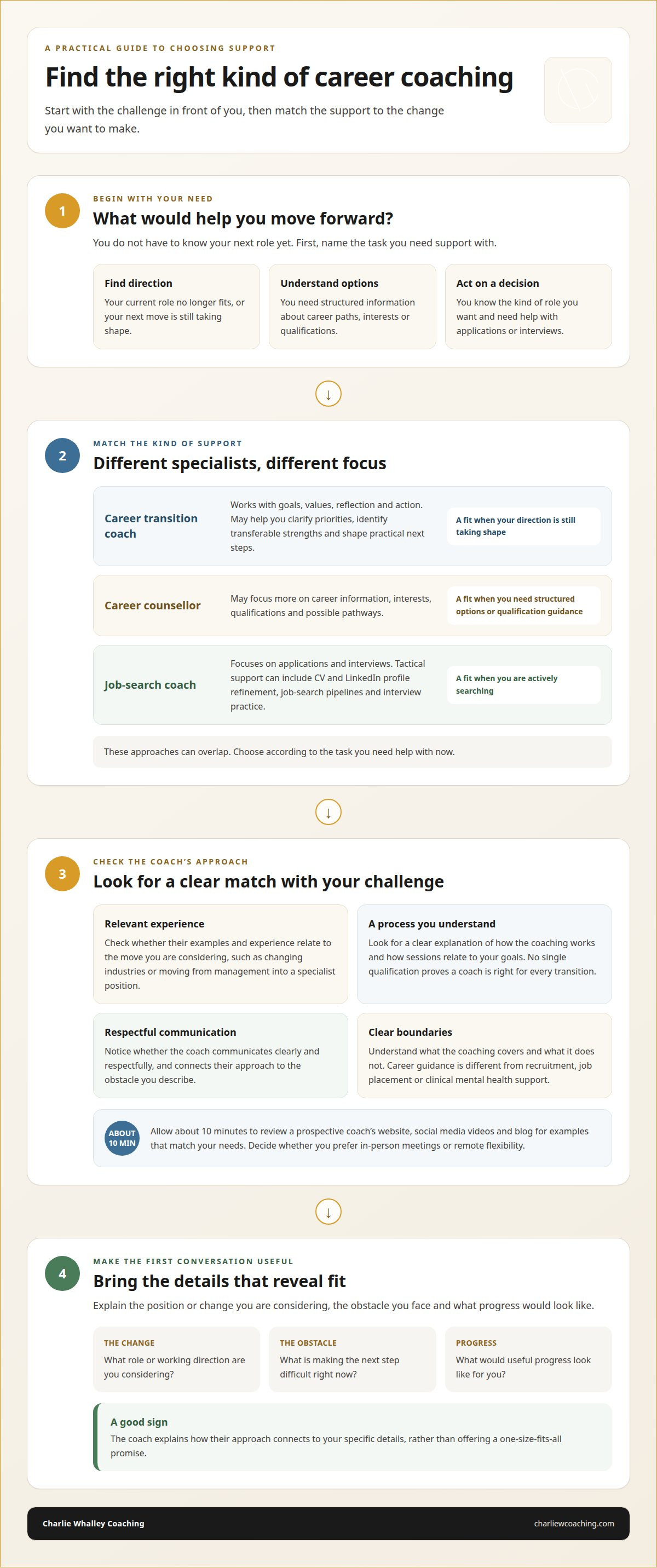
The right approach depends on whether you need direction, career information or help acting on a decision. These options can overlap, but they address different needs.
Career clarity and professional goals
A coach helps turn a broad feeling, such as “this role no longer fits”, into specific decisions about your next move. You might identify that you value autonomy, enjoy solving customer problems and want less travel. Those priorities can shape your goals and narrow the options, perhaps towards a customer success role with a more flexible working pattern.
This approach centres on your motivations and professional identity, rather than starting with a CV or vacancy list. It can also help you decide which parts of your current work you want to keep, change or leave behind.
Coaches and career counsellors
A career change coach typically supports goal-setting, reflection and action. A career counsellor may focus more on career information, interests, qualifications and possible pathways. The distinction is useful, although individual approaches can overlap.
Choose according to the task at hand: coaching can help you clarify priorities and make decisions, while counselling may suit you when you need structured information about career options. These roles can support your career planning, though what they offer varies by practitioner.
Costs, benefits and limitations
In the United States, career change coaching costs depend on the coach’s format, the scope of support and the work involved. The price is determined by the case and provided after a quote request. Career coaching may be covered by employer benefits if the relevant plan includes it; tax deductibility depends on your circumstances and applicable tax rules.
Coaching can help you assess options, but it doesn’t make the decision or secure a role for you. It may not suit you if what you need is clinical mental health support, recruitment or job placement rather than career guidance.
| Option | Main focus | Useful when you need |
|---|---|---|
| Career transition coach | Goals, values and action | Clarity and momentum |
| Career counsellor | Career information and pathways | Structured options or qualification guidance |
| Job-search coach | Applications and interviews | Practical support for an active search |
Choose support that matches your immediate need, whether that’s direction, career information or practical job-search help.
Choosing a career coach based on current needs
Start with the outcome you need, then match a coach’s specialism and working style to it. A clear fit matters more than choosing someone simply because their title sounds familiar.
Coaches with relevant specialities
Specialist coaching focuses on a particular challenge, such as interview preparation, leadership development or changing industries. Tactical career coaches work on CV and LinkedIn profile refinement, job-search pipelines, career storytelling and interview practice. Broader transition support helps you clarify your direction before settling on a target position.
Write down the immediate obstacle: perhaps you’re shortlisted but struggle in interviews, or you’re unsure which roles suit your experience. Then look for a coach whose examples and approach address that specific need.
Career transition coaches
A career transition coach supports people considering a substantial change, such as moving into a new field or a different kind of role. The focus may include your priorities, transferable strengths and practical next steps, rather than just improving application materials.
This approach may fit best when your destination is still taking shape. If you already know the role you want and need focused interview practice, a tactical specialist may better match your immediate goal.
Coach qualifications
There isn’t one qualification that, by itself, proves a coach is right for every career transition. Consider their coaching training, relevant career experience and familiarity with the challenge you’re facing, such as moving from management into a specialist position.
Look for a clear explanation of the coach’s process, boundaries and expertise. A coach should distinguish career guidance from recruitment or clinical support, and explain how sessions relate to your goals.
If you’re wondering how to find a coach nearby or online, decide first whether you value in-person meetings or remote flexibility. Then spend about 10 minutes reviewing a prospective coach’s website, social media videos and blog for examples that match your needs.
Before choosing, consider these practical points:
- Goal: identify whether you need direction, job-search tactics or support through a major transition.
- Approach: check whether the coach’s stated process addresses that goal.
- Fit: notice whether their communication feels respectful and clear.
- Scope: understand what the coaching covers and what it doesn’t.
Use your first conversation to explain the position or change you’re considering, the obstacle you face and what progress would look like. A useful coach will connect their approach to those details, rather than offering a one-size-fits-all promise. If you’d like a reflective space to explore your next career move, explore coaching support.
What career transition coaching involves
Career transition coaching turns a broad ambition into a strategy for moving towards a different role or field. A coach helps you examine your situation, identify barriers and shape practical steps around your goals. Coaching for career change may include reflection, research into target roles, strengthening your career story and preparing for conversations with employers.
The process may begin by mapping your experience, preferences and constraints. You and the coach can then identify possible directions and decide what evidence or skills each requires. For example, someone leaving a client-facing role might explore whether their strengths transfer to product work, finance or technology.
How long does career change coaching usually take? It depends on the scope of the transition and the work involved. Coaching programmes may involve several hours of work a month over a few months, with the focus shifting as decisions and priorities develop.
The balance also varies by need. Tactical career coaching has been characterised as 90% tactics and 10% emotional support. A person with a clear target might spend sessions on applications and interviews, while someone still weighing options may need more time to explore identity, confidence and direction. That distinction can help you decide what you want from coaching for career change.
Moving into big tech or finance
Moving into big tech often calls for explaining your experience in language that fits the roles you’re considering. A teacher moving towards a technology company, for instance, could connect curriculum planning with learning design or customer education. A coach can help shape that story and identify gaps to address.
A move into finance may call for a different strategy. Someone moving from operations into financial analysis could examine role requirements, relevant experience and likely interview questions. Coaching supports preparation and decision-making, but it doesn’t replace technical training or provide job placement.
Product management transitions
Product management can attract people from design, engineering, marketing and customer support. A coach can help connect your experience to product responsibilities, such as understanding user needs, communicating priorities and working across teams. Someone from customer support, for example, can draw on patterns they’ve noticed in customer feedback.
A coach can also help you assess whether a role matches your preferred way of working. That makes your transition more considered than pursuing a job title simply because it sounds appealing.
Choosing a coaching platform
Career transition coaching platforms can make remote sessions and structured programmes easier to access. Formats vary: some focus on matching clients with coaches, while others organise sessions and learning materials in one digital setting. A platform is the delivery route, not the coaching approach itself.
Compare the support offered, the coach’s relevant experience and how progress is reviewed. Whether you meet online or in person, bring a clear account of your situation, target roles and main questions. This gives you and the coach a practical starting point for shaping a strategy.
How a career transition coach can help you build and use your professional network
A career transition coach can help you turn existing relationships into thoughtful conversations about your next move. Rather than treating networking as asking strangers for jobs, identify who might offer insight, context or an introduction. Someone moving from teaching into learning design, for example, might start with former colleagues, education suppliers and people working in digital learning.
The process begins by mapping your network against a clear career goal. A coach can help you group contacts by their connection to a target field, such as former managers, professional peers, alumni or community contacts. This makes gaps easier to see. If you know people in education but not technology, the coach can help you plan how to find relevant communities and begin suitable conversations.
Prepare a concise explanation of your transition. You might practise an introduction connecting your experience with the direction you’re exploring: “I’ve led customer support teams and am learning more about product operations.” A coach can help you make it clear and genuine, rather than sounding as though you expect an immediate job referral.
- Map contacts: sort existing relationships by industry, expertise and how well they know your work.
- Set a purpose: decide whether each conversation is for insight, feedback or a possible introduction.
- Prepare outreach: draft a personal message that explains why you’re contacting that person.
- Plan follow-up: note what you learned and agree a respectful next step.
These steps help you use a network with care. A former colleague may explain how their organisation hires, whilst a professional contact could suggest terms to research before applying. The coach can help you frame specific questions, such as which skills matter most in a target role, so conversations are easier for others to answer.
Networking can feel uncomfortable. If you worry that reaching out will seem self-serving, coaching can help you examine that concern and practise a more balanced approach. You’re not asking someone to solve your transition. You’re opening a professional conversation and making space for mutual exchange, such as sharing your perspective on a project you have in common.
After a conversation, reflect on what you learned. Did it clarify the role, reveal a skills gap or suggest someone else to speak with? Turning those observations into a practical next step keeps your network useful, rather than leaving names in a contact list. The aim is a steady strategy that informs your decisions and builds confidence through real conversations.
Career change and career pivots
A career change moves you towards a different occupation or field; a pivot changes your direction while retaining useful experience. A marketing manager might move into product marketing, for example, carrying forward customer research and campaign planning. A teacher considering instructional design could use curriculum development and communication skills in a new setting. This distinction helps you decide how much change you want, rather than assuming you must start again.
Personal reasons can shape that choice. One market finding says 46% of millennials plan to job hunt in the next 12 months, with a higher salary their top reason. Another says 47% of millennials in the workforce wish they had chosen a different career path. These figures describe different concerns: improving current conditions may call for a pivot, whilst dissatisfaction with the work itself may prompt a larger change.
Separate the role, workplace and lifestyle factors behind your decision. If long hours are the main issue, changing employers may address it without changing professions. If the work no longer fits your values, exploring another field may make more sense. Naming the problem precisely helps you assess each option fairly.
Consider further study carefully. Before committing to an advanced degree, clarify whether your target role actually requires one. The time involved can mean two years or more, and the expense may reach tens of thousands of dollars. Another route may fit your aims better: a client described in the market facts founded two start-ups after choosing a different path from the advanced degree they had initially considered.
A practical decision guide can make the options easier to compare:
- Keep the field, change the setting: consider this if the work suits you but the organisation or conditions do not.
- Pivot to a related role: explore this if your strengths transfer, such as moving from customer support towards product operations.
- Change fields: consider this if the core work conflicts with your interests or priorities.
- Pursue further study: weigh the qualification against the actual requirements of target roles.
Career coaching can help you test each route against your experience, values and practical constraints. A coach may help you identify what has worked, where your skills transfer and what information would clarify your next decision. Coaching doesn’t choose for you; it helps you approach the choice with greater intention.
If you’re weighing a pivot against a larger change, explore career transition coaching to clarify your direction and identify practical next steps.
Charlie Whalley Coaching: Career Transition Coaching
Charlie Whalley Coaching offers Career Transition Coaching for people considering a new role, field or direction. If you’re weighing a career pivot, unsure about your next step or struggling to trust your experience, coaching can help you explore what matters and move towards a considered decision.
Coaching can also help you recognise strengths that carry across roles and build confidence as you shape your next chapter. You don’t need every detail settled before you begin. The questions or choices on your mind are a useful starting point.
When career decisions connect closely with broader leadership or personal goals, Life & Leadership Coaching may also be relevant. It can help you navigate change with greater clarity and in a way that reflects your priorities.
If you’d like support with your next career step, book a discovery call with Charlie Whalley Coaching to explore Career Transition Coaching.
Take your next step with greater clarity
You don’t need to have a career decision fully settled before exploring it. Start with the uncertainty you’re carrying, the parts of work you want to keep or the changes you hope to make. Coaching for career change gives you space to examine those questions and decide what feels like a meaningful next step.
Charlie Whalley Coaching offers Career Transition Coaching for people considering a professional change, alongside Life & Leadership Coaching and Kids Coaching. The right starting point depends on the situation you’re facing now.
If you’re ready to talk through your next move, contact Charlie Whalley Coaching. You can take the process one thoughtful step at a time.
Frequently Asked Questions
What does a career change coach do?
A career change coach helps you make informed decisions about moving towards work that better fits your priorities. They can help you explore what is driving the change, weigh the trade-offs between options and turn your chosen direction into manageable actions. If a demanding role is affecting your wellbeing, for example, coaching can help you distinguish whether you need different responsibilities, a different workplace or a wider career shift.
How do I choose a career change coach?
Choose a coach whose approach suits your challenge and whose manner helps you speak openly. In an initial conversation, notice whether they listen closely, explain how they work and make space for your questions. Chemistry matters: coaching depends on a respectful partnership, and a coach may refer you elsewhere if the fit is lacking or they feel unable to add meaningful value. A good fit should feel collaborative, not pressurised.
What happens in a career coaching session?
A career coaching session centres on the issue that matters most to you at that point. You might explore a difficult workplace decision, reflect on feedback from a manager or prepare for a conversation about changing responsibilities. Charlie Whalley Coaching sessions take place face-to-face or via Zoom, not by telephone. You bring your perspective and take responsibility for any actions you choose between sessions.
How can a career coach help identify transferable skills and new career options?
A career coach can help connect your past responsibilities with skills valued in other roles. A retail supervisor who scheduled staff, resolved customer issues and trained colleagues, for example, may have experience relevant to operations coordination. A coach can help you describe that evidence clearly, consider which roles use those strengths and identify genuine development needs before you pursue a new direction.
How much does career change coaching cost in the United States?
Actual costs depend on the format, scope and work involved; a quote is provided after a request.