
How to Challenge Imposter Syndrome at Work and Recognize Your Accomplishments

Self-doubt isn’t proof that you lack ability. Imposter syndrome describes the feeling that your success is undeserved, or that you’ll be exposed as less capable than others believe. Learning how to overcome imposter syndrome at work starts with noticing those thoughts and comparing them with evidence from your experience.
You might recognise the pattern: you explain away a good result as luck, brush off praise or worry that you need to know more before taking on a new challenge. Those feelings can weigh heavily, but they don’t erase the effort and skill behind what you’ve achieved.
This article explains imposter syndrome and offers practical ways to challenge self-doubt. You’ll learn to record your accomplishments, make sense of feedback and ask for useful support at work, so you can recognise your progress without expecting perfection.
Key Takeaways
- Notice when you dismiss success, overwork to prove yourself or fear being exposed, and look for patterns in what brings those feelings on.
- Challenge self-critical thoughts by separating feelings from evidence and considering the skills and effort behind your results.
- Keep a record of accomplishments and positive feedback so you have something concrete to revisit when self-doubt returns.
- Ask trusted colleagues or managers for specific, constructive feedback to better understand your strengths and where you can grow.
- If self-doubt is shaping your work choices or making progress feel difficult, coaching can help you explore practical ways forward.
What is imposter syndrome?
Pauline Rose Clance and Suzanne Imes coined the term “impostor phenomenon” in 1978. At work, it describes a gap between evidence of success and the feeling that you deserve it. You might believe a promotion came through luck, not skill, even when your work shows otherwise.
Seek therapy or other professional help if self-doubt causes persistent distress or affects your wellbeing, relationships or ability to work. If anxiety, exhaustion or fear of exposure is becoming difficult to manage, a mental health professional can help you explore what’s happening and find support.
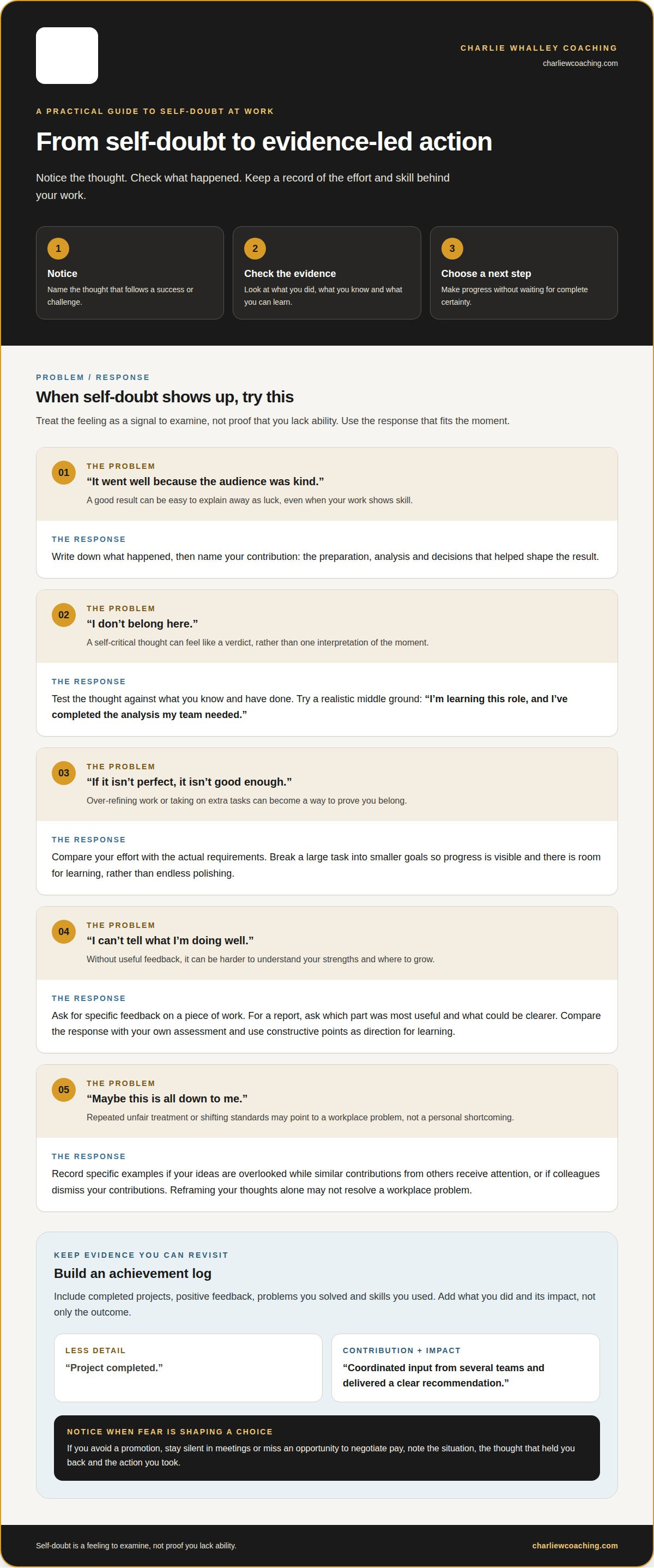
- Notice how you explain away success. When a presentation earns praise, do you credit an easy audience rather than your preparation? Discounting achievements, fearing exposure and attributing good outcomes to luck are common signs. Write down the result and what you contributed, such as the research, decisions or collaboration that helped deliver it.
- Check whether perfectionism is driving overwork. You may spend hours refining a report that already meets its purpose, or take on extra tasks to prove you belong. Compare your effort with the actual requirements. Breaking a large task into smaller goals can make progress visible and create room for learning, rather than endless polishing.
- Look at the workplace around you. Underrepresentation, stereotypes and bias can make belonging feel harder, especially when few colleagues share your background or experience. If your ideas are repeatedly overlooked while similar contributions from others receive attention, record specific examples. This can help separate personal self-doubt from workplace conditions that deserve discussion.
- Question assumptions about who looks qualified. A team may treat one person’s confidence as proof of expertise and another’s questions as evidence they don’t belong. Notice whose behaviour is judged by different standards. Ask for clear criteria for success, then compare those expectations with your work, rather than measuring yourself against a stereotype.
- Track the effect on your choices. Self-doubt can lead you to avoid a promotion, stay silent in meetings or miss opportunities to negotiate pay. Note the situation, the thought that held you back and the action you took. Reviewing these examples can show where fear is limiting your choices and where a practical conversation could help.
Reframing thoughts and recognising accomplishments
Separate feeling unqualified from evidence about your work: repeated unfair treatment or shifting standards may point to a workplace problem. If colleagues dismiss your contributions or fail to give clear feedback, don’t assume that reframing your thoughts alone will resolve it.
1. Recognise imposter syndrome
Notice the thought that follows a success, then write down what happened. For example, if you think a presentation went well only because the audience was kind, record the preparation, analysis and decisions that shaped it. Treat the feeling as a signal to examine, not proof that you lack ability. You don’t have to replace every doubt with confidence straight away.
Check whether the thought recurs in different situations, such as when you receive praise, take on new responsibilities or get a promotion. Believing you’ve simply been lucky may reflect imposter feelings, especially when your work shows evidence of skill. If your concerns follow repeated attempts by specific colleagues to undermine you, record those events separately rather than treating them as personal shortcomings.
2. Recognise personal achievements
Keep an achievement log with a brief account of what you did and its impact. Include completed projects, positive feedback, problems you solved and skills you used. For instance, write that you coordinated input from several teams and delivered a clear recommendation, rather than simply noting “project completed”. Specific details make it easier to recognise your contribution when your memory turns success into luck.
Review the log regularly and include small accomplishments, not just major milestones such as a promotion. A founder might record testing an idea, learning from customer responses and changing the plan. This captures the work behind visible outcomes. Keep praise alongside your examples, and read both before dismissing a result or deciding you haven’t achieved enough.
3. Reframe thoughts
Write down a self-critical thought, then test it against the evidence. Reframe “I don’t belong here” as something realistic, such as “I’m learning this role, and I’ve completed the analysis my team needed”. A credible middle ground is more useful than insisting you’re exceptional. Consider what you know, what you’ve done and what you can still learn.
When success feels like luck, name the choices and effort that contributed to it. If perfectionism tells you one mistake invalidates your work, identify what it taught you and what you’ll adjust next time. This doesn’t mean you have to thrive every day. It gives you a practical way to make progress without demanding flawless performance.
- Ask for specific feedback on a piece of work, such as which part of a report was most useful and what could be clearer. Compare the response with your own assessment, and use constructive points as direction for learning rather than a verdict on your worth.
- Set an intention before a challenging task: focus on communicating your recommendation, not proving you deserve the role. Afterwards, note one decision you handled well and one next step. Repeating this reflection helps you recognise progress without waiting for complete certainty.
Self-doubt and fear of being exposed
Fear of being exposed can make ordinary uncertainty feel like proof you’re unqualified. Use the steps below to notice the pattern and choose a grounded response.
-
Notice self-doubt and fear
Record each moment when you think someone will discover you’re not capable, including what happened beforehand. A new assignment, a manager’s question or a meeting with senior colleagues may bring the feeling into focus. Note the thought and what you did next, such as staying silent or overpreparing.
Review your notes for patterns. Do these thoughts arise around particular tasks, people or expectations? If you’re concerned about a skill you haven’t yet learned, identify the gap and consider how to address it. If you meet the role’s requirements but still expect to be exposed, separate that fear from the evidence.
-
Reframe negative self-talk
Pause when a thought such as “I’m not qualified to lead this” appears. Ask what supports it, what challenges it and what you’d say to a colleague in the same situation. Replace the absolute judgement with a balanced statement: “I’m still learning this part, and I can ask for the information I need.”
A realistic thought doesn’t need to be relentlessly positive. If a presentation didn’t go as planned, name the specific point to improve instead of concluding you’re a failure. This shift helps you respond to the work itself, rather than a harsh story about your overall ability.
-
Apply strategies for self-doubt
Choose one manageable action when doubt starts shaping your decisions. You could ask a trusted colleague for constructive feedback, clarify expectations with your manager or practise a skill through a relevant learning opportunity. A mentor, supportive colleague or coach can also help you put the fear into perspective.
Before a challenging task, pause for a moment of mindfulness and notice your thoughts without treating each one as fact. Then focus on the next practical step, such as drafting an agenda or preparing a question. Self-compassion supports learning: a mistake can show you what to adjust, rather than prove you don’t belong.
Definition and prevalence of imposter syndrome
Imposter syndrome describes persistent thoughts that your competence is lower than others believe, despite evidence of your ability. To understand what those thoughts mean, look at their pattern, context and effect, rather than treating one difficult day as a verdict.
- Compare the feeling with the evidence. After completing a demanding project, you might feel you succeeded only because the task was easy. Check that story against concrete details: the decisions you made, the skills you used and the outcome you helped achieve. A mistake can show you something to learn without cancelling evidence of your competence.
Imposter feelings can recur even when your performance is strong. Notice whether praise, a new responsibility or positive feedback quickly becomes an exception in your mind. The aim isn’t to force confidence, but to see whether your self-judgement consistently overlooks evidence.
- Understand what prevalence figures can and can’t tell you. Up to 70% of professionals experience imposter syndrome at some point in their lives. That figure describes an experience across a broad group, not a prediction about any individual or proof that every person’s feelings have the same cause.
A 2025 meta-analysis of 30 studies involving more than 11,000 participants found that approximately 62% of health service professionals experience impostor syndrome. The estimate concerns that professional group and the studies included. It doesn’t mean your own doubts are automatically harmless, or that a workplace problem should be ignored.
- Keep the terminology in perspective. Imposter syndrome isn’t a diagnosable mental illness and doesn’t appear in the DSM-5. It’s a commonly used term for a pattern of self-doubt, not a clinical label that explains every experience of anxiety or low confidence.
For example, an overlooked contribution may understandably frustrate you, while recurring fear of being exposed despite positive feedback suggests a more persistent pattern. Consider the setting as well as your thoughts: unfair treatment, unclear expectations or repeated exclusion may also affect how secure you feel at work.
- Use the figures as context, then identify your next step. Prevalence estimates show that these feelings occur across professional groups, but a percentage can’t explain why they’re happening in your role. Write down a recent moment of doubt, the evidence for your concern and a possible action, such as asking for clearer expectations.
Then review what changed. Did feedback help you identify a skill gap, or did it reveal inconsistent standards? This distinction supports growth without dismissing your experience. Treat the figures as context, not a measure of your capability or a reason to overlook workplace conditions.
What is imposter syndrome at work and what are common signs?
At work, imposter feelings can make you doubt your ability even when you’re completing the role’s tasks. Use these steps to recognise what’s happening and decide what evidence to consider.
- Identify the thought that follows a work challenge. After presenting a recommendation, you might worry that colleagues will expose you as unqualified. Write down the situation and the exact thought, rather than treating unease as proof. Note what happened next, such as avoiding a follow-up question or repeatedly checking your work.
This record helps distinguish a passing concern from a recurring pattern. For example, if the same fear follows routine updates and successful projects, consider how consistently you discount your contribution.
- Check whether you dismiss success or credit luck. A common sign is attributing a good result to timing, an easy task or someone else’s help, while overlooking your own input. If a client accepts your proposal, list the preparation and decisions you made before deciding the outcome says nothing about your ability.
Notice, too, whether praise feels impossible to accept. You might reply, “It was nothing,” after completing careful analysis. Record the feedback as it was given, then consider which part of your work it recognised.
- Compare your doubts with the actual requirements. You may question your qualifications because you don’t meet every item in a job description. Separate essential responsibilities from skills you can develop. For example, if you can lead a project but haven’t used a particular software tool, treat that as a learning need, not automatic proof that you’re a fraud.
Persistent anxiety about performance can also be a sign. Note whether it appears before particular tasks, after feedback or throughout your working day. The pattern can help you identify what support or clarity would be useful.
- Notice how self-doubt shapes your behaviour. You might avoid sharing an idea, delay applying for a role or spend extra time perfecting work because you fear making a visible mistake. Write down the opportunity or task you avoided and the thought behind that choice.
Then ask what evidence would help you take a measured next step. For a meeting, that might mean preparing a point to contribute. For a new responsibility, it could mean asking your manager what a successful outcome looks like. These actions help you respond to the concern instead of letting it decide for you.
Charlie Whalley Coaching: Life & Leadership Coaching
Charlie Whalley Coaching offers life and leadership coaching for people who want to build confidence and navigate professional challenges. If self-doubt is affecting how you approach decisions, feedback or new responsibilities, coaching can help you explore what’s holding you back and identify practical steps that fit your goals.
Coaching can also support you through a career transition, when familiar measures of success are changing and you’re finding a new direction. The focus is on your development, not on silencing every uncertain thought or proving your worth through perfection.
If you’d like to explore whether coaching could support your next steps, contact Charlie Whalley Coaching or visit charliewcoaching.com.
Choose a next step that feels possible
You don’t have to wait until every doubt disappears before taking action. Choose one small practice for this week, such as noting a contribution you made or asking for clearer feedback on a task. These steady choices can help you build trust in your judgement while you continue to learn.
Learning how to overcome imposter syndrome at work isn’t about forcing yourself to feel confident all the time. It’s about meeting self-doubt with curiosity, noticing what supports your growth and deciding what kind of support could help you move forward. If you’d value a thoughtful space to explore your goals and build confidence, coaching can be a practical next step.
Contact Charlie Whalley Coaching to explore support that fits where you are now. You can take this at your own pace, one considered step at a time.
Frequently Asked Questions
What causes imposter syndrome in the workplace?
Imposter feelings can arise from the interaction between personal expectations and workplace conditions. A promotion with little guidance, unclear success criteria or a team culture that treats mistakes harshly can make it harder to trust your judgement. Underrepresentation or bias may also heighten doubts about belonging. Consider both your internal expectations and what’s happening around you; focusing on only one can obscure useful context.
What practical steps help overcome imposter syndrome at work?
If you’re working out how to overcome imposter syndrome at work, start with an action that responds to the situation rather than trying to eliminate every doubt. Before a meeting, write down the decision you need to contribute to and prepare a relevant point. Afterwards, note what happened and what you learned. If responsibilities are unclear, ask your manager to define the outcome and priorities.
How can you challenge negative self-talk and perfectionism at work?
Turn an absolute thought into something specific and testable. If you think, “I always get this wrong,” identify the task, what went wrong and what you can change next time. Set a clear stopping point before polishing your work, such as checking it against the agreed brief. This helps distinguish care from perfectionism and gives learning a practical place in your day.
How can you build confidence and recognise your workplace achievements?
Connect your strengths to the work they help you do. For example, if colleagues rely on you to explain complex information, record that contribution alongside the project where you used it. Before a performance review, gather examples of responsibilities you’ve taken on, skills you’ve developed and outcomes you helped shape. This gives you specific language to discuss your progress, rather than waiting for confidence to appear first.
How can you ask for feedback or support from a manager or mentor?
Make your request focused and tied to a real piece of work. You might say, “Could you tell me which part of this proposal is strongest and what I should develop?” A clear question makes feedback easier to use. When speaking with a mentor, explain the decision you’re weighing and what perspective would help. Listen for specific observations, then decide on a practical next step.
Are there evidence-based treatments or exercises for imposter syndrome?
Reflection, mindfulness and journalling can help you notice self-critical patterns and respond more deliberately. If you’re exploring how to overcome imposter syndrome at work, these tools can help you examine how self-doubt affects your choices. They aren’t a guaranteed treatment or a substitute for individual care. If distress persists or affects your wellbeing and daily work, a mental health professional can discuss suitable support.