
Leadership coaching for workplace challenges and change

What if the pressure of guiding a team through change could become an opportunity to lead with greater clarity? Leadership coaching for workplace challenges offers a confidential, collaborative space to reflect on your approach, work through real decisions and take purposeful action. The focus is personal to you, your goals and the situation you face.
It’s understandable to feel stretched while balancing business priorities, team concerns and uncertainty about what comes next. Coaching isn’t about already having every answer. It can help you recognise what’s getting in the way, build on your strengths and take responsibility for the changes you want to make.
This article explains what professional leadership coaching involves and how it can align your development with organisational goals. It also explores how coaching can support you through workplace change, strengthen team ownership and build more constructive working relationships, whether you’re an experienced executive, a manager or new to leadership.
Key Takeaways
- Professional coaching helps leaders reflect on real workplace situations and approach difficult feedback with greater clarity and care.
- Connect leadership development to organisational objectives by setting clear goals and tracking progress.
- Coaching can help leaders guide teams through change, explore obstacles and encourage meaningful action.
- Build team ownership through stronger listening, communication and trust.
- Coaching can support executives, managers and emerging leaders as they develop the skills their roles call for.
What is professional leadership coaching?
Professional leadership coaching is a structured partnership centred on your goals, strengths and current workplace decisions. Through reflection, feedback and practical action, you can develop leadership skills in real situations.
Feedback and assessment
Assessment can give leaders a clearer picture of how their behaviour affects colleagues. EQ-i 2.0 offers a framework for exploring emotional intelligence, while 360-degree feedback gathers perspectives from people at different levels, such as peers, direct reports and supervisors. A useful process connects each insight to a specific leadership decision.
Feedback from a team can reveal patterns across responses, rather than treating one comment as the whole story. Stakeholder feedback adds context about relationships and working practices. Choose a coach who explains how feedback will be interpreted and helps you turn it into focused development goals.
Constructive feedback and learning
If you need to address missed deadlines, coaching can help you prepare feedback that is specific, respectful and tied to the work. Describe the behaviour, explain its impact, invite the employee’s perspective and agree a practical next step. This keeps the conversation focused on improvement rather than blame.
Follow-up matters. Use the employee’s response, later conversations and observed changes to reflect on your own approach. This makes continuous learning part of everyday decisions, rather than a separate training event.
Coaching methods and process
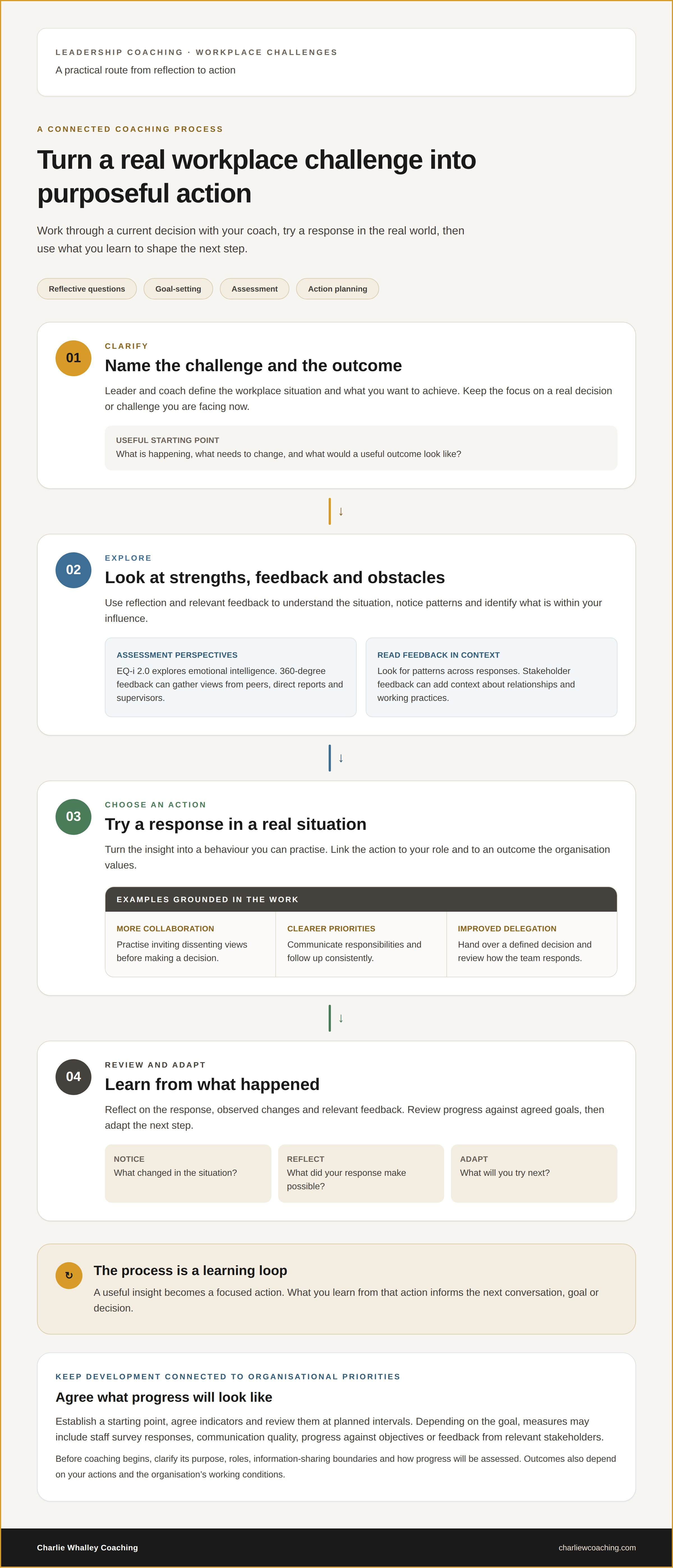
Common coaching methods include reflective questions, goal-setting, assessment and action planning. Your coach helps you examine a real challenge, identify what’s within your influence and consider different responses. Reviewing progress against agreed goals helps turn insights into changes in behaviour.
- The leader and coach clarify the workplace challenge and desired outcome.
- They explore relevant strengths, feedback and possible obstacles.
- The leader chooses an action to try in a real situation.
- They review what happened and adapt the next step.
This practical process makes coaching for workplace challenges relevant to the decisions you face now.
Coaching and related approaches
Leadership coaching centres on the leader’s goals and helps them find and practise their own responses. Executive coaching usually serves leaders in senior roles, whilst mentoring shares a more experienced person’s advice. Management training teaches defined knowledge or skills, such as conducting performance reviews.
In the United States, coaching fees depend on the scope and format of the engagement, as well as the coach’s experience; fees are provided after a quote request. To choose a coach, look for relevant training, clear professional boundaries, experience with your leadership context and a process for setting goals and reviewing progress. In an initial conversation, consider whether the approach feels practical and collaborative.
Aligning leadership development with organisational objectives
Leadership development is most useful when your growth supports the organisation’s priorities. Coaching can help connect your daily decisions with the behaviours and outcomes your team needs.
Start by translating a broad objective into observable leadership actions. If the organisation wants more collaboration across departments, you might practise inviting dissenting views before making a decision. If your team faces unclear priorities, focus on communicating responsibilities and following up consistently. These examples tie development to the work, rather than making it a separate exercise.
Personalised development goals
Leadership coaching is tailored to your role, strengths, development needs and organisational context. Assessment or stakeholder feedback can help identify a useful focus, such as understanding how your decisions affect colleagues. Your goal should describe a behaviour you can practise and a workplace outcome the organisation values.
For example, if you want to improve delegation, you could hand over a defined decision and review how the team responds. This makes development specific while leaving room to adapt as your responsibilities or priorities change.
Effectiveness and return on investment
Measure progress by establishing a starting point, agreeing indicators and reviewing them at planned intervals. Depending on the goal, an organisation could track staff survey responses, communication quality, progress against objectives or feedback from relevant stakeholders. Assessments, surveys and performance measures can help show whether coaching is supporting the intended development.
Return on investment is clearest when measures connect to a business priority, rather than relying on a general sense of improvement. Coaching can support change, but outcomes also depend on your actions and the organisation’s working conditions.
Organisational considerations
Risks include unclear objectives, a poor fit between the coach’s approach and your needs, or uncertainty about confidentiality. Before coaching begins, agree its purpose, roles, information-sharing boundaries and how progress will be assessed. Coaching should support your development, not replace organisational decisions or management responsibilities.
You can explore access through your employer’s learning and development team, manager or benefits information. Ask how coaching relates to organisational goals and what confidentiality applies. A clear process helps you engage openly while giving the organisation a sensible way to assess its investment.
Alignment needs regular attention. If priorities shift, your development goals may need to change too. Review whether the original objective still matters, what evidence of progress is available and which leadership behaviours need more practice. This keeps your development connected to organisational success without reducing it to a single performance measure.
An Axios HQ survey found that 27% of business leaders believed staff were fully aligned with organisational goals, compared with 9% of employees. That difference highlights why assessment should include more than an executive’s perspective. Combining organisational measures with employee feedback can reveal where leaders’ intentions and team experience diverge.
Coaching for change initiatives and workplace challenges
During a restructure, new system rollout or shift to hybrid working, you need to communicate decisions while your team adjusts. Coaching can help you examine your influence, respond to concerns and keep practical learning moving.
Coaching through change and transitions
During a restructure, coaching can help you distinguish confirmed decisions from unanswered questions. You can then plan clear updates, identify who needs support and make space for employee concerns. In a hybrid workplace, this might mean agreeing how colleagues working remotely and in the office receive the same information and contribute to discussions.
Coaching can also help you notice how your own uncertainty affects communication. If you’re unsure about a new process, for example, you can prepare a candid update that explains what’s changing and what the team can influence.
When leading a change initiative, coaching conversations can focus on the next decision instead of trying to resolve every concern at once. Your coach may ask which groups are affected, what’s creating friction and what action would make the transition clearer. This helps you address immediate challenges while keeping the purpose of the change in view.
Hybrid arrangements can make informal communication less visible. You might use a regular team check-in to hear how a new workflow affects colleagues in different locations. Coaching can help you consider whose perspective is missing and how to invite it without assuming everyone has the same experience.
Morale and behavioural change
Employee morale can be affected when change brings unclear expectations or limited opportunities to contribute. Gallup reports that only 31% of U.S. adults feel engaged at work. Coaching can help a leader explore what may be influencing engagement within their team, then choose a specific response, such as explaining priorities or inviting staff to identify obstacles.
For behavioural change, Marshall Goldsmith recommends identifying habits that hinder effectiveness and using feedforward to focus on future opportunities. If you tend to interrupt, for instance, you could invite colleagues to suggest ways to make meetings more inclusive, then practise listening without interruption.
That practice can turn feedback into ongoing learning. Notice whether more colleagues contribute at the next meeting, ask what changed and adjust your approach. These observations offer a practical way to assess behaviour without treating one conversation as proof of lasting change.
Change also affects relationships between teams. If a new approval process slows decisions, coaching can help you explore where delays occur and which conversations could clarify responsibilities. You might bring two teams together to agree how information should move between them, giving people a clearer role in resolving the challenge.
Coaching is particularly relevant when you need to balance delivery with your team’s experience. During a system rollout, for example, you may need to maintain service standards while employees learn new tasks. A coach can help you decide what to communicate, where to seek input and how to respond when concerns reveal a genuine obstacle.
Coaching for team ownership and stronger performance
Team ownership grows when people understand the purpose of their work and can contribute to decisions. Coaching can help you build the communication and trust that make shared responsibility practical.
Performance and team outcomes
Coaching can help you connect performance expectations with the support your team needs. If a project repeatedly misses handover deadlines, for example, your coach might help you explore whether priorities, responsibilities or communication are unclear. Your team can then agree a practical change and review its effect on delivery.
Look for development that links your leadership behaviour to an observable team outcome. You might practise delegating a decision, then notice whether colleagues take greater ownership and raise issues earlier. Leadership training can introduce skills, while coaching helps you apply them to a current work situation and learn from the result.
Performance is about more than output. Consider how your decisions affect workload, collaboration and your team’s ability to solve problems. Reviewing these factors together can help distinguish an individual skills gap from a process that needs attention.
Co-leadership and team alignment
When two leaders share responsibility, differing expectations can leave staff unsure whose direction to follow. Coaching can help you clarify decision rights, agree how to communicate changes and present a consistent approach. For instance, you could decide who leads client updates and how you’ll resolve conflicting priorities.
Leadership-team sessions can also bring colleagues together to examine how their choices affect one another. A team might map a decision from initial discussion to delivery, identify where work becomes stuck, then agree who will take each next step. The aim is clearer coordination, not identical leadership styles.
Repeated actions can shape culture. When you invite challenge in planning meetings and explain the reasons behind decisions, you make participation more visible. Staff can then see how their input connects to shared priorities.
Communication, trust and team coaching
Trust depends partly on whether people feel heard and know what happens after they speak. Practise active listening by summarising a colleague’s concern before responding, then explain what action follows. This creates a clearer link between communication and accountability.
Team coaching focuses on how colleagues work together, rather than only on one leader’s development. A coach might facilitate a discussion about recurring handover problems, help the group explore different perspectives and support agreement on a new working approach. Your group can then review whether responsibilities and communication have become clearer.
For example, a team that avoids raising risks might agree to include a question about blockers in each project meeting. You can model openness by responding constructively when someone raises a concern. Over time, these repeated interactions can strengthen trust and shared ownership.
Choose a coaching focus that fits your team’s current challenge, such as clearer delegation or more open communication. Review progress using specific examples from meetings and projects, then adapt the approach as the team’s needs change.
Coaching for executives, managers, and emerging leaders
Leadership demands change with responsibility. As an executive, you may need to align senior colleagues around a difficult decision; as a new manager, you may be learning to delegate while keeping delivery in view. Coaching can address your real situations and help you develop practical strategies for professional growth.
For executives, coaching can create space to examine how your leadership style shapes the wider organisation. If you’re preparing a restructure, for example, you can consider how to communicate trade-offs, hear concerns and maintain trust. Reflecting on these choices connects long-term direction with the experience of employees affected by change.
Managers often face a close-up challenge: moving from being a reliable individual contributor to supporting other people’s work. Gartner reports that 85% of new managers receive no formal management training when first promoted. Coaching can help them practise setting expectations, handling conflict and delegating tasks that develop team members’ skills.
Emerging leaders can build self-awareness before their responsibilities expand. If you avoid difficult conversations, a coach might help you explore what makes you hesitate, then prepare a clear opening for an upcoming discussion. Practising in this way can strengthen confidence and emotional intelligence without implying there’s one correct leadership style.
Different career stages call for different development priorities. As an executive, you might focus on weighing competing perspectives before a strategic decision. As a manager, you may work on giving useful feedback; as an emerging leader, you might practise speaking up in meetings. The most relevant focus depends on your role, goals and workplace context.
Coaching can also help you investigate performance concerns before choosing how to respond. If a team member misses deadlines, explore whether external barriers, motivation or capability are contributing. The distinction matters: unclear priorities may call for better communication, while a skills gap may need structured learning and support.
Delegation offers another practical route to growth. Identify a decision you currently retain, agree which colleague could take ownership and define the boundaries of that responsibility. Your colleague gains room to develop, while you can give more attention to strategic planning.
Leadership involves more than authority. Simon Sinek recommends helping leaders connect their actions with their purpose and values. Coaching can help you examine whether your daily choices reflect those values, such as showing respect by inviting a quieter colleague’s perspective before settling a team decision.
For tailored support as your leadership responsibilities evolve, explore leadership development coaching.
Charlie Whalley Coaching: Life & Leadership Coaching
Charlie Whalley Coaching offers Life & Leadership Coaching for leaders who want greater confidence and direction through workplace challenges. It may be a useful next step if you’re ready to reflect on your leadership, work through change or build more constructive team relationships.
Coaching is tailored to your goals and professional situation, helping you explore what matters and identify practical steps forward. If you’re focused on a career change rather than a current leadership challenge, Career Transition Coaching may be a better fit.
Ready to talk through what support could look like? Book a discovery call with Charlie Whalley Coaching.
Choose your next leadership step
You don’t need a complete plan to begin. You might start with a difficult decision, a conversation you’ve been postponing or a change that has left your team uncertain. Naming what you’d like to shift can make leadership coaching for workplace challenges relevant to the realities of your role.
In a free discovery session with Charlie Whalley Coaching, you can discuss the support that might suit your circumstances and where you’d like to build confidence. It’s an opportunity to consider your priorities without needing every answer ready.
Start a conversation with Charlie Whalley Coaching and take a considered step towards the leader you want to become. Progress can begin with one clear intention.
Frequently Asked Questions
Can this work for a team, not just an individual?
One-to-one coaching centres on your development, while Speaking & Events includes workshops for groups. A team facing a communication challenge, for example, may benefit from a leadership workshop, while an individual manager can explore their response through coaching. These approaches serve different needs: individual coaching focuses on one leader, while a workshop gives a group shared space to explore leadership or feedback.
How long does an engagement last?
The length of an engagement depends on the coaching focus and the agreed package. A leader preparing for a change in responsibilities may need a different development path from someone working through a longer-term confidence concern. The useful question is what progress would look like for you and how the coaching can support it. A discovery session provides an opportunity to discuss your priorities and the proposed approach.
What assessments do you use?
Coaching centres on your strengths, self-awareness, leadership presence and professional situation. Bring a specific moment, such as finding it difficult to speak up in senior meetings, and explore what’s shaping your response. The focus is on understanding your goals and context, then identifying practical areas for development, rather than treating a test result as a complete picture of your leadership.
What is leadership coaching for workplace challenges?
Leadership coaching for workplace challenges is a one-to-one development partnership focused on situations affecting your work and leadership. You might explore self-doubt before a major presentation, clarify how you want to lead through organisational change or consider your next career step. The process helps you build awareness and confidence, then identify actions that fit your values, responsibilities and working life.
What workplace challenges can leadership coaching help address?
Coaching can support you through self-doubt, complex workplace change, demanding decisions or a shift in responsibilities. If you feel uncertain after a promotion, for example, you can explore ways to build confidence and develop your leadership presence. Coaching can also help you reflect on your career direction if your current role no longer feels aligned with your strengths or values. It supports your development, rather than replacing workplace processes.
How long does leadership coaching take, and how often are sessions held?
There isn’t one fixed schedule for every coaching engagement. The approach depends on your goals and the package agreed with your coach. Charlie Whalley Coaching sessions take place face-to-face or via Zoom, not by telephone. A free discovery session is an opportunity to discuss your priorities and the proposed structure, including how the session schedule can support your development.
How much does leadership coaching cost in the United States?
In the United States, fees depend on the engagement’s scope and format, as well as the coach’s experience, and are provided after a quote request.