
How to regain career direction while keeping your income steady

A career change doesn’t have to begin with handing in your notice. If you’re wondering how to regain career direction, start by exploring options while keeping your income steady, then make decisions as you learn what suits you. You don’t need to map out the whole path today.
It makes sense to want change and financial security at the same time. Uncertainty about your next move doesn’t mean you’ve failed or need to make a dramatic decision. You may simply need room to reflect before choosing a direction.
This article explores how to recognise your strengths and preferred way of working, test possible paths in manageable ways and plan a career change with care. It also considers how career coaching can help you weigh options and make thoughtful progress while navigating financial uncertainty.
Key Takeaways
- Explore possible career paths through low-pressure experiments, without assuming you need to leave your current job straight away.
- Look beyond job titles to identify the strengths, skills and working patterns you want to carry into your next role.
- Give yourself space to make considered decisions, and treat uncertainty as part of the process rather than a personal failing.
- If redundancy or a sudden change unsettles your plans, focus on a short-term direction that leaves room to adjust.
- Career coaching can help you weigh options and shape a practical transition plan while you consider your financial needs.
Exploring options while maintaining financial stability
Explore possible roles gradually, so you can learn what fits before making a major career decision. Small, practical steps can offer useful perspective without requiring you to leave your current job.
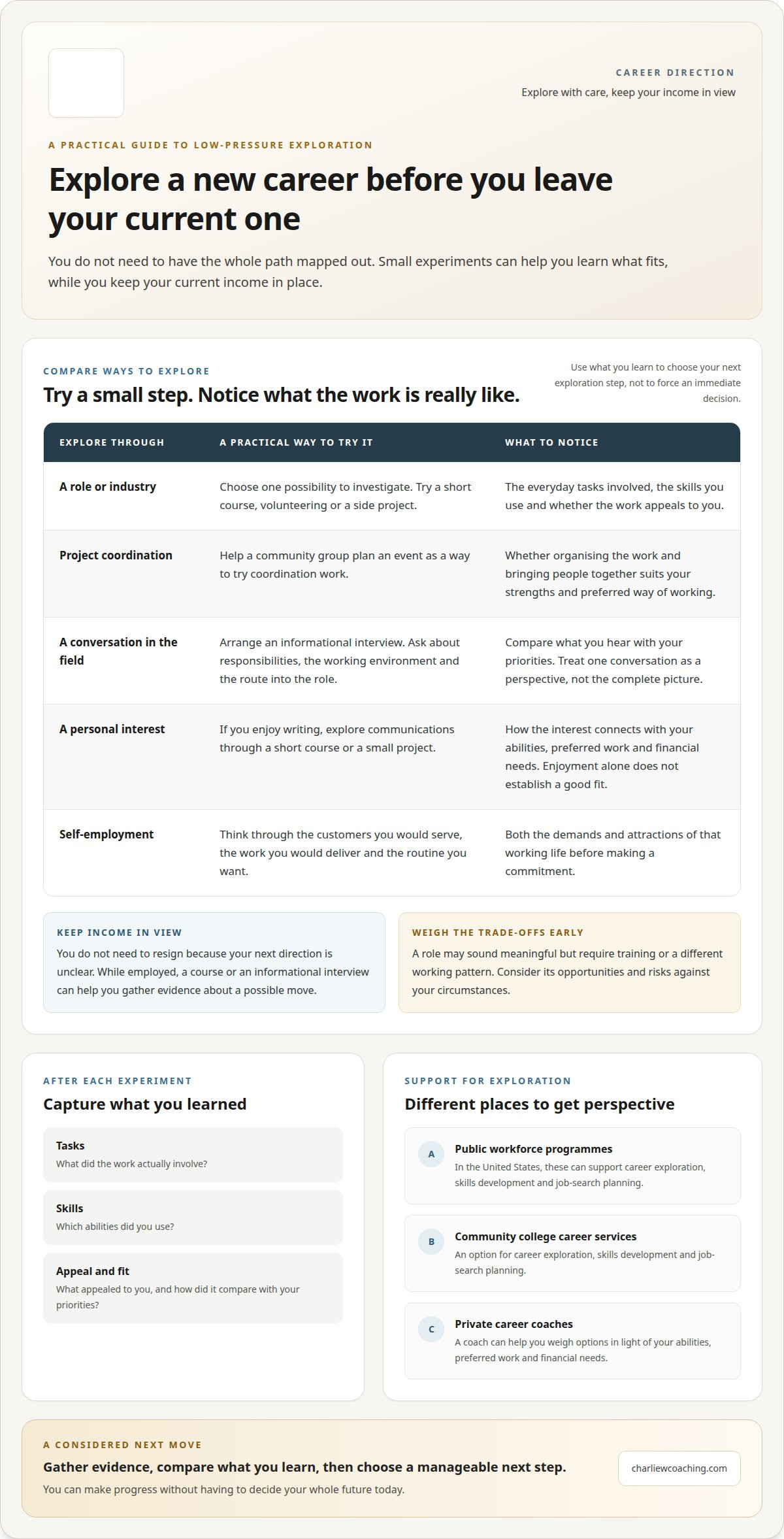
In the United States, career counselling and workforce development resources include public workforce programmes, community college career services and private career coaches. These can support career exploration, skills development and job-search planning.
-
Explore roles and industries without pressure with career coaching
Choose one role or industry to investigate, then set aside time for hands-on exploration. A short course, volunteering or a side project can show you what the everyday tasks involve. For example, helping a community group plan an event could let you try project coordination before applying for related roles.
Use an informational interview to ask someone in the field about their responsibilities, working environment and route into the role. The aim is to learn, not to ask for a job. Compare what you hear with your priorities, and don’t treat one conversation as a complete picture of an industry.
-
Explore personal interests and career options with a coach
Bring your interests into a conversation about possible career paths, then look for practical ways to test them. If you enjoy writing, for instance, explore communications roles through a short course or small project. A coach can help you consider how that interest connects with your abilities, preferred work and financial needs. Enjoyment alone doesn’t make a role the right fit.
If self-employment appeals, consider the working life you want alongside the business plan. Think about the customers you would serve, the work you would deliver and how those choices could shape your routine. Explore both the demands and attractions before making a commitment.
- Keep your income in view as you explore. You don’t need to resign just because your next career direction is unclear. While you remain employed, choose a manageable next step, such as attending a course or arranging an informational interview. This lets you gather evidence about a possible move while keeping your current income in place.
Before pursuing an option, weigh its opportunities and risks against your circumstances. A role might sound meaningful but require training or a different working pattern. Considering these trade-offs early can help you distinguish a promising possibility from an impulsive response to a difficult week.
- Turn what you learn into a comparison. After each conversation or experiment, note what you observed: the tasks involved, the skills used and what appealed to you. A short course, for example, might confirm your interest in a subject while showing that you prefer collaborative projects to independent study.
Use these observations to choose your next exploration step, rather than forcing an immediate decision. If several options remain possible, gather another perspective or test a different aspect of the work. Small, considered steps can help you move towards a new direction without putting your income first at risk.
Identifying transferable skills and preferred work style
Before choosing a new direction, identify what is making your current career feel uncertain. A clearer picture of your skills and preferred working conditions can help you compare possible roles.
Career coaching can connect your interests with strengths you’ve demonstrated, then help you explore roles where both may be useful. It can also help you recognise transferable skills. You can build on your experience to regain career direction, rather than treating it as wasted.
-
Explore careers that match your skills and interests with coaching
Ask a coach to help connect an interest with skills you already use. Someone who enjoys helping colleagues and explaining complex ideas, for example, might explore training, customer support or communications roles. Compare the tasks involved, not just appealing job titles, and notice which options suit your preferred pace and level of collaboration.
Bring specific examples from your work, such as resolving a customer issue or organising a project. They make your strengths easier to recognise and discuss.
-
Change careers without starting over with career coaching
Map your experience against the needs of a possible new role. A project coordinator moving towards events, for instance, may already have experience with schedules, suppliers and stakeholder communication. Identify the skills that transfer, then note any genuine gaps. This helps you distinguish a focused development need from the assumption that you must start again.
Use that comparison to consider roles that build on what you know, rather than focusing only on familiar job titles. This is a practical way to explore how to regain career direction without discarding useful experience.
- Identify the source of your uncertainty. Separate dissatisfaction with your manager, workload or workplace from a lack of interest in the work itself. If you enjoy designing but feel drained by constant interruptions, for example, the issue may be your working conditions rather than your occupation. Naming the cause helps you explore a relevant change instead of reacting to the wrong problem.
Consider what gives you energy and what repeatedly frustrates you. A coach can help you look for patterns across different tasks and situations.
- Describe the value you bring and who needs it. A useful career direction connects your abilities with a real audience, team or customer. Rocco Giordano was advised by Marcus Lemonis to identify Faded Royalty’s signature piece and intended audience. It took Giordano several days to find the words to define his brand.
Apply the principle to your own work: name the problems you solve, the strengths you rely on and the people who benefit. A skilled organiser, for example, might focus on helping teams deliver complex projects. This can shape a cohesive professional identity without forcing you into a single job title.
- Compare work styles before narrowing your options. Decide whether you do your best work independently or with regular collaboration, and whether you prefer structured tasks or changing priorities. A role may use your skills but still feel like a poor fit if its daily rhythm clashes with how you work best. Discuss these preferences alongside your strengths during career coaching.
Use the patterns you identify to assess roles more thoughtfully. If you want support making those connections, career coaching can help you consider your strengths, interests and next steps.
Making career decisions with patience and self-compassion
Career decisions are easier to approach when you understand what matters to you, what drains you and what you fear losing. A coach may ask, “What would you like your working life to make room for?” or “Which responsibilities feel meaningful?” These questions can turn long-term hopes into clearer priorities.
- Make space to notice what matters. After a typical working day, write a short journal entry about tasks that absorbed you and those you postponed. You might enjoy solving customer problems but feel depleted by constant meetings. Looking across these moments can reveal patterns a job title alone would miss.
Include interests outside work, too. Enjoying community projects, making things or supporting others can suggest themes worth exploring, without requiring you to turn every hobby into a career.
- Separate fear from practical concerns. Write down the concern behind each hesitation, then identify what it relates to. “I’m not qualified” may point to a skills gap, while “I might regret leaving” may reflect uncertainty about change. These concerns are different and need different responses.
For a practical concern, such as needing a particular qualification, identify what information would clarify your next step. For self-doubt, recall a specific example of work you handled well. Evidence can make a broad fear feel more manageable.
-
Build self-awareness around interests and strengths with coaching
Bring examples of satisfying and difficult moments to a coaching conversation. A coach can help you examine what these experiences have in common, such as autonomy, teamwork or problem-solving. Check whether a strength appears in different settings rather than assuming one successful project defines your whole career.
Coordinating a family event and organising a work project, for instance, may both draw on planning and communication. Naming the shared skills can help you see how your interests and strengths connect.
-
Manage fear and self-doubt with coaching
Describe the decision you’re facing and the specific outcome you fear. A coach can help distinguish evidence from assumptions, then explore what support or information could make the choice clearer. Don’t treat one difficult experience, such as a failed presentation, as proof that you lack confidence in every setting.
Use journalling, exercise or meditation as a deliberate pause before reacting to a setback. These practices can make room for reflection, rather than letting one anxious moment determine your direction.
-
Clarify long-term career goals with a coach
Explore questions such as, “What would a satisfying working week include?” and “What do I want my work to contribute?” A coach may also ask which compromises feel acceptable and which boundaries matter. Your answers can reveal priorities without requiring a fixed job title or a complete plan.
Choose a near-term decision that reflects those priorities, then notice what you learn. Treating a choice as one step in an ongoing process makes it easier to adjust your direction thoughtfully.
Responding to redundancy and career uncertainty
Redundancy can unsettle your income, routine and sense of identity all at once. Start by steadying the immediate situation before deciding what your whole career should become.
- Give yourself space to absorb the news. If your role is made redundant, you may feel pressured to decide your next career move immediately. Separate what needs attention now from questions that can wait. List the practical conversations you need to have, for example, then note the career questions to revisit when you can think more clearly.
One leader had spent 14 years with a company before learning in 2016 that it would close and her general manager role would be made redundant. A sudden change can follow a long period of commitment. You don’t need to define your next chapter at once.
- Choose a short-term direction for the next few months. Rather than demanding a complete answer about your working life, decide what to focus on for now. You might prioritise finding a similar role, exploring a different field or understanding what you want from work. A temporary focus can reduce pressure while leaving room to adjust.
Make your direction specific enough to guide your next actions. You might focus on roles that use your current experience while exploring a different sector. Revisit your choice as you learn more, rather than treating it as a permanent commitment.
- Let trusted people support your thinking. Tell a family member or friend what feels hardest, then explain what kind of support would help. You might need someone to listen, help organise practicalities or talk through an option. A coach or like-minded professional can also provide a focused space to consider possible next steps.
Keep the decision yours. Trusted people can offer perspectives, but their priorities may differ from yours. If a friend urges you towards a role that doesn’t fit your circumstances, treat that as one viewpoint, not an instruction.
- Separate the loss of a role from the value of your experience. After redundancy, identify what you contributed, such as leading a team, solving a difficult problem or improving a service. These examples can help you describe your experience when considering future roles. A change in employment status doesn’t erase the skills or judgement you’ve developed.
Choose one manageable action that supports your short-term direction, such as updating a relevant part of your CV or speaking with someone familiar with your chosen field. If uncertainty continues, book a discovery call with Charlie Whalley Coaching to talk through the change and consider your next steps.
Taking time to plan career changes
A career change is easier to navigate when you give exploration a clear shape. A 30-60-90 day plan can divide the process into manageable phases, helping you explore how to regain career direction without demanding an immediate, permanent decision.
- Use the first 30 days to clarify what you want to learn. Choose a few career questions to explore, such as whether you want more autonomy or a different kind of work. Write down what evidence could help answer each one. For example, if you’re considering design, identify which tasks and working conditions you want to understand before committing to training.
Make this phase about gathering insight, not proving you’ve already chosen correctly. A short list of questions can focus your exploration and help you spot what remains unclear.
- Use the next 30 days to seek useful perspectives. Speak with trusted people who understand your strengths or the kind of work you’re considering. An informational conversation can reveal what a role involves day to day, while someone close to you may highlight priorities you’ve overlooked.
Listen carefully, but keep ownership of the decision. A friend may value stability above creativity, while your priorities may differ. Treat each perspective as information to weigh, not an instruction to follow.
- Use the final 30 days to review what you’ve learned. Compare your original questions with evidence gathered through conversations, reflection and practical exploration. Note what has become clearer, what remains uncertain and what you want to investigate next. If an option no longer fits, record why. That is progress, not wasted effort.
The 30-60-90 day structure is a planning framework, not a deadline for choosing a permanent career. Adjust each phase to fit your circumstances and the information you need.
- Allow weeks or months for a considered decision. A career choice can affect your income, routine, family commitments and sense of purpose. Give yourself space to consider what you want work to look like and which steps could move you towards it. Someone weighing a move into teaching, for example, may need time to understand the role’s demands and their reasons for considering it.
Set a point to review your thinking rather than demanding instant certainty. Then decide whether to keep exploring, refine your direction or take a practical next step towards regaining career direction.
- Turn reflection into a flexible plan. Write down your next action, the question it should answer and when you’ll review what you’ve learned. If a conversation changes your view, adjust the plan instead of treating that as failure. A flexible process allows for new information while keeping your attention on a thoughtful career transition.
If structured support would help you reflect and plan, book career transition coaching. Ready to speak? Book a discovery call to find out how it can work for you.
Charlie Whalley Coaching: Career Transition Coaching
Charlie Whalley Coaching offers Career Transition Coaching for people considering a professional change or seeking a clearer way forward. It can support reflection on your strengths, values and possible next steps as you navigate a career crossroads.
Coaching offers space to consider your options and shape a direction that feels more aligned with what matters to you. You remain in charge of your decisions and the actions you take.
Ready to speak? Book a discovery call to find out how coaching could work for you.
Let your next step take shape
You don’t need a perfect answer before you begin. A clearer sense of how to regain career direction can grow through thoughtful choices, honest reflection and conversations that help you hear your priorities more clearly. Your next move can be a useful experiment, not a decision that defines the rest of your working life.
If you’d value support turning uncertainty into a direction that feels more like yours, Career Transition Coaching can offer a space to think through what comes next. You’ll remain in charge of the decisions, while giving yourself room to consider them with care.
Ready to speak? Book a discovery call with Charlie Whalley Coaching to discuss your next step. You can move forward at a pace that respects both your ambitions and what matters in your life now.
Frequently Asked Questions
What causes people to lose career direction?
Career direction can become unclear after workplace changes, repeated disappointment, prolonged pressure or shifting personal priorities. A role that once felt meaningful, for example, may no longer fit after caring responsibilities change or an organisation restructures. Sometimes the uncertainty is less about the profession and more about a manager, workload or lack of development. Identifying what changed helps you decide whether you need a new role, different conditions or time to reassess.
How can career coaching help me identify my strengths, values and career interests?
A career coach can guide you through reflective questions that connect what matters to you with how you work. You might discuss a recent project that felt satisfying, then explore whether you valued its purpose, independence or collaboration. Comparing several examples can reveal recurring themes. The coach helps you examine these patterns and consider possible roles, while you decide which insights feel relevant to your next career move.
How can a career coach help me create a realistic career plan?
A coach can help shape a plan around your priorities, current responsibilities and the practical requirements of a possible move. If a new direction involves further learning, for example, your plan can account for how study fits alongside work and home commitments. You can agree what progress would look like, identify likely obstacles and decide when to review your approach. This makes the plan useful without treating it as fixed.
How can career coaching help me test a career path before committing to it?
A coach can help you choose a low-commitment way to explore a role and decide what you want to learn from it. You might complete a small portfolio task resembling work in a creative field, for instance, then reflect on which parts engaged or frustrated you. Discussing the experience afterwards can help distinguish interest in the subject from enjoyment of its everyday tasks.
How can coaching help me regain motivation and confidence during a career transition?
Coaching can help you notice what is affecting your confidence and turn a broad transition into meaningful markers of progress. If an application brings disappointment, for example, a coach might help you review what you learned and what you want to change next, rather than treating one response as a verdict on your ability. Coaching is a partnership: reflection and action both require your involvement.
What financial and professional risks can a career coach help me consider before changing careers?
A coach can help you examine what a proposed move might mean for income continuity, training commitments, responsibilities and professional progression. If self-employment appeals, for example, you could consider how building a client base may affect your plans and what working pattern you want. You can also identify questions that need specialist financial advice. Coaching supports reflection and planning, but it isn’t a substitute for financial advice or a guaranteed outcome.