
Confidence coaching for children: costs and program length
What does confidence coaching for children involve, and how long might it take? It gives a child supportive space to recognise strengths, explore interests and build skills for handling challenges. The programme length and cost depend on the format, the child’s needs and the support involved.
If you notice hesitation, harsh self-criticism or reluctance to try unfamiliar things, it’s understandable to wonder whether extra support could help. These moments don’t define your child. They can, however, help you understand what might support them to feel more capable.
This article explains what coaching can cover, signs that a child may be struggling with confidence, and why programme length and costs differ. You’ll also learn how coaching can support a child’s interests, skills and resilience, helping you make a considered choice about the next step.
Key Takeaways
- Confidence grows through encouragement, meaningful effort and chances to recover from setbacks, not simply through getting everything right.
- Repeated self-criticism, reluctance to try and difficulty recognising strengths can be signs a child may need extra support.
- Programme costs and duration depend on the format, the support included and the child’s individual needs.
- Exploring a child’s interests can help them develop a stronger sense of identity and recognise what they enjoy and do well.
- With supportive guidance, new challenges can become opportunities to practise skills, build resilience and grow confidence.
Building children's confidence and emotional resilience
Confidence grows as children recognise their strengths, practise difficult tasks and recover from setbacks. Coaching can help them turn these experiences into practical skills for home, school and friendships.
Confidence and emotional well-being
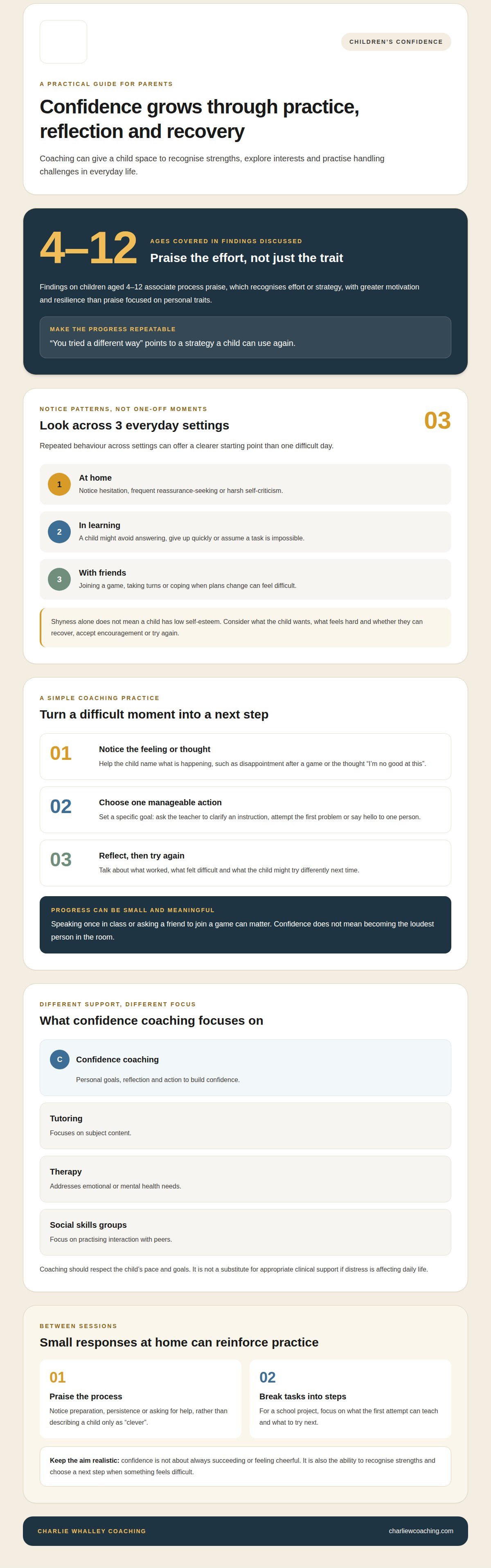
Confidence isn’t about always succeeding or feeling cheerful. It includes naming emotions, recognising personal strengths and choosing a next step when something feels difficult. A coach might help a child who fears making mistakes consider what they can learn from trying, then set a manageable goal for having another go.
Look for an approach that connects emotional awareness with everyday situations. For example, a child might practise describing disappointment after a game, rather than concluding that one loss means they’re bad at sport. This builds resilience through effort and recovery, not pressure to perform perfectly.
Supporting confidence at home alongside coaching
A coach can help parents respond in ways that reinforce practice between sessions. One useful shift is to praise the process specifically: notice a child’s preparation, persistence or willingness to ask for help, rather than describing them only as “clever”. This gives the child a clear example of what they can repeat next time.
Parents can also model how to approach a new task with preparation and optimism. If a child struggles with a school project, a parent might break it into smaller steps and focus on what the first attempt can teach them. A coach can discuss which responses suit the child and family, then help parents use them consistently.
Student confidence and mindset
At school, low confidence might show up as avoiding a question, giving up quickly or assuming a task is impossible. Coaching can help a child notice that thought, identify a specific challenge and choose a practical response, such as asking the teacher to clarify an instruction or attempting the first problem.
Confidence coaching differs from tutoring, which focuses on subject content, and therapy, which addresses emotional or mental health needs. Social skills groups focus on practising interaction with peers. A coach’s focus is setting personal goals and building confidence through reflection and action, while recognising when another kind of support may better suit the child’s needs.
Friendships and social skills
Friendship skills can be practised in everyday situations: joining a game, taking turns in conversation or responding when plans change. A coach might role-play how a child could approach classmates at lunch, then help them reflect on what felt comfortable and what they might try differently.
To find a qualified coach in the United States, ask about their training and experience working with children, their coaching approach, and how they involve parents. Discuss a specific goal, such as speaking up in a group, and clarify how progress and privacy are handled. A clear fit should include age-appropriate activities and boundaries, not a promise that every friendship will change.
Signs of low self-esteem and self-confidence in children
A child’s confidence can show in small choices, from answering in class to joining friends at play. Noticing patterns across home, learning and social situations gives parents a clearer starting point.
Recognising signs of low confidence
Low self-esteem may show up as frequent self-criticism, avoiding unfamiliar activities or giving up after one mistake. A child might say, “I’m no good at this,” before trying a school task, or stay silent even when they know an answer. Look for repeated behaviour across settings, rather than treating one difficult day as proof of a lasting problem.
Confidence can look different from child to child. One might seek constant reassurance before a birthday party, while another hides disappointment after a team game. Notice what happens before and after these moments, including whether the child can recover, accept encouragement or try again.
Support for shyness and self-doubt
Shyness doesn’t automatically mean a child has low self-esteem. Support should reflect the child’s own experience, such as wanting to make friends but feeling unsure how to join a conversation. A coach can help them identify a manageable goal, practise an opening line and reflect on how it felt afterwards.
When a child doubts themselves, focus on specific abilities and effort rather than broad praise. If a child says they can’t draw, an encouraging response might notice their choice of colours or willingness to keep practising. Specific examples make strengths easier to believe.
Self-talk and social situations
Positive self-talk gives a child a more balanced response to a setback. Instead of “Everyone will laugh at me,” they could practise saying, “I can say hello to one person.” Role-playing a school lunch or group activity lets them rehearse words and choices in a calm setting.
Self-reflection can help a child notice what worked, what felt difficult and what they might try next. Progress might mean speaking once in class or asking a friend to join a game, not becoming the loudest person in the room.
Research on self-efficacy highlights the value of recognising progress a child can influence. Children’s self-esteem can change as they grow. Findings on children aged 4-12 also associate process praise, which recognises effort or strategy, with greater motivation and resilience than praise focused on personal traits. For example, “You tried a different way” points to learning a child can repeat.
A coach may be a poor fit if they shame a child, push them into unwanted situations or promise guaranteed success. Coaching should respect the child’s pace and goals. If distress is affecting daily life, a confidence coach isn’t a substitute for appropriate clinical support.
If you’re considering a supportive coaching conversation, book a discovery call with Charlie Whalley Coaching to discuss your child’s goals and what feels manageable to practise.
Confidence coaching programme costs and duration
Programme length depends on its format, session structure and the child’s needs. Costs also vary according to what’s included, such as individual support, parent guidance or learning materials.
For a tailored coaching quote, the price depends on the case and is given after a quote request; relevant factors include session length, frequency and the type of support included. A self-paced course, a series of live sessions and one-to-one coaching use different amounts of professional time. Compare the support and materials included, rather than looking at duration alone.
Some formats are designed around short appointments. For example, Shy and Mighty sessions last 30-45 minutes, depending on the child’s needs and attention span. A separate self-paced course includes approximately 3.5 hours of recordings, divided into three sessions that each take up to approximately two hours. Parents may complete it over two to three weeks, fitting the teaching around family routines.
Video-based programmes can organise learning into steps. One level includes 10 videos across three coaching steps, with coaching time of 50 minutes, 36 minutes and 40 minutes across those steps. Another level has 14 videos plus a bonus video, organised into four steps. Each step contains between 3 and 5 short videos. These figures describe different programme formats, not a single standard schedule.
Session frequency affects how coaching fits around school, activities and time to practise. A child working on speaking up might benefit from space between sessions to try a small action, then reflect on the experience. Ask how the coach adapts the pace if the child feels overwhelmed, loses focus or needs more time to apply a skill. Courage can develop through manageable practice, not a rushed timetable.
Before choosing a coach, ask what sessions cover, how progress is reviewed and how parents are involved. Clarify what happens if a child’s goals or needs change, and whether the format includes learning materials or follow-up support.
Families in the United States can look for local programmes by searching with their city or state alongside terms such as children’s confidence coaching. Then compare whether the programme’s format, session length and parent involvement fit the child’s goals and routine.
Exploring interests and developing identity
A child’s interests offer clues about what feels meaningful, absorbing or enjoyable. A coach might explore why a child loves sketching comic characters, caring for animals or solving puzzles. These conversations help them describe their preferences and strengths in their own words, supporting a developing sense of identity that isn’t tied solely to grades, popularity or praise.
Interests can appear in unexpected places. A child who builds elaborate structures with blocks might value creativity and problem-solving; another who plans games for friends might enjoy bringing people together. A coach can help the child notice these patterns and where they appear at home, at school or during activities. Naming a strength makes it easier to recognise as part of who they are.
Trying an activity doesn’t mean committing to it. In a coaching conversation, a child might explore curiosity about drama, gardening or a school club, and what makes taking part feel appealing or difficult. The coach can help them choose a manageable next step, such as attending a taster session or asking what the club does. The aim is discovery, not pressure to excel.
Parents can offer useful observations, especially when a child finds it hard to name their interests. They might describe how their child spends free time, what prompts enthusiastic conversation or which activities hold their attention. A coach can use these examples to invite reflection without deciding the child’s identity for them. The child remains central, choosing which possibilities feel worth exploring.
Interests can also give a child a steady reference point during change. Starting at a new school, for instance, can unsettle familiar routines and friendships. Remembering a love of drawing or chess may help a child identify a club, activity or conversation that feels like a natural way in. Shared interests can create opportunities to connect without requiring instant confidence.
A child’s journey may involve changing direction. They might try choir, discover they prefer writing songs alone, and still learn something valuable about themselves. Coaching can help them reflect on what they enjoyed, what they found challenging and what they want to explore next. This treats changing preferences as useful information, not failure, and gives children language for their evolving identity.
Look for coaching that makes room for a child’s own choices. If every activity is framed around achievement, they may feel their interests have to impress someone. Instead, conversations can distinguish enjoyment, curiosity and personal meaning from external rewards. Choosing to practise a favourite hobby, or deciding it isn’t for them, helps a child trust their perspective and build confidence through self-understanding.
Skill mastery and positive risk-taking
Children build confidence by practising skills, experiencing progress and recovering when an attempt falls short. Coaching can turn a broad aim, such as “feel more confident”, into an observable step: ask a question in class, try a new activity or finish part of a challenging task. Each completed step gives the child something specific to reflect on.
Mastering a skill isn’t the same as being the best. A child learning to ride a bicycle might first practise balancing, then steering, then travelling a short distance. Breaking a larger goal into realistic steps makes progress visible and helps the child decide what to try next. The coach can notice effort and strategy, not only the final result.
Positive risk-taking means approaching a manageable challenge that matters to the child. For one pupil, that could mean sharing an idea in a group project; for another, joining a familiar friend at a new club. A coach helps the child identify the step, consider what feels difficult and reflect afterwards on what they learnt. This builds confidence in handling challenges, rather than avoiding every uncertain moment.
Struggling is useful information, not proof that a child lacks ability. If a spelling task feels overwhelming, the coach might help the child choose one word to practise, notice which strategy helped and adjust the next attempt. This gives them a way to respond when something doesn’t work first time. Resilience grows through trying, reviewing and continuing with an achievable next step.
Parents and coaches can balance opportunities for success with tasks that stretch a child. If every activity feels too easy, there’s little chance to practise persistence; if the task feels impossible, the child may disengage. A clear step, such as completing part of a task before taking a break, makes the challenge easier to approach. The adult can then recognise the child’s effort and decision-making.
What skills and outcomes can coaching support? Children can develop self-awareness, goal-setting, problem-solving and the ability to ask for help. For example, a child struggling with a group task can name the difficulty, choose one contribution and reflect on the outcome. The aim is practical progress in everyday situations, not a promise of constant success.
To explore how a child could build confidence through manageable challenges, book a coaching conversation.
Charlie Whalley Coaching
Charlie Whalley Coaching offers Kids Coaching for children who could use support building confidence, recognising their strengths and navigating change. If your child is struggling to try new activities, express their ideas or trust their own abilities, coaching can provide space to explore what matters to them and identify practical next steps. The focus is on helping each child move towards personal goals at a pace that feels manageable, with parents able to share context about what they are noticing at home or school. It may be a helpful next step when encouragement alone hasn’t helped your child feel ready to move forward. Contact Charlie Whalley Coaching to talk about what support could look like for your child.
Choose a next step that feels manageable
You don’t need every answer before exploring support. It can be enough to name one situation your child finds difficult, such as joining a group or sharing an idea at school, and consider what they’d like to feel more able to do. Their perspective matters: the next step should make sense for them, not simply meet someone else’s expectations.
A conversation about confidence coaching for children can begin with that goal and the changes you hope to notice in everyday life. Charlie Whalley Coaching offers Kids Coaching to support children as they work towards personal goals and build confidence. If you’re ready to talk through what might suit your family, contact Charlie Whalley Coaching. A thoughtful first conversation can help you find a clear, supportive way forward, one step at a time.
Frequently Asked Questions
What is this programme about?
A children’s confidence programme helps a child understand their strengths and approach personal challenges with greater self-belief. It may use guided conversations, goal-setting and activities to explore situations such as joining a club or asking for help at school. The focus is practical growth in everyday life, not being the best or never feeling unsure. The exact structure depends on the programme.
Who is the course for?
Coaching may suit a child or young person seeking support with self-confidence, resilience or challenges at school. One pupil might want to feel more comfortable contributing in class, while another may want support through a change in routine. A parent’s observations can help clarify the goal, but the child’s interest and willingness to take part are important to a constructive coaching experience.
What is confidence coaching for children?
It’s a supportive, goal-focused process that helps children understand what matters to them and practise ways to work towards personal goals. A coach might help a child prepare for a new activity, reflect on what went well and decide what to try next. Coaching differs from tutoring, which teaches academic content, and isn’t a replacement for clinical support when a child needs mental health care.
What age is appropriate for children to start confidence coaching?
There isn’t one suitable starting age for every child. Readiness depends on whether the child can take part in a conversation or activity, express a simple goal and engage with support suited to their development. A younger child might use play or creative prompts, while an older pupil may prefer discussing a specific school or friendship challenge. The approach should fit the individual child.
How much does confidence coaching for children cost in the United States?
There isn’t one standard cost for children’s coaching. Fees depend on the coach, session format, frequency and support included, so comparisons are most useful when they cover the same kind of service. A free discovery session is available with Charlie Whalley Coaching, where you can discuss whether coaching is a suitable fit for your child.
What happens during a typical child confidence coaching session?
A session usually centres on the child’s priorities, with the coach helping them explore a situation and choose a practical next step. For instance, a child nervous about a presentation might discuss what feels hardest, then consider how to prepare. Charlie Whalley Coaching sessions take place face-to-face or via Zoom. The child contributes to the process: coaching is a partnership, not work done on their behalf.
How can confidence coaching help parents build a child’s confidence at home?
Coaching can help parents understand which responses support their child’s goals and how to reinforce learning in ordinary routines. After a child struggles with a new task, for example, a parent might invite them to name one thing they learnt, rather than focusing only on the result. The coach can help parents consider language and encouragement that feel realistic for their family, so support continues between sessions.