
Build Self-Awareness Through Coaching to Shift Perspective

The leadership habits that feel most natural can be the hardest to see clearly. To build self-awareness through coaching, you explore how your thoughts, emotions and behaviour shape your decisions and affect those around you. This awareness can help you choose a considered response instead of repeating a familiar reaction.
When you’re responsible for a team or organisation, it’s natural to focus on what needs doing next. But feedback can be difficult to absorb when it feels like criticism, and competing demands can leave little space for reflection. That isn’t a personal failing. Self-awareness develops through an ongoing process of noticing, learning and adjusting.
This article explains how coaching makes that process practical through honest feedback, reflective questions and fresh perspectives that can reveal patterns and blind spots. You’ll also learn why self-awareness matters in executive development and how it can help you lead with greater clarity, confidence and intention.
Key Takeaways
- Notice how your thoughts, emotions and behaviour influence decisions and the way you lead.
- Use constructive feedback to understand your impact on colleagues and identify useful changes.
- Explore the assumptions behind a challenge to make room for a more helpful perspective.
- Reflective coaching questions can help you examine what happened before deciding what to do next.
- Ongoing self-awareness can support clearer, more values-led executive development.
What Is Self-Awareness in the Coaching Context?
In coaching, self-awareness means noticing how your thoughts, emotions and actions shape decisions and relationships. It gives you a clearer view of your leadership habits and their effects.
Noticing Thoughts and Emotional Reactions
Noticing your thoughts, emotions and physical reactions means recognising what is happening inside you without immediately judging it. A tense jaw before a difficult meeting, for example, may signal anxiety or frustration worth exploring. A coach can help you connect that reaction with your assumptions and choices. Writing about your feelings can also support understanding and new insights, as the CDC notes.
Mindfulness and Emotional Regulation
Mindfulness means paying attention to the present moment, including physical sensations and emotions. During a coaching conversation, pausing to notice your breathing quicken can help you distinguish pressure from anger. Emotional regulation means responding deliberately to that awareness rather than letting your first impulse dictate your words. A brief breathing pause or quiet reflection can help you stay present and consider your next response.
Self-Awareness in Decisions and Leadership
Self-awareness connects your internal reactions with the decisions and leadership behaviours others experience. If a colleague’s question challenges you, noticing defensiveness can make room to ask what concerns them. That pause supports emotional intelligence: understanding your feelings while recognising others’ perspectives. Coaching can help you examine recurring choices, identify patterns and bring your actions into closer alignment with your values.
Writing regularly can make patterns easier to recognise. After a tense conversation, for example, note what happened, how you felt and how you responded. Reviewing your notes later may reveal recurring triggers, such as impatience when decisions take longer than expected. A coach can help you learn from these observations without treating a single reaction as the whole story.
To choose a qualified coach, look for relevant coaching training, experience with leadership development and a clear explanation of their approach. Discuss your goals, how feedback is handled and what progress might look like in your work.
Coaching uses reflection and questions to help you understand patterns and choose future actions. Therapy focuses on mental health concerns, while mentoring draws on a more experienced person’s perspective. Self-guided reflection, by contrast, relies on your own observations.
Coaching fees vary with the programme and support involved. Charlie Whalley offers a free discovery session to discuss your goals and whether coaching feels like a good fit. Ready to speak? Book a discovery call to find out how coaching can work for you.
Meeting frequency depends on your goals, the pace of reflection and how changes are being applied at work. You and your coach can agree a rhythm that leaves room to reflect between conversations.
Coaching can help you examine your behaviour, but it can’t guarantee a particular insight or outcome. It is not a substitute for clinical support when distress or mental health concerns need treatment.
Receiving and applying constructive feedback
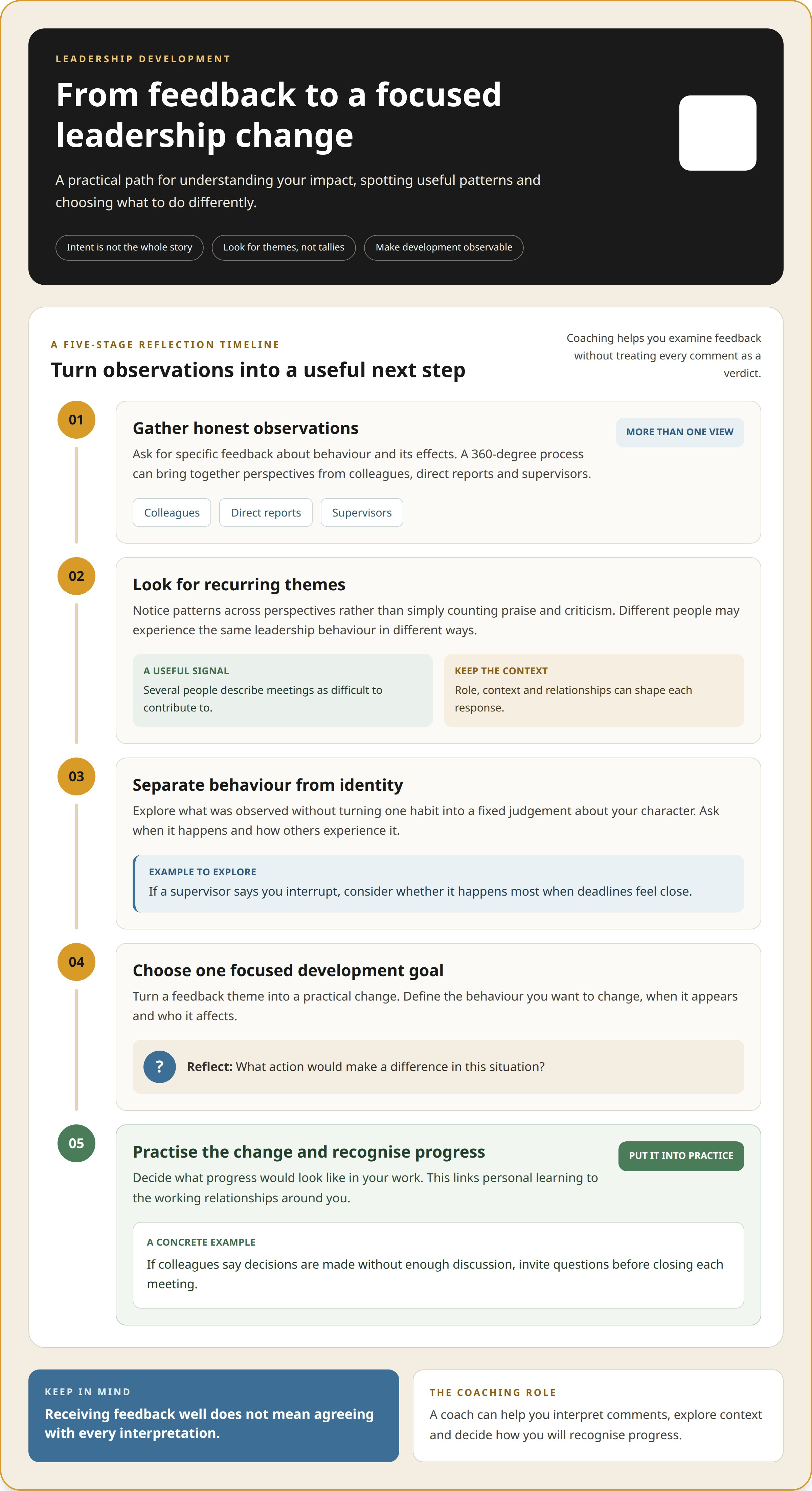
Feedback can reveal the difference between your intentions and how colleagues experience your leadership. Coaching helps you examine that difference without treating every comment as a verdict.
Receiving Honest and 360-Degree Feedback
Constructive feedback is specific information about behaviour and its effects, offered to support learning. In a coaching relationship, you can ask for honest observations and explore them without rushing to defend yourself. A 360-degree process gathers perspectives from people such as colleagues, direct reports and supervisors. For example, if several people describe meetings as difficult to contribute to, that pattern may be more useful than one isolated comment.
Turning Feedback into Development Goals
Development goals turn feedback into a focused change in behaviour. A coach can help you interpret the comments, choose an action and decide how you’ll recognise progress. If colleagues say decisions are made without enough discussion, you might aim to invite questions before closing each meeting. This makes growth observable and links personal learning to working relationships.
Receiving feedback well doesn’t mean agreeing with every interpretation. A coach can help you separate observed behaviour from assumptions about your character. If a supervisor says you interrupt, for example, explore when it happens and how others experience it. You might notice that you interrupt most when deadlines feel close. Understanding the context helps you take responsibility without turning one habit into a fixed identity.
With 360-degree feedback, look for themes across perspectives, not a simple tally of praise and criticism. A direct report may value your availability, while a colleague finds your quick decisions hard to challenge. Both observations can be valuable. A coach can help you consider how role, context and relationships shape each response, then identify where your impact differs from your intentions.
Personality assessments can provide a framework for interpreting feedback, rather than labelling you. A result, for example, might prompt discussion about how your preference for quick decisions affects colleagues who need more time to contribute. An assessment can’t explain every interaction, but it can help you ask better questions about a pattern and consider whether your usual approach suits the situation.
After exploring feedback, a coach can help you turn a theme into a practical development goal. Define the behaviour you want to change, when it appears and who it affects. If you want to make meetings more inclusive, you might invite quieter team members to contribute before sharing your own view. This gives you a clear action to reflect on later.
Progress is easier to discuss when you revisit the original feedback and compare it with later experiences. A coach might ask what has changed in your meetings, what colleagues now notice and what still feels challenging. Reviewing progress keeps the focus on learning, not perfection, and helps you adjust your goal as new insights emerge.
Supporting changes in perspective
Coaching builds self-awareness by helping you examine how your thoughts, assumptions and actions shape a challenge. A coach can explore a specific situation with you, test possible interpretations and help you choose a response that fits your values.
Changing Patterns Through Coaching
Changing a pattern starts with recognising a repeated response and considering what else might be possible. If you take over whenever a project feels uncertain, for example, a coach can help you explore what drives that choice and how it affects your team. Seeing the pattern clearly makes a different response possible, rather than leaving a familiar reaction to seem inevitable.
A coach might invite you to revisit a recent interaction, such as a disagreement about priorities. Together, you can examine what happened, what you assumed and how those assumptions influenced your actions. Perhaps you read a colleague’s question as resistance when they actually needed clarity. Seeing the situation differently can make room for a more useful conversation and a different outcome.
Building Internal Motivation for Change
Internal motivation grows when change connects with what matters to you, rather than simply meeting someone else’s expectations. If you want your team to speak openly, a coach might explore why that matters to your leadership and what you’re willing to do differently. This personal foundation can make growth more meaningful and help sustain effort when a new behaviour feels uncomfortable.
A shift in perspective can also reveal choices within a difficult situation. A coach might ask what part of a strained working relationship you can influence, without implying that you control another person’s behaviour. You may notice that unclear expectations contribute to repeated tension. Recognising that possibility shifts attention from blame towards a practical conversation about responsibilities.
Steps for Developing Self-Awareness
Developing self-awareness through coaching means moving from a specific event towards insight and chosen action. A coach can help you describe what happened, explore why it mattered and consider possible responses. Obstacles and stretch opportunities alike can reveal different patterns. The plan remains yours, supporting ownership rather than dependence on a coach’s answers.
Curious questions can bring hidden assumptions into view. A coach might ask, “What were you hoping would happen?” or “What might your colleague have experienced?” These questions don’t prescribe an answer. They help you consider several interpretations, including ones you may have dismissed under pressure.
The aim isn’t to replace every established habit. It’s to notice which patterns serve you and which limit your influence. If you routinely avoid difficult conversations, for instance, coaching can help you understand the concern behind that response and explore a more direct approach. Insight becomes valuable when it changes how you take part in the next conversation.
The What Box and reflective questions
The What Box begins the What, Why and How method by exploring what happened before considering causes or responses. Open questions, reflective journalling and attentive silence can reveal details you missed in the moment.
Using the What Box for Reflection
The What Box helps you describe an event before interpreting it or planning a solution. A coach might ask what you noticed, what you said and how others responded. If a project meeting became tense, you might recall a sharp reply and a sudden change in the room. Those details give you something specific to reflect on.
Open questions can help uncover your experience without steering you towards a preferred answer. The Centers for Disease Control and Prevention recommends asking open-ended questions about feelings and listening to the answers. In coaching, a question such as “What felt most important in that moment?” can help you find insight in your own account.
Silence and Reflective Journaling
Silence gives you time to notice thoughts that might otherwise get lost in a quick exchange. If a coach waits instead of filling a pause, for example, you may recognise discomfort with uncertainty or difficult conversations. That moment can reveal how your response affects colleagues, rather than letting the conversation move straight to advice.
Reflective journalling records a specific event alongside your thoughts, emotions and actions. After a challenging conversation, you might note what was said, how you felt and what you did next. Your coach can use the entry as a prompt to help identify recurring themes, without treating one difficult day as the whole picture.
Self-Awareness Exercises and Coaching Techniques
Self-awareness exercises give coaching conversations concrete material to explore. A coach might invite you to describe an interaction, pause to notice a strong emotion or review a journal entry. These techniques are most useful when tied to a real situation, such as a decision you regret or a conversation you found difficult to lead.
Mindfulness can support reflection by bringing your attention to the present. A coach might guide a brief breathing pause, then ask what you notice in your body and thoughts. Recognising tension before a presentation, for instance, can help you consider whether anxiety is shaping your preparation or the way you speak to your team.
These methods work best as part of a conversation, not as a test with a right answer. Your coach can help you distinguish what you observed from what you assumed, then explore what feels meaningful. Returning to the same question after a later meeting may show whether your understanding or response has changed.
The 3-Box Method recommends that coaches use open-ended questions to help individuals reflect on what happened before moving to why it happened. After a session, coaches can briefly journal about what went well, where they felt tense or uncertain, and what they avoided.
Self-awareness as a foundation for executive coaching
Executive coaching can help leaders connect their intentions with the effects of their decisions. Self-awareness gives this work a foundation: noticing what drives your response to pressure can help you consider how it shapes your team’s experience. A leader who recognises impatience during delays, for example, can explore its effect on discussion.
Leadership choices rarely happen in isolation. Taking control of a project may feel efficient, yet colleagues might see it as a lack of trust. Coaching can help you examine both sides of the moment, including the feelings and assumptions behind your actions. The purpose isn’t to assign blame, but to develop a more honest understanding of your influence.
In a coaching conversation, self-awareness helps make goals relevant to the situations you face. Rather than vaguely aiming to “communicate better”, you might examine how you respond when a team member questions your plan. A coach can help you consider what you’re protecting, what the other person needs and how a different response could support shared progress.
This process also helps leaders recognise both strengths and limitations. A decisive style can give a team direction in uncertain situations, but it may leave too little room for challenge. Exploring when that strength helps and when it becomes a barrier supports a more flexible approach. Ask yourself: “What does this situation need from me?”
Self-knowledge can shape how you manage relationships across an organisation. If you tend to avoid disagreement with senior colleagues, coaching can help you explore what makes those conversations difficult. You might practise expressing a concern clearly while staying open to another view. Taking that step can support more honest discussion without requiring you to abandon your values.
Executive development isn’t a single transformation or fixed destination. Leaders face new teams, responsibilities and pressures, and familiar patterns can return in unfamiliar settings. Reflecting on a recent decision helps you notice what has changed and what still needs attention. This turns development into ongoing learning shaped by real experiences, not abstract ideals.
Self-awareness has limits, too. Reflection can clarify your perspective, but it can’t tell you exactly how every colleague feels or remove organisational constraints. You may change how you invite input, for instance, while a team member still chooses not to speak. Coaching helps you examine your part and decide what remains within your influence.
If you’re taking on greater responsibility or seeking a more considered leadership style, coaching can give you space to explore these patterns. Explore leadership coaching to consider how reflective conversations could support your development.
Charlie Whalley Coaching
Charlie Whalley Coaching offers a supportive space to explore how your thoughts, choices and leadership patterns shape your work and relationships. If you’re ready to build self-awareness but find it difficult to step back from daily pressures, coaching can help you reflect on what’s happening and identify a direction that feels meaningful to you.
Through Life & Leadership Coaching, you can explore professional challenges, strengthen confidence and consider how you want to show up as a leader. The process is tailored to your goals, with reflection and conversation helping you find your own next steps.
If you’d like support in exploring your self-awareness and leadership development, contact Charlie Whalley Coaching.
Make space for your next step
Self-awareness grows through the choices you make after noticing a familiar reaction. You might pause before a difficult conversation, invite a different perspective or explore what matters most in a decision. Small shifts can help you lead with greater intention, without expecting yourself to change everything at once.
If you’re ready to build self-awareness through coaching, consider what you’d like to understand more clearly: your leadership approach, a career change or the way you respond under pressure. Naming a starting point can make a first conversation feel more focused and personal.
Charlie Whalley Coaching offers a thoughtful setting to explore what you want to shift and how you’d like to move forward. You don’t need to have every answer before beginning. Start a conversation with Charlie Whalley Coaching and take a considered step towards greater clarity.
Frequently Asked Questions
How does self-awareness look in reality?
In practice, self-awareness can mean recognising a familiar response as it happens and choosing what to do next. You might agree to an unrealistic deadline, then realise you said yes because you feared disappointing a colleague. That awareness gives you a chance to revisit the commitment, explain your capacity clearly and make a more considered choice next time. You can strengthen this skill through attention and reflection.
What is self-awareness in coaching, and why does it matter?
In coaching, self-awareness means understanding how your feelings, assumptions and priorities influence your actions. These influences can otherwise stay hidden behind automatic decisions. If you repeatedly accept work that conflicts with your priorities, a coach can help you explore what makes it difficult to say no. That understanding can support choices that better reflect your values, responsibilities and longer-term direction.
What coaching questions improve self-awareness?
Questions that invite curiosity rather than a particular answer can deepen self-awareness. A coach might ask, “What are you assuming about this situation?”, “What evidence could change your view?” or “What do you want the other person to understand?” These prompts help you examine the story you’re telling yourself, consider another interpretation and choose a response that feels honest and useful.