
Bespoke leadership coaching for leaders at every level

Leadership change isn’t just about knowing what to do differently. It’s about turning insight into behaviour you can sustain when the pressure is on, and bespoke leadership coaching can help leaders at every level work towards that shift.
If you’re carrying responsibility for a team, a business or your own next step, it’s natural to want coaching that fits the person and the challenge, rather than a one-size-fits-all programme. This guide explains who tailored leadership coaching can support, how it can reinforce behaviour change, and what influences the cost of a coaching package. It also addresses whether sessions can take place in person or internationally, so you can understand the practical options as well as the personal value.
Here’s what coaching involves, how to make it relevant to your goals and when it may be a useful next step. The aim is to help you consider your options with greater clarity and decide what support could help you lead with more confidence and direction.
Key Takeaways
- Consider how coaching can be shaped around your leadership role, current challenges and the changes you want to make.
- Learn how reflection, practical goals and ongoing reinforcement can help turn new insight into everyday behaviour.
- Understand which factors influence coaching package costs, without assuming that every engagement follows the same format.
- Explore how the length of an engagement can reflect your goals, the work involved and the progress you want to sustain.
- Find out what to consider when looking for coaching that fits your needs, including the setting and format of sessions.
Leadership development for leaders at every level
Leadership development can support you as a new manager, an experienced executive or someone preparing for greater responsibility. Bespoke leadership coaching connects your development to the decisions, relationships and culture that shape your role.
Leadership strengths and talent development
Start by identifying what already helps you lead well, then connect those strengths to a specific development goal. For example, if you build trust easily, you might practise giving clearer feedback. If you excel at delivery, you might focus on delegation. This keeps development grounded in observable behaviour rather than a generic list of leadership skills.
If you’re preparing for board-level responsibility, development may involve shifting from managing a function to considering the whole organisation. Coaching conversations can explore how decisions affect colleagues, customers and long-term priorities. Useful evidence comes from how you handle real responsibilities, such as presenting a recommendation or responding to challenge, rather than from ambition for a senior title alone.
Assessment-based and context-specific development
Assessment can establish a useful starting point. Your coach may draw on your goals, work examples and relevant feedback to identify patterns, such as avoiding difficult conversations or taking on too much. The value comes from connecting those observations to a practical development goal, then revisiting the behaviour as your work progresses.
Your context matters. If you’re joining a growing organisation, you may need to clarify responsibilities and build trust across a changing team. An established executive may be navigating competing priorities or a strained team culture. Discussing your actual situation helps shape relevant scenarios, define what progress looks like and connect coaching to daily leadership decisions.
Coaching formats and alternatives
Bespoke leadership coaching centres on your goals and circumstances; executive coaching usually describes coaching focused on senior roles. Mentoring draws on another person’s experience and advice, while leadership training typically teaches skills or frameworks to a group. The right format depends on whether you need individual reflection, practical guidance or structured learning.
To choose a qualified leadership coach in the United States, look for relevant coach education, experience with leadership challenges like yours and a clear process for agreeing goals. A first conversation can help establish whether their approach feels practical and respectful.
There is no single credential or standard named for every leadership coach in the United States. Look for documented training, clear ethical boundaries and an agreement explaining confidentiality, responsibilities and how progress will be reviewed.
Behaviour change and skills reinforcement
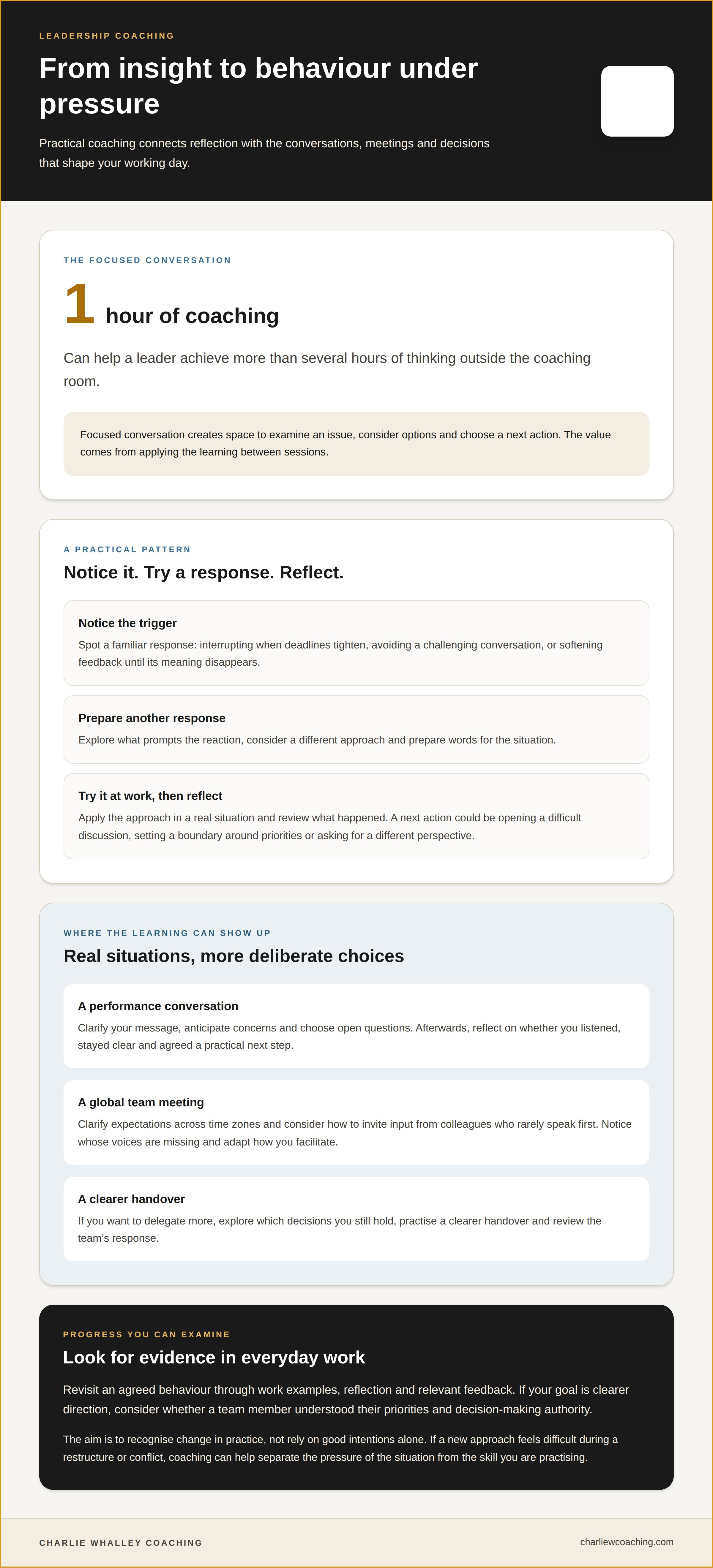
Leadership learning is valuable when it changes what happens in a meeting, a difficult conversation or a decision under pressure. Coaching connects a skill you want to develop with a real situation, then gives you space to reflect on what happened. For example, if you want to delegate more, you could explore which decisions you still hold, practise a clearer handover and review the team’s response. Applying the learning at work is what makes development practical.
Turning insight into behaviour
Reflection can help you understand why a familiar response keeps returning. You may notice that you interrupt when deadlines tighten, avoid challenging a colleague or soften feedback until its meaning disappears. Coaching can help you identify the trigger, consider another response and prepare language for the situation. You can then try that approach at work and reflect on the result.
One hour of coaching can help a leader achieve more than several hours of thinking outside the coaching room. Focused conversation creates space to examine an issue, consider options and choose a next action. That action might be opening a difficult discussion, setting a boundary around priorities or asking a team member for a different perspective. The value comes from applying the learning between sessions.
Leadership communication skills
Communication coaching can focus on a specific moment rather than a broad aim to “communicate better”. You might prepare for a performance conversation by clarifying your message, anticipating the other person’s concerns and choosing open questions. Afterwards, you can reflect on whether you listened, stayed clear and agreed a practical next step. This helps you communicate more deliberately in everyday interactions.
For a global team, communication also means adapting to different working contexts. You might need to clarify expectations across time zones or invite input from colleagues who rarely speak first. Coaching can help you notice whose voices are missing and consider how to facilitate your next meeting differently. Small changes, practised in real situations, can strengthen trust and shared understanding.
Reinforcing skills through assessment
Skills assessment is most useful for identifying progress, not labelling you. Your coach can revisit an agreed leadership behaviour through work examples, reflection and relevant feedback. If your goal is to give clearer direction, for instance, you might consider whether a team member understood their priorities and decision-making authority. That evidence helps distinguish change from good intentions alone.
Tailored development can account for setbacks, too. If a new approach feels difficult during a restructure or conflict, coaching can help you distinguish the pressure of the situation from the skill you’re practising. You might adjust your wording, rehearse a response or choose a more suitable moment. This keeps development connected to your work and helps you practise more consistently over time.
Behaviour change and leadership impact
Leadership impact shows up in decisions, relationships and how you respond to pressure. Coaching can connect a personal development goal with your team’s priorities, then help you examine what changes in practice. For example, if you want to build accountability, you might clarify ownership at a project meeting and follow up on agreed actions. The team’s response offers useful evidence, not proof that one conversation changed everything.
For an executive, a shift in behaviour can influence how strategy is understood across an organisation. Explaining the reason behind a decision may help colleagues see how their work contributes. Coaching can explore the communication choices involved: what to share, when to invite questions and how to respond to concerns. This keeps development grounded in your real responsibilities.
Connecting personal change with organisational outcomes
Useful goals describe behaviour others can observe. “Be a better leader” is difficult to assess; “invite challenge before finalising a decision” gives you a clearer focus. Your coach can help define the situation, the action and the feedback that would indicate progress. You might then review how a planning discussion changed, including who contributed and whether concerns surfaced earlier.
Reported promotion figures can illustrate one possible outcome, but they need careful interpretation. In one reported programme, 60% of coached emerging leaders were promoted, compared with 17% companywide. That comparison does not establish coaching as the sole cause. Role availability, performance, organisational priorities and selection processes may also shape promotion decisions.
Assessing progress without losing context
Assessment can give structure to conversations about impact. At the outset, you and your coach can identify a specific challenge, such as delayed decisions or unclear delegation, and agree what evidence to revisit. This could include feedback from a project team or examples from recent meetings. Later, you can compare those examples with your original goal and adjust the development focus.
Career changes can alter what effective leadership looks like. As a newly appointed manager, you may need to shift from specialist work to setting direction and supporting colleagues. If you’re an experienced leader facing a restructure, communicating uncertainty clearly may be important. Coaching can help you consider your role’s demands, the skills you need and the behaviours that will support your next step.
Leadership impact is rarely captured by one assessment or promotion. A fuller picture may include clearer decisions, stronger working relationships and more consistent follow-through. Reviewing examples over time can help you see which changes are helping, where challenges remain and whether your approach still fits the organisation’s strategy. This keeps development practical and responsive to your work.
Coaching package pricing and reduced-price options
The cost of leadership coaching reflects the work involved, not simply the number of conversations. The price depends on the case and is given after a quote request, with factors including the coaching focus, session format, frequency and level of support. For example, preparing for a new executive role may involve different priorities from strengthening feedback skills within an established team.
Before shaping a coaching engagement, clarify the outcomes you want and the challenges behind them. A focused goal, such as handling difficult conversations more directly, gives the work a clear framework. A broader transition into senior leadership may involve several connected areas. The scope should reflect what you want to work on.
Session format also affects the structure of a package. One-to-one coaching gives space to discuss personal situations in depth, while group learning can centre on shared themes. The choice depends on whether your priority is confidential reflection, peer perspectives or developing a common approach across a team. These formats serve different needs, so a lower fee alone doesn’t show which offers better value.
Reduced-price options can be explored through a narrower scope rather than an assumed discount. For instance, an organisation might begin with one defined leadership challenge instead of a wider development programme. A leader might also prioritise the situations where coaching could make the clearest difference, such as delegation or decision-making. Any adjustment should preserve a useful connection between the work and its intended outcomes.
Executive coaching packages may differ in how they organise sessions, review progress and involve an employer. If an organisation funds the work, the agreement can distinguish confidential coaching conversations from any pre-coaching input the employer provides. Clear boundaries help the leader understand what is shared, while giving the organisation a defined purpose for its investment. That distinction matters when comparing proposals.
To assess value, look beyond the package label. Make sure the scope, session structure, intended outcomes and review points are clear. If your goal is stronger team communication, for example, the coaching should connect that aim with practical situations at work. Discussing your priorities can help shape a proportionate engagement focused on what matters.
Cost is one part of the decision; fit is another. Consider whether the coach understands your role, whether their approach suits how you learn and whether you’ll review progress against relevant examples. A clear focus can help you connect reflection with action and weigh the investment against the development you want to bring to your work.
How long does a bespoke leadership coaching engagement usually last?
There isn’t one standard duration for every leadership coaching engagement. The length depends on your goal, the complexity of the challenge and how often you can apply new approaches at work. Preparing for a board presentation may call for a different focus from a wider transition into senior leadership. Consider what the work needs to cover rather than choosing by package length alone.
At the outset, you and your coach can define the intended change and the situations where it matters. If you want to delegate more confidently, for example, you might identify which decisions to share, practise setting expectations and review what happens with the team. This gives the work a practical focus. You can assess progress through relevant examples rather than an arbitrary end date.
The chance to practise between conversations also shapes the pace of coaching. If you’re working through a live restructure, you may regularly encounter decisions and conversations to reflect on. If you’re preparing for a role change, you may need time to understand new responsibilities before trying different behaviours. The pace of events, access to useful feedback and room in your working week all matter.
Coaching can focus on a defined development goal, with review points to help you decide whether to continue, change direction or conclude. If you want to communicate priorities more clearly, for example, you could revisit recent team meetings, consider what colleagues understood and refine your approach. If the original goal is no longer relevant, a review can help reset the focus rather than extend the work by default.
Longer-term work may suit connected challenges, such as building confidence, strengthening relationships and adapting to broader executive responsibilities. These goals can influence one another, so you and your coach can decide what needs attention first. A more focused engagement may suit a specific decision or transition. Either way, a clear scope helps maintain direction and gives you a basis for reviewing progress.
Before starting, agree how you’ll review goals, what happens if priorities shift and how you’ll bring the work to a close. A planned ending can include reflecting on changes, identifying situations that may test them and considering what will help you sustain progress. That makes the conclusion part of your development, not just the final meeting.
If you’re considering a coaching engagement, discuss your leadership goals and the kind of support that could fit them.
Charlie Whalley Coaching: Life & Leadership Coaching
Charlie Whalley Coaching provides one-to-one Life & Leadership Coaching to help you build confidence, navigate change and develop how you lead. If you’re considering a career shift, Career Transition Coaching can help you reflect on your direction and next steps.
Coaching may be useful if you’re ready to explore a specific challenge, strengthen your leadership or find a steadier way forward. Sessions focus on what matters in your circumstances, helping you turn reflection into practical choices.
Get in touch with Charlie Whalley Coaching to discuss what you’re looking for.
Make space for your next leadership step
You don’t need a complete plan to begin. Name one situation you want to handle differently, such as a decision you’re postponing or a difficult conversation. That gives bespoke leadership coaching a meaningful starting point, grounded in the work and relationships shaping your day.
As you consider coaching, think about what would help you speak openly and turn reflection into practical action. A good fit leaves room for your priorities, questions and changing circumstances. You don’t need every answer before you begin.
If you’re ready to explore what leadership coaching could look like for you, contact Charlie Whalley Coaching. Your next step can start with a conversation, and you can take it at your own pace.
Frequently Asked Questions
How do you make sure the skills stick?
Skills become part of your leadership when you practise them in situations that matter to you. You might use an upcoming meeting to practise setting clearer expectations, then notice how colleagues respond. Coaching is a partnership, so your willingness to try new approaches between sessions matters. Reflecting afterwards helps you keep what works and adapt what doesn’t; one session alone is not a lasting solution.
How do you measure results?
Progress is considered against the goals that matter to you, not a standard score for every leader. If you want to feel more confident speaking up, useful evidence could include whether you share your view in a meeting or raise a concern earlier. As a team leader, you might also consider feedback on how colleagues experience your communication. These examples help you discuss progress without assuming every outcome can be measured in the same way.
What can coaching help with?
Coaching can help you explore self-doubt, build confidence and make sense of change at work. You might be stepping into greater responsibility, questioning whether your career still fits or finding it difficult to express your views. The focus reflects your circumstances and priorities. Coaching is a partnership for reflection and development; it does not make decisions or take action on your behalf.
What does the co-creation process actually look like?
The process begins with a conversation about what you want to work towards and what feels challenging now. You and the coach can discuss whether the relationship feels comfortable, clarify what you want from coaching and agree a useful focus. As your circumstances change, you can revisit that focus together. Mutual chemistry matters; if the fit isn’t right, Charlie Whalley may refer you to another professional.
Who is it for?
Leadership coaching may suit professionals who want to develop, take on greater responsibility or find a more purposeful direction. Charlie Whalley Coaching works with high-achieving people who feel stuck, including women in or aspiring to leadership roles, and professionals at a career crossroads. Career Transition Coaching supports career shifts, while Kids Coaching focuses on resilience and self-confidence for children and young people.
What is bespoke leadership coaching?
Bespoke leadership coaching is one-to-one development shaped around your goals, strengths and real working context. Rather than following a fixed course, conversations can focus on what you’re facing, from building executive presence to navigating workplace change. At Charlie Whalley Coaching, Life & Leadership Coaching supports professionals and leaders with self-awareness and confidence. The work is collaborative, with you bringing your experiences and choices into the process.
What leadership coaching services are typically customized for an individual or organization?
For an individual, coaching may focus on confidence, leadership presence or a career transition. For an organisation, Speaking & Events can include workshops and presentations on leadership, mindset, psychological safety, or giving and receiving feedback. The setting can shape the emphasis: a group exploring feedback, for instance, may need a different conversation from an individual considering a new role. Sessions take place face-to-face or via Zoom.
What steps are involved in designing a bespoke leadership coaching programme?
Start by clarifying your development goal, such as preparing for a leadership role or handling challenge more effectively. You and the coach can then discuss your context, whether the fit feels right and what to focus on. Sessions take place face-to-face or via Zoom. As the work progresses, you can review what’s useful and adjust the focus as your priorities change.