
Handling constructive criticism: what to hear and act on

You don’t have to agree with every criticism to learn from it. To understand how to handle constructive criticism, pause before reacting, listen for the specific point, and ask for clarification if the feedback is unclear. Then consider whether it supports your goals and what, if anything, you want to change.
Even feedback intended to help can sting, especially when it touches something you care about or makes you wonder whether you’ve let someone down. That reaction doesn’t mean you’re being difficult, or that the criticism is necessarily right. You can acknowledge how it feels and still consider what might be useful.
This guide will help you assess feedback without dismissing it or accepting it all as fact. You’ll explore why criticism can feel difficult, learn to ask for clearer examples or practical suggestions, and find ways to listen calmly before choosing your next step. The aim isn’t to silence your instincts; it’s to hear what’s being said and respond with greater clarity and confidence.
Key Takeaways
- Separate the useful point from the way the feedback was delivered, then decide whether it supports what you want to achieve.
- Notice what makes criticism feel personal before choosing how to respond; your first emotional reaction doesn’t have to make the decision for you.
- Ask for a specific example or practical suggestion when feedback feels vague, so you can understand what change is being proposed.
- Listen for the other person’s perspective without assuming that every opinion is a fact or an instruction.
- Give yourself room to respond thoughtfully, then choose a next step that feels clear and useful.
1. Choosing whether to act on feedback
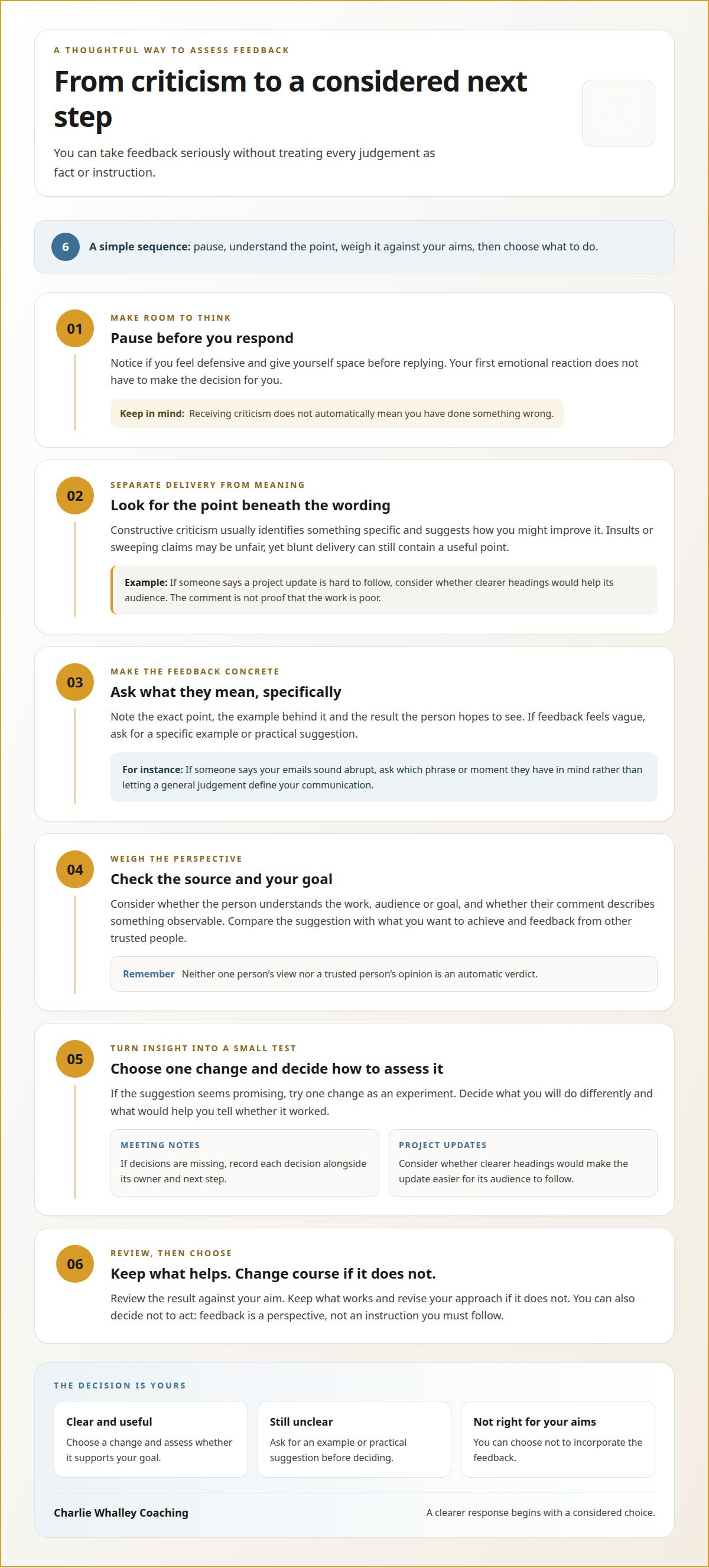
Feedback can offer a useful perspective without becoming an instruction you must follow. If a colleague says your project update is hard to follow, consider whether clearer headings would help your audience, rather than treating the comment as proof that your work is poor. You can take the insight seriously and still choose what to change.
Constructive criticism usually identifies something specific and suggests how you might improve it. Harsh or unfair criticism may rely on insults, sweeping claims such as “you always get this wrong”, or demands that disregard your aims. Blunt delivery can still contain a useful point, so separate the wording from the substance before deciding how to respond.
Choosing whose feedback to consider matters. Look for people who understand the work, audience or goal, and notice whether their comments describe something observable. For example, a trusted colleague who attended your presentation can point out where listeners lost track; someone unfamiliar with the topic may offer a different, but still useful, perspective. Neither opinion is an automatic verdict.
To evaluate feedback objectively, note the exact point, the example behind it, and the result the person hopes to see. Compare the suggestion with your goal and any feedback from other trusted people. If someone says your emails sound abrupt, ask whether they can identify a phrase or moment, rather than letting one general judgement define your communication.
Notice when you feel defensive, then give yourself space to consider the comment before replying. Receiving criticism doesn’t automatically mean you’ve done something wrong; it may reflect another person’s preference or interpretation. Ask yourself, “Would this change help me do what I’m trying to do?” If the answer isn’t clear, ask for an example or try a small adjustment as an experiment.
Turn useful criticism into an action plan: choose one change, decide what you’ll do differently, and identify how you’ll tell whether it helped. If feedback says your meeting notes omit decisions, try recording each decision alongside its owner and next step. Review the next set of notes against that aim, keep what works, and revise your approach if it doesn’t. Growth means learning from feedback, not accepting every judgement.
Choosing not to act is also a decision. Receiving feedback doesn’t require you to accept or act on it; you can decide whether to incorporate it. That choice can help protect a writer’s work and creativity, especially when comments from trusted people are considered rather than thoughtless criticism absorbed. Poor delivery doesn’t erase a potentially valuable perspective, but a valuable perspective doesn’t make every suggestion appropriate.
When criticism comes from someone with power over your job, a defensive response may have consequences, so pause before choosing how to respond. The aim isn’t to satisfy every critic, but to work out whether the comment can help you improve at what you’re trying to do. If it seems promising, try it as an experiment and assess the result. If you don’t like what follows, you can change course.
2. Exploring why criticism feels difficult
A comment about your work can feel like a judgement about you, especially when you’ve invested time and care in it. If a manager says your presentation missed the point, you might hear, “I’m not capable,” even if they meant, “This section needs a clearer example.” Separating the comment from the meaning you’ve attached to it can help you understand your response.
Criticism may stir up a fear of rejection because being accepted matters to us. A colleague’s blunt remark about your contribution can leave you wondering whether you still belong in the team. Notice the story your mind adds: “They’re disappointed in me” is an interpretation, not necessarily what the colleague said. That distinction creates room to consider what you actually know.
Guilt and shame can also shape how feedback lands. Guilt focuses on an action, such as missing a deadline; shame turns that event into a judgement about your whole character. If you missed a handover, you can acknowledge the impact and plan a clearer update next time without deciding you’re a failure. This distinction keeps responsibility connected to a specific action.
Before replying, notice what’s happening in your body. You might feel your shoulders tighten, your face grow warm, or an urge to interrupt. Name the reaction privately, then take a breath and let the other person finish. Observing these signals without criticising yourself can help you choose a response rather than follow your first impulse.
Feedback from an administrator can feel especially difficult when they influence your work. In a classroom, an administrator might suggest a change without understanding the lesson’s context or what happened with a particular group of pupils. Listen for the concern behind the suggestion, then explain what you observed and ask what outcome they’re hoping for. This keeps the discussion focused on the lesson, not a contest over authority.
If you feel defensive, pause before agreeing or arguing. Note the administrator’s exact suggestion and the classroom detail you believe they may have missed. Then ask a focused question, such as, “Would you like me to try this approach during the next discussion?” A practical question gives you both something specific to consider.
Making room for difficult emotions doesn’t mean acting on every one of them. After a critical meeting, you might take a short walk, note what you felt, and return to the feedback when you’re calmer. If frustration remains, record what seemed unfair and what might still be useful. You can hold both thoughts at once.
3. Asking for clarification about criticism
“Be more confident” may sound like useful advice, but it doesn’t show you what to change. Ask the person to describe a specific moment and the effect they noticed. For example, “Could you tell me when my message seemed uncertain, and what would have made it clearer?” A concrete example turns a broad judgement into something you can understand and consider.
If feedback is vague, ask what action the person would like to see instead. If it’s contradictory, identify the competing requests and ask which outcome matters most. For example, if one colleague wants a shorter report and another needs more context, ask who will use it and what decision it needs to support.
Questions work best when they invite detail rather than challenge someone’s authority. Try, “What would a stronger version look like?” or “Which part should I prioritise?” These prompts help the speaker explain their expectations. They also give you a chance to check your understanding before agreeing to make a change.
At work, respond to criticism by acknowledging the point, asking for an example, and agreeing a next step where appropriate. You might say, “Thanks for raising that. Could you show me where the handover missed key information, and what you’d like included next time?” This keeps the conversation calm and focused on the work, rather than turning it into a defence of your character.
Clarify the impact as well as the requested change. If a manager says your updates arrive too late, ask which decision was delayed and when the information would have been useful. That context helps you judge whether the issue is timing, format or missing detail. It also helps you avoid solving the wrong problem by sending more frequent updates when clearer ones are needed.
When two people offer different advice, don’t automatically choose the more forceful voice. Ask each person what goal their suggestion serves, then compare those goals with the task. A designer might favour a bold opening, while a project lead prefers a direct summary. If the audience needs both, discuss a structure that puts the main point first and supporting detail afterwards.
Before ending the conversation, reflect the agreed point back in your own words. “So I’ll put the recommendation first and move the background below it” gives the other person a chance to correct a misunderstanding. If expectations remain unclear, ask what a successful result would look like. A shared understanding makes your next action more deliberate and gives you something specific to review.
4. Listening to understand criticism
Listening doesn’t mean agreeing with every comment. It means understanding the point before deciding what you think. If a colleague says your presentation felt rushed, let them explain which part created that impression. You can stay curious without treating their view as the final verdict.
Notice when you’re preparing a reply before the speaker has finished. Instead, give them your full attention, then summarise the concern in your own words. For example, “You felt the recommendations came too quickly after the opening” gives them a chance to confirm or correct your understanding.
Listen for the examples behind a general comment. If a teammate says your project updates are hard to use, ask which update caused difficulty and what information they needed. Perhaps they couldn’t tell who owned the next step. That detail gives you a clearer picture of their experience than a broad label such as “unclear”.
Pay attention to the outcome the speaker wants. A colleague might suggest moving the main recommendation to the start of a report. Ask what they hope this will help readers do. Their answer may reveal that senior colleagues need the decision quickly, even if you ultimately choose another way to present it.
Listening to understand the speaker’s point is an important part of how to handle constructive criticism. It helps you respond to what was actually said, rather than an assumption about the speaker’s motives. If a comment feels personal, listen for the specific behaviour or result being discussed before deciding what it means about you.
Try a simple pattern during your next feedback conversation: listen without interrupting, reflect the main point, then check your understanding. If a colleague says your handover omitted key decisions, you could say, “You needed clearer actions before taking over. Is that right?” This invites correction before you discuss what to do next.
Body language can also help you stay present. Put your phone away, face the speaker, and avoid typing a response while they talk. If you need a moment to take in a difficult comment, say, “I’d like to think about that before I reply.” A pause can keep the conversation thoughtful rather than rushed.
How to handle constructive criticism becomes easier when you listen for both the concern and its context. A manager who questions a deadline may be worried about a dependency, not your commitment. Ask what they’re most concerned about, then consider their answer alongside what you know. Careful listening doesn’t require you to adopt every suggestion, but it can help you make a more informed choice.
5. How can you respond calmly to constructive criticism?
Before replying to an unexpected comment, take one slow breath and let the first surge of emotion settle. If your manager says a report needs substantial revision, you don’t have to defend every decision immediately. A brief pause gives you a chance to choose words that reflect what you want to achieve.
For written feedback, such as an editor’s letter, read it once without drafting a reply. If you feel stung, step away and return when you can take in the specific suggestions. You might also picture the criticism as words on a screen, rather than a verdict about your ability. This small mental distance can make it easier to consider each point separately.
When a conversation feels heated, you can ask for time to think. Try, “I’d like to reflect on this and come back with a considered response.” If the discussion can wait, sleep on the feedback or revisit it the next day. A delay isn’t avoidance if you use the time to understand the comment and plan a useful reply.
Use self-compassion to keep one mistake from becoming a judgement about your whole self. Ask what you’d say to a friend whose client presentation missed an important detail. You might recognise the oversight, then help them plan a clearer review process. Offer yourself that same balance: acknowledge what happened, consider what it teaches you, and decide what to do next.
If you’re asked to discuss your work, show that you’re open to feedback without promising to accept every suggestion. For example, say, “I’m open to feedback. Could you share one specific change that would strengthen the proposal?” If you agree with the criticism, name the issue plainly: “I missed that requirement, and I’ll add it to the revised draft.” Owning a specific mistake can move the conversation towards the work that needs doing.
You can also explain how a comment affected you when you’re ready. Focus on the words and their impact: “I want to address the missed deadline, but the description of my work as careless felt personal. Could we focus on what needs to change?” This makes space for your perspective without dismissing the original concern.
In a teaching discussion, explain what happened in the lesson, then invite suggestions for a different plan. You might say that pupils struggled with the task and ask which adjustment could help them engage. The aim is a practical next step, not a perfect response. If staying grounded during difficult feedback is a recurring challenge, explore coaching support to build confidence and find a steadier way forward.
Charlie Whalley Coaching: Life & Leadership Coaching
Charlie Whalley Coaching offers Life & Leadership Coaching for people who want to build confidence, navigate change and reflect on how they respond to feedback. If criticism at work keeps prompting self-doubt or makes it difficult to decide what to do next, coaching can offer space to explore your goals and consider a practical way forward. Career Transition Coaching may also support you when feedback raises questions about your current direction or what you want from your working life.
You don’t need to have every answer before you begin. If you’d like to explore coaching, visit Charlie Whalley Coaching and take the next step at your own pace.
Carry your learning into the next conversation
Each piece of feedback gives you a chance to practise responding in a way that reflects your values, rather than the pressure of the moment. You might ask a clearer question, take time before replying, or acknowledge a point without agreeing with every interpretation. These small choices can help you build trust in your own judgement.
Learning how to handle constructive criticism isn’t about becoming unaffected by difficult comments. It’s about staying connected to what matters to you while remaining curious about what could help you grow. With practice, you can meet feedback with greater steadiness and make considered decisions instead of reacting automatically.
If you’d value support as you build confidence and navigate change, contact Charlie Whalley Coaching to explore a thoughtful next step. You can keep learning at your own pace, one conversation at a time.
Frequently Asked Questions
How can you ask clarifying questions about criticism?
Ask for an example that shows what the person means, then check what outcome they’d prefer. If a colleague says your project updates aren’t useful, ask which detail they needed to make a decision. You could follow up with, “Would a short summary of risks help?” This makes the discussion practical and helps distinguish a genuine need from a general preference.
How can you avoid becoming defensive when receiving feedback?
If feedback arrives during a team meeting, avoid trying to resolve every point in front of everyone. You can say, “I’ve heard your concern, and I’ll consider it,” then arrange a focused conversation if you need more detail. Afterwards, separate what the person observed from what you fear it means about you. That can help you respond to the issue without turning it into a judgement about your worth.
How do you handle constructive criticism from friends or family?
With someone close to you, first clarify whether they’re offering an observation, a concern or a request. If a friend says you seem distracted, you might ask whether they mean during a particular conversation. You can then explain your perspective and decide what feels fair to address. If the timing or tone doesn’t work for you, suggest discussing it later, when you can both give the conversation proper attention.