
Dealing with a Difficult Boss: Build Boundaries and Communicate Clearly

A difficult boss doesn’t have to dictate how you respond. Dealing with a difficult boss starts with understanding the patterns behind the tension, communicating calmly and clearly, and setting limits around your time and responsibilities. When a manager’s behaviour feels tyrannical, concrete examples can help you decide what to address and how to raise it.
If you’re replaying conversations after work, second-guessing yourself or bracing for the next interruption, it’s understandable to feel worn down. You can’t control your boss’s behaviour, but you can choose how you communicate, which boundaries you set and what information you bring to a conversation.
This article explains how emotional intelligence can reduce friction, how to make your limits clear and how to use evidence when communicating with a numbers-focused manager. You’ll also find practical ways to document troubling interactions and consider your next steps if the situation doesn’t improve. Small, thoughtful changes can help you regain clarity and confidence at work.
Key Takeaways
- Notice how your manager communicates and use emotional intelligence to adapt your approach without taking responsibility for their behaviour.
- Set clear limits on your workload and keep professional boundaries when a manager becomes overly familiar.
- Use accurate progress updates and relevant data to make your ideas easier for a numbers-focused boss to assess.
- Group questions and choose communication methods thoughtfully to make day-to-day interactions clearer and more manageable.
- Record specific examples of troubling behaviour, look for patterns and prepare practical next steps if a direct conversation does not help.
1. Using emotional intelligence to manage difficult workplace relationships
When your manager’s tone changes or feedback feels personal, notice your reaction before responding. Emotional intelligence means recognising emotions in yourself and others, then using that awareness to guide your behaviour. If a blunt comment leaves you angry, for example, pause, identify the specific issue and choose a calm response rather than replying in frustration.
Look for patterns in how your manager works, then adapt your communication without excusing poor behaviour. A micromanager may respond better to specific project questions and regular progress updates. An inexperienced manager may appreciate your knowledge when you share it constructively, without drawing attention to their lack of experience. A visionary manager may need practical questions about implementation and potential obstacles.
Build on your manager’s strengths while working around their weaknesses. If they are decisive but overlook details, send a concise written summary of deadlines and responsibilities after a conversation. If they step in only during a crisis, explain how earlier guidance could help you resolve issues before they grow. These adjustments can reduce avoidable friction while keeping ownership of your work clear.
When you raise a concern, describe the behaviour and its effect using an “I” statement. For instance: “When priorities change during the day, I find it difficult to meet the agreed deadline. Could we confirm which task comes first?” Listen to the response, ask focused questions and suggest a workable solution. Regular check-ins can clarify expectations before misunderstandings build.
If a difficult boss gives you an unfair performance review, gather specific examples of your work, feedback and agreed goals. Ask calmly which expectations you missed, then share relevant records that provide a fuller picture. Keep notes of the discussion and agreed next steps so you can track whether feedback becomes clearer and more consistent.
Emotional intelligence also means noticing when work strain follows you home. A short walk after a tense meeting, an evening hobby or time with friends can help create space between work and personal life. Stay engaged with your responsibilities, but don’t take on more than you can manage or let conflict draw you into workplace gossip.
If direct conversations fail, take documented concerns to HR or senior management, focusing on specific behaviour and its impact on your work. Record dates, examples and steps already taken, then explain what change would help. If the situation is affecting your career decisions, career transition coaching can help you explore your priorities and possible next steps.
2. Setting limits on workload and responsibility
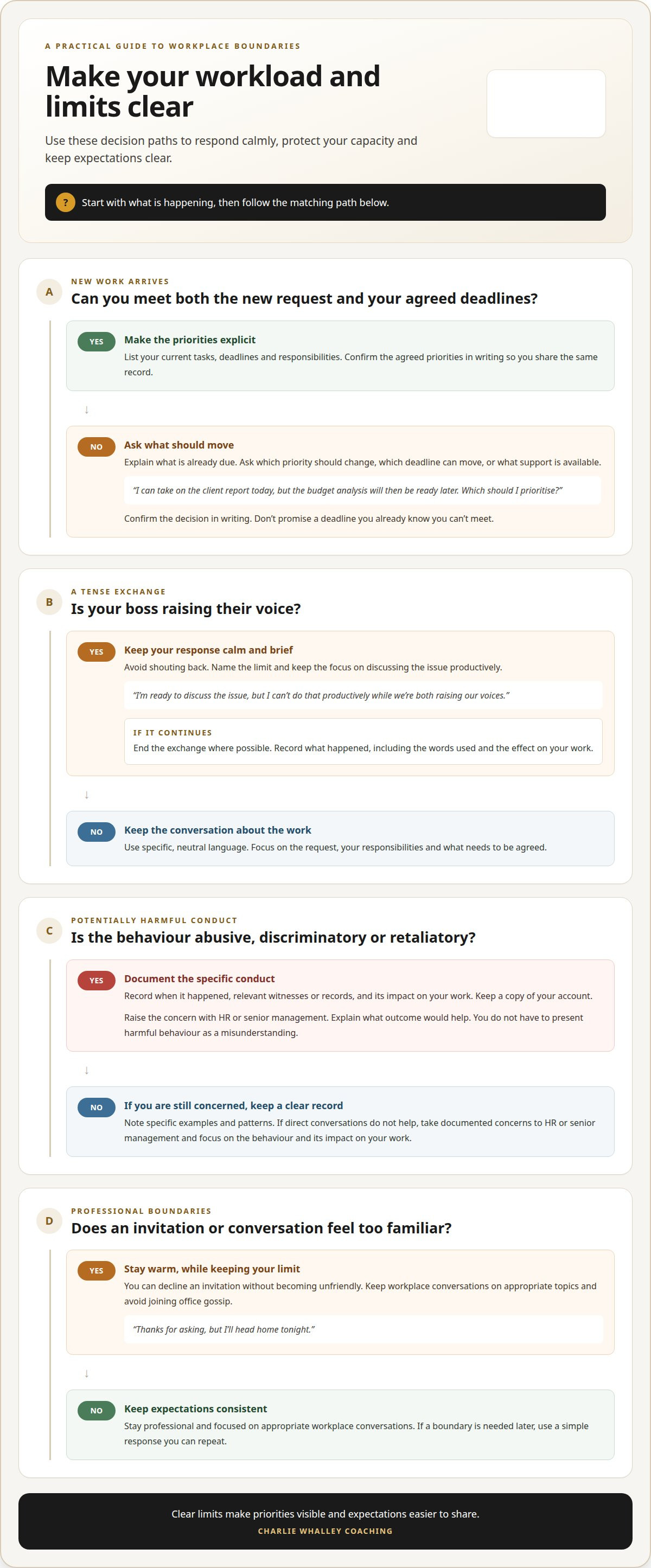
When urgent requests keep arriving, a clear boundary can protect your capacity and the quality of your work. List your current tasks, deadlines and responsibilities. If your manager adds a project, explain what is already due and ask which priority should move. This makes the trade-off visible instead of leaving you to silently absorb an impossible workload.
Use specific, neutral language. You might say, “I can take on the client report today, but the budget analysis will then be ready later. Which should I prioritise?” If your manager expects both, ask which deadline can change or what support is available. Confirm the decision in writing so you have a shared record of the agreed priorities.
Keep the boundary focused on work, not personality. If your manager repeatedly assigns tasks outside your role, ask how each request relates to your responsibilities and which existing task it replaces. For recurring work, suggest a more sustainable process, such as agreeing priorities during a planning conversation. Don’t promise a deadline you already know you can’t meet.
Bullying behaviour can make even a simple boundary feel risky. If your boss yells, avoid shouting back. Respond briefly and calmly, for example: “I’m ready to discuss the issue, but I can’t do that productively while we’re both raising our voices.” If the behaviour continues, end the exchange where possible and record what happened, including the words used and the effect on your work.
If your boss is abusive, discriminatory or retaliatory, record the specific conduct, when it occurred and any relevant witnesses or records. Raise the concern with HR or senior management, explain what outcome would help and keep a copy of your account. You don’t have to present harmful behaviour as a misunderstanding to sound professional.
An overly familiar manager may invite you to socialise after work, share office gossip or show favouritism. You can stay warm and professional without accepting every invitation. For example, say, “Thanks for asking, but I’ll head home tonight,” then keep workplace conversations focused on appropriate topics. Avoid joining gossip, especially if colleagues may overhear or feel pressured to take sides.
Boundaries work best when they’re consistent. If you decline an invitation once but repeatedly feel obliged to attend, choose a simple response you can use each time. Likewise, if extra tasks keep arriving, return to priorities and capacity rather than quietly extending your working day. The aim is to make expectations clear, not to punish or provoke your manager.
3. Using data to communicate with a numbers-focused boss
If your manager responds best to measurable outcomes, connect your ideas to evidence they can assess. For a process-change proposal, describe the current delay, its effect on the team and how the suggested change could be evaluated. Use figures from your actual work records, not estimates presented as facts. A clear explanation helps your manager understand both the result and your reasoning.
Keep progress updates accurate and easy to scan. You could group each update under completed work, current risks and the next milestone. For example, explain that a draft is complete, a dependency is delaying review and you need a decision before proceeding. If a deadline or result changes, say so promptly and explain what has changed. Reliable information builds trust, even when you’re reporting a problem.
Data can also make a concern more constructive. Rather than saying, “The workload is unreasonable,” show the tasks already assigned, their deadlines and the consequences of adding another request. Then ask your manager to identify the priority. This keeps the discussion focused on capacity and delivery, not a personal disagreement. In a numbers-focused organisation, a concise record can make competing demands easier to discuss.
With a micromanager, agree what information they need and how you’ll provide it. Ask specific questions about the deliverable, decision points and preferred progress updates. If feedback repeatedly focuses on the same detail, note the pattern and address it before your next submission. If reports are often returned for missing context, for instance, include a brief summary of the decision each report supports. Relevant updates can reduce uncertainty without inviting constant changes.
To document interactions and problems, keep a private, factual record of dates, times, what was said or requested, and how it affected your work. Save relevant work communications and note any follow-up or agreed action. Keep direct observations separate from your interpretation.
When discussing your record, choose a calm moment and focus on a specific example. You could say, “The project priorities changed after the agreed plan, which delayed the report. Could we record changes as they happen?” Listen to your manager’s response, clarify expectations and summarise decisions in writing. This gives you both a practical point of reference.
Use data to clarify, not to overwhelm or score points. Choose evidence that answers the question, explain its source and acknowledge any limits. If a result depends on another team’s input, make that dependency clear. This keeps your communication fair and grounded, while helping you raise concerns and share progress with confidence.
4. Setting limits on interactions with a boss
To set boundaries with a demanding or micromanaging boss, agree how and when you’ll communicate, then follow that arrangement consistently. You might ask to gather routine questions for a scheduled check-in while agreeing to flag urgent issues promptly. This gives your manager visibility without making every task a live conversation.
If questions repeatedly interrupt your work, keep a running note and raise related points together. For example, collect queries about a report’s format, deadline and approval process, then discuss them in one conversation. This can reduce interruptions and help you leave with clear decisions. If something urgent arises, explain why it needs attention now.
Choose the communication channel carefully. Email can work well for routine updates, decisions and requests that need a written record. A short message such as, “I’m progressing the draft and will send it for review once the agreed sections are complete,” provides useful context. Use a conversation for sensitive concerns or complex discussions, then summarise any decisions afterwards.
Micromanagement can leave employees feeling watched, even when a manager wants reassurance about delivery. Ask what progress information would be useful and agree a practical way to share it. For instance, you could provide an update when a key milestone is complete rather than after every small task. If feedback keeps changing, ask which version of the instructions takes priority.
Set a boundary around interruptions by explaining their effect on a specific piece of work. You could say, “I’m preparing the client presentation. Could I finish this section before we review the smaller edits?” This is respectful and direct. If your manager needs an immediate response, clarify what should pause so expectations remain realistic.
Some interactions are outside your control. When dealing with a difficult boss, you can’t decide whether your manager sends another message, but you can choose when to respond to non-urgent requests, how clearly to state your availability and which work needs your attention first. Setting boundaries starts with recognising what you can influence.
Keep your approach consistent in everyday situations, not only during tense exchanges. If you’ve agreed to discuss routine questions during a check-in, gently return to that arrangement when another conversation begins. If your manager’s needs change, revisit the agreement and clarify the new expectations. Clear limits work best when they are calm, specific and connected to the work.
Grouping related topics can make discussions more focused. Where practical, email can help limit day-to-day contact and keep routine exchanges manageable.
5. Dealing with a tyrannical boss
A boss’s behaviour can feel tyrannical when intimidation, blame or unpredictable interference becomes a pattern. Before deciding what to do, distinguish a difficult moment from repeated conduct. Note specific examples, such as a manager changing instructions and then blaming you for following them. Look for recurring effects on your work, confidence or ability to meet agreed expectations. Recognising patterns gives you a clearer basis for choosing your next step.
Keep your response measured, even when a conversation feels provocative. If your boss criticises you in front of colleagues, you might say, “I’d like to understand the specific concern and discuss how to address it.” Return to the work issue rather than arguing about your manager’s character. Don’t accept blame for something you know you didn’t do. Explain what happened and distinguish your actions from decisions made by others.
Before raising a concern, prepare concrete examples and decide what outcome you want. You might ask for priorities to be confirmed before work begins, or for feedback to be given privately. If you suggest a solution, explain how it could improve the work rather than focusing only on what your boss did wrong. Choose which disagreements to pursue and, where possible, present a useful idea in a way that lets your manager share credit.
Some managers appear only when trouble starts, offer quick advice without first understanding the facts, then leave the team to manage the consequences. If this pattern fits your situation, calmly outline what happened, what remains unresolved and what decision would help. A manager described as a “seagull” may respond with formulaic suggestions; clear context and a practical request can keep the discussion focused on the actual problem.
Consider transferring teams or leaving if documented concerns and reasonable attempts to improve the situation haven’t changed a harmful pattern, or if the work has become unbearable. Before moving internally, learn about the other team’s environment through professional conversations. Before changing employers, explore the organisation’s culture, leadership and management style. Keep your CV and LinkedIn profile current as you consider your options. A difficult experience may also help you build skills for challenging relationships in your future career.
If you decide to confront your boss, prepare for the possibility of escalation or a negative response. Think through whom you could approach, what evidence supports your concern and what practical steps would protect your work. Raise serious issues with HR or senior management when they can address them, and keep your communication respectful and focused on improvement. You deserve to take the effects on your working life seriously.
Charlie Whalley Coaching
Charlie Whalley Coaching offers Life & Leadership Coaching to help you build confidence and navigate professional challenges. If a difficult relationship with your manager is affecting how you see your role or your next steps, coaching can help you clarify what matters and consider how you want to respond. Career Transition Coaching can support you as you explore a change in direction.
You don’t need to decide your future all at once. A conversation can help you reflect on your priorities and consider a next step that feels right for you. Ready to speak? Book a discovery call to find out how coaching can work for you.
Choose a next step that feels right for you
A strained work relationship can narrow your focus until every decision feels tied to your manager’s reaction. Dealing with a difficult boss can also prompt a bigger question: what kind of working life do you want to build from here? You don’t need to answer immediately. Give yourself room to consider what you value, what you can influence and what you want to change.
A useful next step might be a conversation, a new boundary or a fresh career direction. The choice is yours. Move at a pace that respects both your circumstances and your ambitions.
If a thoughtful conversation could help you find clarity and move forward, contact Charlie Whalley Coaching. You deserve to approach what comes next with greater confidence and a clearer sense of direction.
Frequently Asked Questions
How can I communicate effectively with a difficult boss?
Communicate clearly by focusing on the work, using specific examples and agreeing practical next steps. If priorities keep changing, you might say, “I’m working on the client report and the presentation. Which should I complete first?” Keep your tone calm, ask one question at a time and summarise decisions in writing afterwards. This creates a shared record and can reduce misunderstandings without turning every conversation into a confrontation.
When and how should I raise concerns with HR about a difficult boss?
Raise concerns with HR when the behaviour affects your work or wellbeing, especially if a direct conversation feels unsafe or hasn’t helped. Before you meet, write down specific incidents, dates, who was present and how the situation affected your work. Explain what you’ve already tried and what support you’re seeking, such as guidance on next steps. Keep the discussion factual and ask how your information will be handled.
How can I resolve conflict with my manager using a structured conversation?
Arrange a private conversation, describe the issue with a concrete example, explain its impact and invite your manager’s perspective. You could say, “When feedback arrives after a deadline, I can’t make the requested changes. Could we agree how to handle revisions earlier?” Then identify a workable action together and confirm who will do what. A steady, specific approach keeps the discussion focused on improving the working relationship rather than assigning blame.
How can I protect my mental health when dealing with a difficult boss?
Protect your wellbeing by creating a clear boundary between work and recovery, and by speaking with someone you trust rather than carrying the strain alone. Notice whether stress is affecting your sleep, concentration or relationships, and consider appropriate professional support if it persists. Life & Leadership Coaching can help you build confidence and navigate workplace change; it isn’t clinical mental health care. You can book a free discovery session to explore whether coaching feels like a useful fit.
What workplace rights and complaint options apply to a difficult boss in the United States
Document specific incidents, including when they occurred, what happened and how the behaviour affected your work. If direct efforts to resolve the issue fail, raise your documented concerns with HR or senior management.