
Ways to find support and a fresh focus when work feels stuck

Feeling stuck doesn’t automatically mean you need to leave. If you’re deciding what to do when you feel stuck in a job, start by naming what feels wrong, then consider what could change: your responsibilities, the support around you, or the direction you’re working towards. Small, thoughtful steps can help you see whether a fresh focus is possible where you are or whether it’s time to plan a transition.
It can be hard to think clearly when the same tasks, doubts or frustrations follow you through every working day. Feeling pigeonholed or unsure of your next move isn’t a personal failure, and you don’t have to make a sudden decision to take those feelings seriously.
This article will help you understand what’s keeping you stuck, find useful support and gain perspective on what you want from work. You’ll also explore your strengths and ways to shift your focus, whether that means reshaping your current role or considering a change.
Key Takeaways
- Pinpoint which parts of your role feel limiting, then consider a small change that could create room to grow.
- Seek a fresh perspective by speaking with someone you trust and sharing the kind of opportunity you hope to find.
- Compare what matters to you at work with your day-to-day experience to understand where the dissatisfaction may be coming from.
- Look for strengths in the tasks and situations that give you energy, confidence or a sense of purpose.
- Picture what a more satisfying working life could look like, then explore practical steps towards a new focus.
Feeling pigeonholed in a project or role
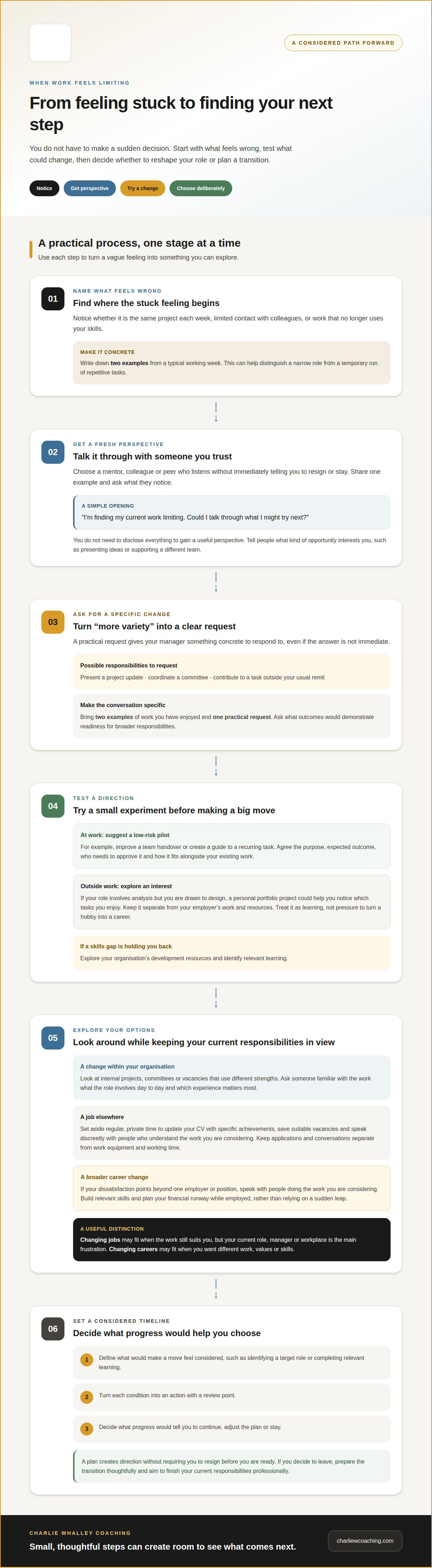
If you’re deciding what to do when you feel stuck in a job, start by pinpointing where the feeling begins. Is it the same project every week, limited contact with colleagues, or work that no longer uses your skills? Write down two examples from a typical working week. This can help you distinguish a narrow role from a temporary run of repetitive tasks, and gives you something concrete to discuss with your manager.
To feel more engaged at work, ask for a specific change rather than a general promise of more variety. You might request responsibility for presenting a project update, coordinating a committee or contributing to a task outside your usual remit. A new responsibility could help you meet different colleagues and demonstrate your skills. If a skills gap is holding you back, explore your organisation’s development resources and identify relevant learning.
A work project can also offer a low-risk way to test a new direction. Suggest a small pilot with a clear purpose, such as improving a team handover or creating a guide to a recurring task. Agree the expected outcome, who needs to approve it and how it fits alongside your existing work. A defined project gives you a chance to learn and contribute without needing to change roles immediately.
A side project outside work can help you explore an interest your current role leaves untouched. For example, if your role involves analysis but you’re drawn to design, you could create a personal portfolio project and notice which tasks you enjoy. Keep the project separate from your employer’s work and resources. Treat it as a way to learn about your interests, not as pressure to turn a hobby into a career.
You can look for a job while employed by setting aside regular, private time for practical steps. Update your CV with specific achievements, save suitable vacancies and speak discreetly with people who understand the work you’re considering. Keep applications and conversations separate from work equipment and working time. This lets you explore options while maintaining your current responsibilities and comparing potential roles carefully.
To set a timeline and goals for leaving, begin by defining what would make a move feel considered, such as identifying a target role or completing relevant learning. Turn each condition into an action with a review point, then decide what progress would tell you to continue, adjust the plan or stay. If you decide to leave, prepare the transition thoughtfully and aim to finish your current responsibilities professionally. A plan creates direction without requiring you to resign before you’re ready.
2. Seeking support from mentors, colleagues, or peer counsellors
Feeling stuck can make it harder to judge whether your role has narrowed or your whole direction needs to change. A trusted mentor, colleague or peer can help you hear your concerns more clearly. Choose someone who listens without immediately telling you to resign or stay. You might begin with: “I’m finding my current work limiting. Could I talk through what I might try next?”
Waiting for the perfect moment to ask for help can prolong uncertainty. Fear of conflict, repercussions or losing your job may make silence feel safer, but it also leaves you carrying every question alone. Start with a lower-pressure conversation: share one example, such as being repeatedly excluded from planning, and ask what the other person notices. You don’t need to disclose everything to gain a useful perspective.
Make the conversation specific enough to lead somewhere. Ask a mentor how they built experience in work you’re curious about, or ask a colleague which skills they see you using well. If you’re unsure what opportunities to name, describe the tasks you want more of, such as presenting ideas or supporting a different team. Tell people what kind of opportunity interests you before deciding it’s out of reach.
When speaking with your manager about growth, bring two examples of work you’ve enjoyed and one practical request. You could say, “I’d like to develop my client presentation skills. Could I lead the next project update?” Then ask what outcomes would demonstrate readiness for broader responsibilities. A clear request gives the conversation something concrete to address, even if the answer isn’t immediate.
Seeking a new role within your organisation may offer change without leaving a team or workplace you value. Look for internal projects, committees or vacancies that use different strengths, then speak with someone familiar with that work. Ask what the role involves day to day and which experience matters most. If your manager can support a move, discuss a handover that protects current commitments.
Consider changing careers when your dissatisfaction points beyond one employer or position, such as wanting different work, values or skills. Consider changing jobs when the work itself still fits, but your current role, manager or workplace is the main source of frustration. Conversations with people doing the work you’re considering can help you distinguish between these possibilities.
To protect financial stability during a career change, take steps while you’re employed rather than relying on a sudden leap. Build relevant skills, speak with people in the new field and keep living costs low while planning your financial runway. A staged transition can give you time to understand the work and prepare for changes in income.
If you want structured support to weigh internal opportunities against a broader career shift, Career Transition Coaching can help you clarify your direction and next steps. Ready to talk it through? Book a discovery call.
3. Gaining perspective on dissatisfaction
Start by separating what happens at work from what you fear it means. For a working week, note when your energy drops, what happened beforehand and what you needed. For example, you may feel engaged while solving customer problems but frustrated by repeated last-minute changes. That contrast offers more clarity than the broad conclusion that everything feels wrong.
To understand why you feel stuck, look for patterns in your notes. Ask whether the main difficulty is the tasks, your manager, your colleagues, workplace values or limited opportunities. Then consider whether the organisation’s mission or priorities have changed, whether your own needs have shifted, or both. A role that once suited you may no longer fit the person you are now.
Compare your stated values with your working week. If you value collaboration but make decisions alone, or value learning but repeat familiar tasks, write down the specific mismatch. Separate what you can influence from what depends on the organisation. This helps you judge whether a conversation or change in responsibilities could address the gap, or whether the role’s structure conflicts with what matters to you.
Notice when dissatisfaction appears. If Sunday evening brings dread because Monday means a particular meeting, identify what happens in that meeting. If frustration follows you across tasks and days, consider whether broader conditions are contributing. Feeling hopeless, stressed, confused or disempowered can accompany feeling stuck, but these experiences alone don’t explain their cause. Track what changes them, even briefly.
Possible signs of burnout or a harmful workplace include persistent exhaustion, difficulty concentrating, withdrawing from colleagues or feeling anxious before specific interactions. Repeated humiliation, intimidation, exclusion or pressure to ignore your values may point to harmful workplace dynamics. These are warning signs to take seriously, not a diagnosis. Consider their pattern, impact and whether they ease when you’re away from work.
To gain perspective, test one small change and observe what follows. If unclear priorities cause stress, ask your manager to agree which task comes first. If isolation is the issue, arrange a focused conversation with a colleague. Note whether the change improves your experience or reveals a deeper mismatch. One attempt can’t settle every question, but it can give you useful evidence.
Finally, imagine a working week that feels more sustainable. Describe its tasks, pace, relationships and opportunities instead of choosing a job title straight away. Compare that picture with your current reality and identify the largest gap. This gives you a practical starting point: explore a change at work, seek support or consider a different direction based on what’s missing.
Careershifters' audience studies found that 48% of career changers want to change careers because they are fed up with their day-to-day work. Still, dissatisfaction does not automatically mean leaving is the only next step: reflect on what bothers you, compare workplace values with your current situation, and assess whether your role aligns with or conflicts with your career values.
Feeling stuck at work can involve fear of looking for a new job, attachment to a team, fear of retaliation, limited opportunities or concern about losing stability. Spending years progressing in a profession can make switching careers seem impossible. Before deciding what to explore, clarify which barriers are practical and which may be assumptions.
4. Identifying personal strengths
When your role feels narrow, it can be difficult to see what you contribute beyond its job description. Look at specific moments when your work made a difference. Perhaps you explained a complicated process clearly, noticed a detail others missed or helped a group reach a decision. These examples reveal strengths through action, rather than relying on broad labels such as “hard-working”.
Build a short evidence list from completed work. For each example, note the situation, what you did and the result. A project handover might show organisation and clear communication; resolving a customer concern might demonstrate listening and sound judgement. Focus on your contribution, not just the team’s overall success. This gives you credible examples for future conversations and applications.
Then look for the skills beneath your tasks. “Prepared weekly reports” describes an activity; “made complex information easier to act on” points to analysis and communication. Try rewriting familiar responsibilities this way. You may uncover strengths that transfer to other teams or industries, even when the job titles look different. The aim is to describe what you can do, not to force a new career idea.
Ask people who have seen you work for precise feedback. A colleague might remember that you stayed calm during a difficult client conversation, while a manager may value how you bring structure to an unclear project. Ask, “Which contribution of mine has been most useful, and what did you notice?” Specific examples are easier to use than general praise.
Notice which strengths you want to use more often. You may be skilled at organising events but prefer solving problems independently, or enjoy mentoring new colleagues more than managing schedules. Ability and interest are different clues. Naming both helps you seek work that fits, rather than assuming that being good at a task means you must build your next role around it.
Consider the conditions that help your strengths emerge. You might do your clearest thinking when preparing before a meeting, or communicate best in a small group rather than a large presentation. These preferences can guide the responsibilities you request and the environment you seek. They aren’t limits; they help you understand where your contribution is strongest.
Finally, turn your evidence into a practical next step. If colleagues rely on you to make complicated plans manageable, offer to shape a project plan or improve a team process. If you enjoy explaining ideas, volunteer to lead a briefing. A small opportunity lets you test whether using that strength brings more interest, and gives you a clearer example to draw on in future career decisions.
If colleagues rely on you to make complicated plans manageable, offer to shape a project plan or improve a team process. If you feel stuck, compare your workplace values with your current situation to identify any gaps. Picture what feeling unstuck would look like to help identify gradual steps towards it. If you’re considering leaving your organisation, make an informed decision and develop a personal transition plan.
5. Changing focus
Changing focus doesn’t always mean handing in your notice. First, picture what feeling more engaged would look like in an ordinary working week. Would you spend more time solving problems, learning a skill, collaborating or working independently? For example, someone tired of routine reporting might want to shape recommendations instead. Describe the change in activities, not just a more impressive job title.
Next, separate the direction you want from the route you might take. If you’re interested in a new field, identify one task from that work you could try in your current role. A marketing assistant curious about research might ask to help gather customer feedback. A small experiment can show whether the work genuinely appeals before you commit to a larger change.
If leaving now feels complicated, consider how to make your current position more manageable whilst planning ahead. You might ask to focus on a different project, adjust priorities, or request a three-day work week as a possible change. Be clear about the arrangement you’re proposing and how your responsibilities would be handled. A temporary shift can create breathing space for deliberate planning.
For a broader move, turn your desired direction into practical learning steps. Compare the skills used in the work you want with the experience you already have. If a role needs presentation skills, look for a chance to deliver a team update. If it needs technical knowledge, explore relevant learning through your organisation’s development resources. Choose learning that connects directly to a role or project you’re considering.
Update your CV by matching your experience to the kind of work you want next. Replace task-only descriptions with clear examples of your contribution, such as improving a handover or making complex information easier to use. Then identify skills to build through a project, course or conversation with someone doing that work. Keep the next step specific, so preparation doesn’t become an endless reason to wait.
Make a transition plan that accounts for both work and life outside it. List the decisions involved, such as exploring suitable roles, developing a skill and understanding how a change could affect your routine. If you’re considering self-employment, a short contract or project could help you test the work before making a larger commitment. Review your progress and adjust the sequence as you learn more.
A fresh focus can also begin without a career change. If you value creativity but spend most of your week maintaining existing processes, propose one improvement and ask to contribute. If the experiment brings energy, build on it; if not, use what you learned to refine your direction. The aim isn’t to force certainty, but to make a considered move towards work that fits better.
Charlie Whalley Coaching
Charlie Whalley Coaching helps people work through self-doubt, build confidence and navigate professional change. If you’ve recognised that your current role no longer fits, one-to-one coaching can give you space to explore what matters, identify a direction and plan considered next steps. Coaching is a partnership that takes your effort, rather than a quick fix. You don’t need to arrive with a finished plan; you can start with the questions you’re carrying, such as whether to reshape your role or pursue a different path.
Career Transition Coaching may support you as you consider a change, whilst Life & Leadership Coaching can help you build clarity and confidence more broadly. The focus is on your circumstances and the direction you want to take, rather than pressure to make an immediate decision.
If you’d like to talk through your situation and explore a helpful next step, contact Charlie Whalley Coaching.
Take one considered step towards work that fits
You don’t have to settle your whole career direction before taking a step. Choose one manageable action, whether that means opening an honest conversation, exploring a different role or taking time to understand what you want. If you’re still weighing what to do when you feel stuck in a job, an outside perspective can help you turn uncertainty into a clearer way forward.
Coaching can offer space to examine what matters to you and decide which possibilities deserve attention. The next move doesn’t need to be dramatic. It needs to feel considered and connected to the working life you want to build.
If you’d like to talk through your situation and explore a helpful next step, contact Charlie Whalley Coaching. You can begin with what’s on your mind and take it from there, at a pace that feels right for you.