
Leadership Development Workshops for In-Person and Online Learning

A leadership development workshop is a focused learning experience that helps you practise skills such as communication, collaboration and influence. It gives you space to reflect, try new approaches and connect leadership with goals that matter to you. Leadership growth is not only about guiding others; it can also help you find a way of leading that feels purposeful and true to your values.
If you’re balancing new responsibilities, navigating change or wondering how to make a greater impact, you may want more than abstract advice. Practical development can help you notice what’s working, explore what feels challenging and identify a next step, without expecting you to have everything figured out already.
This article explains what workshops involve, how in-person and live online learning can support communication and influence, and how to connect learning with personal goals. You’ll also see how a workshop differs from a longer leadership programme, so you can decide which kind of development best fits the progress you want to make.
Key Takeaways
- Choose in-person or live online learning based on how you learn best and the kind of interaction you want.
- Use a focused workshop to practise specific leadership skills, whether you’re new to managing people or building on experience.
- Look for training that includes practical exercises, reflection and clear actions you can apply at work.
- Build communication and influence by paying attention to how your words and behaviour affect the people around you.
- Connect development to a personal goal so the skills you practise support a direction that matters to you.
In-person and live online courses
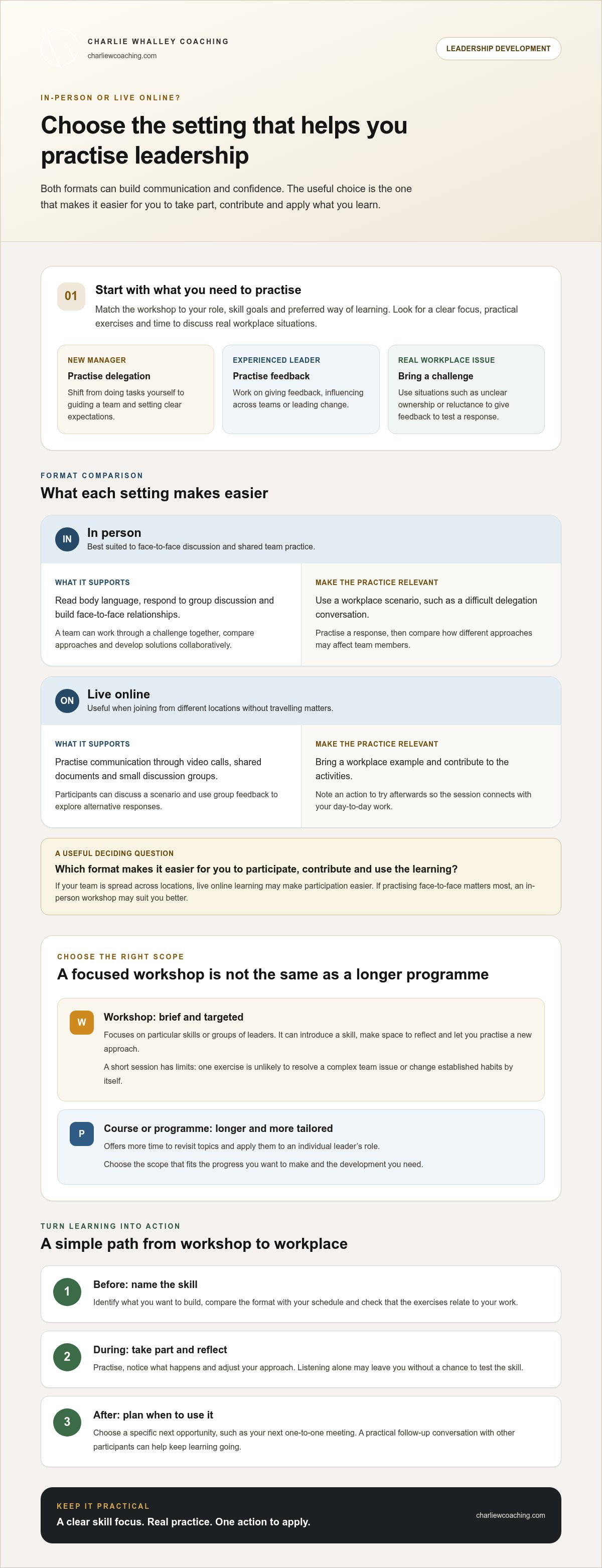
The most useful leadership development workshop in the United States will match your role, skill goals and preferred way of learning. Look for a clear focus, practical exercises and time to discuss real workplace situations. A workshop for new managers might focus on delegation, while experienced leaders may want to practise giving feedback or leading change.
In-person and live online workshops both offer opportunities to practise communication and build confidence, but the experience differs. In a room, you can read body language and respond to group discussion. Online, participants can join from different locations without travelling. Choose the format that makes it easier for you to take part, contribute and apply what you learn.
A workshop is usually a brief, focused learning experience, while a course or programme is longer and can be more tailored to an individual leader’s development. A workshop template for new leaders might combine reflection, discussion and practice of core skills. A longer course gives participants more time to revisit topics and apply them to their role.
In-person sessions can make it easier for a team to work through a challenge together. The U.S. Environmental Protection Agency (EPA) notes that participants can develop solutions collaboratively and build face-to-face relationships. For example, a group might discuss a difficult delegation scenario, practise a response and compare how different approaches affect team members.
Live online sessions can support similar practice through video calls, shared documents and small discussion groups. To make the format useful, bring a workplace example, contribute to activities and note an action to try afterwards. A facilitator might invite participants to discuss a scenario, then use group feedback to explore alternative responses.
Workshops have limits. A short session can introduce skills, but one exercise is unlikely to resolve a complex team issue or change established habits by itself. If participants only listen, they may leave without practising. Set a specific learning goal, take part in the activities and plan when to use the skill, such as in your next one-to-one meeting.
Connections with other participants can help you continue learning after a session. Exchange professional details with people who share a leadership challenge, then agree on a simple follow-up, such as discussing how each of you handled a feedback conversation. Keep the discussion practical and respect workplace confidentiality when sharing examples.
Before enrolling, take these steps: identify the skill you want to build, compare the format with your schedule and check that the exercises relate to your work. If your team is spread across locations, live online learning may make participation easier. If practising face-to-face matters most, an in-person workshop may suit you better.
Choose a workshop suited to your role, with a clear skill focus, practical exercises and discussion of real workplace situations. New managers may benefit from delegation workshops, while experienced leaders may prefer sessions on feedback or leading change. Choose in-person or live online learning according to which format helps you participate.
What is a leadership workshop?
A leadership workshop is a brief, targeted learning experience focused on particular skills or groups of leaders. These sessions can help managers examine their behaviour, practise new approaches and connect leadership training with everyday responsibilities.
Training for new and experienced managers
New managers often need to shift from completing tasks themselves to guiding a team. A workshop can help them practise delegation, set clear expectations and prepare for conversations with team members. One template for new leaders uses a two-day structure for reflection, discussion and core skills practice. For experienced managers, useful topics may include influencing across teams or supporting colleagues through change.
Choose a development programme by matching its learning goals to the manager’s current responsibilities. A first-time manager may benefit from role-play around assigning work, whilst an experienced participant may need to examine how they make decisions with competing priorities. In either case, look for time to practise, reflect and identify actions for the next working week.
Conflict, performance reviews and group dynamics
Conflict exercises can help managers distinguish observable behaviour from assumptions. For example, participants might practise responding when two team members disagree about a deadline. They can explore how to listen, clarify the shared issue and agree on a practical next step without dismissing either person’s perspective.
Performance review practice can focus on preparing specific examples, recognising progress and discussing an area for development. Group dynamics matter too: a confident participant may dominate, while others hold back. A facilitator can invite quieter voices, set clear turn-taking and ask the group to compare perspectives before settling on a solution.
Change management is another useful focus. Managers may need to explain why a process is changing, listen to concerns and clarify responsibilities. A workshop might use a scenario such as introducing a new team workflow. Participants can practise explaining the purpose, asking what support colleagues need and agreeing how to share updates.
Leadership training is most useful when exercises reflect real decisions rather than abstract ideals. Before attending, identify a current challenge, such as unclear ownership or reluctance to give feedback. During the session, test a response, notice what happens and adjust your approach. That cycle turns learning into practical skill.
Workshops are generally focused sessions, though the format varies with the topic and activities. A workshop template for new leaders might include time for reflection, discussion and skill-building. A short session can introduce an approach, while a longer development programme offers more room to revisit learning and apply it in different situations.
Afterwards, choose one action to try, such as setting clearer expectations in your next team meeting. Note the response, then use what you observed to guide further development. Small, deliberate adjustments can make leadership practice more effective and help managers build confidence through experience.
What’s Involved in Leadership Training?
Choose a leadership development workshop by matching its topics to your team’s responsibilities and development goals. Look for practical activities, useful feedback and a clear way to apply learning afterwards.
A practical programme starts with a defined need, such as improving delegation or preparing managers to lead change. Then identify the participants, their experience and the leadership skills they need to practise. Mentoring can support this work by giving someone space to reflect on a real decision, consider alternatives and plan a response. It works best when reflection connects with everyday leadership, rather than sitting apart from the team’s work.
Programme design should make it easy to engage. Combine concise explanations, realistic scenarios, discussion and action planning. For example, managers preparing for a difficult conversation can practise how to open it, hear feedback from peers and try a clearer approach. An executive group might instead examine how decisions are communicated across teams. Choose a format and topics that fit the audience and address practical needs.
The National Institute of Standards and Technology (NIST) included four workshops in a leadership development programme: communication, coaching for high performance, driving change and transitioning into a leadership role. These topics show how a programme can combine interpersonal skills with the demands of a changing role. For your team, use a similar planning principle: connect each session to a capability participants need to use.
Federal leadership development catalogues can include programmes with specific audiences and eligibility criteria. The Department of Health and Human Services Supervisor Development Challenge is required for new supervisors, who must take it within 1 year of appointment. It is listed for employees at GS 13-SES pay levels. These details illustrate why you should match a programme’s stated audience and eligibility to participants before planning attendance.
For a team programme, consider whether participants share a role, experience level or development need. New managers may need support with feedback conversations, while experienced leaders may focus on coaching performance or leading change. A mixed group can still learn together if activities let participants bring examples relevant to their responsibilities.
Feedback helps keep a development programme responsive. Ask participants which exercise helped them practise a skill, where they felt less prepared and what they want to apply next. Review their responses against the programme’s original goals. If managers found a role-play useful but needed more time to discuss follow-up, adapt that session instead of repeating the same design unchanged.
To choose a programme for your team, write down the leadership challenge, the people who need to address it and the behaviour you want them to practise. Compare those needs with the programme’s topics, intended participants and opportunities for feedback. A clear fit makes it easier to engage participants and turn learning into deliberate action.
Communication, collaboration, and influence
Leadership workshops can develop active listening, clear communication, collaboration, thoughtful feedback and the ability to influence decisions. Participants practise these skills through workplace scenarios, then reflect on how their words and behaviour affect colleagues.
For example, imagine an employee raising concerns about a new team process. A leader can listen without interrupting, summarise the concern and ask what would make the change workable. This shows respect and helps team members move from frustration towards a shared next step. In a workshop, participants can practise the exchange and discuss which responses encouraged a productive conversation.
Influence grows through relationships, not just job titles. A leader’s everyday actions can shape workplace culture, sometimes in unintended ways. Consider a manager who praises fast delivery but overlooks careful collaboration. Team members may interpret this as a signal to prioritise speed over shared problem-solving. Reflecting on examples like this helps leaders notice the impact of their choices.
Collaboration exercises can help a group hear a wider range of views before choosing a direction. The 1-2-4-All method gives participants a structured way to contribute: individuals reflect first, then discuss in pairs, groups of four and finally as a whole group. This sequence can make it easier for quieter members to develop an idea before speaking to everyone.
Try the method with a concrete question, such as, “What would help our team share project updates more clearly?” Each participant notes an idea, then compares it with a partner’s. Small groups combine suggestions before sharing themes. The leader can capture common points, identify differences and agree on one action to test, such as using a consistent update format.
Good communication matters during feedback, too. A manager might describe a specific behaviour, explain its effect and invite the employee’s perspective. “The project handover missed two key details” gives a clearer starting point than judging someone’s attitude. Practising this distinction helps leaders discuss performance respectfully and focus on what can change.
To use these skills at work, choose a conversation that needs care. Before speaking, decide what you need to communicate, what you want to understand and how you’ll invite the other person’s view. Afterwards, reflect on the response. Did the person feel heard? Did you agree on a clear next step? These questions turn workshop learning into deliberate practice.
Influence also depends on consistency. If a leader asks team members to share ideas but dismisses suggestions in meetings, trust can weaken. A practical workshop activity is to review a recent decision, identify whose views were heard and consider what the leader could do differently next time. Small changes in listening and follow-through can support a more respectful culture.
Connecting leadership development to personal goals
Leadership development is more useful when you connect a workplace skill with a goal that matters to you. A leadership development workshop can help turn “I want to be more confident” into a practical aim, such as contributing a clear recommendation in your next planning meeting.
Start by asking what you want to achieve and why it matters. The 5 Whys technique can help uncover the deeper purpose behind a goal. If you want to delegate more, ask why. Perhaps you want team members to grow, or you need more time for strategic work. Keep asking until the answer points towards a value or outcome that feels meaningful.
Then turn that purpose into an action you can practise. SMART goals can make leadership and management aims specific and trackable. For example, instead of “become a better listener”, aim to summarise a colleague’s view before responding in your next team discussion. Afterwards, note what you learned and what you’ll adjust.
Personal goals can also show which leadership skills deserve attention. If you want to lead with greater trust, you might practise asking for input before making a decision. If you want a healthier balance, consider which tasks only you can lead and which you can share. Each action connects development with a choice you can make at work.
Investing in development means making room to apply what you learn, not simply attending a session. Choose a real situation where the skill matters, decide what you’ll try and reflect on the response. For instance, after practising constructive feedback, use the approach in a scheduled one-to-one. Record what felt clear and where you hesitated, then use those observations to plan your next conversation.
Coaching can help you explore how personal direction relates to professional choices. A coach can support reflection on what you want to change, what is getting in the way and which next step feels realistic. This may be useful when your goals involve confidence, a change in direction or a leadership role that feels different from your current one.
Keep your goal in mind by reviewing it after important conversations or decisions. Ask whether your actions reflected the leader you want to become, and what you would repeat or change. If your priorities shift, revise the goal rather than treating the change as failure. Effective leadership develops through attention, practice and choices aligned with your values.
If you’d like support connecting your ambitions with practical next steps, explore leadership coaching. Ready to speak? Book a discovery call to find out how it can work for you.
Charlie Whalley Coaching: Life & Leadership Coaching
Charlie Whalley Coaching offers Life & Leadership Coaching for people who want to build confidence, work through self-doubt or navigate change. If a workshop has helped you identify a goal and you would value ongoing reflection while putting it into practice, coaching can help you explore your direction and next steps. Career Transition Coaching may also suit you if your leadership goals connect with a change in your working life.
Your development doesn’t need to follow a fixed path. The focus can be on what matters to you and the changes you’re ready to make. Visit Charlie Whalley Coaching or book a discovery call to find out how coaching could work for you.
Choose a next step that feels right
A leadership development workshop can be a starting point, not a test of whether you already have every answer. Your next step might be noticing a conversation you’d like to handle differently, or making time to reflect on the kind of leader you want to become. Progress can begin with a considered choice.
If you’re ready to explore that choice with support, Charlie Whalley Coaching can help you reflect on your goals and direction. You don’t need a perfectly formed plan before reaching out. Bring the question on your mind and begin there.
Contact Charlie Whalley Coaching to arrange a discovery call and discuss whether coaching feels like a helpful next step. Take the time you need, and trust that thoughtful progress is still progress.
Frequently Asked Questions
What are the benefits of leadership development?
Leadership development can help you make clearer decisions, respond thoughtfully under pressure and support your team’s growth. A leadership development workshop gives you a chance to practise a skill against a real workplace challenge. For example, a manager might explore how to prioritise competing requests, then explain decisions so colleagues understand what needs attention first. Reflecting on how your approach affects the team connects learning with everyday leadership.
What is a leadership development workshop?
A leadership workshop is a facilitated learning session focused on a defined leadership need. It might help a group examine how decisions are made, practise a new approach and agree how to use it at work. For instance, a team could bring a recurring handover problem, map where information gets lost and leave with a shared process to try. The focus is practical application, not just discussion.
What should participants expect during a leadership workshop?
Participants can expect a clear topic, guided discussion and activities that prompt reflection on leadership behaviour. A session about decision-making might ask you to compare responses to incomplete information, then explain your reasoning to a colleague. You may also identify an action to take afterwards. Bring a relevant workplace example and a willingness to hear other perspectives to connect the learning with your role.
How can organisations measure the impact of leadership training?
Organisations can assess impact by agreeing the intended change before training, then reviewing relevant evidence afterwards. For example, if the aim is clearer delegation, managers might discuss during team check-ins whether project responsibilities are understood. A leadership development workshop can also prompt participants to identify a behaviour to practise, giving managers a focus for follow-up. Compare reflections and workplace examples with the original aim to decide what to reinforce or adapt.
What are the best leadership development workshops in the United States?
The most useful workshops match your role, skill goals and preferred learning format. Look for a clear focus, practical exercises and discussion of real workplace situations.